

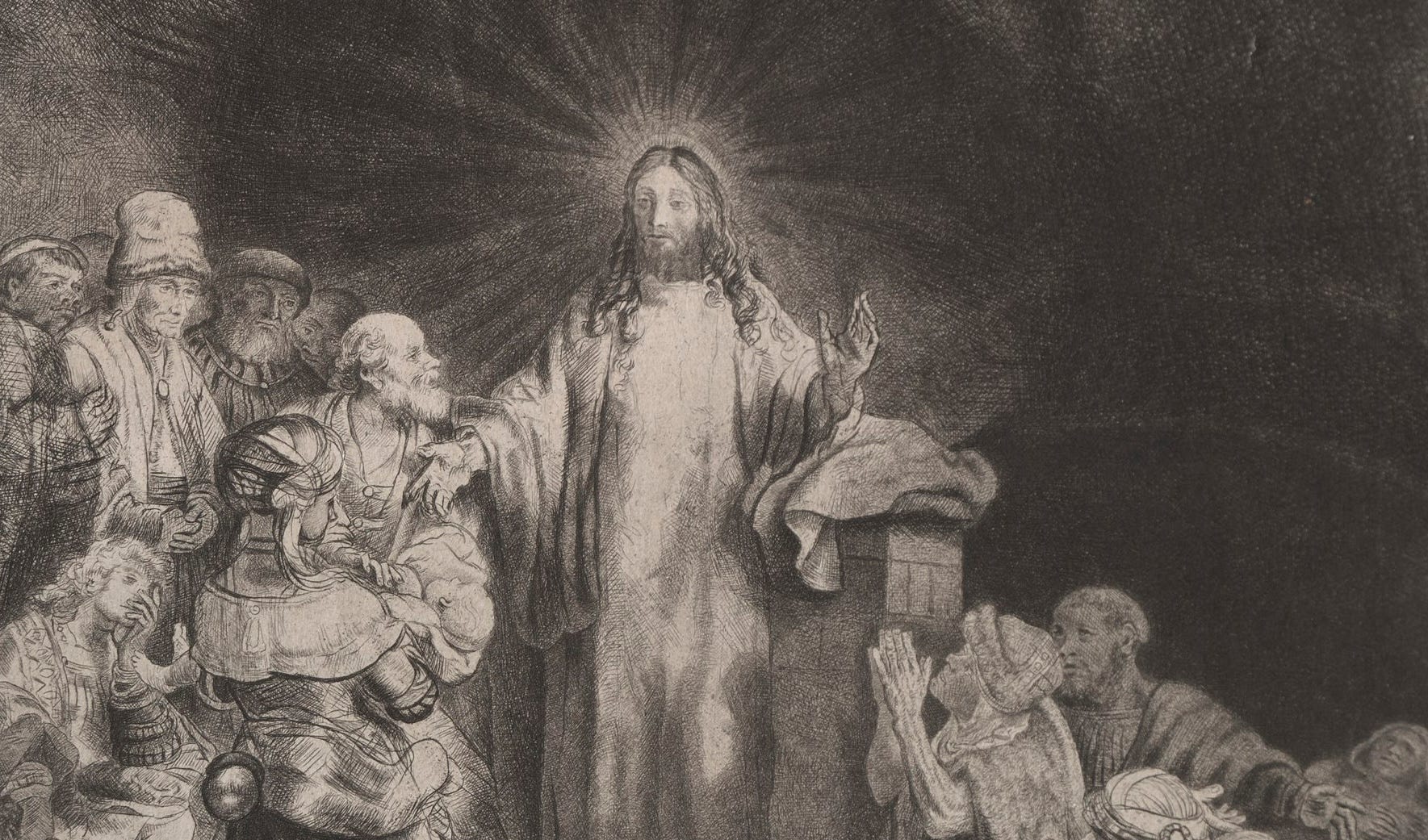
In the Bread of Life discourse, Our Lord tells the Synagogue what it is they must seek from God in order to have faith.
Editor’s Notes
In this piece, Fr Coleridge tells us...
How grace fulfils the prophets’ promises and draws souls to Christ.
That faith requires both outward preaching and inward light, freely embraced by the soul.
Why only the Son can perfectly reveal the Father to mankind.
He shows us that divine grace is what enables faith to flourish.
This is the last part of Chapter X.
For more on this series, see Part I.
Faith in the Son of Man
The Training of the Apostles, Part IV
Chapter X
St. John vi. 25–72; Story of the Gospels, § 74
Burns and Oates, London, 1885.
(Read on Corpus Christi)
The multiplication of loaves pointed towards the Eucharist – but the crowd weren’t interested
What miracles like the multiplication of loaves are supposed to achieve
Jesus worked miracles to draw out faith in himself, the one sent by God the Father
How talk of the manna helped the crowd understand the Bread of Life
Raising us up as members of himself – Why Jesus gives himself to us as the Bread of Life
The unreasonableness that devours those who want to be blind
What Isaias and Jeremias
Our Lord then confirms His assertion respecting the drawing of the Father by the words of one of the great prophets, who had foretold that, in the times of the Messias, the whole people, and all mankind, would be taught by God.
The prophecy is mainly one of the conversion of the Gentiles to the Church, and her consequent enlargement. And in the course of the prediction the words are found, ‘All thy children shall be taught of God, and great shall be the peace of thy children.’1 Our Lord says the prophets, and not only the prophet, for this kind of prediction is repeated in other places, as for instance in the great passage of Jeremias, in which the prediction of the virginal Conception is contained, ‘A woman shall compass a man.’
In the same chapter Jeremias goes on to speak of the new Covenant that God will make with His people:
‘Not according to the Covenant which I made with their fathers… But this shall be the Covenant that I will make with the house of Israel in those days, saith the Lord, I will give My law in their bowels, and I will write it in their hearts, and I will be their God and they shall be My people, and they shall teach no more every man his neighbour and every man his brother, saying, Know the Lord, for all shall know Me, from the least of them even unto the greatest, saith the Lord.’2
He goes on:
‘Every one that hath heard of the Father, and hath learned, cometh to Me.’
It seems that the distinction between hearing and learning amounts to this, that some who hear will not learn, but that all who learn must first have heard. The learning is not without their own cooperation, and it generates faith in the soul. The hearing is the enlightenment offered to them by God. In truth, there are two kinds of hearing, the external hearing of the Word of God by the mouth of teachers and witnesses sent by Him, and the interior listening to the same Word which is the work of grace in the heart.
These two things make up that teaching of the Father, which our Lord here declares to be necessary. It is so necessary, that faith cannot be without it, and as this interior teaching of the Father was that which was wanting in these people in the synagogue of Capharnaum, our Lord insists on it as the one requisite.
What is necessary for faith
Thus for the generation of faith, which had not taken place in these listeners to our Lord, there are in truth more things than one necessary.
The outward preaching of the Word is necessary, and the attention and goodwill of the hearers themselves are necessary, and beyond these, the interior teaching of the Father by His grace, corresponding to the external Word, and aiding the human consent and readiness, is necessary.
So necessary is this, that, as has been said, our Lord speaks of this alone, in the same way, it may be said, as He speaks of the accomplishment of the will of the Father and not of His own will, as the one reason why He has come down from Heaven. Because the power of the Divine command laid upon Him for the salvation of mankind moved His human will so forcibly and overwhelmingly as to be the one great motive on which it acted, burning as was the Sacred Heart for the very same accomplishment of the salvation of mankind.
So in this process of the genesis of faith, which our Lord describes as coming to Him. Men come or come not by their own free will, that is, they do not come, if they do not come, because they do not choose to come. But if they come, they come willingly, yet their own willingness is not enough without the aid of God.
Our Lord might have reproached these people for their unwillingness to believe. But instead of reproaching them directly, He says they do not come, because they have not been willing to be assisted by God, and thus are both unable and unwilling, unable because unwilling, though their ability would depend on God not on themselves.
St. Paul to the Thessalonians
The whole process is drawn out in the passage of St. Paul in the First Epistle to the Thessalonians, in which he expresses his thankfulness to God for their faith, ‘because that when you had received of us the Word of the hearing of God, you received it, not as the word of man, but as it is indeed, the Word of God, Who worketh in you that have believed.’3
Here we have the external word of the preacher, for faith cometh by hearing, and the willing listening of the hearers, and beyond all these, the working of God in those who have believed. For it is Paul who plants, and Apollo who waters, but it is God that giveth the increase. It was this last element, the working of God in their hearts, which was wanting in these people to whom our Lord was delivering this great discourse, and therefore they were not able to receive the truths which He set before them, claiming their faith in His word as that of One Whom God had accredited to them by miracles and other evidences.
As to their inability, it was occasioned by the want of the teaching of God in their hearts, but this was so, not because God was not willing to teach them, but because their hearts were not fit to receive His teaching on account of their own obstinacy. The action of the Father had not taken place, but it had not been refused to them arbitrarily. It had been hindered by their own fault.
No man hath seen the Father
To make His teaching still more clear, and also, it seems, for the purpose of shutting out a possible misconception, our Lord adds the words which follow.
‘Not that any man had seen the Father, but He Who is of God, He hath seen the Father.’
It follows, therefore, that this teaching or drawing of the Father, which is necessary for the formation of faith, is a teaching which is not received in the ordinary way, as when a master has his disciples around him and they listen to his doctrine.
This is the way, more or less, in which the external teaching is carried on, of which St. Paul speaks in the passage just now quoted. The teaching of the Father is invisible and spiritual, it is addressed to the heart and soul, like all the other whispers of grace. It accompanies the external teaching, in the case of those who receive that external teaching in a simple and childlike spirit.
But our Lord’s words explain that it is interior only, and does not conflict with, or remove the necessity of, the external teaching of the messengers of God. And it was quite possible that these people to whom He was speaking on this occasion, so literal and unspiritual in their minds and hearts, might think that He was really speaking to them of the necessity of some sensible and tangible and external communication between those whom the Father was thus to teach and the Father Himself.
Necessity for this truth
It was necessary therefore to assert the great truth, that no man hath seen the Father, and that the only One Who has this right to speak in His Name and to state the truth concerning Him, as knowing Him, is the Son Himself Who is of God, that is, Who has from Him by generation the Divine Nature itself. It is the same doctrine which He had laid down to Nicodemus, when He found him hesitating and making difficulties about what He told him as from God:
‘No man hath ascended into Heaven, but He that descended from Heaven, the Son of Man Who is in Heaven.’4
And we find the same truth at the opening of this Gospel of St. John, whether in the words of the Evangelist himself, or in those of the blessed St. John Baptist:
‘No man hath seen God at any time, the only-begotten Son, Who is in the bosom of the Father, He hath declared Him.’5
And there is the same teaching in St. Matthew, in the place where he records our Lord’s exultation of spirit on the rejection of the wise and prudent and the revelation of the Divine truth to little ones.
‘No one knoweth the Son but the Father, neither doth any one know the Father but the Son, and he to whom it shall please the Son to reveal Him.’6
And these words are a kind of commentary on the passage before us, for they show the Father leading people to the knowledge of the Incarnate Son, and the Son in turn revealing the Father to those whom He chooses so to enlighten, His choice being decided by their own fitness to receive light, and their readiness to correspond to it when received.
Faith in the Son of Man
The multiplication of loaves pointed towards the Eucharist – but the crowd weren’t interested
What miracles like the multiplication of loaves are supposed to achieve
Jesus worked miracles to draw out faith in himself, the one sent by God the Father
How talk of the manna helped the crowd understand the Bread of Life
Raising us up as members of himself – Why Jesus gives himself to us as the Bread of Life
The unreasonableness that devours those who want to be blind
Previous Chapter:
The Discourse in the Synagogue
How Our Lord gradually unveiled the doctrine of the Holy Eucharist
How Jesus used the loaves to explain his doctrine to the people – and to us
How Jesus presented the Eucharist in the face of dulness and antagonism from the crowd
How Christ can demand faith in his teaching on the Eucharist
From:
The Training of the Apostles, Part IV
Here’s why you should subscribe to The Father Coleridge Reader and share with others:
Fr Coleridge provides solid explanations of the entirety of the Gospel
His work is full of doctrine and piety, and is highly credible
He gives a clear trajectory of the life of Christ, its drama and all its stages—increasing our appreciation and admiration for the God-Man.
If more Catholics knew about works like Coleridge’s, then other works based on sentimentality and dubious private revelations would be much less attractive.
But sourcing and curating the texts, cleaning up scans, and editing them for online reading is a labour of love, and takes a lot of time.
Will you lend us a hand and hit subscribe?
Follow our projects on Twitter, YouTube and Telegram:
Twitter (The WM Review)
Isaias liv. 13.
Jer. xxxi. 32—34.
1 Thess. ii. 13.
St. John iii. 13.
St. John i. 18.
St. Matt. xi. 27.