

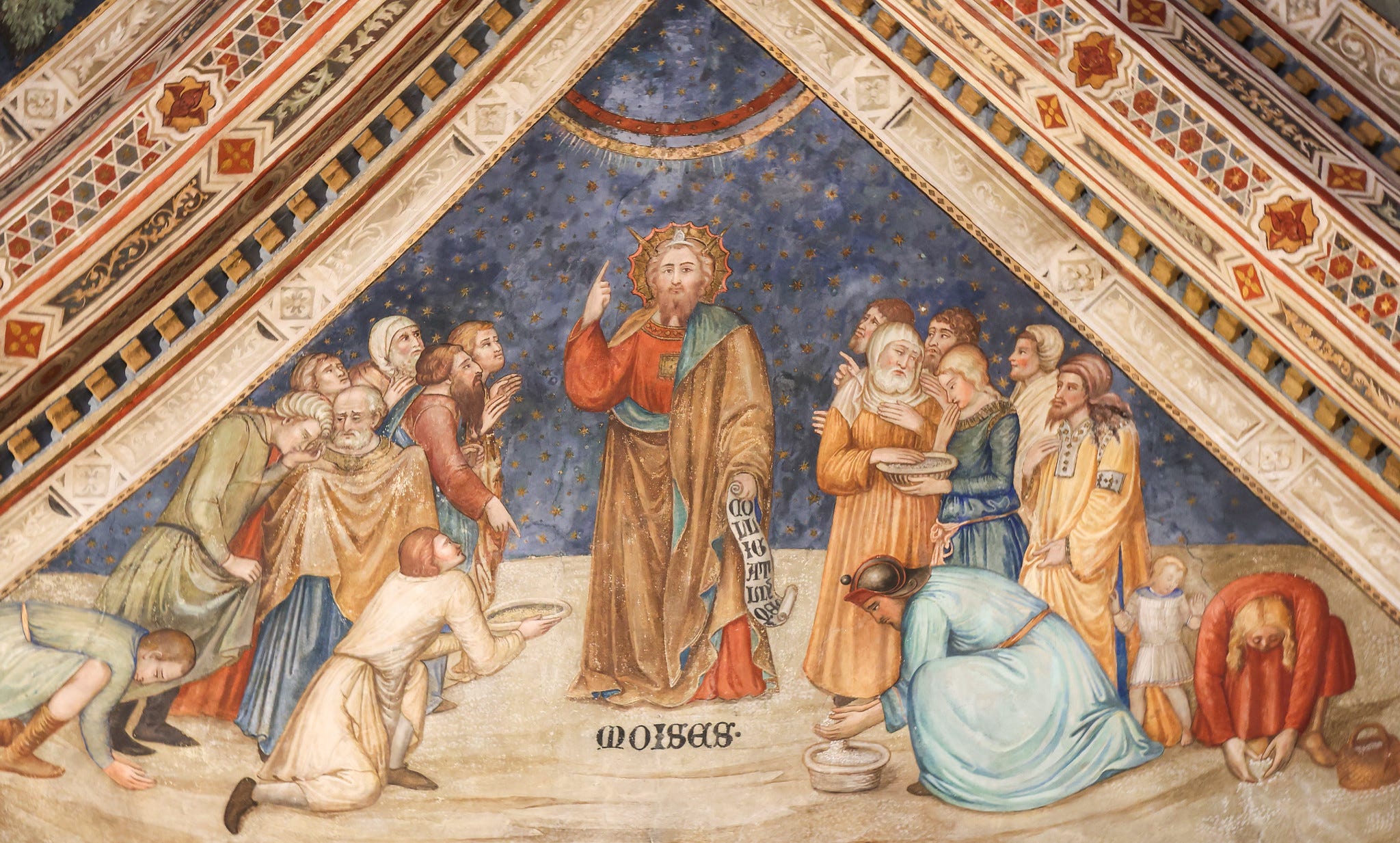
This was a miracle beyond relieving the extreme miseries Jesus had cured – and they took it as a sign they were to leave aside work and ordinary cares.
Editor’s Notes
We now begin Chapter X, the following section on Our Lord’s ‘Bread of Life Discourse’. His purpose in working the previous miracle – the multiplication of the loaves – was pointed to the teaching he was about to give.
But the miracle impressed them because it was not just the relieving of extreme miseries and demonic possession, but supplying the ordinary wants of life. Rather than turning to the heavenly grace he was offering, and to which the miracle pointed, the crowd wanted to return to the existence Israel had had in the desert, being fed by God without having to work.
This is what Our Lord was facing in teaching the sublime doctrine of his Body and Blood.
In this piece, Father Coleridge tells us:
Why Christ reproved those who followed him for material benefit rather than spiritual
How his discourse is structured step by step around the reactions of the crowd
What the miracles of loaves and wine show about the Blessed Eucharist.
He shows us that Christ leads men from earthly motives to divine truth through miracles and doctrine.
For more on this series, see Part I.
Faith in the Son of Man
The Training of the Apostles, Part IV
Chapter X
St. John vi. 25–72; Story of the Gospels, § 74
Burns and Oates, London, 1885.
(Read on Corpus Christi)
Stages of the discourse
The last chapter has set before us a number of general considerations concerning the great discourse of our Lord on which we are engaged.
We may now proceed, in the light of these general truths, to trace, one by one, the various stages into which the discourse naturally divides itself. These stages are marked out for us, partly by what we are told of the people who formed the audience in the synagogue of Capharnaum, partly by our Lord’s own precise and dogmatic assertions, first of one great truth and then of another.
These assertions disclose to us, as they go on, more and more clearly the doctrine on which it was now His purpose to insist as a matter of faith. They only stop short of a complete exposition of the doctrine of the Blessed Sacrament as it has ever been taught in the Catholic Church, because, as has been said, the time for the institution of that Adorable Sacrament had not yet come, and thus the final explanation of the promise that He would give His Flesh and Blood to us to eat and to drink could not be given, as it was to be given at the time of that institution.
Nor could our Lord as yet speak of His Sacrifice on the Cross.
Miracle at Cana
There had been a kind of anticipation of one great feature in these mysteries, in the earliest of our Lord’s miracles, in which water had been changed into wine.
That miracle was, in the counsels of God, a distinct prophecy of the marvel of Transubstantiation. It was a prophecy which made it easy for the Apostles to receive our Lord’s words at the Last Supper with implicit faith, and it sheds great light on the doctrine of the Church, by showing us the true meaning of the Divine words of consecration.
But this was still to come. So far, then, the doctrine of the Blessed Eucharist was unfinished without it. It had been the same with the doctrine concerning the power of the keys in absolution. This had been prefigured in a miracle, then it had been asserted in so many words by our Lord, then it was made the subject of a promise to the Apostles, but it was not finally complete until our Lord, after the Resurrection, gave them the power of absolution, with the gift of the Holy Ghost for that purpose.
We begin now with the opening passage by which the present discourse is introduced.
Question to our Lord
The people, who had followed our Lord from the other side of the lake, began naturally by asking Him how He came at Capharnaum, not having sailed in the boat with the Apostles. But if our Lord gave them any satisfaction as to this, it is not recorded by the Evangelist. The account in St. John proceeds at once to the point of the direct instruction given by our Lord.
The first thing He says to them is by way of reproach, reading their hearts, and seeing there the imperfect and earthly motive which brought them after Him.
‘Jesus answered them and said, Amen, amen I say to you, you seek Me, not because you have seen miracles, but because you did eat of the loaves and were filled.’
It was not that the miracle had not impressed them, but because what had most impressed them and most influenced them was the fact that they had been fed, whether miraculously or not. If the miracle had been something else, such as the stilling of the storm, or the casting out of devils, it would not have brought them to Him.
They had a selfish purpose in their following Him, and this selfish purpose was earthly, and material also. The object of God’s Providence in ordaining the evidence of miracles, in the case of our Lord and of the Church after Him, was indeed, secondarily, the relief of human miseries, hunger, and thirst, and sickness, and suffering, and the like. But this was a purpose subordinate to the great object, of drawing to our Lord, and to those who were to speak in His name after Him, the faith of the people, who might, by means of that faith, be led on to their own salvation.
The object of these people was to profit, if so it might be, again and again, by the miracles of the mercy of God, without making any progress in faith, or being more inclined than before to listen to the teaching of which the miracles were the Divine authentication.
Anticipations raised by the miracle
It is easy to understand that the miracle of the loaves must have raised hopes and anticipations in the minds of the people altogether new.
Up to this time they had had nothing of the kind done for them, although there is some resemblance to this in the other miracle which has reference to the Blessed Eucharist, that of the water turned to wine. In each of these miracles our Lord had gone beyond the relief of disease, infirmity, the deliverance from devils, and the like. He had stretched His miraculous compassion into the region of ordinary wants, not of the most pressing kind.
Those who were relieved by the other miracles were saved from pain, from positive disease, from the incapacities and infirmities and miseries which are the effects of the paralysis of natural powers, which reduce the sufferers to a state of something less than full life, to what is the beginning and the anticipation of death. But to supply food, bread and wine, and the like, by means of miraculous power, is to change the whole conditions of human life, as it is ordinarily arranged by the dispositions of Providence.
As a matter of history, the Israelites in the desert were raised above the common conditions of human existence. They had no need to labour, to sow or reap, to toil or spin, for their ‘garments were not worn out, neither were the shoes of their feet consumed by age.’1
The tradition of this marvellous existence lingered among the people, and they seem to have thought that the last miracle of our Lord was a kind of beginning of its restoration. Thus they had said that He was of a truth the Prophet Who was to come into the world, the Prophet Whom Moses had promised, like himself. What might not be hoped, even in the display of temporal and material power, from such a Prophet?
Our Lord goes on to reprove these earthly and worldly motives, and to raise their souls to something higher, according to the intention of God in granting them this miraculous evidence.
Faith in the Son of Man
Previous Chapter:
The Discourse in the Synagogue
How Our Lord gradually unveiled the doctrine of the Holy Eucharist
How Jesus used the loaves to explain his doctrine to the people – and to us
How Jesus presented the Eucharist in the face of dulness and antagonism from the crowd
How Christ can demand faith in his teaching on the Eucharist
From:
The Training of the Apostles, Part IV
Here’s why you should subscribe to The Father Coleridge Reader and share with others:
Fr Coleridge provides solid explanations of the entirety of the Gospel
His work is full of doctrine and piety, and is highly credible
He gives a clear trajectory of the life of Christ, its drama and all its stages—increasing our appreciation and admiration for the God-Man.
If more Catholics knew about works like Coleridge’s, then other works based on sentimentality and dubious private revelations would be much less attractive.
But sourcing and curating the texts, cleaning up scans, and editing them for online reading is a labour of love, and takes a lot of time.
Will you lend us a hand and hit subscribe?
Follow our projects on Twitter, YouTube and Telegram:
Twitter (The WM Review)
Deut. xxix. 5; 2 Esdras ix. 21.
Thank you for sharing this series. As I grow older I understand how easy it is to become attached to the material things provided for our sanctification by God and to forget the immaterial things that are far more important, especially our relationship with God.
This quote in particular stood out for me: "As a matter of history, the Israelites in the desert were raised above the common conditions of human existence. They had no need to labour, to sow or reap, to toil or spin, for their ‘garments were not worn out, neither were the shoes of their feet consumed by age.’1
This isn't something that has previously been drawn to my attention.