

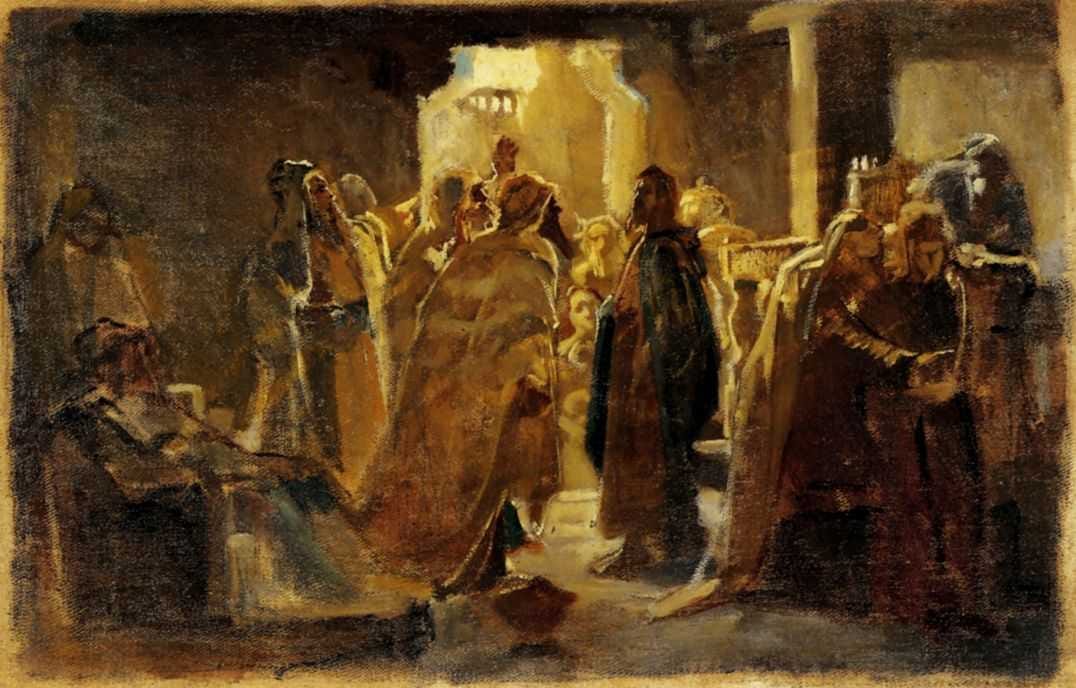
Our Lord chose to begin his revelation of the Blessed Eucharist in the synagogue, in a very particular way.
Editor’s Notes
We are beginning a new series on Our Lord’s “Bread of Life” discourse.
This series covers three chapters in Fr Henry James Coleridge' SJ’s The Training of the Apostles, Part IV:
Chapter IX: The Discourse in the Synagogue
Chapter X: Faith in the Son of Man
Chapter XI: The Blessed Eucharist
The doctrine of the Holy Eucharist, announced in this discourse, is one of the most beautiful demonstrations of the love of the Sacred Heart for mankind. There could be no better time to begin this series than June, the month of the Sacred Heart.
In this piece, Father Coleridge explains how Christ prepared his hearers for the doctrine of the Blessed Sacrament. In particular, he tells us:
How the miracle of the loaves laid the foundation for Christ’s discourse.
That St John presents the miracle and discourse as inseparably connected.
Why Christ first demanded faith, before revealing the harder doctrine.
The Discourse in the Synagogue
The Training of the Apostles, Part IV
Chapter X
St. John vi. 25–72; Story of the Gospels, § 74
Burns and Oates, London, 1885.
(Read on Corpus Christi)
How Our Lord gradually unveiled the doctrine of the Holy Eucharist
How Jesus used the loaves to explain his doctrine to the people – and to us
How Jesus presented the Eucharist in the face of dulness and antagonism from the crowd
How Christ can demand faith in his teaching on the Eucharist
The miracles and the discourse
By a prudent arrangement of His own movements, our Lord had now brought to Capharnaum a large number of those who had been present at the great miracle of the multiplication of the loaves and fishes, while at the same time He had avoided the danger to the crowd of the possible result of their enthusiasm in an attempt to make Him a King.
It is clear that if, as we have supposed, His Sacred Heart was now full of the wonderful boon of the Blessed Sacrament, which had been so pointedly prefigured by the miracle just named, and if He desired to prepare the hearts and minds of His Apostles and others, for the reception of the great and difficult doctrine which His Church was to teach after Him, concerning this great boon, it must have been a part of His plan to deliver in some public place of teaching some commentary on the miracle, which might lead to the formation in their minds of at least the lineaments and outlines of the great doctrine to which that miracle had reference.
This it was necessary should be done at once, while the marvel of the miracle was as yet fresh in their minds, for otherwise the words which He was to speak might seem to miss their full meaning. The discourse was necessary for the intelligence of the miracle, but the miracle was also necessary as the foundation of the discourse.
Thus we find that although our Lord had now for some time absented Himself from the city, and even the neighbourhood, of Capharnaum, He chose to be there now for a short time, for the sake of promulgating, at least fundamentally, the doctrine which was to fill so large a place in the dogmatic treasury of the Catholic Church.
The discourse as related by St. John
The great discourse, of which we are now to speak, is related to us by St. John, and it is only natural to suppose that he has reported it to us in the same way as the other discourses of our Lord, which form the characteristic feature in his Gospel.
Indeed, as has been said, it is clear that he might not have given us any narrative of the miracle itself, but for the sake of the subsequent teaching of our Lord, and that he has given both is an evidence that, in his mind, the two are inseparably connected.
This discourse in the Gospel narrative is comparatively short, not with reference to other discourses, but with reference to the importance of the subject and the length of time which was probably occupied by the actual conversation or teaching of our Lord on this occasion.
It is the manner of St. John, as indeed of St. Matthew also, to give us in our Lord’s own words the heads of the discourses which he records, rather than the whole of what He said. The discourse before us was evidently one which proceeded gradually onward, our Lord taking advantage, so to say, of the interruptions by His audience, or of the effects produced upon them, as He went on, to add line upon line of the full doctrine which He desired to set forth.
All through He claims their faith, and expects His word to be accepted as authoritative, and He also seems to add, after each break in the continuity of His words, some things still more difficult of belief than what had preceded. The last and the greatest of the difficulties which are raised, He hardly explains at all, as we shall see.
Its explanation is suggested by the miracle of the loaves, and also by the image of the manna. But no direct explanation is given as to the marvellous way in which the Body and Blood of our Lord are received as food, under the species of bread and wine. This must be remembered all through in our commentary. It is well to take a general view of the discourse, in its successive stages, before examining each stage by itself.
First question and answer
The discourse begins with the question of the people as to how our Lord came to be found at Capharnaum. They had seen Him send away His disciples, and remain Himself on the further side of the lake. Thus they had expected to find Him in the morning where He had last been seen, especially as they knew there was no boat that could have brought Him over.
Our Lord answers nothing to this inquiry.
‘And when they had found Him on the other side of the sea, they said to Him, Rabbi, when camest Thou hither?’
There seem to have been some people in the boat as well as the Apostles, but whether they had published the new miracle of the walking on the waters or not, our Lord did not choose to refer to it Himself. He proceeds at once, in the report of St. John, to put His finger on the weak motives which had brought so many of them to seek Him on this occasion.
‘Jesus answered them, and said, Amen, amen, I say to you, you seek Me not because you have seen miracles, but because you did eat of the loaves and were filled.’
Thus He directly establishes the connection of the teaching which He is about to impart with the miracle of the loaves. And He goes on at once to raise them from the thought of the material bread which they had received at His hands, to that of a far more wonderful and powerful Bread which He does not yet explain, but of which He says three things, that it endures to life everlasting, that it is the gift of the Son of Man, and that it is His gift because the Father has sealed Him.
‘Labour not for the meat that perishes, but for that which endureth unto eternal life, which the Son of Man will give you, for Him hath God the Father sealed.’
Thus the Heavenly Bread is at once put before their minds, as the chief subject of the teaching.
The second stage
The next stage in the discourse is what it is, on account of the questions to which our Lord’s former words led. ‘They said therefore to Him, What shall we do, that we may work the works of God?’ taking up, apparently, the word which in the last verse has been translated by the English word ‘labour,’ and repeating it in the form of a question.
The word is the same in both verses in the Greek. ‘You bid us work,’ they say, ‘for the Bread of life everlasting; what are we to do to work this work of God?’ Our Lord answers them by requiring their faith.
‘Jesus answered and said to them, This is the work of God, that you believe on Him Whom God hath sent. They say therefore to Him, What sign therefore dost Thou show, that we may see and may believe Thee?’
For they reasoned rightly, that faith must be founded on some evidence, not of the things that are to be believed in, but of the Divine mission of the Person Who speaks in the name of God, and so claims belief.
And then they go back at once to the evidence of the mission of Moses, which was in their minds in consequence of the resemblance between that evidence and the miracle which they had lately witnessed.
‘Our fathers did eat manna in the desert, as it is written, He gave them bread from Heaven to eat.’1
They seem to have attributed the words of the Psalm which they quote to the person of Moses, as if he had been the giver of the manna, instead of God.
Our Lord corrects them, and at the same time goes further in the development of the doctrine which He has now to impart. In the former sentence He spoke of the bread that endureth unto life everlasting, which is to be the gift of the Son of Man. Now He speaks of the bread as something personal, as coming down from Heaven, and as giving life to the world.
‘Then Jesus said to them, Amen, I say to you, Moses gave you not bread from Heaven, but My Father giveth you the true Bread from Heaven. For the bread of God is that which cometh down from Heaven, and giveth life to the world.’
The original words may mean, ‘He that cometh down from Heaven, and giveth life to the world.’
There is therefore an advance in the teaching in this statement, and a preparation for the further doctrine which immediately follows.
The Discourse in the Synagogue
From:
The Training of the Apostles, Part IV
How Our Lord gradually unveiled the doctrine of the Holy Eucharist
How Jesus used the loaves to explain his doctrine to the people – and to us
How Jesus presented the Eucharist in the face of dulness and antagonism from the crowd
How Christ can demand faith in his teaching on the Eucharist
Here’s why you should subscribe to The Father Coleridge Reader and share with others:
Fr Coleridge provides solid explanations of the entirety of the Gospel
His work is full of doctrine and piety, and is highly credible
He gives a clear trajectory of the life of Christ, its drama and all its stages—increasing our appreciation and admiration for the God-Man.
If more Catholics knew about works like Coleridge’s, then other works based on sentimentality and dubious private revelations would be much less attractive.
But sourcing and curating the texts, cleaning up scans, and editing them for online reading is a labour of love, and takes a lot of time.
Will you lend us a hand and hit subscribe?
Follow our projects on Twitter, YouTube and Telegram:
Twitter (The WM Review)
Psalm lxxvii. 24.
What a joy to see this series begin! Fr Coleridge always brings out something unexpected, going deeper into beloved passages. For one thing, here, Fr Colerdge shows the tension Our Lord maintains between miracles and faith, a faith that transcends reliance on miracles--and all this while introducing a most stupendous miracle, which will tax many of the disciples' faith to the breaking point.
Whatever AI you're getting for the spoken version is horrible. It can't pronounce Eucharist right. I had to turn it off. Still love reading but it would be handy to listen