

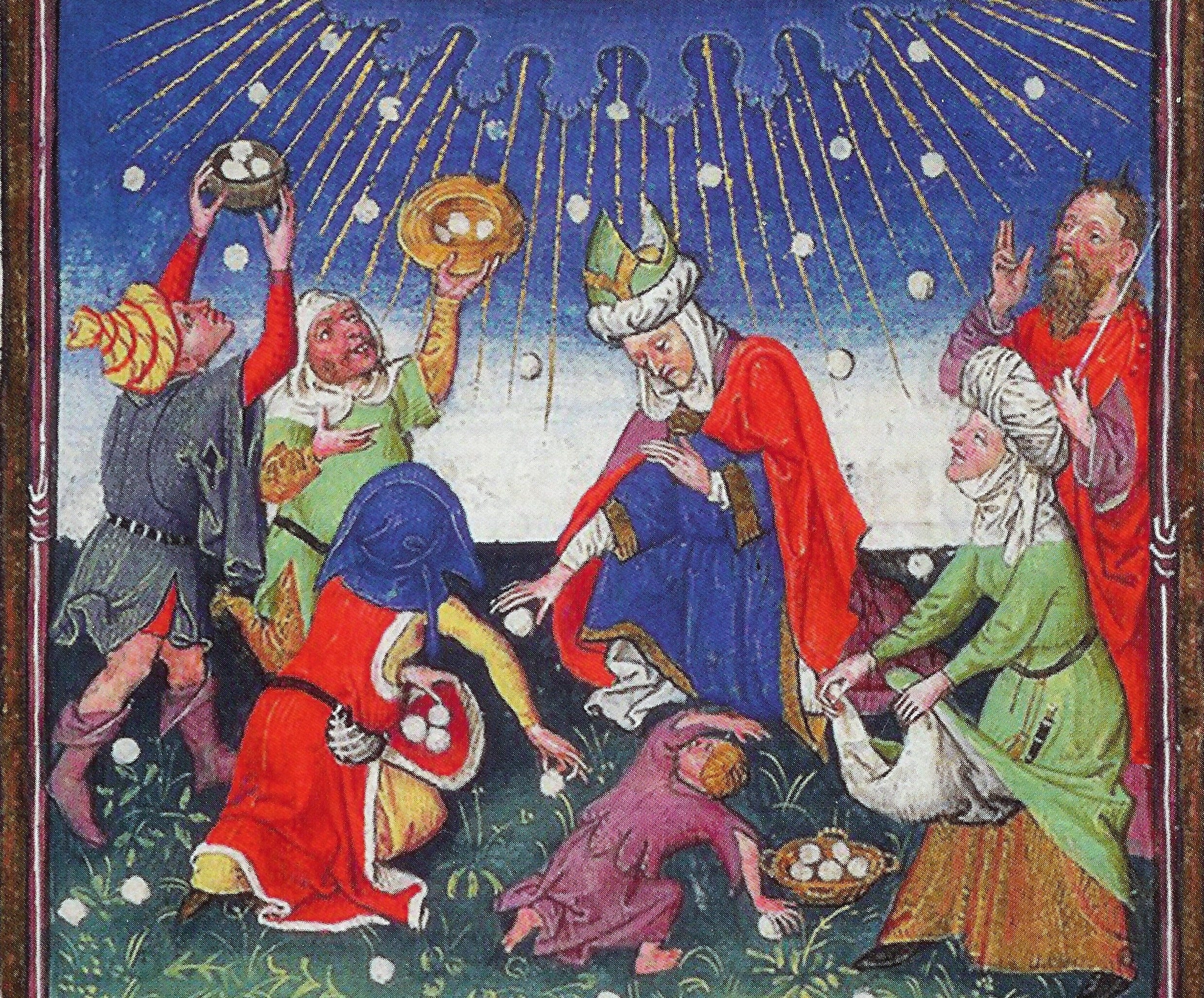
The crowd begin by quibbling, but appear to make some progress – but would it be enough to understand the doctrine of the Holy Eucharist which Christ was teaching?
Editor’s Notes
In response to Our Lord’s assertion, discussed in the previous part, that the crowd should put their faith in him as a result of the multiplication of the loaves, they begin quibbling about how the miracle differed from that of the manna in the desert, and Moses’ conduct after the miracle.
But while all this quibbling and demanding of further signs and earthly benefits reflects poorly on the crowd, Our Lord’s responses do begin to draw them towards the desire he wishes to instil in them.
But would it be enough?
For more on this series, see Part I.
Faith in the Son of Man
The Training of the Apostles, Part IV
Chapter X
St. John vi. 25–72; Story of the Gospels, § 74
Burns and Oates, London, 1885.
(Read on Corpus Christi)
The multiplication of loaves pointed towards the Eucharist – but the crowd weren’t interested
What miracles like the multiplication of loaves are supposed to achieve
Jesus worked miracles to draw out faith in himself, the one sent by God the Father
How talk of the manna helped the crowd understand the Bread of Life
The people naming the manna
It is remarkable that it is our Lord Who introduces the subject of the food which endureth to life everlasting, without naming the manna.
The people fly at once to the reference, and seem to have in their minds some indistinct notion that the miracle of the loaves implied a kind of claim to the same power which had been exerted in the feeding of the people by the manna.
At the same time they seem to have thought that the feeding of the five thousand, which occurred only once, was not so great a sign as that of the manna, which lasted for forty years, and also that the logical inference from the miracle of the manna was not so much as that which our Lord claimed from them, in consequence of the miracle of the loaves.
Moses did not require the people to believe in him in the same sense as our Lord, Who spoke in a way which demanded not simply faith in His word as a messenger from God, but faith in His Person as the Messias and the promised Son of God. And indeed it was true that the simple performance of the miracle by a Prophet proved only that God was with him.
They forgot that the presence of Divine Power with the worker of miracles, whether in God Himself or Moses, was quite enough to secure faith to whatever the worker of the miracle might teach on the part of God, for the reason already mentioned, that God cannot cooperate with falsehood.
Moreover, there were circumstances about the way in which our Lord wrought His miracles which could not be found in those of any of the prophets. He worked them as the Master of Nature, and they worked them by means of prayer, at the command of God and as His ministers.
The true Bread from Heaven
‘Then Jesus said to them, Amen, amen, I say to you, Moses gave you not bread from Heaven, but My Father giveth you the true Bread from Heaven, for the Bread of God is that which cometh down from Heaven, and giveth life to the world.’
The words about Moses may be understood in two ways. They may be taken as meaning that the bread which Moses gave was not truly bread from Heaven, especially in comparison with the true Bread from Heaven which His Father was giving in the carrying out the counsel of the Incarnation.
Or it may mean that it was not Moses that gave the bread, such as it was, which is called bread from Heaven, but God the Father, Who is now giving the true Bread from Heaven.
Both senses may be combined, as if the words meant, it was not Moses that gave to them what was given, but My Father, nor was it the true Bread, for He is now giving you the true Bread, which has those qualities of giving life which were wanting in the manna.
Inferiority of the manna
And then our Lord goes on to tell them in what consisted the inferiority of the manna, as compared with the true Bread from Heaven.
The manna was not, as they supposed, taking literally the figurative and prophetic words of the Psalms, the Bread of Angels, as if the Angels were fed upon it in the way in which men feed on common bread. It was the Bread of Angels, because it was a prophecy and a type of the true Bread, by which, in the Holy Eucharist, men are to be fed on the same Divinity, the communication of which to them is the life and the food of the blessed Angels.
It was the Bread of Heaven figuratively also, for the same reason, but it came in truth from the air above the earth, where it was formed by the hands of Angels, and it fell on the ground, as hailstones or flakes of snow fall on the ground.
But from that true Heaven, in which the blessed Angels enjoy for ever the presence and the sight of God, and are thereby sustained in life everlasting, the manna did not come any more than the hail or the snow. The heathen had their legends about the food of the gods, the nectar and ambrosium, and these people may have taken the words of the Psalm in this carnal sense.
The true Bread from Heaven is that of which the manna was a type, and which is promised to you in the miracle of the loaves. It is in truth Bread from Heaven, for It is He that is always in Heaven, the true Heaven where God dwells. It does not fall from Heaven, nor is It sent down from Heaven, but It comes down of Itself, It is He that comes down into this lower world in the Incarnation of the Son of God.
And It gives life to the world, to the whole world in a certain sense, not only to those who receive It, because the Incarnation is virtually the life of the whole human race, and it is even the redemption, as St. Paul tells us, of the material universe itself. The whole race of men will rise at the last day by virtue of the Incarnation. And the life which this Bread gives is eternal and undying, not as He says presently, like the life which was prolonged from day to day by means of the manna.
‘Lord, give us this bread’
‘They said therefore unto Him, Lord, give us always this Bread.’
They did not understand what they were asking for, for their minds were still full of the thought of the manna, or of the loaves which had been multiplied, and their words remind us of the words of the poor Samaritan woman, as has been said. As she asked that she might not thirst nor go to the well to draw, so they thought of the boon which might keep them in perpetual life without more ado, whether by its reception once for all, or by its continual supply.
This last sense is more in accordance with the words which they use, for they say give us always this Bread, go on giving it us always. They had a kind of faith, but not a perfect faith, and their notions concerning the Bread of Life had not yet risen above the bread which supports the bodily existence day after day.
Our Lord had taken a step in advance of His former declaration of His words about the Bread of Life, which came down from Heaven, and giveth life to the world, and now He makes this declaration still more explicit, by saying that He is Himself the Bread of which He speaks.
Faith in the Son of Man
The multiplication of loaves pointed towards the Eucharist – but the crowd weren’t interested
What miracles like the multiplication of loaves are supposed to achieve
Jesus worked miracles to draw out faith in himself, the one sent by God the Father
How talk of the manna helped the crowd understand the Bread of Life
Previous Chapter:
The Discourse in the Synagogue
How Our Lord gradually unveiled the doctrine of the Holy Eucharist
How Jesus used the loaves to explain his doctrine to the people – and to us
How Jesus presented the Eucharist in the face of dulness and antagonism from the crowd
How Christ can demand faith in his teaching on the Eucharist
From:
The Training of the Apostles, Part IV
Here’s why you should subscribe to The Father Coleridge Reader and share with others:
Fr Coleridge provides solid explanations of the entirety of the Gospel
His work is full of doctrine and piety, and is highly credible
He gives a clear trajectory of the life of Christ, its drama and all its stages—increasing our appreciation and admiration for the God-Man.
If more Catholics knew about works like Coleridge’s, then other works based on sentimentality and dubious private revelations would be much less attractive.
But sourcing and curating the texts, cleaning up scans, and editing them for online reading is a labour of love, and takes a lot of time.
Will you lend us a hand and hit subscribe?
Follow our projects on Twitter, YouTube and Telegram:
Twitter (The WM Review)