

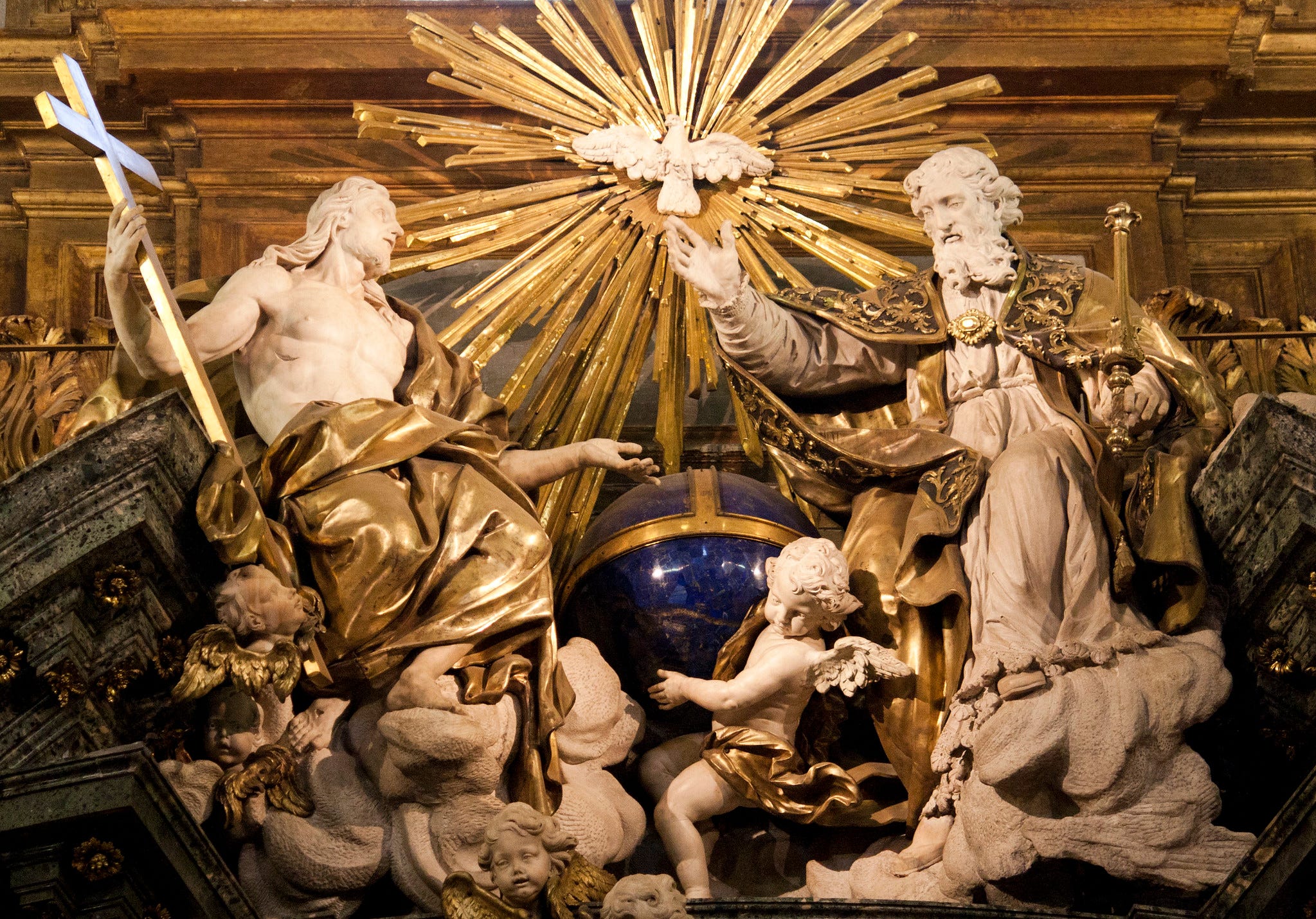
Do you think of yourself as a gift given by one Divine Person to another?
Editor’s Notes
In this piece, Father Coleridge tells us:
Why the Father gives souls to Christ through the gift of faith.
How eternal life is already possessed by promise before the resurrection of the body.
What Christ’s perfect obedience to the Father’s will reveals about the movements of his Sacred Heart.
For more on this series, see Part I.
Faith in the Son of Man
The Training of the Apostles, Part IV
Chapter X
St. John vi. 25–72; Story of the Gospels, § 74
Burns and Oates, London, 1885.
(Read on Corpus Christi)
The multiplication of loaves pointed towards the Eucharist – but the crowd weren’t interested
What miracles like the multiplication of loaves are supposed to achieve
Jesus worked miracles to draw out faith in himself, the one sent by God the Father
How talk of the manna helped the crowd understand the Bread of Life
Seeing and believing
Our Lord goes on, in the next sentence, to explain still further what He has said about the will of the Father. He varies the expressions which He has used, in order thereby to make His meaning more plain and more full.
He repeats the words, ‘This is the will of My Father Who sent Me,’ but instead of the words, ‘All that He hath given me,’ He uses others, ‘That every one who seeth the Son and believeth in Him, may have life everlasting, and I will raise him up at the last day.’
From this we gather that it is the same thing to be given by the Father to our Lord, as to see the Son in His Incarnation and to believe on Him. And it is the same thing to have life everlasting, and not to be lost, or not to be cast out. He goes on in the following part of the discourse to insist on this still further, but what He now says is worthy of all our consideration.
Those who are given to Him by the Father, are those whom the Father guides by His Providence and by His grace to the sight of Jesus Christ, and to belief in Him. They do not believe what they see, but they believe what they do not see, and therefore He means that, seeing the Son in His human nature and form, like other men, they nevertheless believe Him to be, not what they see, but what they do not see, the Eternal Son of God, God of God.
Those who have this faith both see the Son, and believe in Him, as the Son of God in human flesh. And this is the giving of them to Him by the Father, because this true faith can only be in those to whom it is given by the Father, and it is given to them by the Father that they may go to the Son and may give themselves to Him by their faith.
Everlasting life
To this faith life everlasting is promised.
Faith is the condition of life everlasting, which cannot be forfeited unless the life of those who have the faith is in contradiction to their faith. And then, as it seems, to avoid a possible mistake which might arise in their minds, as if those who had this faith were so to have life everlasting as never to die, our Lord adds that He will raise up at the last day him who has this faith.
The life everlasting will then be given to him in possession, having been his before in promise and in right. But he will first pass through the stage of death, which is appointed to all men by a law which is not cancelled, even as to those who have the right to life everlasting.
Devotion to the Father’s will
There are occasions in the course of some of the discourses of our Lord when He seems almost to be soliloquizing, rather than addressing Himself to the audience before Him, although we know well that this was not the case.
What He said He meant them to hear, and He ordered His words with perfect wisdom and prudence for their benefit, and for our benefit for whom the words are recorded.
Yet sometimes He seems to open to us the thoughts and feelings of His Sacred Heart, as if in that also there was an immense boon for us. The passage on which we are now engaged is one of those in which we may find many revelations, so to say, of the thoughts and feelings and motives of the Sacred Humanity.
There are four great topics of thought suggested by it. In the first place we may note His devotion to the will of His Father. We have already said a few words on this. The will of His Father did not constrain Him, as if there could be any opposition between His own will and the Divine will. But it added to His choices and actions and purposes an immense weight of power, of intensity, of strength, of constancy, and above all, perhaps, of joy.
Every choice which He made in obedience to the will of the Father was an act of the intensest love for His Father, an act which so conformed His will to that of His Father as to make it, even His human will, Divine and god-like. That most perfect pliancy and docility which characterized His human will in its correspondence to the Divine will, gave it a beauty and a strength and a might and a purity and a joyousness, which have nothing like them, even in the most perfect choices of the angels and the saints.
It added a fresh lustre to the works which He accomplished for the salvation of men, glorious as they were in themselves.
Providence of the Father
Another thought with regard to these choices of our Lord, in obedience to the will of His Father, is found in the words in which He speaks of those who come to Him by faith as being given to Him by His Father.
Under this expression are contained two great thoughts.
In the first place, it contains the thought of all that has been done by the Father in His Providence to bring about the coming of these souls to our Lord. Thus, for instance, when St. Peter, in the name of the Apostles, made his great profession of faith at Cæsarea Philippi, our Lord spoke of his blessedness because flesh and blood had not revealed to him the truth which he confessed, but His own Father Who is in Heaven.
The history of each of the souls of that Apostolic company, in whose name the confession was made, was a history of the most beautiful and delicate and powerful dealings with that soul on the part of the Eternal Father of our Lord, the object of which dealings was the gradual training of that soul in the faith which at last it attained in fulness, when the time came for the confession. Thus our Lord could dwell on the whole of this most marvellous and beautiful process, in each case, and this would be the subject of immense rejoicing and satisfaction to His Sacred Heart.
The Giver and the gift
This is the first thought. But there is something more, as has been said, in this expression, because it implies a personal action of the Father in giving the souls to our Lord, as well as in preparing them for Him.
In all gifts which pass between those who intensely love, the thought of the Giver is the principal element—it adds a preciousness to what is most precious, if so it be, and it gives a priceless value even to what is not in itself valuable. The reason is that the gift represents the giver, and it represents the immense love with which the giver gives it, and this is in itself an appeal and a provocation, so to say, to reciprocate love on the part of him who receives it.
And these souls are not simply presented to our Lord, as jewels are given by a friend to his friend, they are sent, or brought, or given, to our Lord, in order that with regard to them He may do His great work of salvation, and accomplish in them the commission which He received from His Father Who sent Him into the world.
Thus these souls are given to our Lord as the objects of His special love, and of His special beneficence. They are given to Him as if the Father had done His part, and now asked His Son to do His. They are given Him as the materials, so to say, out of which He is to make His Kingdom, and win His victory. He is to pour out on them the treasures of His love, He is to triumph in them, they are to be the trophies of His conquests.
That is to be accomplished in them of which our Lord speaks to His Father in His prayer, ‘That they may have My joy fulfilled in themselves.’ He sees in each of them the gift of His Father, and not the gift alone, but the Giver and the love with which they are given, and the joy and triumph which are to be His because of the perfect accomplishment of His work in them.
This is a separate joy from that which consists in doing with regard to them exactly and fully the will of the Father.
Faith in the Son of Man
The multiplication of loaves pointed towards the Eucharist – but the crowd weren’t interested
What miracles like the multiplication of loaves are supposed to achieve
Jesus worked miracles to draw out faith in himself, the one sent by God the Father
How talk of the manna helped the crowd understand the Bread of Life
Previous Chapter:
The Discourse in the Synagogue
How Our Lord gradually unveiled the doctrine of the Holy Eucharist
How Jesus used the loaves to explain his doctrine to the people – and to us
How Jesus presented the Eucharist in the face of dulness and antagonism from the crowd
How Christ can demand faith in his teaching on the Eucharist
From:
The Training of the Apostles, Part IV
Here’s why you should subscribe to The Father Coleridge Reader and share with others:
Fr Coleridge provides solid explanations of the entirety of the Gospel
His work is full of doctrine and piety, and is highly credible
He gives a clear trajectory of the life of Christ, its drama and all its stages—increasing our appreciation and admiration for the God-Man.
If more Catholics knew about works like Coleridge’s, then other works based on sentimentality and dubious private revelations would be much less attractive.
But sourcing and curating the texts, cleaning up scans, and editing them for online reading is a labour of love, and takes a lot of time.
Will you lend us a hand and hit subscribe?
Follow our projects on Twitter, YouTube and Telegram:
Twitter (The WM Review)