

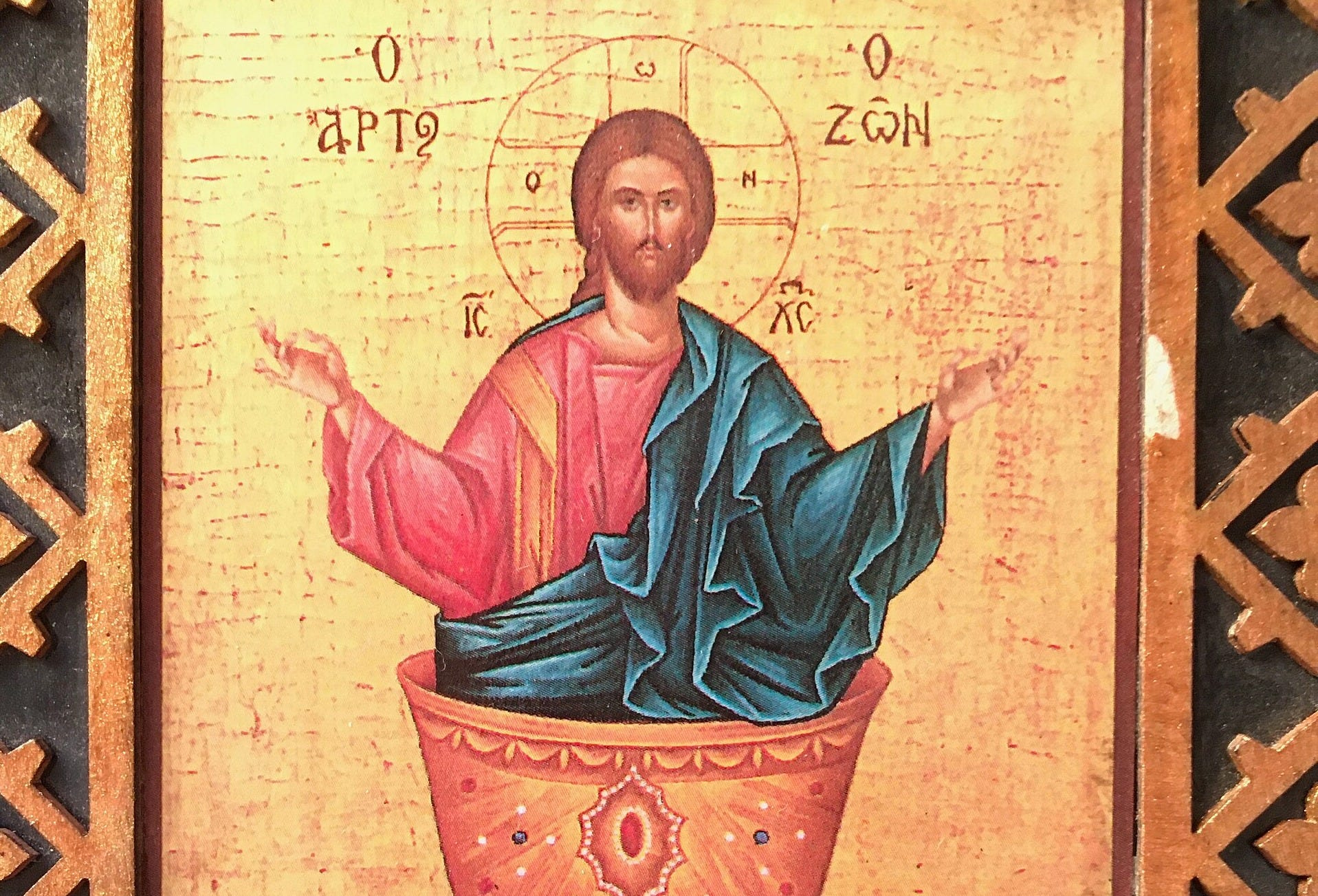
Jesus revealed, little by little and in response to the crowds’ resistance, parts of the sublime doctrine of the Eucharist.
Editor’s Notes
In this piece, Father Coleridge tells us how Christ unfolded the doctrine of the Blessed Sacrament by degrees.
How he declared himself the Bread of Life come down from Heaven.
That the Jews resisted his heavenly origin before objecting to the command to eat his flesh.
Why he strengthened, rather than softened, the hard doctrine of the Holy Eucharist.
For more on this series, see Part I.
The Discourse in the Synagogue
The Training of the Apostles, Part IV
Chapter X
St. John vi. 25–72; Story of the Gospels, § 74
Burns and Oates, London, 1885.
(Read on Corpus Christi)
How Our Lord gradually unveiled the doctrine of the Holy Eucharist
How Jesus used the loaves to explain his doctrine to the people – and to us
How Jesus presented the Eucharist in the face of dulness and antagonism from the crowd
How Christ can demand faith in his teaching on the Eucharist
‘Give us this Bread’
‘They said therefore unto Him, Lord, give us always this Bread!’ The exclamation is like that of the poor Samaritan woman, when our Lord spoke to her about the water of life:
‘Sir, give me this water, that I may not thirst, nor come hither to draw.’1
These people did not understand what our Lord meant, but they understood that He was speaking of some great boon, and so they broke out into a prayer that it may be given to them.
The Bread of Life
Then He goes on to specify still more clearly the character of the gift. Before, He had spoken about the Bread which cometh down from Heaven, and now He says plainly that it is Himself.
‘And Jesus said to them, I am the Bread of Life, he that cometh to Me shall not hunger, and he that believeth in Me shall never thirst.’
And then He goes on to speak in general terms about the necessity of faith in Himself, and to connect the promise of the Living Bread with the resurrection to a new and perfect life.
For this was in a manner more necessary, lest it might seem that He promised to those who eat of this Heavenly Bread that they should not pass through death, enjoying at once the everlasting life, which is the fruit of this Bread. And it may be supposed that He discerned among the audience some difficulty in receiving His words on this subject.
‘But I say unto you, that you also have seen Me, and you believe not. All that the Father giveth Me shall come to Me, and him that cometh to Me I will not cast out. Because I came down from Heaven, not to do My own will, but the will of Him Who sent Me.
‘Now this is the will of My Father Who sent Me, that of all that He hath given Me I should lose nothing, but should raise it up at the last day.
‘And this is the will of My Father that sent Me, that every one that seeth the Son and believeth in Him, may have life everlasting, and I will raise him up at the last day.’
Here we find a number of new thoughts and ideas suggested by the words of our Lord, and we shall have to explain the passage presently, as far as may be, in detail. But the remark must be repeated here, that our Lord again leaves something which is most important to be the subject of future teaching. For He does not say how it is that He will raise men up at the last day.
This, then, is what we may call the third stage in the unfolding of the truths which our Lord desires to set forth on this occasion, and we can see that He has now got so far as to have declared that He is Himself the Bread that cometh down from Heaven, and so far also as to connect this statement with the future raising up, to newness of life and immortality, of those who come to Him and who believe on Him.
There is not as yet a word about eating or drinking, except so far as that idea is contained in the use of the figure of bread.
‘Jesus, the Son of Joseph’
We can gauge accurately the impression produced on the hearers by the next objection which the people present make.
‘The Jews therefore murmured at Him, because He had said, I am the Living Bread which came down from Heaven. And they said, Is not this Jesus the Son of Joseph, Whose father and mother we know? How then saith He, I came down from Heaven?’
They fasten on the statement about coming down from Heaven, rather than make any objection about His being the Living Bread.
Our Lord’s answer: His Flesh to be eaten
Our Lord answers this objection in the next paragraph or stage of the teaching, in which He first of all tells them that they cannot believe, unless God the Father leads them to faith, and, in the second place, insists still further on the necessity of eating this Living Bread, adding at the end the new and most startling declaration, that the Bread of which He speaks is His own Flesh.
‘Jesus therefore answered them and said, Murmur not among yourselves. No man can come to Me except the Father Who hath sent Me draw him, and I will raise him up at the last day. It is written in the prophets, “And they shall all be taught of God.”2
‘Every one that hath heard of the Father and hath learned, cometh to Me. Not that any man hath seen the Father, but He Who is of God, He hath seen the Father.
‘Amen, amen, I say unto you, he that believeth in Me hath everlasting life. I am the Bread of Life. Your fathers did eat manna in the desert, and are dead. This is the Bread that cometh down from Heaven, that if any man eat of It, he may not die. I am the Living Bread which came down from Heaven.
‘If any man eat of this Bread, he shall live for ever, and the Bread that I will give is My Flesh, for the life of the world.’
Fourfold declaration
The advance of the doctrine here is quite evident. Our Lord does not explain away what He had said. On the contrary, He insists on it and adds to it a further statement, that the Bread of which He speaks is His Flesh.
Nor can there be any doubt that it was in this way that His words were understood by those who heard them at the time. For St. John adds:
‘The Jews therefore strove among themselves, saying, How can this Man give us His Flesh to eat?’
Our Lord again answers without in the slightest manner qualifying His words.
‘Then Jesus said to them, Amen, amen, I say unto you, Except you eat the Flesh of the Son of Man and drink His Blood, you shall not have life in you. He that eateth My Flesh and drinketh My Blood hath everlasting life, and I will raise him up at the last day.
‘For My Flesh is meat indeed, and My Blood is drink indeed. He that eateth My Flesh and drinketh My Blood, abideth in Me, and I in him. As the Father hath sent Me, and I live by the Father, so he that eateth Me, the same also shall live by Me.
‘This is the Bread that came down from Heaven, not as your Fathers did eat manna, and are dead. He that eateth this Bread shall live for ever.’
Here, then, we have the true doctrine of the Blessed Sacrament set forth in the most solemn and dogmatic form before the institution of the Blessed Sacrament.
Nothing can be added and nothing can be taken from these Divine words as far as they go. They constitute by far the most explicit and definite statement on the subject of Holy Communion that can be found in the Gospels or in the New Testament.
And yet there is still something kept back. There is nothing direct as yet about the Adorable Sacrifice, there is nothing direct about Transubstantiation. This doctrine may be discerned, so to say, lurking under the words of our Lord, for after speaking of the eating and drinking of His Body and Blood, He goes on to speak of eating of that Bread. The Bread, therefore, which is to be eaten is the same as the Flesh and Blood of our Lord. But the doctrine which is discernible to Catholics who possess the teaching of the Church, was still veiled from those to whom our Lord was speaking in this place.
The Discourse in the Synagogue
How Our Lord gradually unveiled the doctrine of the Holy Eucharist
How Jesus used the loaves to explain his doctrine to the people – and to us
How Jesus presented the Eucharist in the face of dulness and antagonism from the crowd
How Christ can demand faith in his teaching on the Eucharist
From:
The Training of the Apostles, Part IV
Here’s why you should subscribe to The Father Coleridge Reader and share with others:
Fr Coleridge provides solid explanations of the entirety of the Gospel
His work is full of doctrine and piety, and is highly credible
He gives a clear trajectory of the life of Christ, its drama and all its stages—increasing our appreciation and admiration for the God-Man.
If more Catholics knew about works like Coleridge’s, then other works based on sentimentality and dubious private revelations would be much less attractive.
But sourcing and curating the texts, cleaning up scans, and editing them for online reading is a labour of love, and takes a lot of time.
Will you lend us a hand and hit subscribe?
Follow our projects on Twitter, YouTube and Telegram:
Twitter (The WM Review)
St. John iv. 15.
Isaias liv. 13.
I love how this portion of Fr Coleridge's chapter conveys the heights and depths of the Bread of Life discourse, part by part, revealing how Our Lord patiently taught those with ears to hear it and also those in whom strong resistance arose, without ever swerving from the will of His Father.
We are now fortunate, far beyond our deserving, to have this teaching of Our Lord on the Holy Eucharist and centuries of Church tradition to explain it, as much as such a divine mystery can be explained to us mortals. We have only to keep defending it, to not abandon it or Him! It is not surprising that THAT is where the attack of the evil one has been focused--on the Mass, the priesthood, and the hierarchy.