

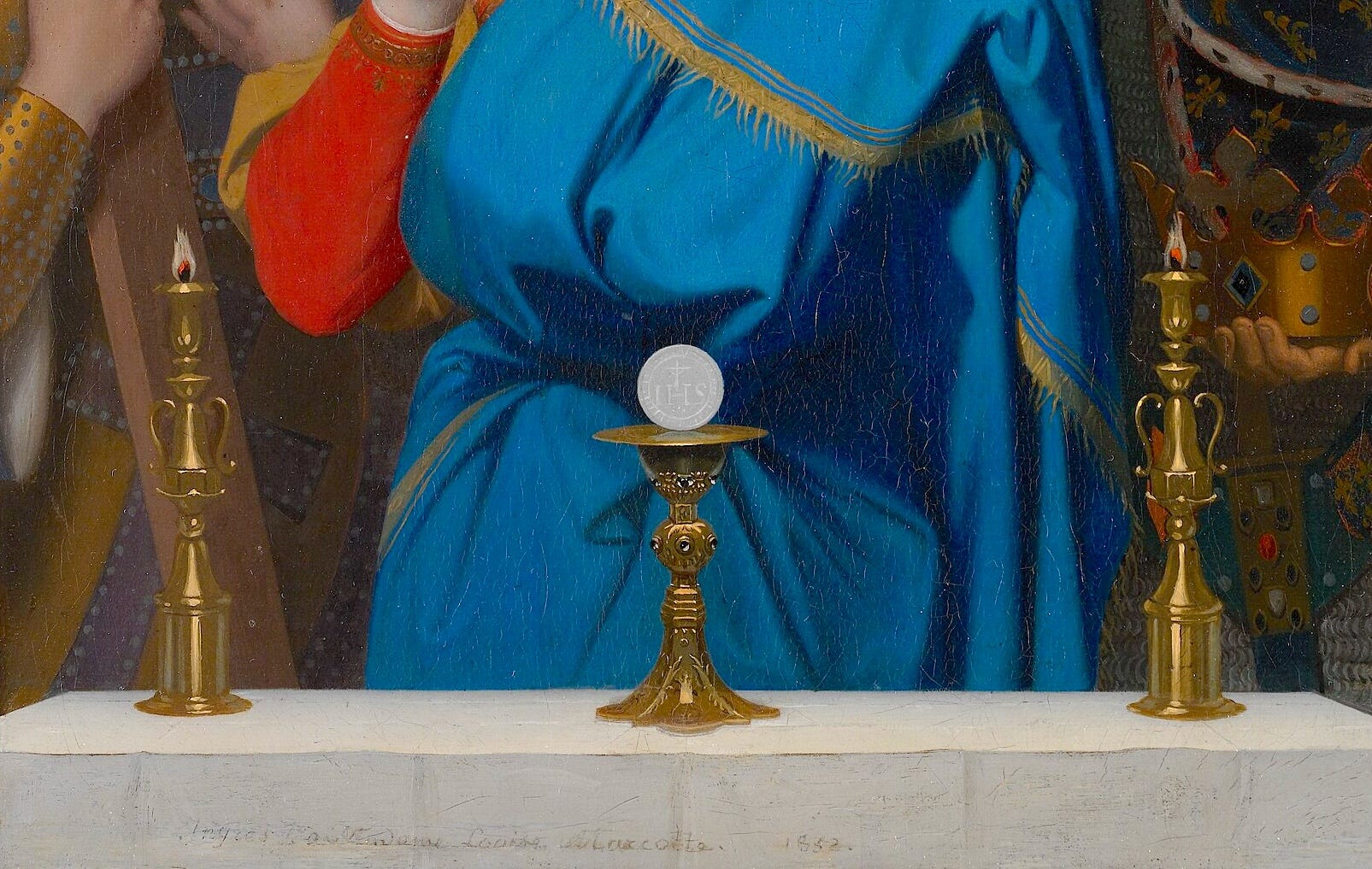
The temperament of the crowd is intrinsic to the way Our Lord taught them about this mystery.
Editor’s Notes
In this piece, Father Coleridge tells us:
Why the crowd’s lack of faith helped draw out Christ’s fuller teaching
How the Father leads souls to believe the words of the Son
What the Blessed Sacrament demands from every Catholic who adores it.
He shows us that the Eucharist is the mystery of faith, received through the Father’s grace and the Son’s authority.
For more on this series, see Part I.
The Discourse in the Synagogue
The Training of the Apostles, Part IV
Chapter X
St. John vi. 25–72; Story of the Gospels, § 74
Burns and Oates, London, 1885.
(Read on Corpus Christi)
How Our Lord gradually unveiled the doctrine of the Holy Eucharist
How Jesus used the loaves to explain his doctrine to the people – and to us
How Jesus presented the Eucharist in the face of dulness and antagonism from the crowd
How Christ can demand faith in his teaching on the Eucharist
Copious teaching about faith
It may seem as if there had been no great need for the preservation of so much of our Lord’s teaching on this occasion, which had direct reference to the dulness of faith in that particular crowd of hearers to whom the discourse was addressed.
But it must be remembered that it is the way of God to bring good out of evil. Here, in an especial manner, He made the hesitation and doubt and dulness, and even the far worse qualities of malice and hostility, which are to be found, some among the friends, some among the enemies of our Lord, serve to the greater elucidation and illustration of the truths which He had to teach, or which were involved in His actions.
Thus we have been greatly the gainers by the hesitation of St. Thomas, by the rivalries among the Apostles, by the questions which they so often put to Him, even when He had to reprove them for their dulness of faith, and the like. In the case before us it has been an immense gain to the Church that our Lord should have spoken so plainly and so strongly about the necessity of faith, and about the manner in which faith is produced in the soul, with especial reference to the great doctrine of the Blessed Sacrament.
For that marvel of Divine love requires the constant daily exercise of Christian faith, in a manner of which it may be said that it is hardly found with regard to other Christian mysteries, and that we all have constant need of the teaching of the Father and of the active lively faith in the words of the Son, quite as much as these crowds had need of the same graces, to enable them to understand this discourse in the synagogue at Capharnaum and to accept its truths.
The Blessed Sacrament is, in a manner and to a degree of its own, the mystery of faith, as it is called in the Canon of the Mass. It is in the world, age after age, the ‘sign which shall be contradicted,’ of which holy Simeon spoke to our Blessed Lady. And we ourselves should have the greatest need of this part of the teaching of this discourse, even if the audience to whom it was addressed had not been so poorly furnished with faith. Thus these remarks of our Lord are as practical to us as they were to the crowd assembled in the synagogue.
Frequent mention of the Father
There is yet another general remark to be made, before we enter on the detailed consideration of the discourse. This remark relates to the very frequent mention of the Father, and to the large part assigned by our Lord in the passages before us to the decree, the will, the action of the Father. It is nothing wonderful to find our Lord so constantly speaking of His Father, when we know that His Sacred Heart was occupied with the thought and love of Him with an intense and unbroken attention.
This attention shows itself almost every time that we have any recorded words of our Lord to comment on, and we may consider that, even if the Divine truths which He was uttering did not require it, the affections of His Heart would have brought the name of His Father perpetually to His lips. But no such loving exaggeration, so to say, of the work and office of His Father was possible with our Lord. Still it requires to be noted, how the will and operation of the Father are continually meeting us in the discourse.
In the first place, it is the ‘sealing’ of the Son of Man by God the Father that is the cause of His giving to men the Food that does not perish, but endureth unto life everlasting. Then it is said that the work which God desires of the people is that they may believe in Him Whom He hath sent. Then it is said that it is the Father Who gives the true Bread from Heaven, which cometh down from God and giveth life to the world.
Then our Lord says that they do not believe in Him, but that He will not cast out any one who comes to Him, Who is given to Him by His Father. He came down from Heaven, not to do His own will, but His Father’s, and the will of His Father is that of those whom He has given to Him He should lose nothing, but raise it up at the last day. And then this is explained further, the will of the Father is that every one who seeth the Son and believeth in Him may have life everlasting, and that the Son will raise Him up at the last day.
Then when they murmur at the thought of His having come down from Heaven, He tells them that no one can come to Him, except the Father Who hath sent Him should draw him, and that such persons He will raise up at the last day. Then comes a distinct instruction as to the action of the Father. No one can come to Him, except the Father Who has sent Him, draw him. Then this is confirmed from prophecy. Then He says that every one that hath heard of the Father, and learned, comes to Him, and this again is explained, to avoid the danger of misconception.
Doctrine of the Eucharist set forth by our Lord
It is also very remarkable that this language is entirely changed when the doctrine is proposed which is to be accepted on faith from our Lord.
When He comes to speak of the distinct doctrine of the Blessed Sacrament, He does not say that this is the direct teaching of the Father. The teaching of the Father is the whole process which brings men to our Lord, Whom He has sent. But when they come to Him, it is His office, and the office of the Church after Him, to impart the distinctly Christian doctrines, such as that before us.
So the whole of the doctrine about the Bread of Life, the Flesh of our Lord which He will give for the life of the world, the necessity of eating the Flesh and drinking the Blood of the Son of Man, the everlasting life and the raising up at the last day of those who do so, their abiding in our Lord and His abiding in them, is set forth by our Lord as His own teaching. This is the doctrine for which the faith of the multitudes, as of all Christians after them, is required.
The foundation of this faith is the teaching of the Father leading them to our Lord as the Messenger Whom the Father has sent. But it is for the Messenger to deliver the special truths entrusted to Him. The only reference to the Father, therefore, in the latter part of the discourse, is that contained in the illustration, which is also a dogmatic truth:
‘As the living Father hath sent Me, and I live by the Father, so he that eateth Me, the same also shall live by Me.’
The chain of statements concerning the Father contained in this discourse might be considered and meditated upon, apart from the particular doctrine which is the primary object of the discourse, the doctrine of the Bread from Heaven, which becomes definite and precise as the doctrine of the Blessed Sacrament.
Every one of these Divine words is in its proper place, and there is nothing omitted which it was our Lord’s purpose then to set forth, as there is certainly nothing superfluous.
This is the end of the first chapter in this series. The next deals with the faith Our Lord asks to be placed in himself during this discourse; the chapter following this deals with the doctrine of the Blessed Eucharist as presented in this discourse. Both these chapters are quite long, and so will be spread across several parts.
The Discourse in the Synagogue
How Our Lord gradually unveiled the doctrine of the Holy Eucharist
How Jesus used the loaves to explain his doctrine to the people – and to us
How Jesus presented the Eucharist in the face of dulness and antagonism from the crowd
How Christ can demand faith in his teaching on the Eucharist
From:
The Training of the Apostles, Part IV
Here’s why you should subscribe to The Father Coleridge Reader and share with others:
Fr Coleridge provides solid explanations of the entirety of the Gospel
His work is full of doctrine and piety, and is highly credible
He gives a clear trajectory of the life of Christ, its drama and all its stages—increasing our appreciation and admiration for the God-Man.
If more Catholics knew about works like Coleridge’s, then other works based on sentimentality and dubious private revelations would be much less attractive.
But sourcing and curating the texts, cleaning up scans, and editing them for online reading is a labour of love, and takes a lot of time.
Will you lend us a hand and hit subscribe?
Follow our projects on Twitter, YouTube and Telegram:
Twitter (The WM Review)