

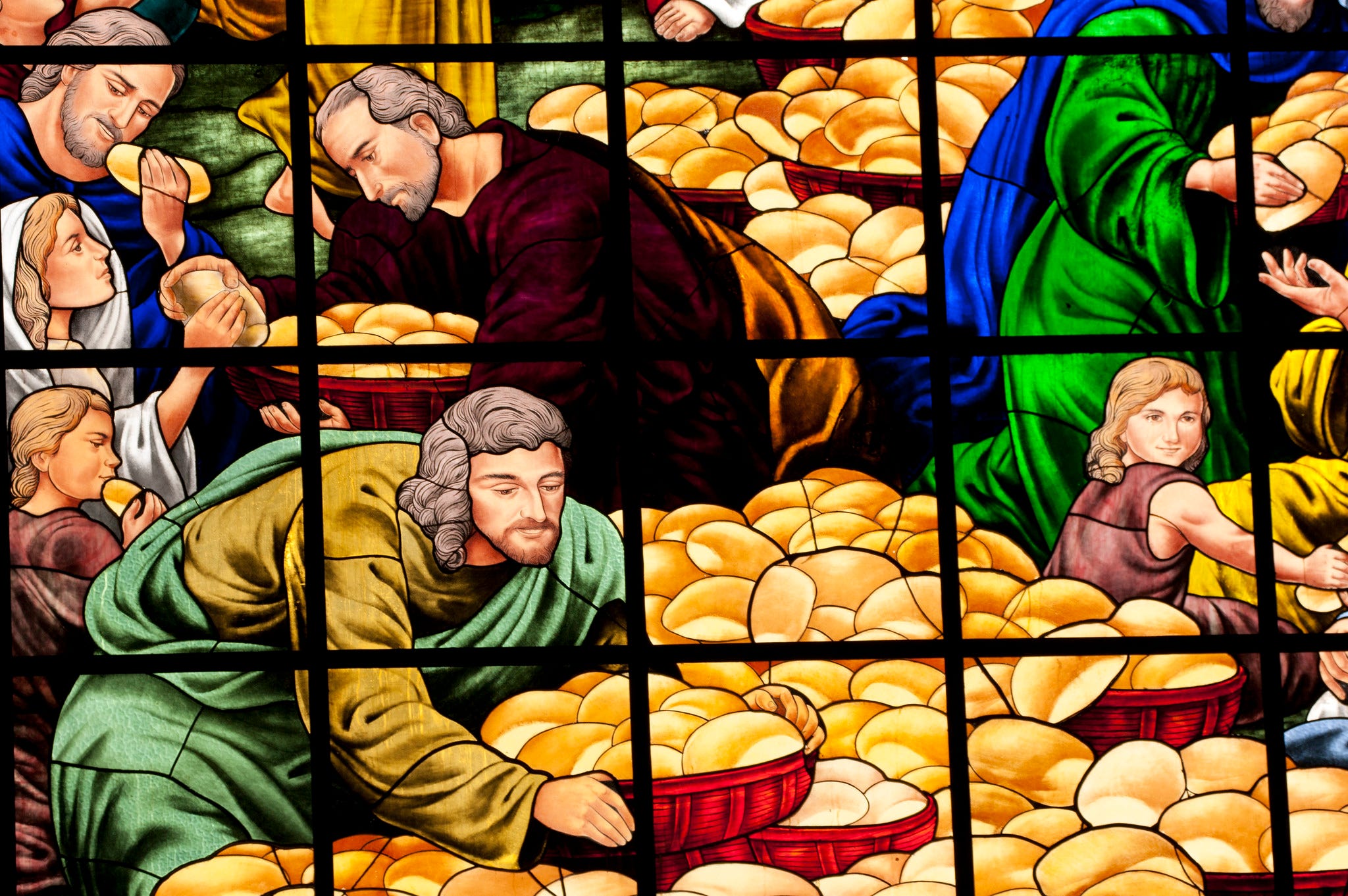
Sometimes Our Lord worked miracles less connected to his teaching – but on other occasions, they were very deliberately linked.
Editor’s Notes
In this piece, Father Coleridge tells us:
Why Christ let many disciples leave rather than soften his doctrine
How the miracle of the loaves and the manna in the desert are connected to the Holy Eucharist
What miracles teach us about trusting Our Lord when his doctrine seems difficult.
He shows us that Christ’s miracles prove his authority, and his authority demands faith.
For more on this series, see Part I.
The Discourse in the Synagogue
The Training of the Apostles, Part IV
Chapter X
St. John vi. 25–72; Story of the Gospels, § 74
Burns and Oates, London, 1885.
(Read on Corpus Christi)
How Our Lord gradually unveiled the doctrine of the Holy Eucharist
How Jesus used the loaves to explain his doctrine to the people – and to us
How Jesus presented the Eucharist in the face of dulness and antagonism from the crowd
How Christ can demand faith in his teaching on the Eucharist
After the discourse
It would seem that here at last is a pause in this great discourse. Our Lord had finished the teaching on the subject in the words last recited. And St. John adds, ‘These things He said, teaching in the synagogue in Capharnaum.’
He adds that in consequence of this teaching many of the disciples forsook our Lord. In the former part of the chapter, he had told us how they murmured or objected, which is what is done when the discussion is continued on the same spot and at the same time. But it is something different to say, that the disciples, or many of them, hearing what had been said, complained of the hardness of the doctrine. And it is not of the Jews that St. John now speaks, but of the disciples themselves.
Nevertheless, it may be quite as well to suppose that the following words also may have been spoken on this occasion, especially as they contain the one explanatory clause which occurs in our Lord’s whole statement.
‘Many, therefore, of His disciples, hearing it, said, This saying is hard, and who can bear it? But Jesus, knowing in Himself that His disciples murmured at this, said to them, Doth this scandalize you? If then you shall see the Son of Man ascend up where He was before!
“It is the spirit that quickeneth, the flesh profiteth nothing. The words that I have spoken to you are spirit and life. But there are some of you who believe not. For Jesus knew from the beginning, who they were that did not believe, and who he was that would betray Him. And He said, Therefore did I say to you, that no man can come to Me unless it be given him by My Father.’
Here again it is to be noted that, if the time had come for the full statement of the manner in which the Body and Blood of our Lord are to be made our food, He might have given a different answer from that which He did give. But He had Divine reasons for not completing His doctrine at this time, and it was not completed until the very eve of His Sacred Passion.
The words of eternal life
In order to complete this preliminary statement of the whole teaching of our Lord, we may add here, before further explanation of the several parts of this discourse, the remainder of the statement of St. John in relation to this whole subject.
‘After this many of His disciples went back, and walked no more with Him. Then Jesus said to the twelve, Will you also go away? And Simon Peter answered Him, Lord, to whom shall we go? Thou hast the words of eternal life, and we have believed and have known, that Thou art the Christ, the Son of God.
“Jesus answered them, Have not I chosen you twelve, and one of you is a devil? He meant Judas Iscariot, the son of Simon, for this same was about to betray Him, whereas he was one of the twelve.’
What has been said may suffice as a general survey of the whole narrative of St. John in the passage before us, a survey which enables us, in some degree, to see at once the gradual advance of the discourse from an undefined promise of a Bread from Heaven, the efficacy of which shall be nothing less than the production of eternal life, to the specific and particular declaration that this heavenly food is to consist of the Body and Blood of our Lord Himself, eaten and drunk.
Our next step would naturally be the consideration of the several stages in the discourse which have been already indicated. But it will be better, before proceeding to this, to make a few general remarks which may illustrate the discourse as a whole.
Father Coleridge Reader is a labour of love. But curating, cleaning up and publishing these texts takes real work.
To keep this project going, and to make more of this treasury available, we rely on reader support. Some posts are reserved for members to sustain this mission.
We’re trying to keep something precious alive.
If you’ve benefited, consider joining us as a subscriber. It makes a real difference.