

Our Lord had many reasons for calling his flesh the ‘Bread of Life’, and for giving himself to us under the appearances of bread and wine.
Editor’s Notes
In this piece, Fr Coleridge tells us...
Why Christ rejoiced in the eternal glory awaiting all whom the Father gives him – even though they cannot yet fully appreciate it themselves
How the Blessed Eucharist communicates Christ’s own life, and prepares souls for resurrection
What it is that reveals Christ’s boundless love, given continually as the Bread of Life.
He shows us that Our Lord delights in leading his faithful into everlasting union with himself.
For more on this series, see Part I.
Faith in the Son of Man
The Training of the Apostles, Part IV
Chapter X
St. John vi. 25–72; Story of the Gospels, § 74
Burns and Oates, London, 1885.
(Read on Corpus Christi)
The multiplication of loaves pointed towards the Eucharist – but the crowd weren’t interested
What miracles like the multiplication of loaves are supposed to achieve
Jesus worked miracles to draw out faith in himself, the one sent by God the Father
How talk of the manna helped the crowd understand the Bread of Life
Raising us up as members of himself – Why Jesus gives himself to us as the Bread of Life
Our Lord’s work in souls
Another thought which is contained in these words of our Lord is that of the character of the work which He is to accomplish in them. It is no light or transitory work. He describes it in very few words.
First it is that He will not cast them out.
Then it is that they shall not be lost, but raised up at the last day.
Then this is somewhat expanded, where He says that the will of the Father is that they should have life everlasting, and that He should raise them up at the last day.
These words convey little in comparison to us. They represent great realities and great acts of our Lord, which are different, indeed, in His mind and in truth, from what they are in our poor conceptions.
It is a great thing not to be cast out, not to be without a share in the great work which our Lord came on earth to do, from which, nevertheless, very many who were intended by Him to profit by it are excluded for faults of their own, which compel Him to say to them that He never knew them, and even in this life to leave them outside His Kingdom.
It is a great thing to have life everlasting, even only in expectation and promise, to have a right and title to it, of which nothing but ourselves can deprive us.
It is a great thing to be raised up by our Lord at the last day, not by that universal and common resurrection which will be the lot of the whole human race, in consequence of the Incarnation, but by that glorious resurrection which is to be the condition and the beginning of the true eternal glories of the saints in light.
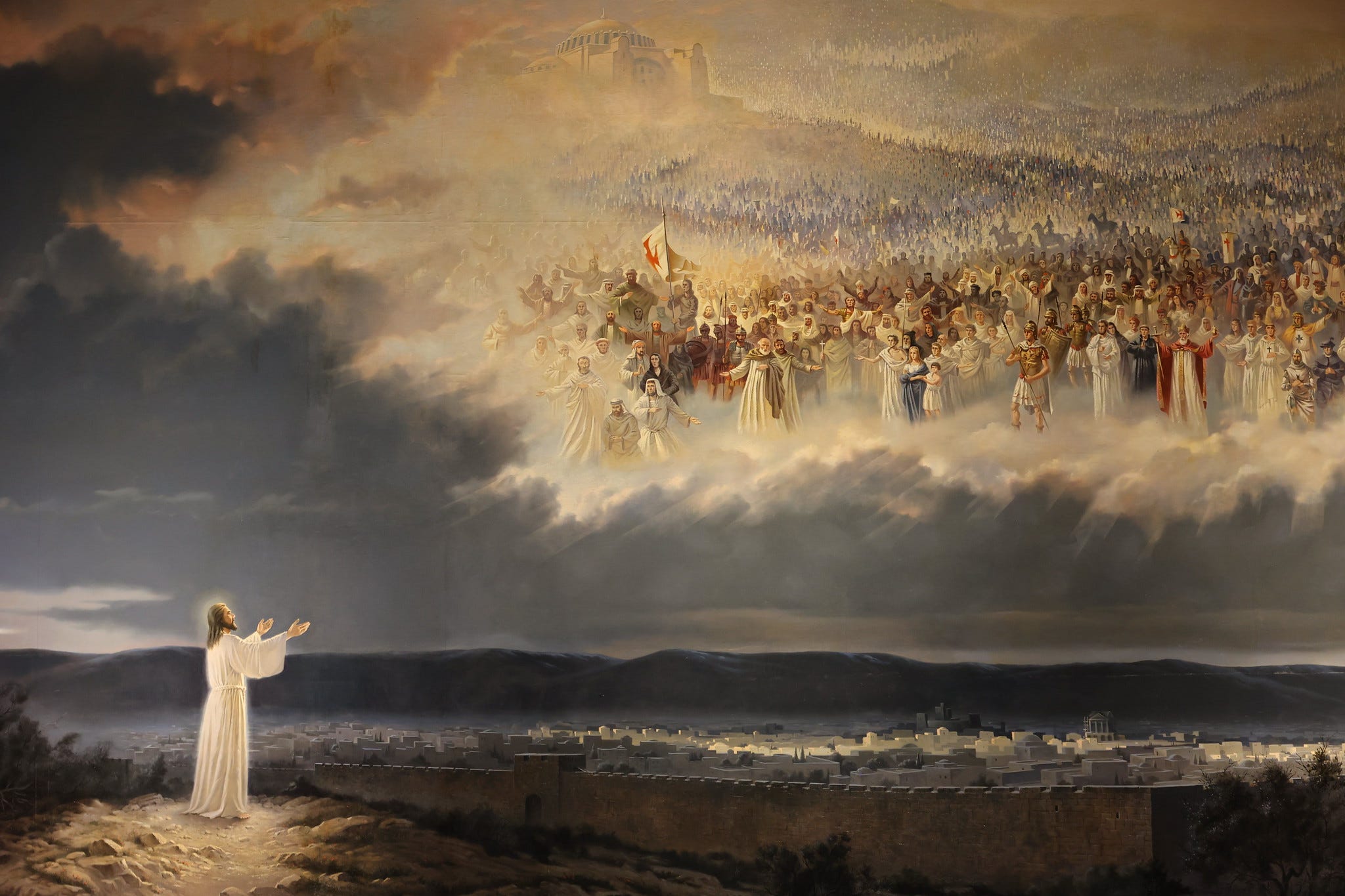
The glories and delights of the body, the glories and delights of the soul, the unfading crowns, the ineffable bliss in the companionship of the blessed angels and saints, and the inconceivable and yet not unsupportable rapture of the Beatific Vision—these are words and little more to us. But to our Lord they were the realities on which His Sacred Heart continually dwelt, and which inundated Him with joy when He reflected on how many millions of souls most dear to Him He was to confer them, as the consequence of the Resurrection which was to be His own work.
He mentions them here, because they were the truths which it was fit should now be set forth to this dull-hearted multitude, but they were nevertheless the source to Himself of joy inextinguishable and unutterable.
Raising up as part of Himself
And there is something still unmentioned in the words before us, implied though not fully expressed in the truth that He is to raise up the blessed at the last day.
He will raise them up as His own members, as parts of Himself, as united to Himself with a tie so close and so inseparable, that it will be closer even than that sacramental union with Him in Holy Communion which is now a foretaste of Heaven, and which has so much mysterious connection with the resurrection and the future life of glory.
It will not only be His work, as the creation was His work, but it will be a raising them to a participation of His own life. He will live in them, and they in Him, He will enjoy in them the vision of ineffable bliss, He will see God in them, and partake in them of the unalterable peace and tranquil possession of all goods of body and soul which will be their lot for ever. Every glory and every joy will be His work, and it will come back to His own Heart as a fresh joy and glory of His own.
Our Lord’s intelligence, then, of these wonderful boons which He was to bestow throughout all eternity on those whom the Father gives Him, must have been a distinct element on the prospect to which His Sacred Heart was now occupying itself.
He is the principle of life
And there is yet one more subject of importance, contained in these words, or rather contained in what we know to be, as it were, wrapped up in these words.
It is not our Lord’s design, in this part at least of His discourse, to explain fully how it is, by what means, or by what actions of His own, this great effect is to be produced of imparting eternal life and raising up the faithful at the last day. He has laid down the principle from which all this result is to flow down.
He has said that He is the Bread of Life that came down from Heaven. He is the principle, therefore, of everlasting life in His Incarnation and Sacred Humanity. When He speaks of the Bread of Life, He hints at the truth and at the particular manner in which He will impart that life of which He speaks, and plant, as it were, in the human body the seeds of the future resurrection which it is to owe to Him at the last day.
For if Life is to be conveyed as from Bread, it must be by the way in which bread supports natural life.
How he is the Bread of Life
Life might be imparted as light, as by rays from the sun, or it might be given as the air which is breathed, and the like. But in that case He would not have called Himself the Bread of Life.
We know from the miracle to which this discourse is attached, as well as from the continual direction given to it by our Lord, by the successive truths which He adds to what has been given before, and most of all from the plain and unmistakeable language in the later sections of the discourse itself, that our Lord had in His mind from the very beginning the marvel of the Blessed Eucharist.
After a time, as it were, He restrains Himself no longer, and He forces on them, little prepared as they were, the truth concerning this great miracle of love. And when, as it were, He lets His words flow on without check, we see that He connects the reception of His Body and Blood in the Blessed Sacrament with these two fruits, resurrection at the last day, and everlasting life. It is right therefore to say that the earlier passage includes also the thought of the manner, in which the results of His love to those whom the Father has given Him are to be brought about, by means of this Heavenly Food.
This will have to be explained a little later on, when we come to the words in which this truth is more directly enunciated. In the meantime we may remind ourselves that here also is a head of ineffable consolation to the Sacred Heart. Not only are these great results to be produced by Him, not only are they to be to Himself the cause of such wonderful joy. But they are also to come about in consequence of a continual excess of love on His part to which there is no parallel, even the giving His own Flesh and Blood to those whom He loves so much to be their food.
He said Himself that there was no greater love, than to give His Life for His friends. But if anything could be greater than the love shown by dying for them, it must surely be that love which makes Himself not only once their Victim, but day after day, securing to them eternal life.
Faith in the Son of Man
The multiplication of loaves pointed towards the Eucharist – but the crowd weren’t interested
What miracles like the multiplication of loaves are supposed to achieve
Jesus worked miracles to draw out faith in himself, the one sent by God the Father
How talk of the manna helped the crowd understand the Bread of Life
Raising us up as members of himself – Why Jesus gives himself to us as the Bread of Life
Previous Chapter:
The Discourse in the Synagogue
How Our Lord gradually unveiled the doctrine of the Holy Eucharist
How Jesus used the loaves to explain his doctrine to the people – and to us
How Jesus presented the Eucharist in the face of dulness and antagonism from the crowd
How Christ can demand faith in his teaching on the Eucharist
From:
The Training of the Apostles, Part IV
Here’s why you should subscribe to The Father Coleridge Reader and share with others:
Fr Coleridge provides solid explanations of the entirety of the Gospel
His work is full of doctrine and piety, and is highly credible
He gives a clear trajectory of the life of Christ, its drama and all its stages—increasing our appreciation and admiration for the God-Man.
If more Catholics knew about works like Coleridge’s, then other works based on sentimentality and dubious private revelations would be much less attractive.
But sourcing and curating the texts, cleaning up scans, and editing them for online reading is a labour of love, and takes a lot of time.
Will you lend us a hand and hit subscribe?
Follow our projects on Twitter, YouTube and Telegram:
Twitter (The WM Review)