

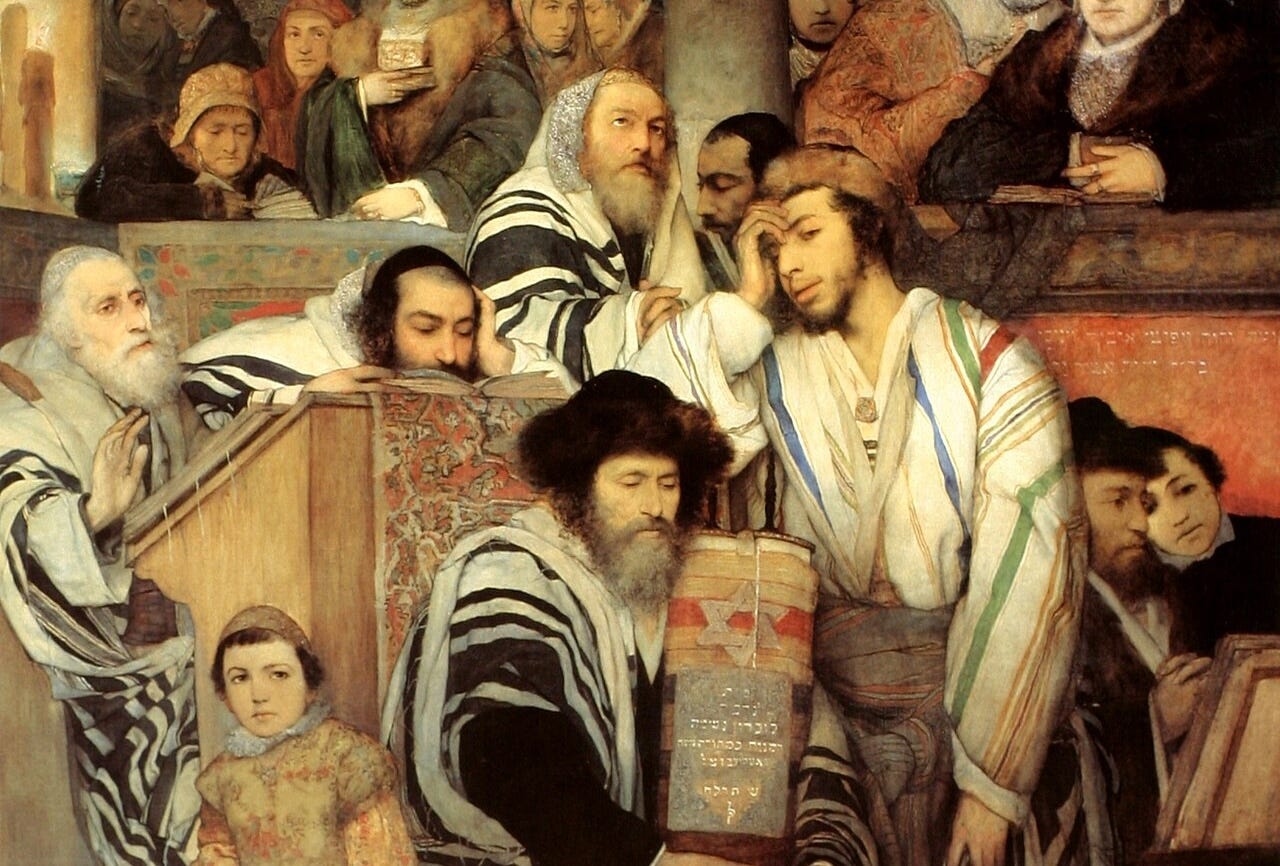
Editor’s Notes
In this part, Fr Coleridge tells us…
How our Lord adds a final scene to the parable of the Prodigal Son to answer his original critics.
That the elder brother exposes the hardness hidden beneath outward obedience.
Why the mercy shown to the Prodigal foreshadows God’s welcome to the Gentiles.
He shows us that true likeness to the Father lies not in service alone, but in charity. But as we shall see in the next part, anyone favoured by God can fall into the same temptations as the Elder Brother.
For more context on this Gospel episode, see Part I.
You can find The WM Review’s audio recording of Fr Aloysius Ambruzzi’s meditation on this parable here:
Parables of God’s Love for Sinners
The Preaching of the Cross, Vol. II
Chapter IX
St. Luke xv. 1—32 ; Story of the Gospels, § 124
Burns and Oates, 1886.
(Read at Holy Mass on the Third Sunday after Pentecost)
How Jesus responds to the charge of associating with sinners
The accusation you might miss in the Parable of the Lost Sheep
How does a wandering sheep differ from lost coin in Christ’s parables?
Does God love repentant sinners more than those who stay faithful?
Why does the younger son want his inheritance, when he lacks for nothing?
Why does the father give the Prodigal his portion, knowing what he will do with it?
Why God’s pardon can be a greater triumph to Him than a benefit to us
Does the Prodigal’s Elder Brother represent the Jewish people?
The elder brother
In the last part of the parable we have an instance of our Lord’s method in this kind of teaching.
For He has often added a new strain of teaching at the end of such instructions, taking the imagery of the parable already given, and subjoining a fresh instruction which seems to grow out of the former. This we shall find in His teaching about the Rich Glutton and Lazarus, where He has added a new point of doctrine in the answer of Abraham to the petition of the rich man that Lazarus may be sent to his own brethren. Thus we find when He seems to repeat the parable of the Great Supper, that He adds the teaching about the wedding garment.
In the present case, the addition deals with the case of the persons who gave immediate occasion for its delivery, and whom our Lord is therefore answering all through.
‘Now his elder brother was in the field, and when he came and drew nigh to the house he heard music and dancing. And he called one of the servants and asked what these things meant. And he said to him, Thy brother is come, and thy father hath killed the fatted calf, because he hath received him safe.
‘And he was angry, and would not go in. His father therefore coming out began to entreat him. And he answering said to his father, Behold, for so many years do I serve thee, and I have never transgressed thy commandment, and yet thou hast never given me a kid that I might make merry with my friends. But as soon as this thy son is come, who hath devoured his substance with harlots, thou hast killed for him the fatted calf.
‘But he said to him, Son, thou art always with me, and all that I have is thine. But it was fit that we should make merry and be glad, for this thy brother was dead and is come to life again, he was lost and is found.’
Contrast to the father
These words of our Lord put the case of the Scribes and Pharisees very gently and kindly.
For He might certainly have exposed in them many faults, which might have made them ashamed of their objections to His treatment of the publicans and sinners.
He might have shown them that their place was by the side rather of the Prodigal than of his brother, that it was only their own blindness which made them self-satisfied and hard upon others whom they thought worse than themselves.
He might have uncovered their many hypocrisies, and spoken openly of their interior corruption.
He might, as He had done before, have shown them how the spirit of mercy was better than sacrifice, how condescending and tender was God in His dealings with men, as they are described in the Sacred Scriptures.
But instead of this, He takes them, as we may say, at their own price, and allows them the virtues which they claimed for themselves. The elder brother describes himself as having always been faithful in the service of his father, and the father does not deny his faithfulness. He goes out to remonstrate with him, instead of leaving him alone or rebuking him for his unnatural hardness of heart.
The father speaks to him most lovingly, even after he has listened to his undutiful reproaches, which charge the father with partiality to the Prodigal and with coldness to himself. He tells him, ‘Thou art always with me, and all that I have is thine,’ instead of reminding him of his entire dependence, and that whatever he himself had given he might also take away.
He does not notice the rude and coarse manner in which he speaks of his brother. He seems to apologize for his own excessive tenderness, while at the same time he defends it as reasonable and fitting in its manifestation, and these are the only words which can be understood as a rebuke. For when he says, ‘It was fit that we should make merry and be glad,’ he implies that the elder brother should have been the first to join in the merriment and gladness, as no one in the household, except the father himself, could be so closely bound to affection to the Prodigal and to gratitude for his recovery from misery.
These traits belong to the character of God as it is here drawn for us by our Lord, and, while they show His boundless tenderness and compassion, they shed a soft light on the character of those represented by the elder son, which brings out in strong relief all that is unamiable therein, and its immense contrast to the father’s love.
The elder son may have served his father without breaking his commandment, but he was as unlike his father in his charity, as the Prodigal had been unlike him in his purity. His whole demeanour is churlish and harsh.
Men are revealed by sudden surprises. When they are caught unawares, their character comes out. This man’s first acquaintance with the fact that something new had happened was caused by the sound of music and dancing, which fell on his ear as he drew nigh his home. There was nothing in his heart to answer it, nothing to make him rejoice at the merriment he heard. He will not even see for himself what it is that has made his father so glad, and he takes his cue, so to say, from the ungenial servant who had no reason, as he had, to rejoice whenever the good father of the household made merry.
And so, when he learns the truth which ought to have filled his heart with joy and gratitude, and made him rush in to embrace his brother and join in his father’s joy, he hangs back as if he had met with some great injury or disappointment. He could not have kept the Prodigal in his heart, nor prayed for his return. To him his brother was indeed dead and lost, and he did not even think of him with that tender regret which men keep in their hearts for those who are dead and gone, whose frailties they forget, whose errors they forgive, dwelling on their memories with affection, however far they may have wandered ere they died.
This is the secret of the conduct of such men as are here sketched by our Lord. They may be correct in their outward lives, but they have no tenderness of heart, no breadth of affection, no deep sympathies for the fallen, no true yearning for their recovery. So when that recovery comes, and they themselves are the persons who ought most naturally to rejoice at it, they are more ready to take scandal at the indulgence which welcomes them back than to break out in joy and thanksgiving at their return.
Interpretation as to the Gentiles
In their comments on these and other similar passages in the Gospels, we find the Fathers frequently understanding them as prophecies and anticipations of that most signal act of God’s love and mercy whereby the Gentile world was admitted into the Church, much to the offence of the Jews, whom they consider to be depicted in the elder brother.
That they should so have understood these words of our Lord is very natural, and the fact shows us how deep and lasting in the mind and heart of the Church was the gratitude for that wonderful feature in her history. We, on the other hand, are inclined to take the mercy of God on the Gentile world as a matter of course, although we are the people who inherit the blessings thus imparted to those who, at the time of our Lord, were aliens from the covenant and outside the pale of the chosen people.
These comments of the Fathers are a perpetual chorus of thanksgiving for the mercies of God on the Gentile world, and we who inherit those mercies do well to keep them continually in our mind, as if they had only just been extended to us, and to make them a matter of perpetual thanksgiving, which is a means with which few can compare of securing the continuance and increase of the favour of God.
The Counsel of God
It is certainly, moreover, very highly probable that our Lord had this application of His words in His own mind when the parables in question were spoken.
It was not the counsel of God that He should Himself admit the Gentiles into the Church, but He was always looking forward to what was to be in her history. Nor could any portion of that history be more important in itself, more imminent in the rapidity with which it was to succeed after His Ascension into Heaven, than this.
It was to be the first great onward step of the Church towards her universal Empire, the first great stroke of Providence, opening out new paths for the feet of the Apostles, breaking down the narrow limits within which the Kingdom of Heaven had seemed to be confined. It was a stroke of Providence which it would strain the minds even of Apostles to understand, and which fell as a shock on a great portion of the Jewish community which had embraced the faith, while the Jews outside the Church received it with indignation and hatred.
To say this is to say that there was in these classes of men more or less of the feelings and dispositions which are attributed in the parable to the elder brother. This is, indeed, not the only passage in the later portions of the Gospel narrative which seems to have reference to that impending change in the arrangements of God’s Kingdom on earth which was to be the salvation of the Gentile world, while it was to arouse a certain amount of hostility and censure on the part of some of the Jewish nation.
Parables of God’s Love for Sinners
How Jesus responds to the charge of associating with sinners
The indictment you might miss in the Parable of the Lost Sheep
How does a wandering sheep differ from lost coin in Christ’s parables?
Does God love repentant sinners more than those who stay faithful?
Why does the younger son want his inheritance, when he lacks for nothing?
Why does the father give the Prodigal his portion, knowing what he will do with it?
Why God’s pardon can be a greater triumph to Him than a benefit to us
Does the Prodigal’s Elder Brother represent the Jewish people?
Here’s why you should subscribe to The Father Coleridge Reader and share with others:
Fr Coleridge provides solid explanations of the entirety of the Gospel
His work is full of doctrine and piety, and is highly credible
He gives a clear trajectory of the life of Christ, its drama and all its stages—increasing our appreciation and admiration for the God-Man.
If more Catholics knew about works like Coleridge’s, then other works based on sentimentality and dubious private revelations would be much less attractive.
But sourcing and curating the texts, cleaning up scans, and editing them for online reading is a labour of love, and takes a lot of time.
Will you lend us a hand and hit subscribe?
Follow our projects on Twitter, YouTube and Telegram:
Twitter (The WM Review)