

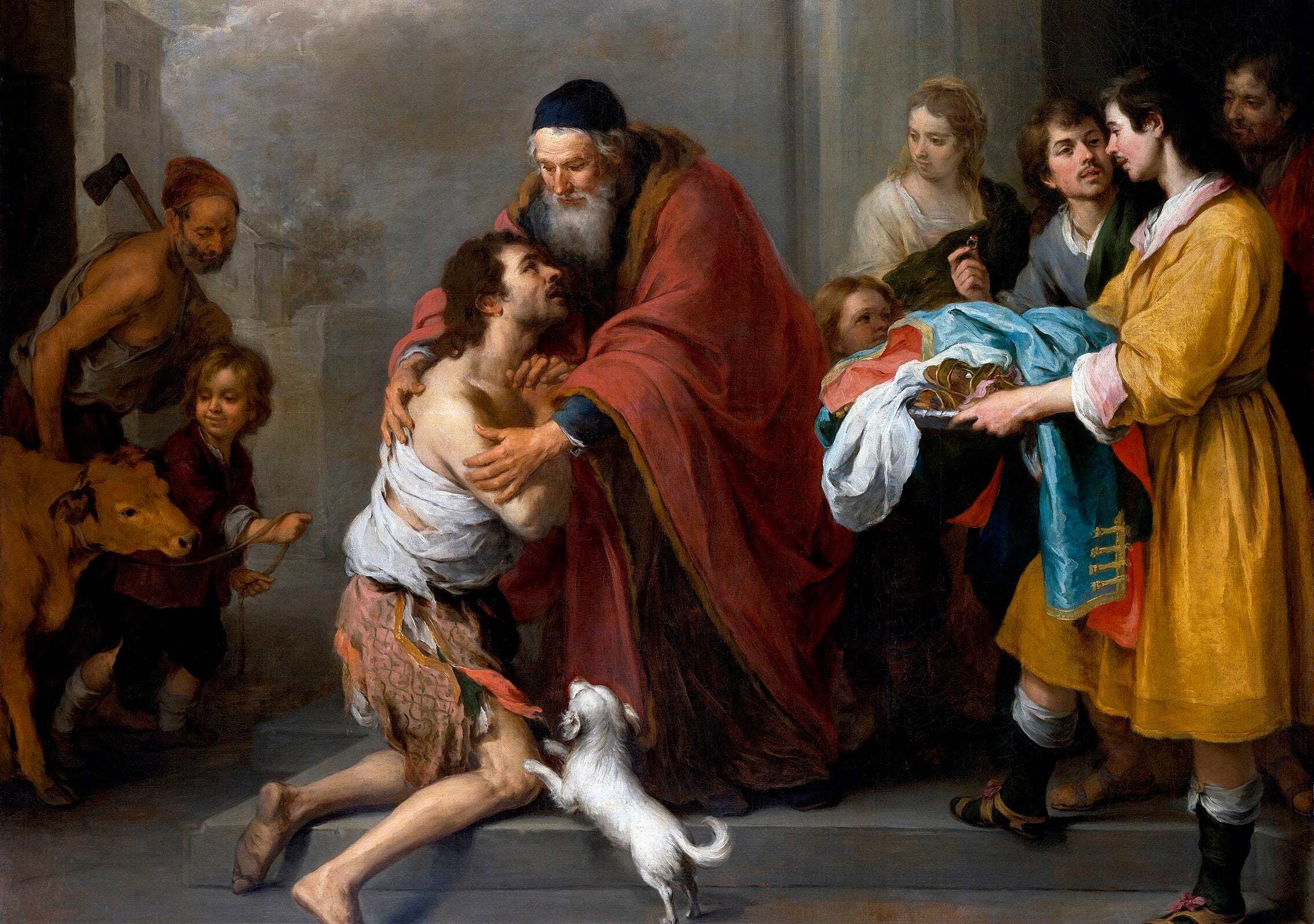
The father’s extravagant welcome reveals God’s pardon, restoring the penitent to full sonship rather than the mere servitude for which he had hoped.
Editor’s Notes
In this part, Fr Coleridge tells us…
How the Prodigal’s conversion reveals the dispositions required for true penitence and return.
That God’s welcome overwhelms the sinner with honours far beyond what repentance dared hope.
Why the father does not let the son finish his plea to become a hired servant.
He shows us that divine mercy restores the penitent not to servitude but to sonship, lavishing joy without reserve.
For more context on this Gospel episode, see Part I.
Parables of God’s Love for Sinners
The Preaching of the Cross, Vol. II
Chapter IX
St. Luke xv. 1—32 ; Story of the Gospels, § 124
Burns and Oates, 1886.
(Read at Holy Mass on the Third Sunday after Pentecost)
How Jesus responds to the charge of associating with sinners
The accusation you might miss in the Parable of the Lost Sheep
How does a wandering sheep differ from lost coin in Christ’s parables?
Does God love repentant sinners more than those who stay faithful?
Why does the younger son want his inheritance, when he lacks for nothing?
Why does the father give the Prodigal his portion, knowing what he will do with it?
Why God’s pardon can be a greater triumph to Him than a benefit to us
Does the Prodigal’s Elder Brother represent the Jewish people?
Action of the father omitted
As has been said, our Lord does not trace out for us any action of the father for the recovery of his son. In the true history which He has in His mind, that of the return of the sinner to God, we know how great is the importance of the workings of grace, without which the external measures of Providence in afflicting, chastising, awakening the sinner would be of no avail.
It might be expected, therefore, that He should tell us of messages of love and remonstrance sent by the father to the wanderer, and of other attempts to bring him to a better mind. But this part of the history of the return of the sinner is here left untouched, apparently because it has been sufficiently hinted at, at least, in the two preceding parables, which belong to the same subject.
The man who has lost one sheep out of a hundred, leaves the ninety-nine and goes to search after that which was lost, and the woman who has lost her groat does not rest till she has found it. In the same way God does not cease pleading with the soul which has abandoned Him, and what He does in this way is, in truth, the foundation and cause of the conversion which follows, whenever it does follow.
But what parable could describe the tenderness, the perseverance, the inventiveness, the delicacy, and the efficacy of the graces by which God woos back the soul? In this part of the parable our Lord is sketching what passes in the mind and heart of the Prodigal himself. We must fill up the picture in our meditations by borrowing from the other parables that which is here left out.
The change of heart which answers to the external circumstances of which we have had to speak, is the beautiful fruit of Divine grace. It is that which makes profitable the external discipline by means of which the Prodigal is awakened, which drives him in upon himself, and lights up in his mind the thoughts and reflections which are the foundations of his resolution to return.
‘And returning to himself, he said, How many hired servants in my father’s house abound with bread, and I here perish with hunger! I will arise, and will go to my father, and say to him, “Father, I have sinned against Heaven and before thee, I am not now worthy to be called thy son, make me as one of thy hired servants.”’
Conversion
Here the foundation of the conversion is the thought of the goodness of the father. Even the menials in his home are abundantly supplied with food. He had left it out of a love of independence, and his use of the freedom which had been granted him had brought him into a worse case than that of those who lived with his father as servants, not as sons. Those hired servants were now objects of envy to him, who had not been content to depend as a child upon his father, who was their master, supporting and maintaining them, not out of love, but out of justice, in reward for their services.
He had forfeited his father’s loving care, but he might at least offer him the service of a mercenary. This is put before us as the first thought of the Prodigal, but it is but the occasion of other reflections and dispositions which go beyond it. In the words which our Lord puts into his mouth we can trace his love for his father, his grief at having left him and disgraced him, his humility and disregard of human respect in proposing to go and confess his fault, his desire to atone for the past by a life of penitential servitude among people who had known him in his former state of liberty and honour, and his consciousness that above all he had offended God far more than men, that consciousness which made holy David cry out after his greatest sin, Tibi soli peccavi et malum coram te feci.
He does not speak of his misery, but of his sin. These are the affections and dispositions of the true penitent, of Magdalene as of David, contemplating an entire change of life, and hoping bravely to be enabled to serve God diligently and profitably in a course of reparation. Thus the few words of the Prodigal may be used by us as pointing out the affections which we should endeavour to make dominant in our souls if we desire to turn to God and lead a life of true and generous penitence.
Joy of the father at his return
‘And rising up, he came to his father. And when he was yet a great way off, his father saw him, and was moved with compassion, and running to him, fell upon his neck, and kissed him. And his son said to him, Father, I have sinned against Heaven and before thee, I am not now worthy to be called thy son.
‘And the father said to his servants, Bring forth quickly the first robe, and put it on him, and put a ring on his hand and shoes on his feet, and bring hither the fatted calf, and kill it, and let us eat and make merry, because this my son was dead and is come to life again, was lost and is found. And they began to make merry.’
All through this parable our Lord has before Him the joy of God at the return of the sinner, and He now describes more particularly the manner in which that joy shows itself, as well as the special ground on which it is founded, namely, that a conversion from sin is a recovery of what had been lost, a coming to life of what had been dead, and is therefore a greater victory of grace than even the perseverance of the just in their virtue.
The source of all this special joy lies in the tender loving heart of the father in the parable, which cannot reflect except most faintly the infinite love of God, our Creator and Father. The depths of that love can never be fathomed, until we can understand the ineffable joy and love which are the life of God, and comprehend what it is in Him to have created us after His own image and likeness, and designed us for the possession of His own blessedness throughout all eternity.
How expressed
The particulars are specified in which the manifestation of this love is set forth, the first or best robe, the ring on the finger, the shoes to the feet, to do away with the last vestige of poverty and misery in his appearance.
They express the thoughtful charity with which, in the reception of the sinner by God, every honour is lavished on him and every blemish is removed from him. The picture teaches us that there is no stinting, no reserve, no half measures, in the pardon which God delights to impart to us, as if it were a greater triumph and a greater joy to Him than it is a benefit to ourselves.
The ‘first robe’ is understood by many Fathers as the baptismal innocence which is restored to perfect penitence, the ring on the finger as the mark that the penitent is once again the acknowledged child of God, the shoes on the feet are taken to mark his freedom to walk on in the path of virtue. In the picture drawn in the parable, these are just what would have been given in the East to one who was to take his place in the household as son of the lord.
It is remarkable that our Lord does not make the Prodigal repeat the request which he had intended to make, that he might henceforth be as one of the hired servants of his father. For the welcome which he had received, the embrace and kiss of his father, had anticipated any words of his, and after such demonstrations of love he may have felt it more meet to leave his future condition in his father’s hands. But the words of the father seem designed to answer the request which he had intended to make. For the treatment which he is to receive is one which places him at once back again where he was before, or even raises him higher than he had ever been in his father’s house.
The first robe, the ring on the finger, the banquet and rejoicing, are not in keeping with the position of a hired servant. He is a son, who can never forfeit his relationship. He has been dead, and is alive again. He has been lost, and is found.
Thus, then, the picture sets before us the truth that the children of God, when they return to Him, are still to be treated as the darlings of His heart. It also represents the truth which is often noticed in the case of the penitent, that it pleases God in His tenderness to overwhelm them with delights and spiritual favours, filling them with unutterable joy and consolation, such as perhaps they will know only occasionally in their after-lives, however faithful they may be to the grace of God.
For He sees fit to give them these first tastes of heavenly joys, for the sake of increasing their love and confidence, and preparing them to be courageous and patient when it pleases Him to treat them in a different manner with regard to consolation and spiritual delights. These things are the sweets with which He feeds His children when they are as yet beginners in His service, and He constantly grants them in large abundance to those who have to begin again after having been wanderers.
Parables of God’s Love for Sinners
How Jesus responds to the charge of associating with sinners
The indictment you might miss in the Parable of the Lost Sheep
How does a wandering sheep differ from lost coin in Christ’s parables?
Does God love repentant sinners more than those who stay faithful?
Why does the younger son want his inheritance, when he lacks for nothing?
Why does the father give the Prodigal his portion, knowing what he will do with it?
Why God’s pardon can be a greater triumph to Him than a benefit to us
Does the Prodigal’s Elder Brother represent the Jewish people?
Here’s why you should subscribe to The Father Coleridge Reader and share with others:
Fr Coleridge provides solid explanations of the entirety of the Gospel
His work is full of doctrine and piety, and is highly credible
He gives a clear trajectory of the life of Christ, its drama and all its stages—increasing our appreciation and admiration for the God-Man.
If more Catholics knew about works like Coleridge’s, then other works based on sentimentality and dubious private revelations would be much less attractive.
But sourcing and curating the texts, cleaning up scans, and editing them for online reading is a labour of love, and takes a lot of time.
Will you lend us a hand and hit subscribe?
Follow our projects on Twitter, YouTube and Telegram:
Twitter (The WM Review)