

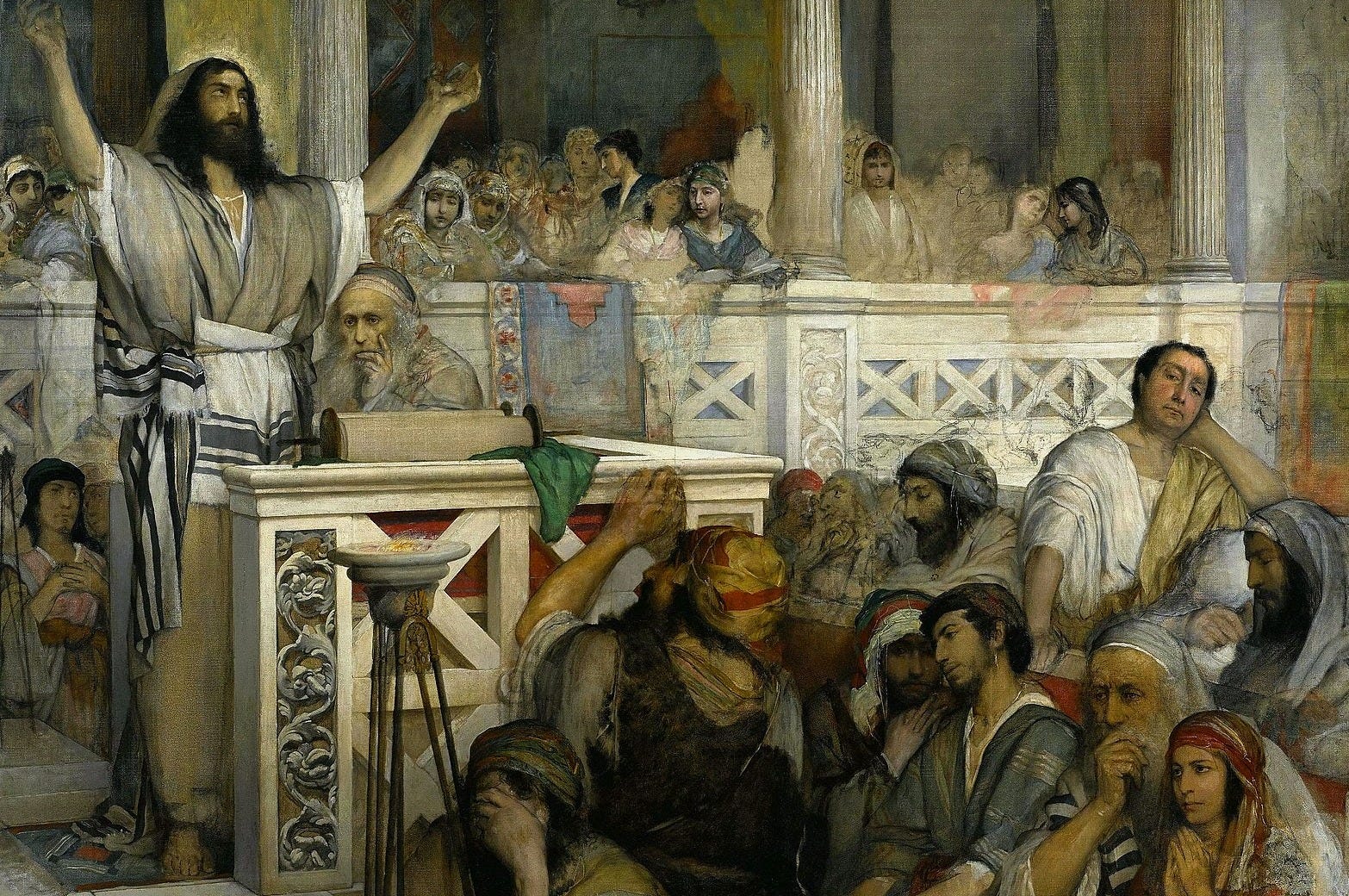
The captiousness of the Pharisees prompted Our Lord to respond with three distinct parables.
Editor’s Notes
The following mini-series consists of Fr Henry James Coleridge’s commentary on the Gospel pericope read on the Third Sunday after Pentecost.
This Sunday was the only one that we have missed in this first year of Father Coleridge Reader, and so we are publishing it now.
The first two parables – the Lost Sheep and the Lost Coin – are read at the Mass. The parable of the Prodigal Son, which immediately follows, is not read on this day, but we include it in this mini-series for the sake of completeness.
These parables directly follow the Pharisaic murmuring over Christ’s association with sinners, and they represent Our Lord’s answer against this criticism. They recall earlier controversies over the same matter (e.g., St Matthew’s feast).
The three parables progressively reveal God’s joy at the conversion of sinners – first through metaphors of ownership (sheep, coin), then through the full human story of father and son. Each builds upon the last, and continues the themes of loss and pursuit, discovery and conversion, and the responses provoked in others.
These parables affirm both the Church’s mission to seek sinners and the joy of Heaven at each conversion. They also rebuke the spirit of the “elder brother,” found then in the Pharisees – and still today, both inside and outside of the Church. They offer a lesson of continuing importance: zeal for purity cannot turn into “purity spirals,” and cannot eclipse charity – lest one fall further than the penitent.
Parables of God’s Love for Sinners
The Preaching of the Cross, Vol. II
Chapter IX
St. Luke xv. 1—32 ; Story of the Gospels, § 124
Burns and Oates, 1886.
(Read at Holy Mass on the Third Sunday after Pentecost)
How Jesus responds to the charge of associating with sinners
The accusation you might miss in the Parable of the Lost Sheep
How does a wandering sheep differ from lost coin in Christ’s parables?
Does God love repentant sinners more than those who stay faithful?
Why does the younger son want his inheritance, when he lacks for nothing?
Why does the father give the Prodigal his portion, knowing what he will do with it?
Why God’s pardon can be a greater triumph to Him than a benefit to us
Does the Prodigal’s Elder Brother represent the Jewish people?
Characteristics of St. Luke
St. Luke now passes on to another subject, on which, as we may judge from the whole character of his Gospel, his tender and compassionate heart loved to dwell. He has always been considered as the Evangelist of the Priesthood and Atonement of our Lord, and certainly he often selects incidents and words of his Master which bear upon this aspect of the Mission of the Incarnate Son.
In the passage of his Gospel now before us we have as many as three distinct parables or parabolic instructions of our Lord, in each of which the delight of God and of the Sacred Heart in the recovery of the penitent sinner is the chief feature.
St. Luke tells us that the words of our Lord which are here recorded were occasioned, as happened so often, by the criticism of His enemies. We have already had more than one instance, in the history of the Galilean preaching, in which our Lord had defended Himself against the charge of being too lax in His intercourse with sinners. This had been the case when the blessed Evangelist St. Matthew had been called to the close following of our Lord, and in his joyous gratitude had made a great feast to Him in his house, at which ‘a great many publicans and sinners had sat down together with Jesus and His disciples.’1
Then He had gently defended Himself by answering to the taunts and questions of the Scribes and Pharisees that they that are well have no need of a physician, but they that are sick. And He had also bidden His critics go and learn the meaning of the Scripture where it was said by Osee, ‘I will have mercy and not sacrifice.’2 He had complained of the treatment, first of St. John and then of Himself, by the people of that generation, who were like the children in the market-place, finding fault with His Precursor for his austerity and with Himself for His supposed laxity.3
Thus, when St. Luke tells us that, at the time which we have now reached, there was the same criticism made on Him as before, he adds another line to his testimony that the treatment our Lord met with in His later preaching in Judæa was identical in many of its features with that which greeted the earlier teaching in Galilee.
Murmurs against Our Lord
‘Now the publicans and sinners drew near unto Him to hear Him. And the Pharisees and Scribes murmured, saying, This Man receiveth sinners, and eateth with them.’
The words of the Scribes are an echo of the old charge made in Galilee, and we have as yet no account in this part of St. Luke of any incident which might have occasioned them, such as afterwards was found in the visit to the house of Zaccheus.
But the incident of the publicans and sinners drawing near to hear Him was a constant feature in His preaching, as it is always a feature in the preaching of the Church and especially of her saints. The publicans and sinners of the Gospel represent some classes of men who are always to be found in the world, classes who make no pretence to the practices of devotion and religion, and who are in consequence looked down upon by those who make a profession of better and higher things.
They are sometimes almost given up as hopeless by the less fervent among the clergy, who may go to them when they are called, as to a bed of sickness, but who generally leave them to themselves. Such men have often within them sorrow and remorse of conscience, promptings to reconciliation with God, the desire of a better life, and much readiness to embrace it, if the door is only opened to them by the charity of those to whom the ministry of reconciliation is committed by our Lord.
Attractiveness of sanctity
But it is one of the privileges of sanctity to have the power of attracting such men, of inspiring them with confidence, and winning them to break the silence that has so long enchained their tongues and the winter that has frozen up their hearts. The saints breathe a fragrance around them which seems to invigorate men with the hope of God’s mercy, and their gentleness and sweetness, which are reflections of the character of our Lord, can soften the most obdurate as by a new revelation of God’s mercifulness and fatherly love.
The Heart of our Lord was all on fire with the love of God and the love of God for man, which our Lord understood as no one else ever understood, and all His words and actions were steeped in the tenderness of His Heart. This explains to us how it is of necessity that the devotion to the Sacred Heart, when practised faithfully by priests, gives them a power over the hearts of sinners which is peculiar to itself.
It seems inevitable that a true devotion to the Sacred Heart must result in a great growth both in knowledge of our Lord and in resemblance to Him, and His whole character and manner, which were endowed with this especial power of winning souls, are thus insensibly communicated to those who have to carry on in the world His work among men.
Classes of men
We need not dwell on the murmuring of the Scribes and Pharisees, with some of whom it had become almost a second nature to find fault with whatever our Lord did and said. Their captiousness is only worthy of consideration as having furnished the occasion of the words of our Lord in reply.
But St. Luke seems to mean to draw a silent contrast between them on the one hand, and the publicans and sinners on the other. The publicans draw near to hear our Lord, and the Scribes and Pharisees carp at Him and find fault with Him. The contrast shows us at least how much more difficult it is to convert hypocrites than to convert open sinners.
All the attractive elements in our Lord’s words and character must have addressed themselves alike to both classes. Each class must have been conscious in the secret of their hearts of the need of reconciliation with God, and it seems wonderful to us that the Pharisees did not feel as the publicans felt when brought under the winning and consoling influence of our Lord.
The truth seems to be that their hypocrisy, against which He so strongly warned the Apostles, made conversion and submission difficult to the one class, while the other was free from this danger. Conversion implied a great public humiliation to the hypocrites, it implied a confession not only of their other sins, but of the imposture which they had been passing off upon the world. When this hindrance of conscious hypocrisy was united, as in the case of many of them, to evil living, or to ambition, or to covetousness and pride, it would produce in them obstacles to conversion which it might be very difficult to surmount.
Answer of Our Lord in three parables
Our Lord’s answer on this occasion was more gentle in tone than when He had been attacked in Galilee. For now He did not blame His censurers for not understanding the Scriptures. His words are rather an effusion of the tenderness of His Sacred Heart, appealing to their own best feelings, and making almost an apology for the conduct which had seemed to them blameworthy.
We may gather how full His Heart was of the love of sinners from the fact that He set forth the truths of which He was thinking in three different forms, each one of which has some peculiar feature in reference to the general argument. It is as if His enemies had touched a spring, which set His tongue, as it were, flowing on the subject on which He delighted to feed His thoughts.
We must take these three separate portions of His apology one by one, trying at the same time to observe how they are connected with each other, and flow on, the latter from the former.
First we have the parable of the shepherd seeking the wandering one of the flock, then that of the woman seeking the groat which she has lost, and then the long history of the Prodigal Son. In each case the rejoicing, whether of the owner of the lost sheep, or the owner of the lost groat, or of the father of the prodigal, is made a distinct and very marked feature in the discourse. Indeed it would not be too much to say that the whole discourse, parable after parable, is directed to this end, the vindication of the tenderness shown to sinners by His Father, of which His own manner and method were the expression.
At the end of the third parable, the censurers of our Lord are themselves introduced in the person of the elder son. Thus we see that our Lord is chiefly intent on most gently and lovingly remonstrating with His enemies for finding fault with His conduct in this regard, which He vindicates by parallel cases from common life in the two first parables, and then in the third sketches the tender-heartedness of God for wandering sinners, which was the pattern which He Himself as Man was always following.
Parables of God’s Love for Sinners
How Jesus responds to the charge of associating with sinners
The accusation you might miss in the Parable of the Lost Sheep
How does a wandering sheep differ from lost coin in Christ’s parables?
Does God love repentant sinners more than those who stay faithful?
Why does the younger son want his inheritance, when he lacks for nothing?
Why does the father give the Prodigal his portion, knowing what he will do with it?
Why God’s pardon can be a greater triumph to Him than a benefit to us
Does the Prodigal’s Elder Brother represent the Jewish people?
Here’s why you should subscribe to The Father Coleridge Reader and share with others:
Fr Coleridge provides solid explanations of the entirety of the Gospel
His work is full of doctrine and piety, and is highly credible
He gives a clear trajectory of the life of Christ, its drama and all its stages—increasing our appreciation and admiration for the God-Man.
If more Catholics knew about works like Coleridge’s, then other works based on sentimentality and dubious private revelations would be much less attractive.
But sourcing and curating the texts, cleaning up scans, and editing them for online reading is a labour of love, and takes a lot of time.
Will you lend us a hand and hit subscribe?
Follow our projects on Twitter, YouTube and Telegram:
Twitter (The WM Review)
St. Mark ii. 15; Story of the Gospels, § 40.
Osee vi. 6.
Story of the Gospels, § 52.