

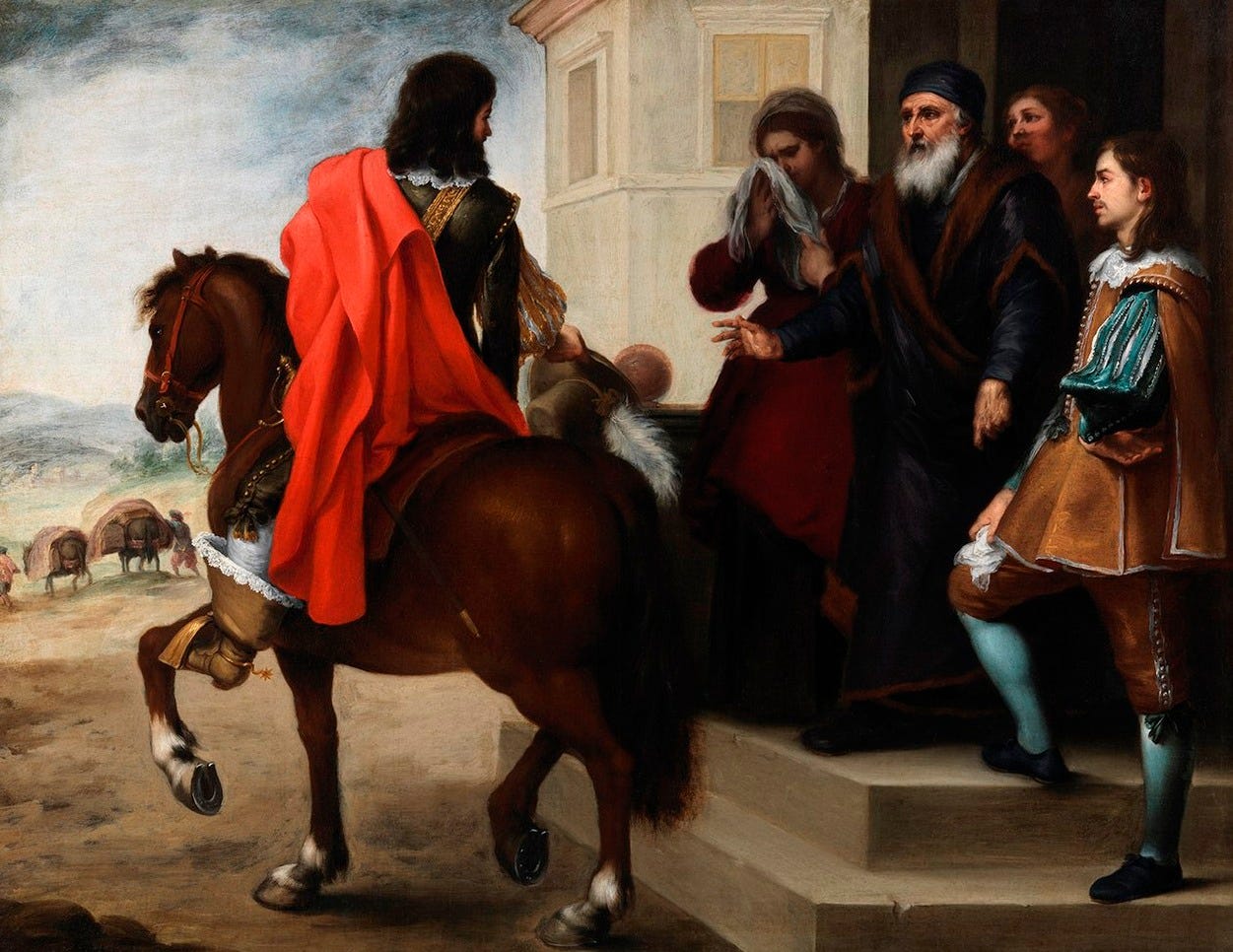
God honours our freedom by letting rebellion run its course, and uses the consequences as a means of awakening us to our plight.
Editor’s Notes
In this part, Fr Coleridge tells us…
How God respects human freedom even when He foresees it will lead to ruin.
That divine Providence waits upon the sinner, letting false satisfactions collapse into famine and despair.
Why worldly success often marks God’s most terrible chastisement upon the impenitent.
He shows us that God permits rebellion to work its own consequences, honouring the freedom He has given.
For more context on this Gospel episode, see Part I.
You can find The WM Review’s audio recording of Fr Aloysius Ambruzzi’s meditation on this parable here:
Parables of God’s Love for Sinners
The Preaching of the Cross, Vol. II
Chapter IX
St. Luke xv. 1—32 ; Story of the Gospels, § 124
Burns and Oates, 1886.
(Read at Holy Mass on the Third Sunday after Pentecost)
How Jesus responds to the charge of associating with sinners
The accusation you might miss in the Parable of the Lost Sheep
How does a wandering sheep differ from lost coin in Christ’s parables?
Does God love repentant sinners more than those who stay faithful?
Why does the younger son want his inheritance, when he lacks for nothing?
Why does the father give the Prodigal his portion, knowing what he will do with it?
Why God’s pardon can be a greater triumph to Him than a benefit to us
Does the Prodigal’s Elder Brother represent the Jewish people?
The father
Before proceeding further in tracing the course of the Prodigal, we must not forget to pause a moment over the conduct of the father in the parable, in which is depicted by our Lord the method of God in dealing with rebellious children.
It will be observed that our Lord does not mention that the father made any resistance to the proposal that the son should be put in possession of the portion which fell to his share, nor does He say that the father made any effort to retain the Prodigal at home after the division had been made. The demand is made as if it were a matter of right. It did not imply due respect or affection on the part of the son to make the demand, and the father might have refused to comply with it, and by such refusal might have saved the foolish youth from working out his own ruin.
Nor, as a matter of fact, can it be said that God allows the declining sinner the full use of his liberty, without putting many difficulties in the downward path, and warning him, in many ways, externally and internally, against the moral suicide which he is committing.
God respecting liberty
Yet it is a certain and most important feature in the methods of God, that He respects the liberty of His creatures, even when He knows that it will be used against Himself, and to their own great loss and harm.
He has made them free, that they may have a share in winning their own rewards, and that He may have from them that special glory of a free service which cannot be paid to Him by the other creatures, who do His will so perfectly and so beautifully without the exercise of their own. And thus, when He sees that men will use the liberty which is their most noble endowment in a wrong way, He chooses to bring good out of their evil rather than to hinder their evil by the exercise of His own Almighty power.
The most marvellous instance of this method of God is in the permission of the sin of the angels. For the angels were, on the one hand, the highest order of spiritual existences created by Him, they were endowed with the noblest gifts of intelligence and capacity. And, on the other hand, their fall was to be irreparable, without the opportunity of revocation by repentance or of remedy by redemption and atonement.
It was well that in the creation of God there should be this instance of absolute justice in dealing with the rebellion of free spiritual beings, justice which was not tempered by mercy in any opening of the door of restoration, although it was tempered by mercy in the infliction of a punishment less than was deserved by the sin. He allowed them to use their freedom, and then turned away from them His face for ever. He has not dealt in this way with fallen man, for He has provided for him the redemption which is offered through our dear Lord. But He acts on the same principle in permitting sin, ‘reverencing,’ as the Scripture speaks, the free will which He has given, just as He may be said to ‘reverence’ the nature which He has created by never destroying it if He has made it immortal.
Thus the father of the Prodigal may be said to represent to us God the Father of all, and especially of those whom He has made free, faithfully allowing to them the exercise of their liberty, without doing it violence, even although He sees that in particular cases that exercise will result in His own dishonour and in their rebellion against Himself.
He does not abandon sinners, but He ordinarily lets them have their own way if they insist upon it, and His Providence waits upon them as they run on in their reckless course, ever ready to seize on the opportunity which they may give Him of bringing them to their senses by the experience which they gather of the emptiness and fickleness of the world, of the slavery of sin, of the need of the Creator of which man cannot divest himself. Sometimes He chastises at once, but ordinarily He forbears.
He allows men to choose paths in life which He did not mean for them, to stifle their consciences as to matters which involve the whole of their future, and He lets the false step which they have taken lead to its own natural consequences, and then He shows them what they have done. On those who are not to be converted He allows temporal prosperity and success to wait for a time, giving them at least in this world ‘the portion of substance that falleth to them,’ because He sees that they may force Him to deny them the eternal goods.
The good health, worldly success, popularity, and applause which seem to haunt them continually, are often, in the eyes of the servants of God, the most terrible of His chastisements, because they show that He deems them unworthy of the discipline of suffering by which so many others are reclaimed.
Father Coleridge Reader is a labour of love. But curating, cleaning up and publishing these texts takes real work.
To keep this project going, and to make more of this treasury available, we rely on reader support. Some posts are reserved for members to sustain this mission.
We’re trying to keep something precious alive.
If you’ve benefited, consider joining us as a subscriber. It makes a real difference.