

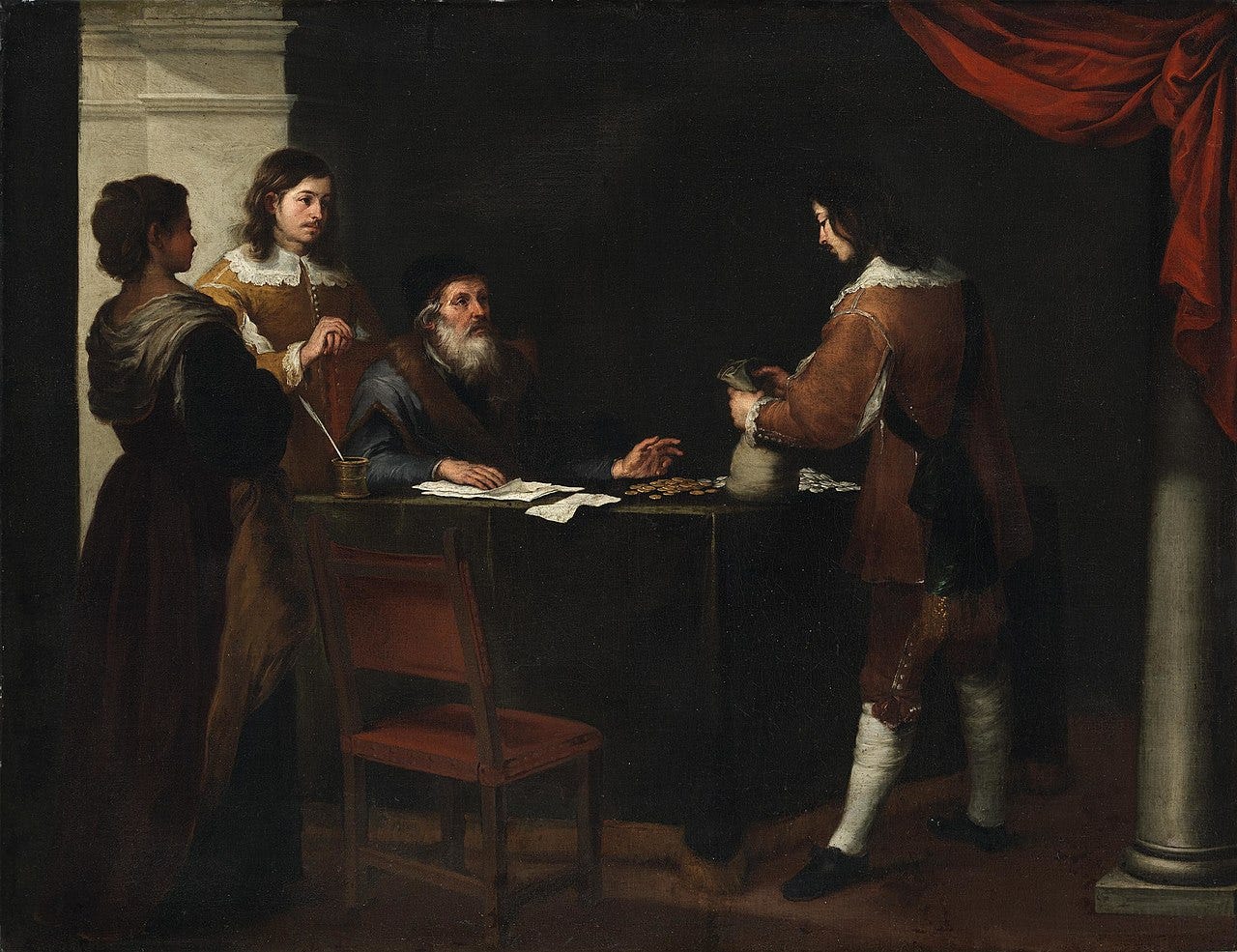
The Prodigal’s rebellion begins in craving independence – the root sin beneath the others.
Editor’s Notes
In this part, Fr Coleridge tells us…
How the soul’s state before sin compares to a child’s freedom in the father’s house.
That rebellion begins not in lust or greed but in the craving for independence from God.
Why the Prodigal’s father divides the inheritance and lets him depart into ruin.
He shows us that sin starts when we trade communion with God for the phantom of self-mastery.
For more context on this Gospel episode, see Part I.
Parables of God’s Love for Sinners
The Preaching of the Cross, Vol. II
Chapter IX
St. Luke xv. 1—32 ; Story of the Gospels, § 124
Burns and Oates, 1886.
(Read at Holy Mass on the Third Sunday after Pentecost)
How Jesus responds to the charge of associating with sinners
The accusation you might miss in the Parable of the Lost Sheep
How does a wandering sheep differ from lost coin in Christ’s parables?
Does God love repentant sinners more than those who stay faithful?
Why does the younger son want his inheritance, when he lacks for nothing?
Why does the father give the Prodigal his portion, knowing what he will do with it?
Why God’s pardon can be a greater triumph to Him than a benefit to us
Does the Prodigal’s Elder Brother represent the Jewish people?
The Parable
‘And He said, A certain man had two sons, and the younger of them said to his father, Father, give me the portion of substance that falleth to me. And he divided unto them his substance.
‘And not many days after, the younger son, gathering all together, went abroad into a far country, and there wasted his substance, living riotously.
‘And after he had spent all, there came a mighty famine in that country, and he began to be in want. And he went and cleaved to one of the citizens of that country, and he sent him into his farm to feed swine. And he would fain have filled his belly with the husks the swine did eat, and no man gave unto him.
‘And returning to himself, he said, How many hired servants in my father’s house abound with bread, and I here perish with hunger! I will arise and will go to my father, and say to him, Father, I have sinned against Heaven and before thee, I am not now worthy to be called thy son, make me as one of thy hired servants. And rising up he went to his father.
‘And when he was yet a great way off his father saw him, and was moved with compassion, and running to him, fell upon his neck, and kissed him. And the son said to him, Father, I have sinned against Heaven and before thee, I am not now worthy to be called thy son.
‘And the father said to his servants, Bring forth quickly the first robe, and put it on him, and put a ring on his hand, and shoes on his feet, and bring hither the fatted calf, and kill it, and let us eat and make merry, because this my son was dead and is come to life again, was lost, and is found. And they began to be merry.
‘Now his elder son was in the field, and when he came and drew nigh to the house, he heard music and dancing. And he called one of the servants, and asked what these things meant. And he said to him, Thy brother is come, and thy father hath killed the fatted calf, because he hath received him safe. And he was angry, and would not go in.
‘His father, therefore, coming out began to entreat him. And he answering said to his father, Behold, for so many years do I serve thee, and I have never transgressed thy commandment, and yet thou hast never given me a kid to make merry with my friends. But as soon as this thy son is come, who hath devoured his substance with harlots, thou hast killed for him the fatted calf.
‘But he said to him, Son, thou art always with me, and all that I have is thine. But it was meet that we should make merry and be glad, for this thy brother was dead and is come to life again, he was lost and is found.’
Stages of the history
If we take the successive stages of the history here set before us, we have first to speak of the state of things in the house of the father, with his sons living with him in happy freedom and intercourse, before as yet the evil thought of liberty had entered the mind of the younger. This is contained in the words of the answer to the elder brother, ‘Son, thou art always with me, and all that I have is thine.’
We are the children of God, and we live in daily and hourly intercourse with Him, which is more than enough to satisfy our hearts, which is, indeed, the only condition, being what we are, in which our hearts can find any satisfaction.
There is here, perhaps, a silent rebuke to the angry complaint of the elder son, that he had never had a kid given him that he might make merry with his friends. He had far more, for he was always with his father. In the state of the soul of which we speak, God is enough for it. God is its all in all, it has no other cravings but such as are within His law, and are satisfied by the peaceful enjoyments of the life of virtue and obedience. Children in the home of their father, even on earth, have no need of anything. All their wants are anticipated and supplied beforehand, as, in the holy homes of the religious life, men continue year after year without any purse or resource of their own, and yet with no need of anything.
And on the other hand, those who enjoy this condition of the children of God are rich beyond all measure and calculation. For all that He has is theirs. All His treasures are already theirs, or at their disposal. Earth and Heaven and all that is in them belong to them, in a way in which no one else can possess them. All things minister to them in revealing Him to them, in instructing them concerning Him, in supporting their life, in training them in virtue, as means of enjoyment or of the victories which are opened to them either by temptation or affliction, or suffering of any kind.
Heaven is theirs also, because all the angels and saints are their friends, and they have the inexhaustible treasures of grace in the sacraments, the word of God, the ministry, and the other means in which the fruits of the Precious Blood are stored up. He Himself is theirs, and their prayers and wishes and needs are open to Him before they know them themselves, and they can ask nothing in faith which He will refuse them. The essence of their blessedness lies in their being His children and being always with Him, and in this is included the second clause of the answer, ‘All that I have is thine.’ Being with Him ensures them untold treasures of every kind of good which they can enjoy.
The perversion
The next stage in the history is the perversion of the Prodigal Son. Our Lord seems to intend us to see that all sin begins in the love of liberty, of having our own independence, of being our own masters. It is not said that the Prodigal became better off in the sense of being more able to supply his own needs, that his life became more peaceful, more enjoyable, after his emancipation. It is not said that he had lacked for anything, or had any lawful desire checked.
But we gather from the words of the elder son that his state was one of obedience. ‘I never transgressed thy commandments,’ he says to his father. The Prodigal desired to be his own master, to manage his own affairs, to have his own way, to use his own means as he chose. It is clear that the love of independence is something different from the passion of avarice, or lust, or gluttony, and the rest, and that it is the first thing in rebellion against God, in whatever way, or by yielding to whatever evil temptation, we may break His law.
And so, on the other hand, the principle of obedience, submission, dependence, is the natural condition of all true humility and of all true consciousness of our due relations to God. After the love of independence, our Lord places alienation from God, for it is His yoke under which we have found ourselves, it is from Him that we wish to emancipate ourselves, and that being the case, we would gladly be free of Him, get out of His sight, and if possible put Him out of our mind and thoughts.
Thus the departure of the Prodigal follows upon his emancipation. ‘And not many days after the younger son, gathering all together, went abroad into a far country, and there wasted his substance, living riotously.’ Our Lord speaks gently in these last words, as we find the elder son speaking plainly and roughly, when he says that his brother ‘devoured his substance with harlots.’
Before proceeding further in tracing the course of the Prodigal, we must not forget to pause a moment over the conduct of the father in the parable, in which is depicted by our Lord the method of God in dealing with rebellious children.
Parables of God’s Love for Sinners
How Jesus responds to the charge of associating with sinners
The indictment you might miss in the Parable of the Lost Sheep
How does a wandering sheep differ from lost coin in Christ’s parables?
Does God love repentant sinners more than those who stay faithful?
Why does the younger son want his inheritance, when he lacks for nothing?
Why does the father give the Prodigal his portion, knowing what he will do with it?
Why God’s pardon can be a greater triumph to Him than a benefit to us
Does the Prodigal’s Elder Brother represent the Jewish people?
Here’s why you should subscribe to The Father Coleridge Reader and share with others:
Fr Coleridge provides solid explanations of the entirety of the Gospel
His work is full of doctrine and piety, and is highly credible
He gives a clear trajectory of the life of Christ, its drama and all its stages—increasing our appreciation and admiration for the God-Man.
If more Catholics knew about works like Coleridge’s, then other works based on sentimentality and dubious private revelations would be much less attractive.
But sourcing and curating the texts, cleaning up scans, and editing them for online reading is a labour of love, and takes a lot of time.
Will you lend us a hand and hit subscribe?
Follow our projects on Twitter, YouTube and Telegram:
Twitter (The WM Review)