

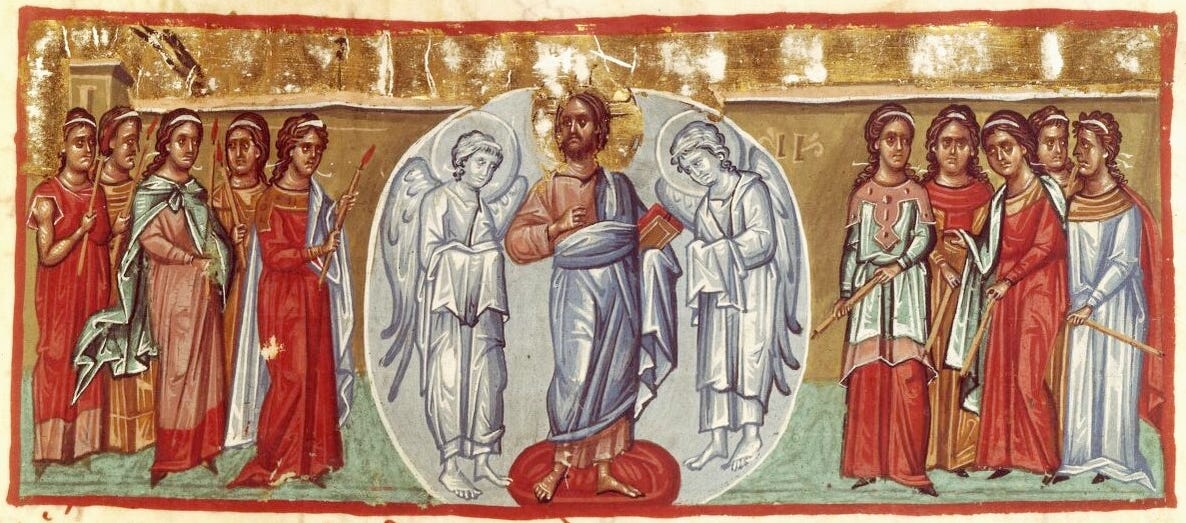
Christ commands vigilance through varied parables, knowing that servants easily forget their Master’s certain return, when delays test their faith.
Editor’s Notes
Doomsday—Part VIII
In this passage, Fr Coleridge tells us:
How Christ weaves stern warnings with gentle repetitions, adapting His teaching to each occasion’s solemnity.
That faithful stewards win eternal rewards while those who abuse their trust face separation and torment.
Why our Lord returns again and again to watchfulness, knowing how easily His servants grow slack.
He shows us that Divine patience in repeating warnings proves both God’s mercy and man’s stubborn forgetfulness.
The Lord’s coming will be sudden, unexpected, and decisive—only those who watch and prepare will be saved.
Does it seem strange to be reading about the end of the world, and such watchfulness, on Christmas Eve?
No, it does not. Many men at the time of Christ’s birth missed what was happening. This could put us in mind of Our Lord’s words, to which Fr Coleridge refers in this passage:
‘But this know ye, that if the good man of the house knew at what hour the thief would come, he would certainly watch, and would not suffer his house to be broken open. Wherefore be ye also ready, because at what hour you know not the Son of Man will come.’
This is because Advent itself is not just ordered towards Christmas as the commemoration of Christ’s birth in the flesh, but also towards his Second Coming in Glory.
For more context, see Part I.
Doomsday for the World
From
Passiontide—Part I
Fr Henry James Coleridge, 1889, Ch. XIV, pp 272-8
St. Matt. xxiv. 29–36; St. Mark xiii. 24–34; St. Luke xxi. 25, 26;
Story of the Gospels, § 144, 5.
Sung on the First Sunday of Advent
Why Christ warns that physical signs will signal the end of the world
Doomsday – Why Christ tells us to hope for it, as for summer figs
What do Noah and the great flood tell us about the end of the world?
‘Watch!’
In this passage of St. Luke,1 the image is different, for the servants there are waiting for the return of their lord from a wedding:
‘Let your loins be girt, and lamps burning in your hands, and you yourselves like to men who wait for their lord, when he shall return from the wedding, that when he cometh and knocketh they may open to him immediately. Blessed are those servants, whom the Lord, when He cometh, shall find watching.
‘Amen, I say unto you, that He will gird Himself, and make them sit down to meat, and passing will minister unto them. And if he shall come in the second watch, or come in the third watch, and find them so, blessed are those servants.’
And then St. Luke follows on with a paragraph about the householder and the thief, and the house being broken open. The teaching of these passages is quite the same, but the words and phrases are varied by our Lord in beautiful accordance with the different occasions on which the several instructions were given.
Of course, on the present occasion, which was our Lord’s last teaching before the Passion, when He had been speaking so solemnly of the Last Day and its surprises, everything He said was in a tone more grave and severe than before.
And it is interesting to trace how He has partly repeated and partly expanded His former teaching, for the Parable of the Ten Virgins, of which we shall presently have to speak, is implicitly contained in the few words used at the time of which St. Luke is speaking, about the men with their loins girded and lamps burning in their hands, and the waiting of servants for their lord when he will return from the wedding. The passage before us says nothing about this image, but it seems to suggest the parable in the last words:
‘Lest coming on a sudden, he find you sleeping. And what I say unto you, I say unto all, Watch!’
Something of the same kind must be said of the passage which immediately follows on that which we have last quoted from St. Matthew:
‘Who, thinkest thou, is a faithful and wise servant, whom his lord hath appointed over his family, to give them meat in season? Blessed is that servant whom, when his lord shall come, he shall find so doing. Amen I say to you, he shall place him over all his goods.
‘But if that evil servant shall say in his heart, My lord is long a coming, and shall begin to strike his fellow-servants, and shall eat and drink with the drunkards, the lord of that servant shall come in a day that he hopeth not, and at an hour when he knoweth not, and shall separate him, and appoint him his portion with the hypocrites. There shall be weeping and gnashing of teeth.’
This passage is to the same purpose with another which is also among St. Luke’s anticipations and follows immediately after another of the same kind with that which we have just quoted from St. Mark.
St Peter’s question
In the other account, given by St. Luke, our Lord is speaking in answer to the question of St. Peter:
‘And Peter said to Him, Lord, dost Thou speak this parable to us, or likewise to all? And the Lord said, Who, thinkest thou, is the faithful and wise steward, whom his lord setteth over his family, to give them their measure of wheat in due season? Blessed is that servant, whom his lord when he cometh shall find so doing. Verily I say unto you, he will set him over all that he possesseth.
‘But if that servant shall say in his heart, My lord is long a coming, and shall begin to strike the men-servants and the maid-servants, and eat and drink, and be drunk, the lord of that servant will come in the day that he hopeth not, and at the hour that he knoweth not, and shall separate him, and appoint him his portion with unbelievers.
‘And that servant who knew the will of his lord and prepared not himself, and did not according to his will, shall be beaten with many stripes, but he that knew not and did not according to his will, shall be beaten with few stripes. But unto whomsoever much is given, of him shall be required much, and to whom they have committed much, of him they will demand the more.’2
The passages repeated
There is so much resemblance between these two passages, that we may easily understand how some commentators have supposed them to have been spoken but once.
But the true principle to follow in such cases is first to see whether there is anything against the supposition that our Lord spoke the words on more occasions than one, then to consider whether it is quite respectful to the Evangelists, and to the Divine author and arranger of the Gospels which He inspired them to write, to consider that they had no reason for putting them at different times, and that they were either mistaken or careless in so putting them.
The words are obviously in perfect harmony with the context, and the occasion to which they are attributed by each Evangelist. They are words relating to a most important practical matter, and it is far more probable that our Lord uttered them innumerable times in the course of His preaching than that He uttered them only once.
The slight discrepancies between the two reports are not unimportant, and the best way of accounting for them is to suppose the report in each case given as what our Lord actually said. The difference between the occasions is not slight, for St. Luke clearly reports what was spoken to the multitude of disciples, St. Matthew what was spoken to the Apostles alone, if not to four of them only. In St. Luke, St. Peter puts the question, ‘Lord, dost Thou speak the parable to us, or likewise to all?’ In St. Matthew the question, which would have been superfluous, is omitted, but the words used are such as to awaken in the minds the memory of the question of St. Peter.
The passage which is added in St. Luke about the different chastisements of the greater and lesser offenders is in itself a very important element in the teaching, but it is easy to suppose that it was not added in the discourse on Mount Olivet, because the Parable of the Talents was to follow, in which the doctrine of the difference of retribution is set forth.
Usually, with additional light
We shall speak presently of this and the other great parables with which this discourse, as it seems, concluded, and we shall have to point out their relation to former utterances of our Lord.
That our Lord constantly repeated in one place and at one time what He had said elsewhere and at another time must be self-evident to any careful and reverent student of the Gospels, as it is also the only rational hypothesis under the circumstances. But we gain greatly by having these instances of repetition given us by the Evangelists, as they often shed a new light upon the doctrine itself.
The parables which follow at the end of this great discourse will illustrate this. That of the Ten Virgins seems to grow out of the former words about ‘loins girded and lamps burning;’ that of the Talents has reference, as has been said, to the doctrine of retribution. The last of all deals, if we are not mistaken, with a subject not unconnected with St. Peter’s question in St. Luke.
The Doom of the World
Why Christ warns that physical signs will signal the end of the world
Doomsday – Why Christ tells us to hope for it, as for summer figs
What do Noah and the great flood tell us about the end of the world?
Here’s why you should subscribe to The Father Coleridge Reader and share with others:
Fr Coleridge provides solid explanations of the entirety of the Gospel
His work is full of doctrine and piety, and is highly credible
He gives a clear trajectory of the life of Christ, its drama and all its stages—increasing our appreciation and admiration for the God-Man.
If more Catholics knew about works like Coleridge’s, then other works based on sentimentality and dubious private revelations would be much less attractive.
But sourcing and curating the texts, cleaning up scans, and editing them for online reading is a labour of love, and takes a lot of time.
Will you lend us a hand and hit subscribe?
Follow our projects on Twitter, YouTube and Telegram:
Twitter (The WM Review)
St. Luke xii
St. Luke xii. 41.