

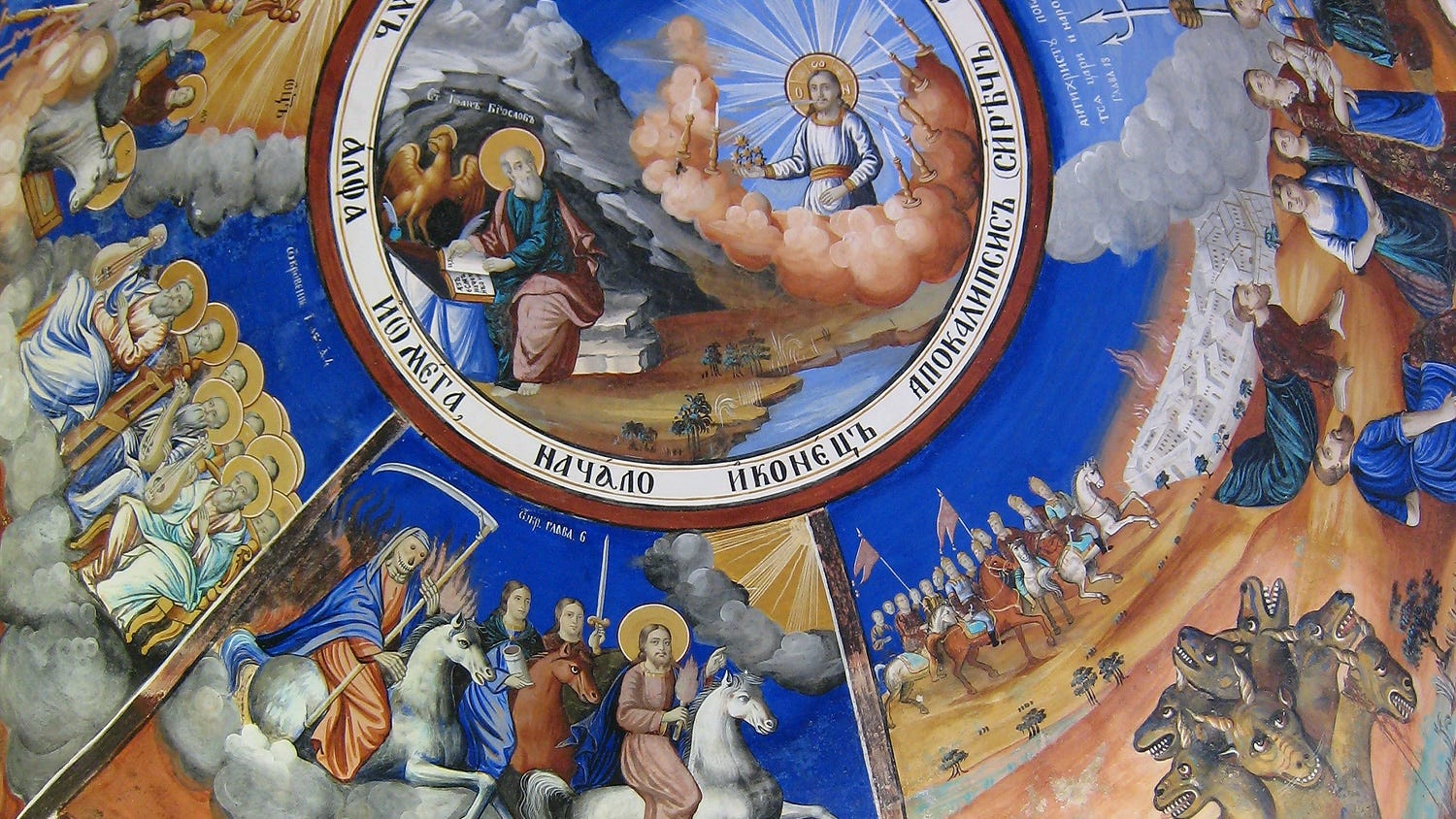

Christ silences curiosity about the end, calling us to trust in God’s timing, and to prepare for his coming in readiness, and not in speculation.
Editor’s Notes
Doomsday—Part VI
In this chapter, Fr Coleridge tells us…
Why Christ forbids curiosity about the Day of Judgment.
How as God, Christ knows all things, including the Judgment Day.
Despite this, how as man, Christ’s infused knowledge serves the purpose of his mission on earth.
He also explains how and why Christ’s statement on “not knowing the day and hour” does not reflect any alleged ignorance on Our Lord’s part, but the Father’s providential plan for secrecy – and the purpose behind this plan.
For more context, see Part I.
Doomsday for the World
From
Passiontide—Part I
Fr Henry James Coleridge, 1889, Ch. XIV, pp 272-8
St. Matt. xxiv. 29–36; St. Mark xiii. 24–34; St. Luke xxi. 25, 26;
Story of the Gospels, § 144, 5.
Sung on the First Sunday of Advent
Why Christ warns that physical signs will signal the end of the world
Doomsday – Why Christ tells us to hope for it, as for summer figs
‘Ignorance of the Day of Doom’
St. Matthew and St. Mark here add some remarkable words concerning the great day of the doom of the world.
‘But of that day and hour knoweth no man, neither the angels in Heaven, nor the Son, but the Father.’
These words seem to have been spoken by our Blessed Lord as an answer to the question about the time of His coming again. It is a question which people are always asking, for the innate curiosity of the human mind naturally manifests itself about such things as are future, and especially future things of the greatest importance.
Our Lord is always forbidding and mortifying this curiosity, for it is an intrusion into the things of God, and it would also be a great calamity and injury to us to have the knowledge for which it craves. We can partly understand the reason why that great day is kept hidden, though there may be many reasons for it which we cannot fathom. Our Lord certainly discourages in the most peremptory way all curiosity on this point.
There is therefore no difficulty about the meaning of the passage, although there may be a question about the statement in the text of St. Mark, in which the Son is added to the number of those who do not know the Day of Judgment.
The knowledge of our Lord may be either Divine or human, what He knows as God, and what He knows by infused knowledge as Man, as well as the natural knowledge, such as that of experience, which He has, and which might be His even if He were not a Divine Person.
As God, He must know all things, for the Divine Nature and all that belongs to It, power, wisdom, and the rest, is the same and one in each of the Three Divine Persons. These words therefore cannot apply to Him as God, and whenever anything that belongs to the Divine Nature is spoken of in Scripture as belonging to any one of the Three, it is not meant that it does not also belong to the other two.
We are surprised sometimes by passages like that of St. Matthew:
‘No one knoweth the Son but the Father, neither doth any man know the Father, but the Son, and he to whom it shall please the Son to reveal Him.’1
These words seem to deny that the Holy Ghost knows either the Father or the Son, but the language of Scripture about the Divine Persons is only to be understood according to the rule just now mentioned. It is certain, therefore, that the Divine knowledge of our Lord as to future things, and therefore of the Day of Judgment, is one and the same with that of the Father.
How the Son can be ‘ignorant’
It remains therefore to find how it is that the Son can be said not to know the Day of Judgment as Man.
It is commonly taught that as Man He has infused knowledge of everything, and therefore of the Day of Judgment. But in speaking of Himself, He often uses language which, if carelessly understood, would represent Him as knowing or doing nothing of Himself. Thus He says in His dispute with the Jews after the miracle at the Probatic Pool,
‘The Son cannot do anything of Himself, but what He seeth the Father doing, for what things soever He doth, these the Son also doth in like manner.
‘For the Father loveth the Son, and showeth Him all things which He Himself doth, and greater works than these will He show Him, that ye may wonder.
‘For as the Father raiseth up the dead, and giveth life, so also the Son giveth life to whom He will… I cannot of Myself do anything, as I hear, I judge, and My judgment is just because I seek not My own will, but the will of Him that sent Me.’
This passage, and others of the same kind, are understood of our Lord even as God, because He receives the Divine Nature, and with it all knowledge and power, from the Father. In this sense, He might have said that even as God He did not know the Day of Judgment, that is, as it is said He can do nothing of Himself, and so know nothing of Himself, because that power and knowledge would be His as having been received from the Father, although they are the same power and knowledge which is in the Father.
Further, there are certain matters which belong to each of the Divine Persons by appropriation, as it is called, Providence to the Father, Redemption to the Son, Sanctification to the Holy Ghost.
Thus in the sense in which it might be said that the Father did not redeem us, it might be said of the Son that He did not know the Day of Judgment, because that Day belongs to the Providence and Predestination which is attributed to the Father, although belonging alike to the Father, the Son, and the Holy Ghost.
Infused knowledge
The infused knowledge possessed by our Lord as Man may be divided under two heads. There is that which He had generally, and that which He had for the particular purpose of His Mission, to teach and inform us. In something of this way, He said that to sit on His right hand and on His left was not His to give, that is, it did not belong to His office as the Messenger of God to give it.
With regard to the Day of Judgment, He might know it by this infused knowledge as well as by His Divine knowledge, and yet it might not be one of the truths which He was commissioned to reveal. On the contrary, it may have been an especial intention of His Mission that it should be kept a secret from all.
Many things belonging to that Mission it may have been intended that He should make known in due time, other things it may have been determined that He should not make known, and yet He said afterwards, ‘All things whatsoever I have heard of My Father I have made known to you.’2
In this sense, our Lord may have said that He did not know the day, that is, there was a sense in which He did not know it so as to reveal it, for it may have been in the Divine counsels that the knowledge He had of it was outside the range of what He had to reveal.
Now, the words spoken by Him were with reference to the question of revelation to others, and in that sense He did not know the day. This seems to be the most natural way of understanding the passage.
The Doom of the World
Why Christ warns that physical signs will signal the end of the world
Doomsday – Why Christ tells us to hope for it, as for summer figs
Here’s why you should subscribe to The Father Coleridge Reader and share with others:
Fr Coleridge provides solid explanations of the entirety of the Gospel
His work is full of doctrine and piety, and is highly credible
He gives a clear trajectory of the life of Christ, its drama and all its stages—increasing our appreciation and admiration for the God-Man.
If more Catholics knew about works like Coleridge’s, then other works based on sentimentality and dubious private revelations would be much less attractive.
But sourcing and curating the texts, cleaning up scans, and editing them for online reading is a labour of love, and takes a lot of time.
Will you lend us a hand and hit subscribe?
Follow our projects on Twitter, YouTube and Telegram:
Twitter (The WM Review)
St. Matt. xi. 27.
St. John xiv. 15.
Thanks for this. I also thought the reason why He said that He did not know the day was because it was part of the Jewish wedding practice.
The father of the groom would decide when the wedding feast would start. So Christ is alluding to the last day as the beginning of the wedding banquet between Him and the Church.
If you want to call Jesus the christ a liar, do it boldly. If he didn't lie, then he didn't know.
There is no middle ground on this we need to believe what Jesus said is true. Not give his words some sort of "symbolic" meaning, as some do concerning the Eucharist.