

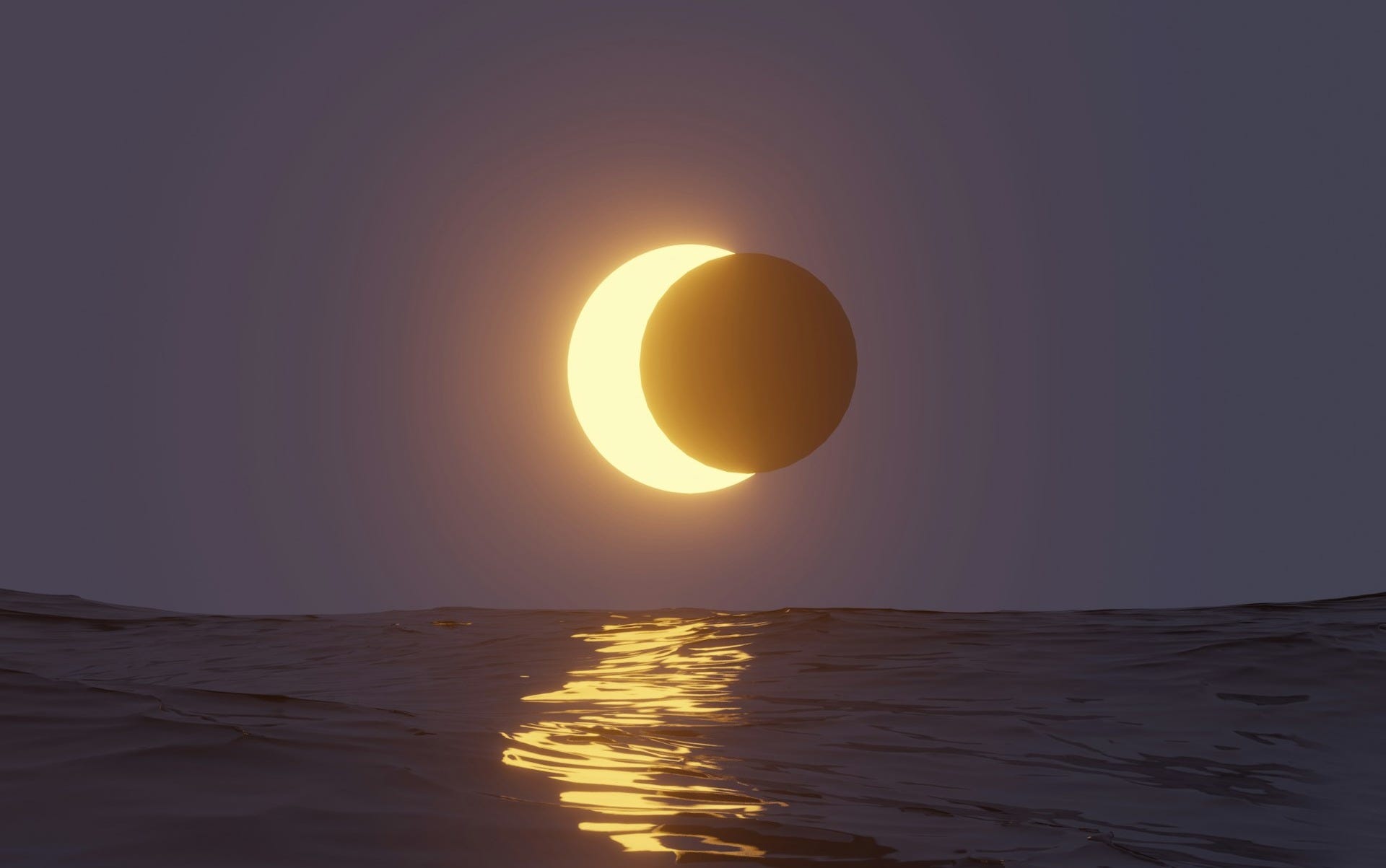
Our Lord foretells cosmic signs that will shatter modern man’s materialist confidence, and prove God’s sovereignty over nature’s laws.
Editor’s Notes
Doomsday—Part III
In this chapter, Fr Coleridge tells us…
How Christ maps the eschatological timeline from Jerusalem’s fall through intermediate ages to world’s end.
That physical convulsions will warn men who trust only material forces and natural law.
Why God mercifully uses the very elements in which unbelievers place their faith.
He shows us that the cosmos itself becomes witness against those who deny its Maker.
For more context on this part of the Gospel, see Part I.
The Doom of the World
Passiontide—Part I
Chapter XIV
St. Matt. xxiv. 29–36; St. Mark xiii. 24–34; St. Luke xxi. 25, 26;
Story of the Gospels, § 144, 5.
Burns and Oates, 1889
Sung on the First Sunday of Advent
Signs before the end of the world
The passage which now follows must be certainly considered as having reference to the end of the world. Our Lord has answered the question of His disciples about His coming at the destruction of Jerusalem, and, if the opinion here followed be true, has given the necessary counsels and warnings which may preserve the faithful in the intermediate ages—far longer, as they lay before His eyes, than they were in the opinions of those who lived when He spoke.
Then He proceeds, in a few sentences, to describe the catastrophe of the world.
‘And immediately after the tribulation of those days, after that tribulation, the sun shall be darkened, and the moon shall not give her light, and the stars shall fall from heaven, and the powers that are in heaven shall be moved.
‘There shall be signs in the sun and in the moon and in the stars, and upon the earth distress of nations, by reason of the confusion of the roaring of the sea and of the waves, men withering away for fear, and expectation of what shall come upon the whole world. For the powers of heaven shall be moved.
‘And then shall appear the sign of the Son of Man in heaven, and then shall all tribes of the earth mourn, and they shall see the Son of Man coming in the clouds of heaven with much power and majesty.
‘And He shall send His angels with a trumpet and a great voice, and shall gather together His elect from the four winds, from the farthest part of the earth to the uttermost part of heaven.’
We understand this passage thus. There is to be great tribulation in the days before the end. They are called ‘those days’1—‘those days of which I am thinking,’ and thus are distinguished from the subject of the former words, concerning the destruction of Jerusalem.
After this tribulation, there will be great signs in the physical world, which are mentioned, sun, moon, stars, the earth, the sea. Nothing less will take place than a movement or shaking of the powers of the heavens.
‘Then shall appear the sign of the Son of Man,’ which many Fathers understand as the Holy Cross. Then shall follow the Second Advent and the Judgment.
In convulsions of nature
The signs here enumerated are interpreted by some ancient commentators in an allegorical sense, but the majority of the Christian writers take them literally.
Nothing is so appalling to men as an evident change in the natural course of the universe. They are panic-struck in an earthquake or in a terrible storm at sea, for they feel themselves absolutely without help at the mercy of unknown forces from which they cannot fly.
At the end of the world, as seems very probable from the progress of that incomplete and partial knowledge of natural phenomena which goes by the name of science, men will have persuaded themselves to believe in nothing but material forces and the supposed unchangeableness of the laws of nature. It will therefore be a great mercy of God, as well as an act of justice, to warn them by those physical forces of the universe around them in which alone they believe.
Apart from this, when the sun and moon and stars seem to fail men, there is nothing that they can look for but destruction. We are already aware by experience of elements in the physical constitution of things which are sufficient to warn us that these great catastrophes are perfectly possible. Indeed, convulsions of nature have happened in our own time that might prepare us for anything, though they have not seemed to take the particular form of signs in the sun and moon and stars.
The phenomena of which St. Luke speaks, and which are not mentioned by the other Evangelists, ‘the confusion of the roaring of the sea,’ are probably added by him in order to fill up the picture which was incomplete if the signs in heaven alone are considered.
Previous Prophecies
The whole passage is founded upon previous predictions of the ancient prophets relating to the destruction of Babylon and Egypt, the signs here mentioned having been anticipated more or less, at such destructions, which are considered by the prophets as foreshadowings of this.
Isaias says:
‘Behold the day of the Lord shall come, a cruel day and full of indignation and wrath and fury, to lay the land desolate, and to destroy the sinners thereof out of it. For the stars of heaven and their brightness shall not display their light, the sun shall be darkened in his rising, and the moon shall not shine with her light.’2
Ezechiel says of the destruction of Egypt:
‘I will cover the heavens when thou shalt be put out, and I will cover the sun with a cloud, and the moon shall not give her light.’3
St. Peter, also, in his first speech on the Day of Pentecost, adopts the language of Joel with regard to the latter day:
‘And I will show wonders in the heavens above, and signs upon the earth beneath, blood and fire and vapour of smoke. The sun shall be turned into darkness, and the moon into blood, before the great and manifest day of the Lord come.’4
Passage in St. Peter
In his last Epistle St. Peter gives his own account of the Last Day to his converts. It is by no means a transcript of earlier prophecies, and goes further than our Lord’s words in this place.
‘Of this one thing be not ignorant, my beloved, that one day with the Lord is as a thousand years, and a thousand years as one day. The Lord delayeth not His promise, as some imagine, but dealeth patiently for your sake, not willing that any should perish, but that all should return to penance.
‘But the day of the Lord shall come as a thief—’
(Here St. Peter evidently remembers our Lord’s expression.)
‘—in which the heavens shall pass away with great violence, and the elements shall be melted with heat, and the earth and the works that are in it shall be burned up.
‘Seeing then that all these things are to be destroyed, what manner of people ought you to be in holy conversation and godliness, looking for and hasting unto the coming of the day of the Lord, by which the heavens being on fire shall be dissolved, and the elements shall melt with the burning heat?’5
St. Paul on the Man of Sin
This prophecy of St. Peter’s may be considered as adding some lines, under the guidance of the Holy Ghost, to the picture already drawn by our Lord for the prophets. In the same way we find St. Paul adding many details to the prophecy as it had been before him, especially with relation to the Man of Sin.6
The Christians to whom St. Paul wrote were very new converts, and it seems wonderful that they should have been so instructed almost at the very outset in these matters, although, what is not surprising, they were imperfect in their knowledge, and St. Paul thought it worth while to write his second Epistle almost for the sole purpose of setting them right.
It is remarkable how our Lord leaves out this part of the picture of the Last Day. He said, indeed, to the Jews, ‘I am come in the name of My Father, and you receive Me not; if another shall come in his own name him you will receive’—words which are understood in the Church as a prophecy of the reception of Antichrist by the Jews.7
But He has left to others to describe the wicked one…
‘… whom the Lord Jesus shall kill with the spirit of His mouth and shall destroy with the brightness of His coming, him whose cunning is according to the working of Satan, in all power and signs and lying wonders, and in all seduction of iniquity to them that perish, because they received not this love of the truth that they may be saved.’
The Doom of the World
Here’s why you should subscribe to The Father Coleridge Reader and share with others:
Fr Coleridge provides solid explanations of the entirety of the Gospel
His work is full of doctrine and piety, and is highly credible
He gives a clear trajectory of the life of Christ, its drama and all its stages—increasing our appreciation and admiration for the God-Man.
If more Catholics knew about works like Coleridge’s, then other works based on sentimentality and dubious private revelations would be much less attractive.
But sourcing and curating the texts, cleaning up scans, and editing them for online reading is a labour of love, and takes a lot of time.
Will you lend us a hand and hit subscribe?
Follow our projects on Twitter, YouTube and Telegram:
Twitter (The WM Review)
Gr. εκεινωυ
Isaias xiii. 9.
Ezechiel xxxii. 7.
It is a mistake to think that St. Peter quotes these verses as having been fulfilled when he spoke—that is, on the Day of Pentecost. He quotes the verses which precede this passage as having been then fulfilled.
‘This is that which was spoken of by the Prophet Joel, And it shall come to pass in the Last Day, saith the Lord, I will pour My spirit upon all flesh, and your sons and your daughters shall prophesy, and your young men shall see visions, and your old men shall dream dreams. And upon My servants, indeed, and upon My handmaids will I pour out in those days of My Spirit, and they shall prophesy. And I will show wonders,’ &c.
St. Peter quotes the first verses of the passage as having a fulfilment in what took place on the Day of Pentecost. He completes the quotation, because it is to his purpose to excite compunction in the hearts of his hearers for the murder of our Lord. After speaking of His Resurrection and proving it from Scripture, and also His exaltation to the right hand of God, where he quotes the Psalms which our Lord had put before the Jews in His last question, ‘Sit thou on My right hand till I make thy enemies thy footstool,’ he adds, ‘Therefore let all the house of Israel know most certainly that God hath made both Lord and Christ, this same Jesus Whom you have crucified.’
The burden of his exhortation is summed up at the end, ‘Save yourselves from this perverse generation.’
St. Peter iii. 8-12.
2 Thess. ii. 3.
St. John v. 43.
I think the interesting thing to note about the prophecy of Joel is that God is talking about all people, that all people, regardless of their relationship with God will have the Spirit poured out on them and that the pouring out of the Spirit on His servants will be a *secondary consequence* of that pouring out not the immediate consequence or intention. You can see this made manifest, the sense of gloom that has settled over humanity, this shows us that they see what even many so called Christian sages and prophets will not admit - we are standing on the edge of a great catastrophe and the collapse of the West is neigh.