

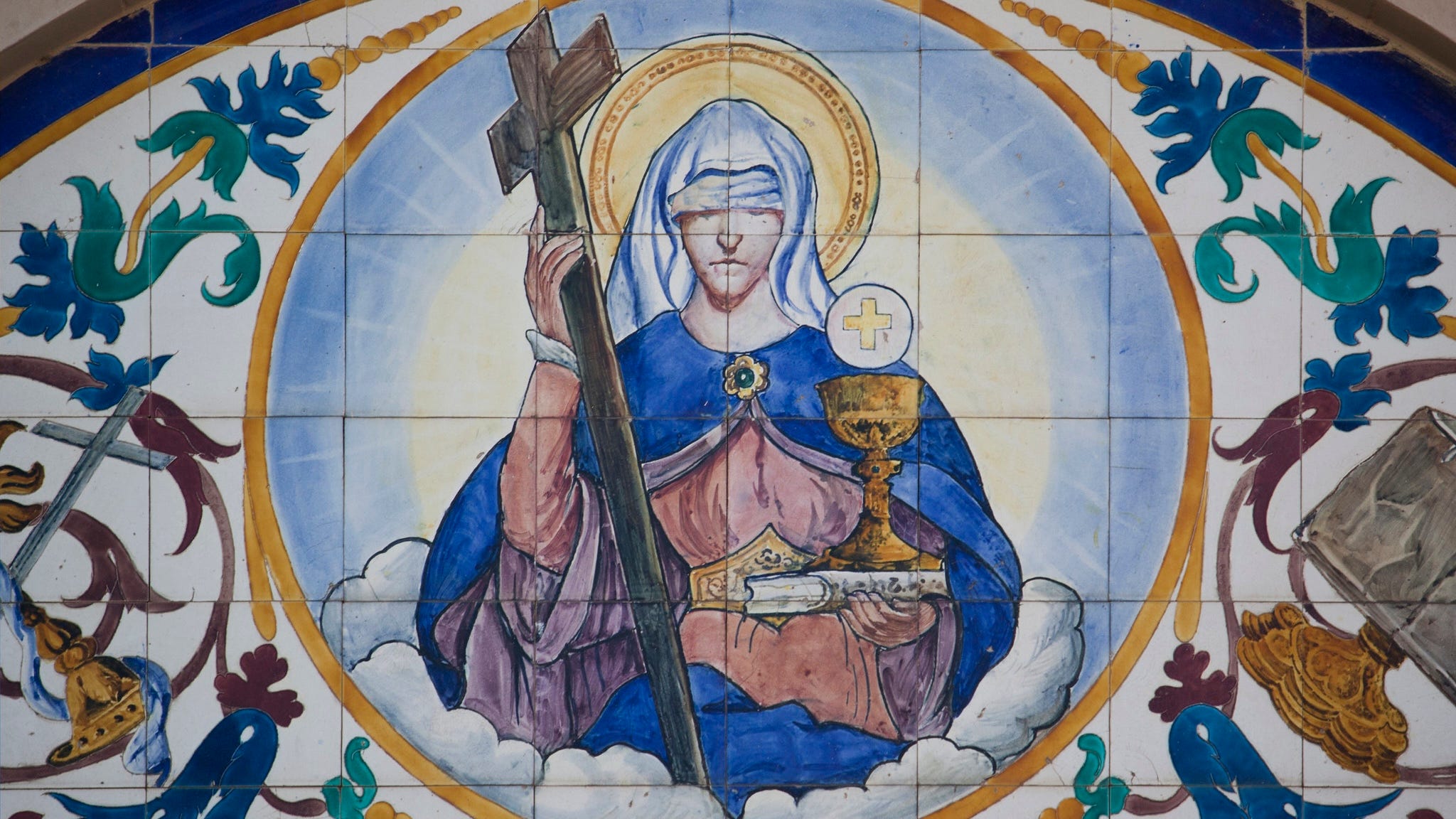
Following his prophecies about Jerusalem’s doom, Our Lord turns his attention more directly to the end of the world, making startling promises to his faithful.
Editor’s Notes
Doomsday—Part I
The following mini-series deals with the Gospel read on the First Sunday of Advent – the season which marks the Church’s preparation for the celebration of Christ’s coming at Christmas, and his second coming in glory.
This discourse belongs to the final days of Holy Week, delivered on Mount Olivet after Christ’s triumphal entry and cleansing of the Temple.
Following his prophecies about Jerusalem’s doom, Our Lord turns his attention more directly to the end of the world, making some startling promises to his faithful.
This Gospel is read on the First Sunday of Advent. Advent is often thought of as the start of the new liturgical year, but as we can see, this Gospel reading flows seamlessly from that of the last Sunday of Pentecost-tide.
This is because Advent itself is not just ordered towards Christmas as the commemoration of Christ’s birth in the flesh, but also towards his Second Coming in Glory.
In this part, Fr Coleridge tells us…
How Christ’s prophecy pauses between Jerusalem’s fall and the world’s end to warn against deception.
That this warning applies to every age of the Church, for false teachers arise continually throughout history.
Why Christ saw all coming ages with perfect clarity, yet chose to address dangers common to all.
He shows us that forewarning against imposture is itself a proof of Christ’s abiding presence with His Church.
We have addressed some of the reasons for this below:

The Doom of the World
Passiontide—Part I
Chapter XIV
St. Matt. xxiv. 29–36; St. Mark xiii. 24–34; St. Luke xxi. 25, 26;
Story of the Gospels, § 144, 5.
Burns and Oates, 1889
Sung on the First Sunday of Advent
Pause in the prophecy
After the passage in which the destruction and desolation of Jerusalem was foretold, the prophecy of our Lord seems to pause before He proceeded to the signs which are to foretell the destruction of the world and the Day of Judgment.
It has been observed already as to this great prophecy, that it must be remembered that it is not only a prophecy of the two great events about which the disciples had asked Him, but also, and all through, a prophecy deeply tinged, so to speak, with a character of admonition, exhortation, and instruction.
It was our Lord’s last instruction to the Apostles of this kind, for, as we shall see, the instructions conveyed in the last great discourse on the evening of Holy Thursday were more doctrinal, and pitched in a more sublime key of thought.
Nor need we suppose that our Lord felt obliged to confine Himself within the limits of the questions which the Apostles had put to Him. In the minds of the Apostles, there was no very clear conception of what has been called the perspective of the prophecy, that is, they did not know how far in point of time the destruction of Jerusalem was separated from the end of the world, how much was to happen between the two, what a glorious unfolding was to take place of the counsels of God in the history of the successive ages of the Catholic Church—an unfolding of which we do not know how much more than what is already past remains to be seen by future generations.
History of the Church seen by our Lord
But to our Lord all was clear and distinct.
He saw the history of all the generations that have succeeded one another since the destruction of Jerusalem, as well as that of those which are yet to come, all the changing and shifting phases of the undying war against the truth of which the earth is to be the scene, all the succession of nations and empires, the vicissitudes which are to mark the path of the Church across the stormy waters, the heresies, the schisms, the glories of the saints as they rose in succession on the field, the consolations and triumphs of the Church of Christ as well as her sorrows and afflictions.
It is not wonderful if our Lord should have given a few words to this long and ever-shifting battle kept up by the power of Hell against Him and His. We may consider the passage that follows in this light, as intended by our Lord to give us guidance as to the chief dangers to Christians, dangers which were rife at the time of the Jewish revolt, dangers which will be certainly not less rife at the end of the world, dangers which are always pressing in the interval between these two catastrophes.
‘Lo here, lo there’
‘Then,1 if any man shall say to you, Lo, here is Christ, He is there, do not believe him. For there shall rise up false Christs and false prophets, and they shall show great signs and wonders, so as to deceive, to seduce, if it were possible, even the elect. Take ye heed, therefore, Lo, I have foretold you all things.’
Thus far St. Matthew and St. Mark use the same words. St. Mark does not continue the next sentence, which is given by St. Matthew, but has been anticipated by St. Luke in an earlier part of his Gospel.
‘If therefore they shall say to you, Behold He is in the desert, go ye not out, Behold He is in the closets, believe it not. For as the lightning cometh out of the east, and appeareth even into the west, so shall also the coming of the Son of Man be. Wheresoever the body is, there shall the eagles also be gathered together.’
Two securities for Christians
It is clear that this whole passage contains two prophecies of warning.
The first is the warning against being seduced by false claims to the office of Christ, which will be continually made by the emissaries of evil. No matter what may be the signs and wonders which they may adduce in support of their claims, our Lord says peremptorily, do not believe them, ‘Behold I have told you beforehand.’ That ought to be enough for faithful servants of our Lord.
But there is also an assurance added, which St. Luke, though he omits it here, has already mentioned, where he records our Lord's former words in anticipation of the present prophecy.
This second assurance consists in this. Not only has our Lord foretold the coming of the false Christs and prophets, and told us not to heed their claims nor attend to the signs they show, but He adds further that there will always be evidence sufficient to fill the minds of the faithful with a conviction of His presence with them, that will be quite enough to make it superfluous for them even to consider the pretensions of the false teachers.
This seems to be the meaning of the words,
‘If therefore they shall say to you, Behold He is in the desert, go ye not out, Behold He is in the closets, believe it not. For as the lightning cometh out of the east, and appeareth even into the west, so shall also the coming of the Son of Man be.’
The meaning of this passage seems to be something of this kind. We are kept from giving in to false doctrines and impostures of any kind, in two ways. The first way to see through the falsehood and penetrate the imposture is to remember the warnings of our Lord against seduction. This is one way of saving ourselves from being deluded. And in this way we gain a fresh evidence of the truth—for our Lord has told us beforehand that there are to be these pretended signs, which thus evidence to us their own falsity.
The Doom of the World
Here’s why you should subscribe to The Father Coleridge Reader and share with others:
Fr Coleridge provides solid explanations of the entirety of the Gospel
His work is full of doctrine and piety, and is highly credible
He gives a clear trajectory of the life of Christ, its drama and all its stages—increasing our appreciation and admiration for the God-Man.
If more Catholics knew about works like Coleridge’s, then other works based on sentimentality and dubious private revelations would be much less attractive.
But sourcing and curating the texts, cleaning up scans, and editing them for online reading is a labour of love, and takes a lot of time.
Will you lend us a hand and hit subscribe?
Follow our projects on Twitter, YouTube and Telegram:
Twitter (The WM Review)
It has often been said that the readers of the Gospels have to notice the way in which the Greek word which answers to ‘then’ is used by the Evangelists, especially St. Matthew. In many cases it has no reference at all to what has preceded the sentence which it begins. It seems often to mean ‘at the time of which I am going to speak,’ rather than ‘at the time of which I have been speaking.’ In passages in St. Matthew, who does not follow the order of time in preference to that of thought, this may create great confusion unless the reader understands his meaning. The passage immediately before the verse we are speaking of in St. Matthew relates to the destruction of Jerusalem. The passage we are commenting on refers, as may be thought, to the period before the end of the world, either immediately, or indefinitely, but after the destruction of Jerusalem.
I’ve always thought of this as an added built-in assurance to the words ‘…For as the lightning cometh out of the east, and appeareth even into the west, so shall also the coming of the Son of Man be.’ —- namely, that just as lightning is swift, sure, sudden, dramatic and unmistakably lightning, so will His second coming be. Leaving us no need of debate, discussion, what-ifs, qualifications, or any other discernments. We’ll know.
Blessings and appreciation from Sydney Australia.