

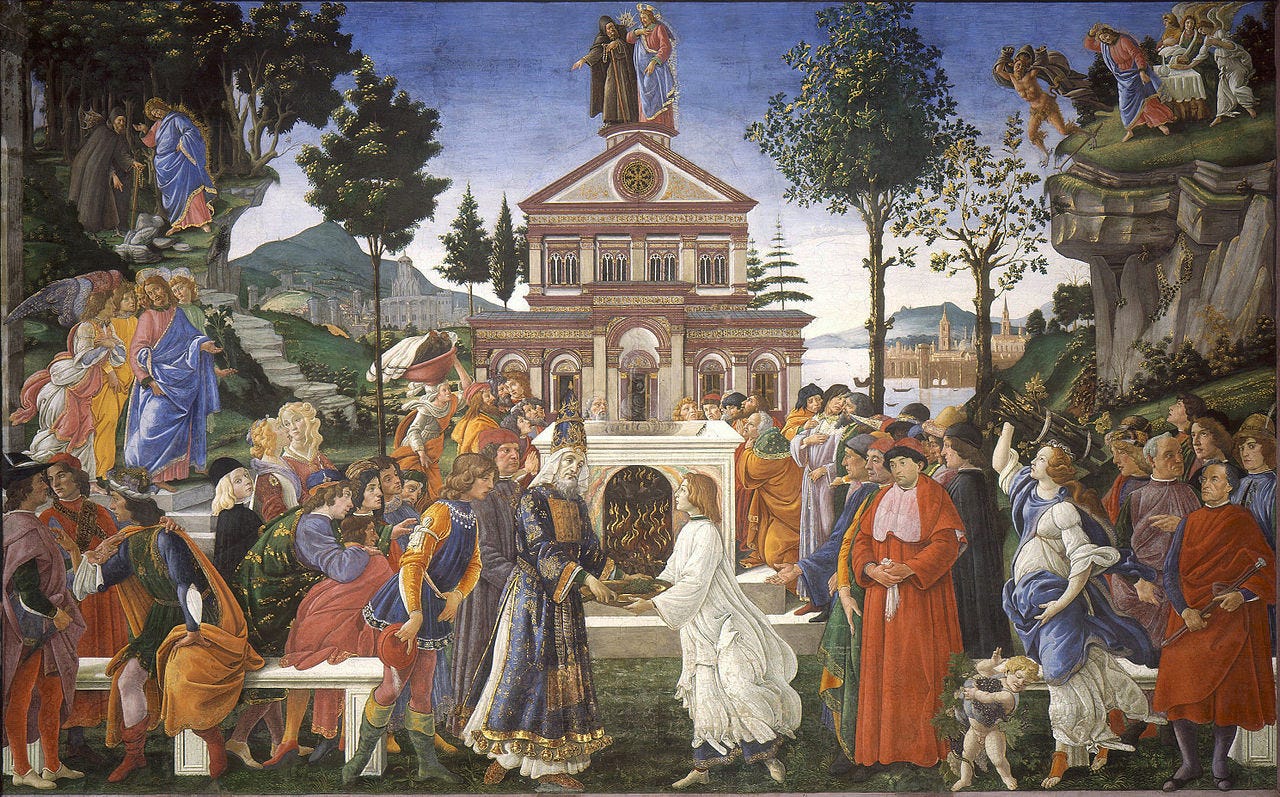
St Matthew and St Luke give different orderings for the three temptations. Which should be followed?
Editor’s Notes
In this part, Fr Coleridge tells us…
How our Lord was led into the desert by the Holy Ghost through a higher interior motion.
That beyond virtues there are gifts of the Holy Ghost which move the soul above ordinary rule.
Why some acts, judged rash by reason alone, are good through divine impulse.
He shows us that Christ’s conflict in the wilderness flowed from obedient surrender to the Holy Ghost, not from impulse or chance.
For more context on this episode, see Part I.
Temptations of our Lord
The Ministry of St. John the Baptist
Chapter V
St. Matt. iv. 2–10; St. Mark i. 13; St. Luke iv. 2–12.
Story of the Gospels, § 18
Burns and Oates, London, 1888
Headings and some line breaks added.
Sung on First Sunday of Lent
On the order of the Temptations.
As St. Matthew and St. Luke give the three temptations of our Lord in a different order, it is not easy to decide which of the two ought to be followed, and it is only the necessity of selecting one of the two as to our guide on the point, in a work like the present, that has forced us to adopt one arrangement rather than the other, without pretending to settle the question.
It is generally decided on internal grounds in favour of the order of St. Matthew, because it is at the close of His temptation on the mountain that our Lord used the words, ‘Avaunt Satan!’ and it is supposed that these imply that the tempter was then chased away. But there is no necessary connection between the words of our Lord and the departure of Satan, which took place, as St. Luke tells us, ‘when all the temptation was ended,’ and he speaks of the withdrawal for a time as if it had been made simply, as far as it depended on Satan himself, because he was completely baffled.
It is hardly necessary to add, what must be obvious to every critical student of his Gospel, that St. Matthew and the other Evangelists frequently use the word τότε, ‘then,’ without any necessary reference, as to order of time, to what has preceded. The common use of the word, at the beginning of a sentence, is something like that of the words, ‘In illo tempore,’ which are placed in the Missal at the beginning of the ‘Gospels’ for the several Masses, meaning, ‘At a certain time,’ ‘Once upon a time.’ No argument can therefore be drawn from the use of this word by St. Matthew as an apparent conjunction between what is to him the third temptation and the departure of Satan.
If this is the case there seems no reason left for preferring the order of St. Matthew.
The tendencies of both Evangelists
On the other hand we have a general principle to guide us which it is important to follow throughout, and which has therefore been followed in the present case here. That principle is twofold:
First, it is clear from an examination of St. Matthew’s Gospel that he does not as a rule follow the order of time, but rather the order of ideas, in the arrangement of his Gospel.
Secondly, it is also clear that the later Evangelists, and especially St. Luke, writing with a knowledge of the earlier Gospels, as well as an independent acquaintance with the facts, sometimes change the order, add, and by addition, seem to correct, not the statements of the previous writers, but the impression that might arise from such statements.
The whole intelligence of the arrangement of our Lord’s Life depends mainly on the knowledge of the scope and method of each Evangelist, and also of the relations, usually tacit but obvious, of the narratives to each other. It is almost a principle that St. Luke always adheres to the order of time, and whenever he or St. Mark seem to differ from St. Matthew, it is safer to follow the later writer, because he could not have inverted the order but for some good reason. It is on this general principle that the arrangement of the Gospels in Vita Vitæ Nostræ has been based.
Internal probability of St Luke’s arrangement
It may also be added that there is some internal probability in favour of St. Luke’s arrangement. Certainly, a greater exertion of his natural powers was permitted to Satan in the temptation on the pinnacle of the Temple than before, and the mention of the angels in his quotation from the ninetieth Psalm, seem to lead naturally to the approach of the angels after his defeat to minister to our Lord.
Some critics have said that the Evangelists have of set purpose told the temptations in a different order, that we may understand that temptations of various kinds do not always succeed in the same order, for example, that avarice may sometimes lead to vainglory, and vainglory may sometimes lead to avarice.1
It is also worthy of notice that when St. Ignatius, in his Spiritual Exercises, describes the method of warfare pursued on the one hand by Satan and on the other hand by our Lord, in his meditation of ‘The Two Standards,’ he seems to follow the order, as we may call it, of St. Luke, rather than that of St. Matthew, for he describes Lucifer as bidding his emissaries tempt men first to the love of riches, and then to lead them, through the love of human honour, to pride, from which it will be perfectly easy to plunge them into any vices whatsoever. Jesus Christ, on the other hand, adopts the corresponding method, desiring to lead men first to poverty, spiritual or actual, then to the love of dishonour, and so to humility.
St. Ignatius leaves out in both cases the field of the lower temptations to sensuality, as he supposes those who are desiring to follow our Lord’s example to have no need to be warned concerning them, and on account of his extreme reluctance even to touch those subjects, of which St. Paul says,2 ‘Let them not be even so much as named among you.’3
These are reasons which support the order of St. Luke, by tending to show that the temptation which he puts in the last place is a kind of climax, and that the order of the spiritual conflict usually follows such an arrangement. There are also some authorities who see in the temptation in the pinnacle of the Temple a climax, for another reason, namely, that, as have been hinted in the foregoing chapter, those are the most dangerous of all temptations, which are founded on, or consist in, doctrinal errors, the false teaching of one who apparently supports his error by the Word of God, as Satan used the Psalms to persuade our Lord to tempt God.
Why does St Matthew differ?
It remains to assign, if possible, some reason why, if the temptations really took place in the order given by St. Luke, St. Matthew should have inverted the order. Such a reason may perhaps be found in the fact that it is one of the leading ideas in his Gospel to bring out the kingdom of our Lord, in all its majesty and universality, as conferred upon Him by the Father, and thus he may have been led to regard the temptation in which the kingdoms of the world were offered to Him by Satan on conditions of his own as the climax of all.
Another reason, which is given by some authorities, is founded on the continual though tacit reference made by St. Matthew throughout his Gospel to former events which are connected with what he is relating either as types or as contrasts. His Gospel can certainly never be fully understood unless this part of his method is discerned, and his use of it is very far more frequent than would be supposed merely from the number of his distinct references to prophecy in those familiar words, ‘This was done that it might be fulfilled,’ and the like.
The proper place for drawing out this characteristic of St. Matthew is in another part of this work, and it is enough here to assume that, from the beginning to the end of his Gospel, he has the Old Testament history before his mind, with all its anticipations of our Lord, whether in type or in prophecy, and that his references are sometimes contained in a single word or half sentence.
Links with Adam and Eve
There can be no question, therefore, about the principle now mentioned, and it only remains to see how the authors of whom we speak apply it to the present difficulty. The application is founded on the reference to the order of the temptations addressed by Satan to Adam and Eve, for his words in Genesis apply to both. St. Matthew is thought to have had this order before his mind, and to have arranged his narrative of the temptations addressed to our Lord accordingly.
‘These authors say,’ says Sylveira,4 ‘that St. Luke in his order of the temptations follows the historical truth, but that, because Christ in these temptations intended to overcome the devil in the same things in which he conquered Adam, therefore St. Matthew follows the order of the temptation of Adam; for the devil said to our first parents,5 “In the day in which you shall eat thereof,” and here is gluttony, “you shall be like God,” and here is vainglory, “knowing good and evil,” and here is avarice, because there is avarice not only of money, but also of knowledge. And thus according to the intention which Christ had of conquering Satan the order of the temptations is arranged.’
It is, of course, quite out of the question to suppose that either Evangelist was really ignorant of the true order.
Temptations of Our Lord
Read Next:

Here’s why you should subscribe to The Father Coleridge Reader and share with others:
Fr Coleridge provides solid explanations of the entirety of the Gospel
His work is full of doctrine and piety, and is highly credible
He gives a clear trajectory of the life of Christ, its drama and all its stages—increasing our appreciation and admiration for the God-Man.
If more Catholics knew about works like Coleridge’s, then other works based on sentimentality and dubious private revelations would be much less attractive.
But sourcing and curating the texts, cleaning up scans, and editing them for online reading is a labour of love, and takes a lot of time.
Will you lend us a hand and hit subscribe?
Follow our projects on Twitter, YouTube and Telegram:
Twitter (The WM Review)
See Ludolph’s Vita Christi, p. i. c. 22.
Ephes. v. 3.
See Palma, Camino Espiritual, l. iii. c. 2.
In Evangel. tom. i. l. iii. c. 3, q. 21.
Gen. iii. 6.