

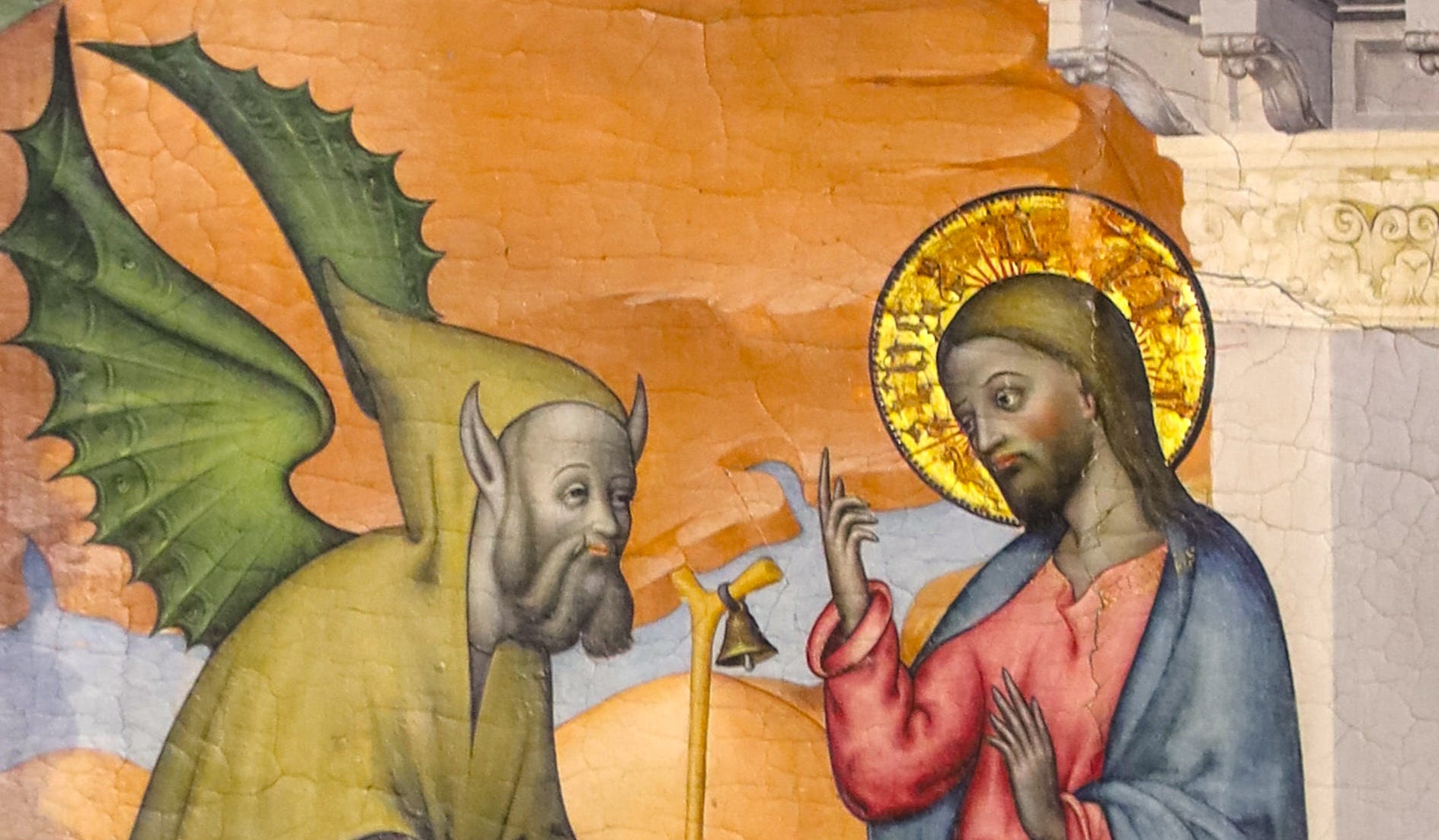
The Devil’s suggestion that Our Lord turn stones into bread seems innocuous, but carries something more sinister...
Editor’s Notes
In this part, Fr Coleridge tells us…
How Satan’s suggestion to turn stones into bread is actually a temptation against faith
How to defeat every assault of the Devil
Why it is that man lives by God’s will, and not by bread and good.
For more context on this episode, see Part I.
Temptations of our Lord
The Ministry of St. John the Baptist
Chapter V
St. Matt. iv. 2–10; St. Mark i. 13; St. Luke iv. 2–12.
Story of the Gospels, § 18
Burns and Oates, London, 1888
Headings and some line breaks added.
Sung on First Sunday of Lent
The first temptation
Tradition has fixed on the mountain tract which lies somewhat to the south-west of Jericho as the scene of the forty days’ fast and temptation of our Lord. The mountains are pierced by many caves, and there are some lofty peaks. In the early ages they became the habitation of hermits and monks who sought this desert for the purpose of leading the life of Christian ascetics near the actual spot which our Lord had sanctified by His long sojourn in the wilderness.
Here it was then that the tempter, appearing as it seems in the form of a man, approached our Lord in the extreme state of weakness to which He had allowed Himself to be reduced, with the suggestion, ‘If Thou be the Son of God, command that these stones be made bread.’
In what it consisted
The suggestion was a temptation in the first place to a sort of infidelity, as if our Lord could doubt that He was the Son of God, as He had lately been declared to be by the Voice from heaven at the time of His Baptism. Satan’s hatred is ever most intense against God Himself, and he here insinuates a question as to the truthfulness of God, as if He could not really have left the Son of His love in such a condition of famine and hunger in the wilderness, and in this respect the words recall to mind the manner in which he also called in doubt the veracity of God in his temptation to Eve.
All his temptations indeed have this in view, to make God’s creatures disbelieve and distrust Him, and then to substitute himself and his own lies as the object of our confidence and faith.
In the second place, his suggestion was an appeal to the sensual appetite, because it promised a relief to the terrible hunger with which our Lord had now allowed Himself to be afflicted. But it was not simply an appeal to the appetite, inasmuch as he might have made such an appeal by presenting our Lord with delicate viands, such as he might doubtless have produced, and which might have been in our Lord’s case what the forbidden fruit was to Eve.
He does not tempt our Lord to eat when it was forbidden Him or what was forbidden, but he says, ‘If Thou be the Son of God, command that these stones be made bread’—that is, show Thy Sonship by using the power of miracles, which cannot but be attached to such a dignity, by commanding stones to be made bread so that Thy hunger may be satisfied.
He does not say, Ask Thy Father or pray to Thy Father, for prayer, humility, the loving petitions of a child to God the Father are things which Satan hates and can never recommend, and his one idea of Divine Power is that which St. Paul speaks of when he seems to allude to him in contrast with our Blessed Lord, saying that Jesus Christ did not think it a thing ‘to be seized on, clutched, and used as a prey,’1 as a robber uses the riches of which he gets possession, or as a tyrant uses his usurped power, at his own caprice and fancy, without regard to justice or decency, and merely to show that he has it.
Certainly, if our Lord had so chosen, He might have made the stones become bread, as He soon after this time turned the water into wine, or again, if He had chosen, He could have permitted the pangs of hunger no longer to afflict Him, or in many other ways, even without having any recourse to supernatural means, He might have obtained relief. But our Lord was fasting in obedience, as is clear from the whole history, to the guidance of the Holy Ghost, and as His Sacred Humanity was ever perfectly obedient to and dependent upon that guidance, it would have been against what we may call the law of His life to supply His temporal needs by a miracle without such guidance.
The rest of this part is for paid annual/monthly subscribers.
Father Coleridge Reader is a labour of love. But curating, cleaning up and publishing these texts takes real work.
To keep this project going, and to make more of this treasury available, we rely on reader support. Some posts are reserved for members to sustain this mission.
We’re trying to keep something precious alive.
If you’ve benefited, consider joining us as a subscriber. It makes a real difference.