

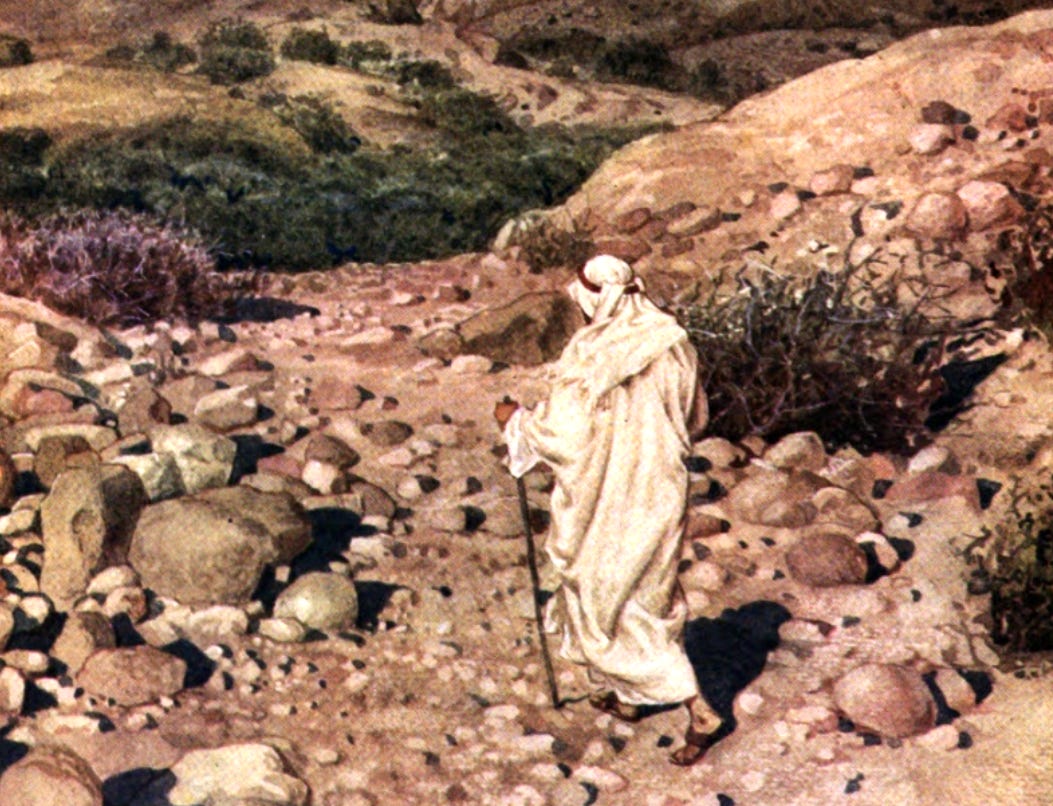
The Evangelists tell us that Our Lord was “led” or even “driven” into the desert. What does this mean?
Editor’s Notes
In this part, Fr Coleridge tells us…
How our Lord was led into the desert by the Holy Ghost through a higher interior motion.
That beyond virtues there are gifts of the Holy Ghost which move the soul above ordinary rule.
Why some acts, judged rash by reason alone, are good through divine impulse.
He shows us that Christ’s conflict in the wilderness flowed from obedient surrender to the Holy Ghost, not from impulse or chance.
For more context on this episode, see Part I.
Temptations of our Lord
The Ministry of St. John the Baptist
Chapter V
St. Matt. iv. 2–10; St. Mark i. 13; St. Luke iv. 2–12.
Story of the Gospels, § 18
Burns and Oates, London, 1888
Headings and some line breaks added.
Sung on First Sunday of Lent
On the action of the gifts of the Holy Ghost.
It has been said above that the language of the Evangelist intimates that our Lord’s going to His temptation was one of those actions which are attributed to the gifts of the Holy Ghost. It may be useful to subjoin an abstract of the passage quoted in the footnote from Lanuza, in illustration of this point.
Lanuza’s language may be thus epitomized, ‘Christ was led by the Spirit. Not that He lost His free will, but He was urged by the Spirit as distinguished from going (into temptation) of His own accord. He was urged by a strong internal motion, as the saints sometimes are, without any violence done to the free will; of whom it may be said, Spiritu Dei aguntur.’1
To understand this, we may assume the Catholic doctrine, that, besides acquired and infused virtues, which enable us to act rightly, there are also gifts of the Holy Spirit, which excite to more noble acts.2 A carriage will go downhill of its own weight, but if it is to go up-hill, its wheels must be greased.
“A man,” says St. Ambrose, “is a carriage: he goes down-hill easily enough; but if he is to resist the tendencies of the flesh, he must have virtues and the gifts of God, by which the wheels of his faculties are lubricated.”
But what is the difference between virtues and gifts? Both move a man to what is good: but this good is of two sorts, and to both a man can direct his actions. The first sort of good is in accordance with natural reason imprinted in the soul, or supernatural reason as declared to us by God in the Scripture, or by holy mother Church.
To attain to this good, virtues are given to us: e.g. faith to believe what passes sense; hope in a future reward; charity to love God, the chief good; prudence, to guide the actions of our life; justice, to give to each one what is his; fortitude, in the irascible part to meet danger; temperance in the concupiscible, to lead a man to acts of mortification.
There is a second sort of good, whose goodness (bonitas) is not derived from or dependent on the rules of reason, but on the particular movement of the Holy Spirit—Aliud quoque datur bonum, cujus bonitas non desumitur nec dependet ex regulis rationis sed ex particulari S. Sp. impulsu.
Instances are:
Samson, destroying himself while destroying his enemies
David, fighting Goliath
Judith, going through an army of rude soldiers and passing the night in the tent of the lustful Holophernes
Apollonia, leaping into the flames out of the hands of her torturers
Alexius leaving his wife.
All this was good, since it is proposed to us as such by the Church and by Scripture—quum ut tale (bonum) nobis proponit Ecclesia et Scriptura; still its goodness does not depend on natural or supernatural reason (ratione); for judged by that, it would not only not be good, but worthy of censure; but it depends on the spiritual impulse of the Holy Spirit, Who in His decrees and acts is not bound by the ordinary rules of reason.
“But that a person be impelled to such a good, which is above (supra) all rule, the gifts of the Holy Spirit are needed,” says St. Thomas; “and these gifts are nothing else than certain divine qualities which perfect the soul to allow itself to be bound and led to such goods which surpass all reason and law.”
This is what Christ meant when He said to Nicodemus: Spiritus ubi vult spirat, and the rest. This “spiratio” is shown in all history, especially in His choice of instruments: for example, Amos, the Apostles; in His grace, for example, when given to great sinners, Magdalene, St. Paul, the Penitent Thief.’
Temptations of Our Lord
Read Next:

Here’s why you should subscribe to The Father Coleridge Reader and share with others:
Fr Coleridge provides solid explanations of the entirety of the Gospel
His work is full of doctrine and piety, and is highly credible
He gives a clear trajectory of the life of Christ, its drama and all its stages—increasing our appreciation and admiration for the God-Man.
If more Catholics knew about works like Coleridge’s, then other works based on sentimentality and dubious private revelations would be much less attractive.
But sourcing and curating the texts, cleaning up scans, and editing them for online reading is a labour of love, and takes a lot of time.
Will you lend us a hand and hit subscribe?
Follow our projects on Twitter, YouTube and Telegram:
Twitter (The WM Review)
Rom. viii. 14.
Vide St. Thom. Sum. 1. 2, q. 68.