

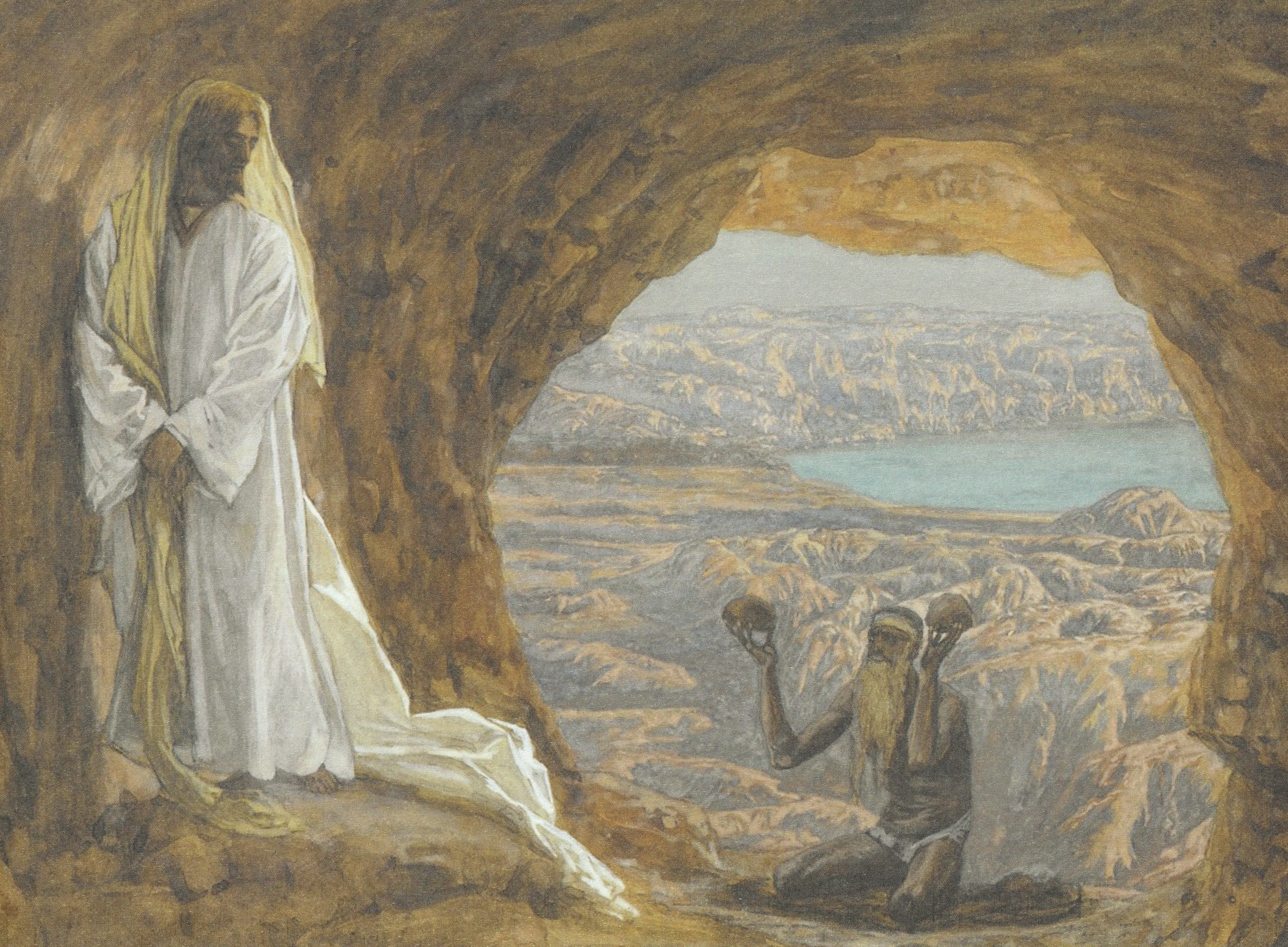
No one can escape being tempted – and Christ has shown us how to overcome these trials.
Editor’s Notes
The Gospel of the First Sunday of Lent recounts Christ’s forty days in the wilderness, fasting and being tempted by the Devil. This takes place immediately after Christ’s baptism by St John the Baptist, and precedes the beginning of his public ministry.
Having previously given Fr Coleridge’s account of why Our Lord fasted for forty days, how this incident represented his victory over the Devil, and the under-appreciated aspect of the angels coming to minister to Our Lord – let us return to the temptations themselves.
In this part, Fr Coleridge tells us…
How Christ entered the desert under a singular impulse of the Holy Ghost.
That his victory over Satan restores man, strengthens grace, and guides souls.
Why temptation marks the beginning of the Christian life and every advance.
He shows us that temptation, endured with him, becomes strength, victory, and life.
Temptations of our Lord
The Ministry of St. John the Baptist
Chapter V
St. Matt. iv. 2–10; St. Mark i. 13; St. Luke iv. 2–12.
Story of the Gospels, § 18
Burns and Oates, London, 1888
Headings and some line breaks added.
Sung on First Sunday of Lent
Special impulses of the Holy Ghost
There, as has been said, are reasons for our Lord’s retirement into the desert which may be considered as general in character, and as suggested by what may be called the ordinary maxims of spiritual prudence.
But holy writers have seen in the strong expressions of the Evangelists of which mention has already been made, an intimation that our Lord was now guided, as has been said, rather by an extraordinary and singular movement of the Holy Ghost than by more usual motives, and they have connected the mention of such a movement with that which is also assigned by the Evangelists as the particular end of His retirement into the desert, that is, ‘that He might be tempted of the devil.’
For He Who has taught us to pray that our Heavenly Father may not lead us into temptation, and Who has given us so many holy warnings about the avoidance of all that may be an occasion of sin to ourselves, may have wished us to understand, that, although temptations are inevitable, although we are not to be surprized at them or fear them, or even be sorry for them when they come to us unsought, although we are to resist the devil and he will flee from us, and the like, still we are not to seek them out and, as it were, go forth to defy the devil and try our strength with him, unless it be under some very special and extraordinary impulse from the Holy Ghost, the guide of our souls.
Theologians are wont to distinguish between various motive powers for good and holy actions, some of which proceed from the ordinary use of reason, some from the principles of an acquired or infused virtue, as temperance, courage, faith or hope, while others are caused by the special influence of the gifts of the Holy Ghost—wisdom, understanding, counsel, fortitude, and the rest.1 And it certainly belonged to our Lord as a part of His special office, in the carrying out of the dispensation of the Incarnation, and of the redemption of mankind as the second Adam, to fight with and overcome the great enemy of the human race, whose wiles had seduced our first parents, and whose temptations have ever since been the chief occasions of the sins of their children.
It was therefore a work, not of ordinary Christian virtue, or even one in which all Christians would be called upon to imitate our Lord, willingly to undertake such a conflict. This doctrine of the special guidance and impulse of the Holy Ghost, does not of course exclude the truth that this conflict of Satan was willingly undertaken by the Sacred Humanity of our Lord, Who would have seen in it no danger to Himself, and on the other hand immense glory to His Father, wonderful benefit to mankind, and a great humiliation and confusion to the enemy both of God and man.2
Mystery of the temptation – Our Lord the Second Adam
We are thus led to consider the temptation of our Blessed Lord as one of those great mysteries of His Life which are for ever to be commemorated and honoured and contemplated in the Church, and from which we are to derive continual strength and support, light, and life.
We are led to consider it as one of the great actions which belonged to Him in the character, as has been said, of the second Adam, the new Head of our race, the first-born of the new creation. All through the mysteries of the Incarnation and of our Redemption, there runs a perpetual reference to the history of man in his original condition in Paradise, and our Lord is continually doing this or that, or suffering this or that, which is a counterpart to something which is found in the history of Adam.
In the present case it is obvious that as Satan had tempted our first parents in Paradise, and as his temptation of and victory over them had been the turning-point in their history, and in the history of their race, so it was right and fitting that the second Adam should also fight with and overcome the same adversary, and that by means of His victory the race of which He was the Head should win blessings and crowns which might more than compensate for the losses which they had incurred by the weakness of Adam and Eve.
Thus the outset of the new dispensation is marked by a triumph of Man, as the outset of the history of the human race had been marked by a triumph of Satan.
Power to aid us in temptation – and the weakening of Satan
Another consideration which we find in the Fathers is somewhat different from this, namely, that as mankind had become in a certain sense, and to their own inexpressible misery, the subjects of Satan by means of his victory over our first parents, it was fitting that our Lord, Who was now beginning the work which His Father had committed to Him of ‘bringing many sons unto glory’ and making men partakers of the kingdom of heaven, should in the first instance fight with and overcome him, who by means of sin held mankind in bondage to himself, and thus begin the work of redemption by the destruction of our bondage.
It must be further added, that as our Lord’s temptation and victory over Satan were intended in the providence of God, not so much to free us from temptation as to make easy for us to endure it and to conquer it, as our Lord knew how terribly those who were to belong to Him were to be tried in this way and how entirely their salvation would depend upon their faithfulness under the trial, we must suppose that in this mystery He was providing for each one of us in that loving and complete manner in which all our needs, and dangers, and sufferings have been guarded against by Him.
Thus we are led to consider that, as St. Paul tells us, His temptation is the mystery on which His power to help us under temptation rests, not as if He had not that power otherwise, but because such is the harmony and correspondence between what He has done for us and the blessings which we derive from Him. ‘For in that He Himself hath suffered and been tempted, He is able to succour them that are tempted.’3
Thus, also, His temptation is an instruction as well as an encouragement to us, an encouragement, because it teaches us that to be tempted is not necessarily to fall, nor any mark of God’s displeasure with us, an instruction, because, as we shall presently see, our Lord has so arranged His own temptations, and His conduct under them, as to provide for us most perfectly an example how to bear ourselves under such trials and how to conquer whatever assault may be made against us.
And again, Satan no longer approaches with the strength and vigour and audacity which he used of old, after he had conquered man and had established his kingdom well-nigh over the whole world. He is intensely proud as well as intensely malicious and cunning, and as pride is so great a cause of blindness in him, so also to have his pride broken down and utterly confounded by defeat weakens him. But this is not the only cause of the comparative weakness of his temptations to man after our Lord’s victory.
The strength of Satan has been immensely weakened, but also, on the other hand, the strength of our human nature has been immensely increased by the Incarnation, and especially by the triumph of that nature in our Lord’s Person in this mystery of the Temptation. Our Lord has the right of a conqueror over Satan, and we have conquered in Him.
Temptations at the outset of spiritual life
These general reasons throw light on the importance as well as the position of this mystery on the Life of our Blessed Lord. It is put at the very outset of His Apostolical and Public Life, immediately after His Baptism, as if to show us that the very first condition of the Christian life is conflict and temptation.
And the particular circumstances under which our Lord’s temptations took place are further understood by the Fathers as signifying that no one can press on generously in the path of His imitation without at once meeting with the opposition which comes from temptation. It is when we set ourselves to ‘the service of God,’ as the Wise Man tells us,4 that we are to prepare our souls for temptation, and when men have cleansed their souls in Baptism or in the Sacrament of Penance, when they aim at higher things, and fast and pray and seek to keep themselves in retirement or at least in innocence from the world, then it is that the tempter is certain to assail them.
Then it is that he is alarmed, because he sees them endeavouring to follow our Lord more and more closely, and then it is that they must study our Lord’s example, have recourse to Him in humble prayer, and trust in the victorious strength which trampled Satan down in the desert, and by that triumph weakened him for future assaults, and provided for us a store of illumination and grace in which it is easy for us to conquer also.
Temptations of Our Lord
Read Next:

Here’s why you should subscribe to The Father Coleridge Reader and share with others:
Fr Coleridge provides solid explanations of the entirety of the Gospel
His work is full of doctrine and piety, and is highly credible
He gives a clear trajectory of the life of Christ, its drama and all its stages—increasing our appreciation and admiration for the God-Man.
If more Catholics knew about works like Coleridge’s, then other works based on sentimentality and dubious private revelations would be much less attractive.
But sourcing and curating the texts, cleaning up scans, and editing them for online reading is a labour of love, and takes a lot of time.
Will you lend us a hand and hit subscribe?
Follow our projects on Twitter, YouTube and Telegram:
Twitter (The WM Review)
See St. Thomas 2. 2æ, q. 52, art. 1, and Lanuza, Serm. in 1. Dom. Quadrag.
See Suarez, De Mysteriis, disp. xxix. 1, 6.
Heb. ii. 18.
Ecclus. ii. 1.