

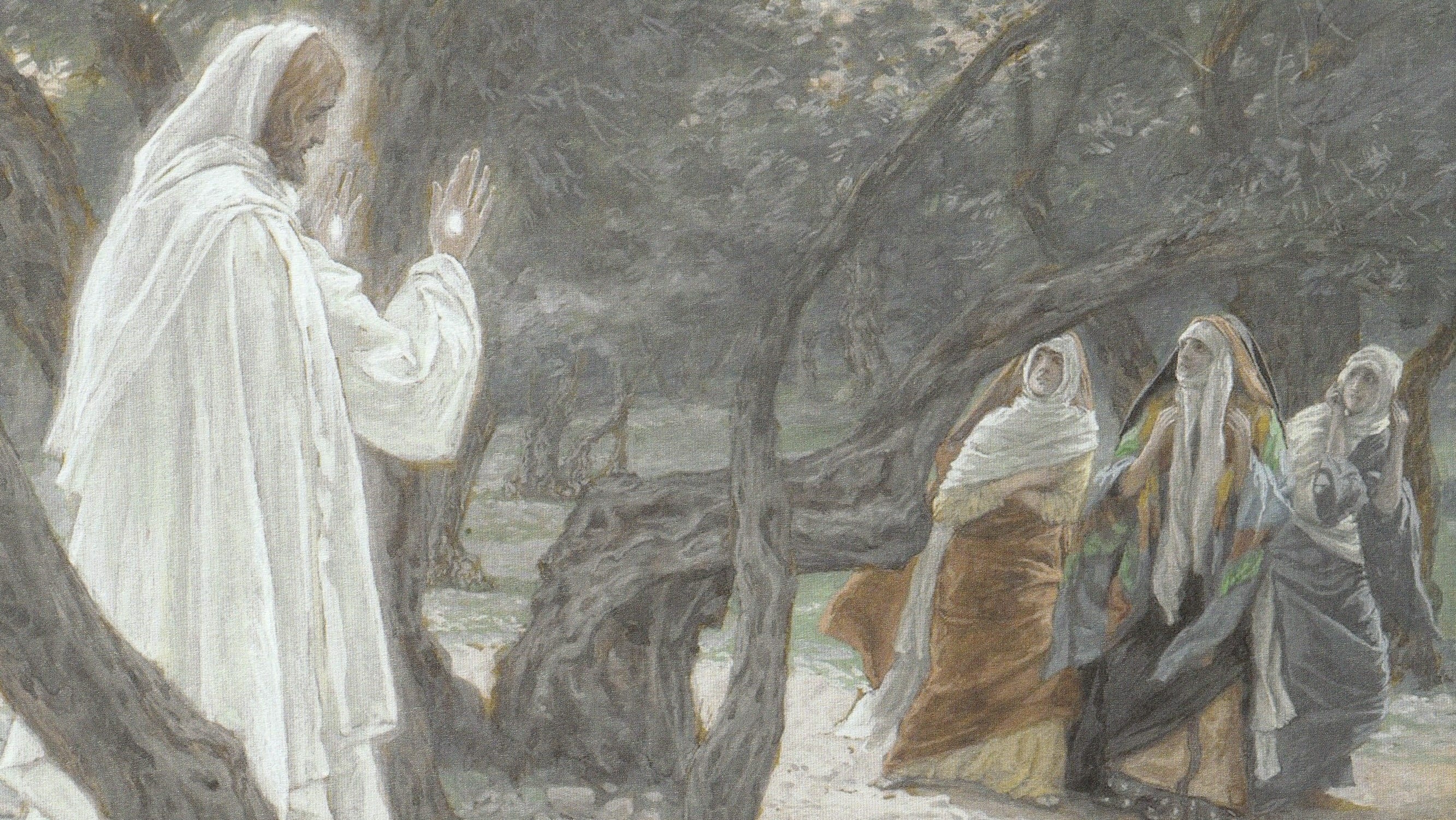
What was it about the Holy Women that made Christ choose them to prepare the Apostles?
Editor’s Notes
In this Part, Fr. Coleridge tells us…
How the risen Christ appeared to devout women, whose love led them first to the tomb.
That their fidelity prepared the way for the Apostles' faith and the Church’s witness.
Why their joy and fear were met by Christ himself with peace, confirmation, and command.
He shows us that those who serve humbly and persevere in sorrow are rewarded with first sight of glory.
Easter Day
The Passage of Our Lord to the Father—Chapter XIV
St. Matt. xxviii. 2-15; St. Mark xvi. 2-13; St. Luke xxiv. 1-43; St. John xx. 1-29.
Story of the Gospels, § 173-177
Burns and Oates, London, 1892
Why Christ told Magdalene not to touch Him—and what it means for us
What the risen Christ did when he met all the Apostles together
Our Lord and the Holy Women
The gracious dealings of our Lord with the others of these holy women are next to be mentioned, the party of whom Mary Magdalene formed a member either in going to the sepulchre originally, or later, on the Sunday morning, is mentioned by St. Luke, as failing like her to find the Body of which they were in search.
Soon after they were accosted by two Angels, who asked them, ‘Why seek you the living with the dead? He is not here, but is risen.’ They then reminded them of what He had said while He was yet in Galilee.
‘And going in, they found not the Body of the Lord Jesus. And it came to pass, as they were astonished in their mind at this, two men stood by them, in shining apparel.
‘And as they were afraid, and bowed down their countenance towards the ground, they said unto them, Why seek you the living with the dead? He is not here, but is risen. Remember how He spoke unto you when He was yet in Galilee, saying, The Son of Man must be delivered into the hands of sinful men, and be crucified, and the third day rise again. And they remembered His words. And going back from the sepulchre, they told all these things to the Eleven, and to all the rest.
‘And it was Mary Magdalene, and Joanna, and Mary of James, and the other women that were with them, who told these things to the Apostles. And these words seemed to them as idle tales, and they did not believe them.’
The party mentioned by St Mark
Later on we find a further appearance recorded by St. Mark, who says that it was very early, but adds that the sun had now risen. The names of these holy women are not given by the Evangelist, but they seem to have belonged to a party different from the former.
One remarkable thing about this party is that the words addressed to them by the Angel, who appears to them, are almost like a continuation of the appearance of the Angel of the earthquake mentioned by St. Matthew, which must have been much earlier in the day than the other apparitions already mentioned. But the words of this Angel are very similar to those of the former.
‘And the Angel answering, said to the women, Fear not you, for I know that you seek Jesus Who was crucified. He is not here, for He is risen, as He said. Come and see the place where the Lord was laid. And going quickly, tell ye His disciples that He is risen, and behold He will go before you into Galilee, there you shall see Him. Lo, I have foretold it to you.
‘And they went out quickly from the sepulchre with fear and great joy, running to tell His disciples. And behold Jesus met them, saying, All hail. But they came up and took hold of His feet, and adored Him. Then Jesus said to them, Fear not! Go, tell My brethren that they go into Galilee, there they shall see Me.’
The only difference is that the name of St. Peter is not given where the message is sent to the Apostles. The difficulty may be only apparent, and it would probably soon disappear if we were more perfectly acquainted with the circumstances as they occurred. We are also at some loss where exactly to place the appearance of our Lord Himself, the first as it seems to the disciples after that to Magdalene, of which we have an account in St. Matthew, which follows in his text directly after the former, and seems to refer to the same holy women to whom the words of the Angel were addressed.
As the women went quickly out of the sepulchre, with fear and great joy, running to tell His disciples…
‘Behold Jesus met them, saying, All hail. But they took hold of His feet, and adored Him. And Jesus said to them, Fear not! Go tell My brethren that they go into Galilee, there they shall see Me. Who when they were departed, behold some of the guards came into the city, and told the Chief Priests all things that had been done.
‘And they being assembled together with the ancients, taking counsel, gave a great sum of money to the soldiers, saying, Say you, His disciples came by night, and stole Him away when we were asleep. And if the Governor shall hear of this, we will persuade him and secure you. So they taking the money did as they were taught, and this word was spread abroad among the Jews even unto this day.’
The office of the women
These manifestations exhaust the accounts which we possess of which the recipients were the holy women. After this, these women are withdrawn from the scene. It seems natural to think that their fervour and readiness for faith made them the fittest persons to receive these Divine favours, and that they had certainly earned them by their devotion to our Lord in His burial. They had the peculiar and most blessed office of preparing the Apostles, the appointed and chosen witnesses of the great truth, for the gradual though swift manifestation of the Resurrection itself, which St. John gathered after the words of Magdalene and the sight of the empty sepulchre, and others perhaps not long after.
It may be supposed also that the women could be of service where the Apostles could not act with safety. They were led to visit the sepulchre, not by their faith in the Resurrection, which they did not yet think of, but by their devotion to our Lord, Whom they hoped to be allowed to embalm. St. Peter was prepared for his faith by his visit to the sepulchre, as well as St. John. But no one seems to conceive the full faith exactly at the same time with another, nor do those who were the earliest to arrive at the full conviction guided to communicate it, in the present stage of its growth, to any one else, until perhaps it became the property of the Church, as when the Apostles could say, as it were officially:
‘The Lord is risen indeed, and hath appeared to Simon.’
Subscribe now to never miss an article:
Easter Day
Why Christ told Magdalene not to touch Him—and what it means for us
What the risen Christ did when he met all the Apostles together
Easter’s lasting gift: Confession and the power of absolution
Read Next:

Here’s why you should subscribe to The Father Coleridge Reader and share with others:
Fr Coleridge provides solid explanations of the entirety of the Gospel
His work is full of doctrine and piety, and is highly credible
He gives a clear trajectory of the life of Christ, its drama and all its stages—increasing our appreciation and admiration for the God-Man.
If more Catholics knew about works like Coleridge’s, then other works based on sentimentality and dubious private revelations would be much less attractive.
But sourcing and curating the texts, cleaning up scans, and editing them for online reading is a labour of love, and takes a lot of time.
Will you lend us a hand and hit subscribe?
Follow our projects on Twitter, YouTube and Telegram:
Twitter (The WM Review)