

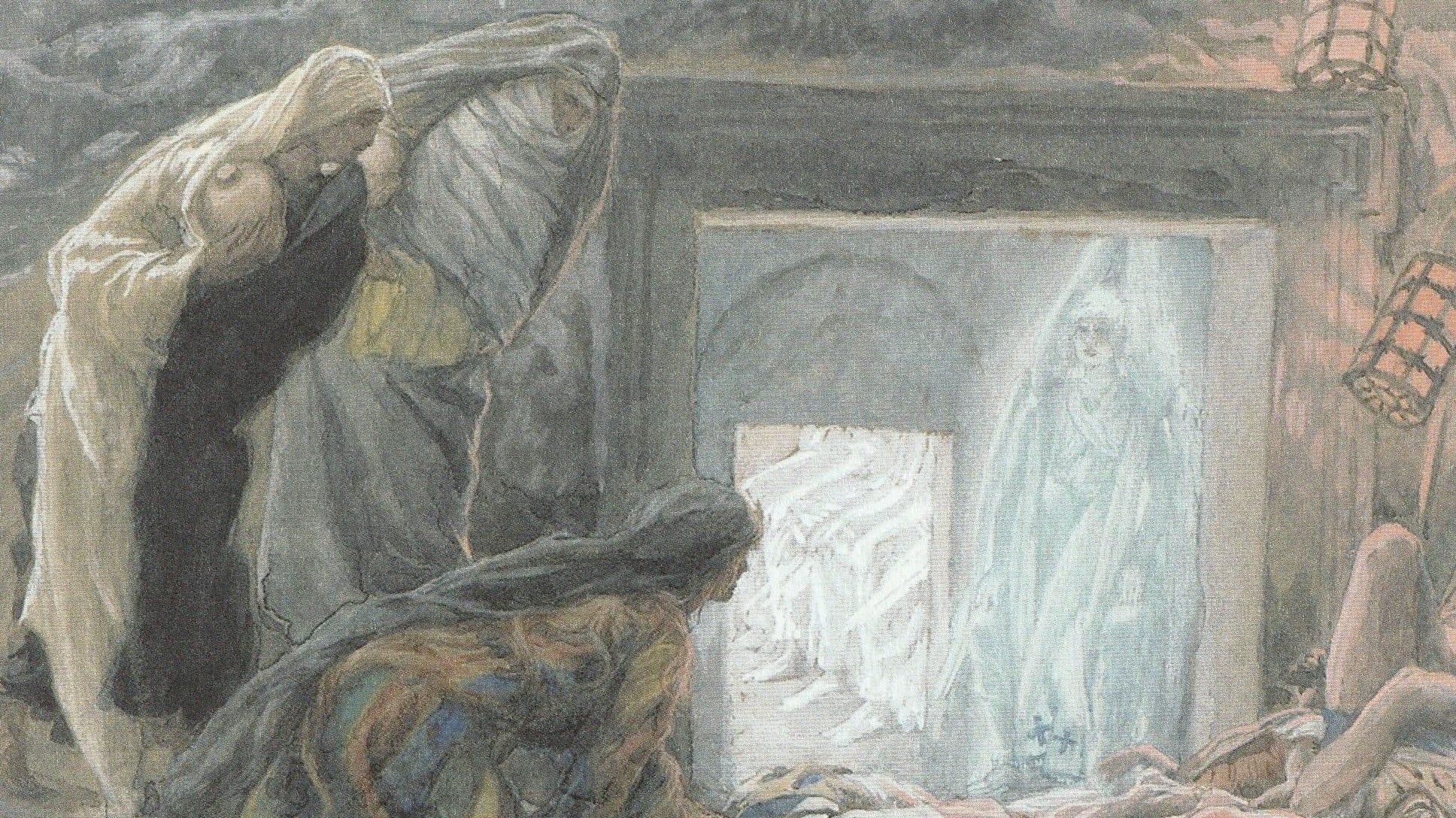
The accounts of the women arriving at the Holy Sepulchre came seem very mysterious.
Editor’s Notes
In this Part, Fr. Coleridge tells us…
How the women went to anoint the body of the Lord.
That divine Providence rewarded St Mary Magdalene’s love with a revelation the Apostles had not yet received.
Why her tears and constancy drew Christ to manifest himself before even ascending.
He shows us that a heart burning with love will be consoled before all others by the Lord's presence.
Easter Day
The Passage of Our Lord to the Father—Chapter XIV
St. Matt. xxviii. 2-15; St. Mark xvi. 2-13; St. Luke xxiv. 1-43; St. John xx. 1-29.
Story of the Gospels, § 173-177
Burns and Oates, London, 1892
Why Christ told Magdalene not to touch Him—and what it means for us
Why Christ appeared to the Holy Women before the Apostles
What the risen Christ did when he met all the Apostles together
Easter in the Gospel
We must proceed without more delay to the comparatively short and simple accounts which are furnished to us by the Evangelists, who, especially the two earlier, seem to take the fact of our Lord’s triumph over death and restoration to life almost for granted, as if they lived among a community in which the details of what they wrote were far too well known to their companions to be related at length and repeatedly. St. Matthew’s account of the Resurrection is concise and abrupt in the highest degree, nor is that of St. Mark much less so. The account expands under the hand of St. Luke, and St. John adds some valuable details, not however of the great mystery itself.
We shall take these remains and shreds of information in their order, as far as we can ascertain it. We have spoken of the abruptness of St. Matthew. The last chapter of his Gospel begins with the visit of the two Maries, Mary Magdalene and the mother of James and Joseph, to the sepulchre, on the Friday evening.
But the first Evangelist seems too full of his subject to pause, and he passes on at once to the account of the earthquake on the Sunday morning, when the day had hardly begun, and adds some words of the Angel who then rolled away the stone from the sepulchre and sat upon it. There is in this account a continuity of narrative, as if the women had been present at the earthquake, and in this consists the abruptness of which we speak.
The holy women
We venture to think that the words of this Angel to the holy women are meant to refer to a later time of the morning, as we shall explain. St. Matthew tells us:
‘And behold there was a great earthquake. For an Angel of the Lord descended from Heaven, and coming rolled back the stone and sat upon it. And his countenance was as lightning, and his raiment as snow. And for fear of him, the guards were struck with terror, and became as dead men.’
Here we may make a break in the short narrative, as it seems, for the words of this Angel to the holy women appear to belong to a later hour of the early morning, the special purpose of the presence of the Angel, sitting upon the stone which had been rolled away, being to terrify the guards and secure free access for the holy women.
It must remain uncertain—so fragmentary are the records—whether the Angel remained very long on the stone before the sepulchre before the latter was visited by any of the followers of our Lord. The Evangelists tell us of the visit of Magdalene, to whom first of all our Lord appeared, and she is mentioned by St. John as going alone, and also by St. Luke as going in company with others, intending as soon as possible to accomplish their work of the embalmment, which had been left unfinished, or hardly begun, on the Friday.
Magdalene
On the whole, as the blessed Magdalene seems to be distinguished in the history of the Resurrection from the other holy women, as having a kind of right of her own to a special mention in that history, we think it safest to conclude that her first-mentioned visit to the sepulchre was alone. St. John tells us it was still dark, and therefore before the sun had risen. She may of course have been, in her eagerness, just a little in advance of her companions.
As she approached she perceived that the stone was rolled away. The Angel was not seen by her, and she ran away instantly to tell the Apostles. Peter and John were close at hand, having passed the night, probably, close to the little abode where our Lady and Magdalene herself were lodged, not far from the sepulchre. She saith to them:
‘They have taken away the Lord out of the sepulchre, and we know not where they have laid Him.’
On this the two Apostles ran off to the sepulchre, and St. John, the youngest and strongest of the two, reached the sepulchre first. Everything seems to have passed very swiftly—the words of Magdalene, and the actions of the Apostles. St. John tells us that he stayed outside till St. Peter came up, who saw the linen cloths lying in which the Head had been wrapped, and the napkin which had been about His Head, not with the linen cloths, but apart in a place of its own. St. John went in after St. Peter, and saw the linen cloths and the napkin. St. John tells us of himself, that he saw and believed,’ that is, as we must understand the words, he rose to the full height of faith in the Resurrection of our Lord. He adds with regard to the whole body of the Apostles:
‘For as yet,’ up to that time, ‘they knew not the Scripture, that He must rise from the dead.’ St. Luke tells us, with regard to St. Peter, that after seeing the linen cloths, he ‘went away wondering in himself at that which had come to pass.’
‘The disciples,’ says St. John, ‘departed again to their home.’
We may as well place here the simple narrative of St. John, giving the account of the manifestation to the blessed Magdalene.
‘And on the first day of the week, Mary Magdalene cometh early, when it was yet dark, unto the sepulchre, and she saw the stone taken away from the sepulchre. She ran, therefore, and cometh to Simon Peter, and to the other disciple whom Jesus loved, and saith to them, They have taken away the Lord out of the sepulchre, and we know not where they have laid Him!
‘Peter therefore went out, and that other disciple, and they came to the sepulchre. And they both ran together, and that other disciple did outrun Peter, and came first to the sepulchre. And when he stooped down, he saw the linen cloths lying, but yet he went not in. Then cometh Simon Peter, following him, and went into the sepulchre, and saw the linen cloths lying, and the napkin that had been about His Head, not lying with the linen cloths, but apart, wrapt up into one place.
‘Then that other disciple also went in, who came first to the sepulchre, and he saw, and believed. For as yet they knew not the Scripture, that He must rise again from the dead. The disciples therefore departed again to their home.
‘But Mary stood at the sepulchre without, weeping. Now as she was weeping she stooped down and looked into the sepulchre. And she saw two Angels in white sitting, one at the head, and one at the feet, where the Body of Jesus had been laid. They say to her, Woman, why weepest thou? She saith to them, Because they have taken away my Lord, and I know not where they have laid Him.
‘When she had thus said, she turned herself back and saw Jesus standing, and she knew not that it was Jesus. Jesus saith to her, Woman, why weepest thou? Whom seekest thou? She, thinking that it was the gardener, saith to Him, Sir, if Thou hast taken Him hence, tell me where Thou hast laid Him, and I will take Him away. Jesus saith to her, Mary! She turning saith to Him, Rabboni! (which is to say, Master).
‘Jesus saith to her, Do not touch Me, for I am not yet ascended to My Father. But go to My brethren, and say to them, I ascend to My Father and to your Father, to My God and your God. Mary Magdalene cometh, and telleth the disciples, I have seen the Lord, and these things He said to me.’
But what did this strange instruction mean? This is the subject of the next part.
Subscribe now to never miss an article:
Easter Day
Why Christ told Magdalene not to touch Him—and what it means for us
Why Christ appeared to the Holy Women before the Apostles
What the risen Christ did when he met all the Apostles together
Read Next:

Here’s why you should subscribe to The Father Coleridge Reader and share with others:
Fr Coleridge provides solid explanations of the entirety of the Gospel
His work is full of doctrine and piety, and is highly credible
He gives a clear trajectory of the life of Christ, its drama and all its stages—increasing our appreciation and admiration for the God-Man.
If more Catholics knew about works like Coleridge’s, then other works based on sentimentality and dubious private revelations would be much less attractive.
But sourcing and curating the texts, cleaning up scans, and editing them for online reading is a labour of love, and takes a lot of time.
Will you lend us a hand and hit subscribe?
Follow our projects on Twitter, YouTube and Telegram:
Twitter (The WM Review)