

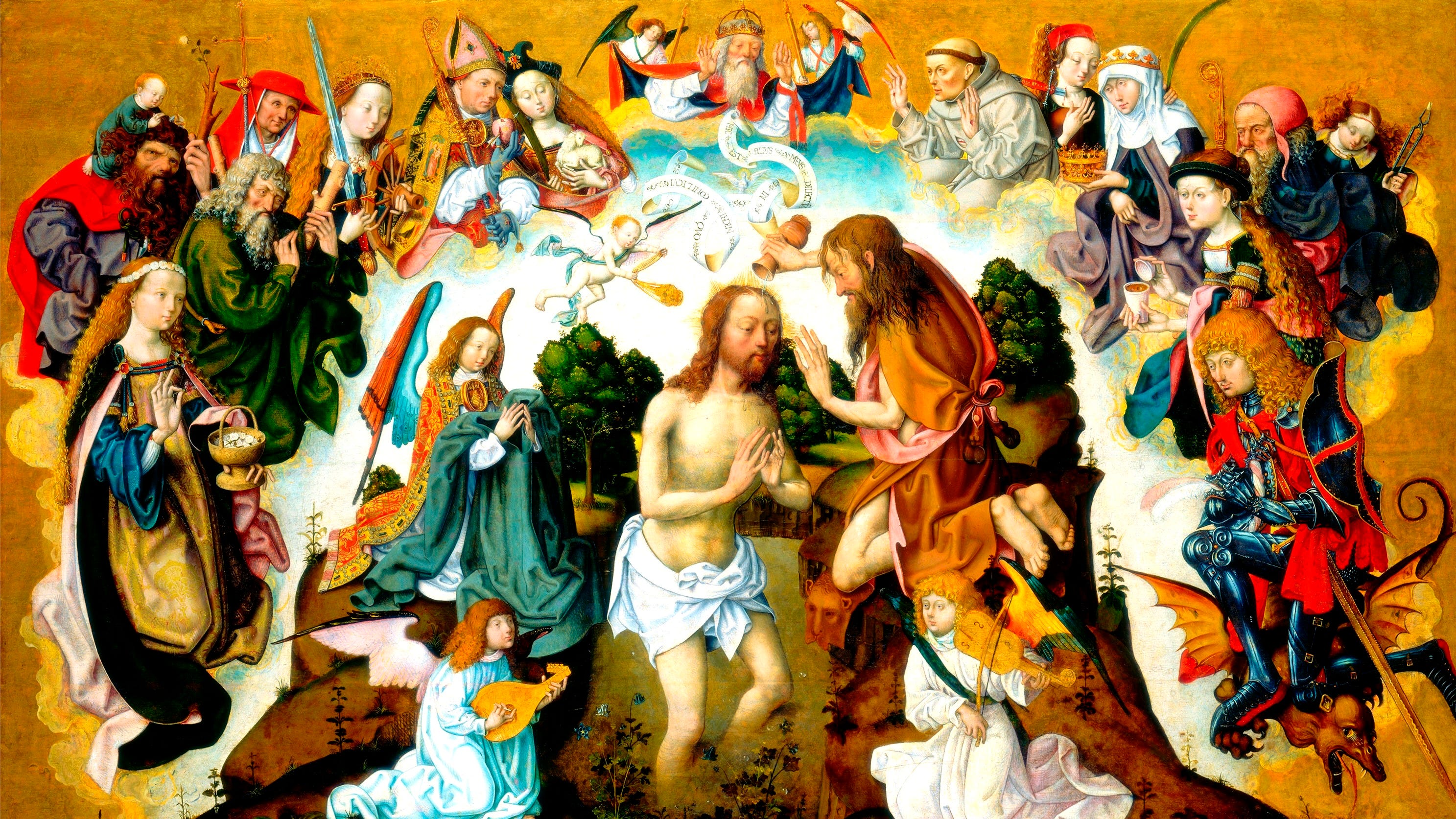
Christ’s humiliation at the Jordan was answered by exaltation and the institution of Baptism.
Editor’s notes
Before we proceed to the text: The WM Review’s Preparing for Total Consecration to the Blessed Virgin Mary series included Fr Aloysius Ambruzzi SJ’s meditation on the Baptism of Our Lord in podcast form. You can find that here:
For more context on this episode, see Part I.
In this part, Father Coleridge tells us…
How the opening of heaven revealed Christ as the living bond between God and man.
That the descent of the Holy Ghost manifested his anointing as head and source of grace.
Why the Father’s voice inaugurated his office as Mediator and giver of adoption.
He shows us that the Baptism of Christ publicly manifests the whole work of the Incarnation.
Baptism of Our Lord
From
The Ministry of St. John the Baptist
Fr Henry James Coleridge, 1886, Ch. III
St. Matt. iii. 13–17; St. Mark i. 9–11; St. Luke iii. 21–23;
Story of the Gospels, § 17
Why was Christ’s Baptism chosen as the moment of a divine theophany?
Why Christ’s humiliation in his Baptism had to precede his exaltation
Exaltation after humiliation
This manifestation of the dignity of His Humanity is considered by many holy writers as corresponding to the great humiliation by which our Lord lowered Himself, as has already been said, in submitting to seek baptism at the hands of His Forerunner—as if in this too were fulfilled the saying of St. Paul to the Philippians,1 that inasmuch as ‘He humbled Himself, being made obedient,’ therefore hath God highly exalted Him.
And the Fathers remark both that our Lord always signally humbled Himself before any great stage or act of His Ministry, and that the Father in His Providence always answered such humiliation by a great exaltation.
Sanctification of water
It remains to point out the further significance of the several parts of the mystery of our Lord’s Baptism in relation to the sacrament which He was now to institute as the fundamental source of grace in the Church.
In the first place, the Fathers tell us that in His own Baptism He sanctified the element of water that it might become in His own sacrament the instrument of that regeneration and of that adoption of sons which were to be conferred upon mankind. Thus they say that the old Adam was buried in the waters of His Baptism, which, as Suarez explains, may be understood in three ways. For that mystery was a representation and figure, showing how human nature was to be washed from sin in Christ and through Christ.
Again, the merit of the humiliation which our Lord then underwent was applied to the destruction of the sins of mankind, which were thus, as it were, buried in the waters of Jordan.
Burial of the old Adam
And lastly, as has been said, our Lord then gave to the waters the power of sacramentally healing and cleansing our poor human nature, the old Adam, which is thus buried, as St. Paul says, together with sin by baptism unto death.
Again, the sacrament of regeneration, which by the institution of our Lord is to be accomplished in the name of the Father, the Son, and the Holy Ghost, was founded and instituted at the moment of this great manifestation, in which the Three Persons of the Ever Blessed Trinity were each singly revealed: the Father in the Voice from heaven, the Son in the Person of our Blessed Lord Himself, declared to be so by the Voice of the Father, and the Holy Ghost in the visible appearance of the dove.
Again, the threefold privilege which is attributed in this mystery to the Sacred Humanity of our Lord, as has been pointed out above, is as it were stored up in the Sacrament of Baptism as the means of grace by which that privilege is conveyed.
For in it men are admitted again to have access to heaven, and are indeed made its heirs; they are enriched in their new birth with the gifts and presence of the Holy Ghost, and they are made the children and the sons of God the Father.
Institution of Baptism—in the Name of the Three Divine Persons
Thus, in this mystery we have both the meritorious cause, and the form, and the matter, and the effects and fruits of the great sacrament of regeneration set forth and manifested—that is, the action and Person of our Blessed Lord, the invocation of the Three Divine Persons, the water sanctified by our Lord’s touch, and the threefold privilege which has already been named more than once.
It is, moreover, the doctrine of many of the Fathers that the great Sacrament of Baptism was at this time not only virtually and meritoriously established, but also positively instituted by our Lord.
For, they say, a sacrament may be established by act as well as by word, and there is a clear analogy between this mystery and that of the Last Supper in this respect, that in each our Lord did two things: first, He approved and sanctioned what was old and figurative, that is, the legal Paschal supper in the one case and the baptism of St. John in the other; and, secondly, He established what was new and true and far more perfect, that is, in the one case, the Sacrament of His own Precious Body and Blood, and in the other, the Sacrament of Baptism.
Moreover, it seems clear that Christian baptism began to be administered very early in our Lord’s teaching, and indeed soon after this, and from this it is gathered that it must have been already instituted. And it could at no time have been more fittingly instituted than at this.
It must, however, be understood, that the obligation to Baptism as the door to the kingdom of heaven and the means of admission to the blessings of the Christian covenant, and of regeneration in particular, did not become obligatory on men until after our Lord’s Ascension into heaven and the descent of the Holy Ghost on the Day of Pentecost.
Significance of this manifestation
It is clear from the words of the Baptist to his disciples shortly after this, that he at least, as has been said, saw the visible sign of the descent of the Holy Ghost upon our Lord in the form of a dove, and we may thus fairly presume that he heard the Voice of the Father, and saw the heavens opened.
And yet it seems also to be the truth, that these marvellous signs were lost upon the great mass of the bystanders, and the whole manifestation passed away without leaving any great impression upon the multitude to whom it yet was of so transcendent an importance.
The silence and outward hiddenness which shroud so many of the great acts of God, had their place in some measure here, although the whole scene was essentially a manifestation, and a manifestation which was the object and end of the baptism of St. John, as he said himself, ‘that He may be made manifest in Israel, therefore am I come baptizing in water.’2
And yet we cannot contemplate the Baptism of our Lord without being struck with the magnificence and grandeur of the manifestation. It was no longer a star in heaven, testifying to the homage which the visible creation owed to its Master, Who had now become a creature, nor were the voices of the angels heard, to show that they too owned allegiance to the Child of Bethlehem.
The shepherds and kings, who were His earliest earthly visitors, the ancient oracles of the prophecies which were consulted and gave so true an answer as to the place of His Birth, were as nothing compared to the witnesses who here testified to the dignity of the Lord of the new Creation.
The scene was thronged with penitent crowds, the saint higher in office than all the prophets of the Old Testament stood by our Lord’s side, the appointed minister of the holy rite which was made the occasion of so great a display of supernatural majesty.
Never since the beginning of time had the Three Divine Persons manifested themselves so clearly, never had Man been so solemnly proclaimed as the beloved Son of God, never had benefits so immense been conferred on the human race as those which, as has been seen, were then granted to it through and in Jesus Christ, and represented by the circumstances of the manifestation itself.
Influence on our Lord’s life
Henceforth the earthly Life of our Blessed Lord becomes distinctly the Life of the Anointed One, the Messias, the Christ. Mystery after mystery is now to succeed, manifesting and exercising the attributes and prerogatives which belong to Him by virtue of that unction which is here sensibly represented.
The whole Public Life is founded on the mystery of the Baptism. Its culminating point, in which it issues in the foundation of the Church, which, in a certain sense, is a continuation of our Lord’s Life on earth, is the confession by St. Peter of his faith in that declaration concerning our Lord which is here made by the Voice of the Father, and in which St. Peter answers in the name of all, ‘Thou art the Christ, the Son of the living God.’
And the final act of our Lord, in regard to the application to the world of all that He had done and suffered, is His commission to the Apostles to ‘go and teach all nations, baptizing them in the name of the Father, and of the Son, and of the Holy Ghost.’
Baptism of Our Lord
Why was Christ’s Baptism chosen as the moment of a divine theophany?
Why Christ’s humiliation in his Baptism had to precede his exaltation
From Fr Henry James Coleridge, The Ministry of St. John the Baptist
Here’s why you should subscribe to The Father Coleridge Reader:
Coleridge provides solid explanations of the entirety of the Gospel
His work is full of doctrine and piety, and is highly credible
He gives a clear trajectory of the life of Christ and all its stages.
If more Catholics knew about works like Fr Coleridge’s, then other works based on sentimentality or dubious private revelations would be less attractive.
Sourcing and curating the texts, cleaning up scans, and editing them for online reading is a labour of love, and takes a lot of time.
Will you lend us a hand and hit subscribe?
Read next:


Follow our projects on Twitter, YouTube and Telegram:
Twitter (The WM Review)
Phil. ii. 9.
St. John i. 31.