

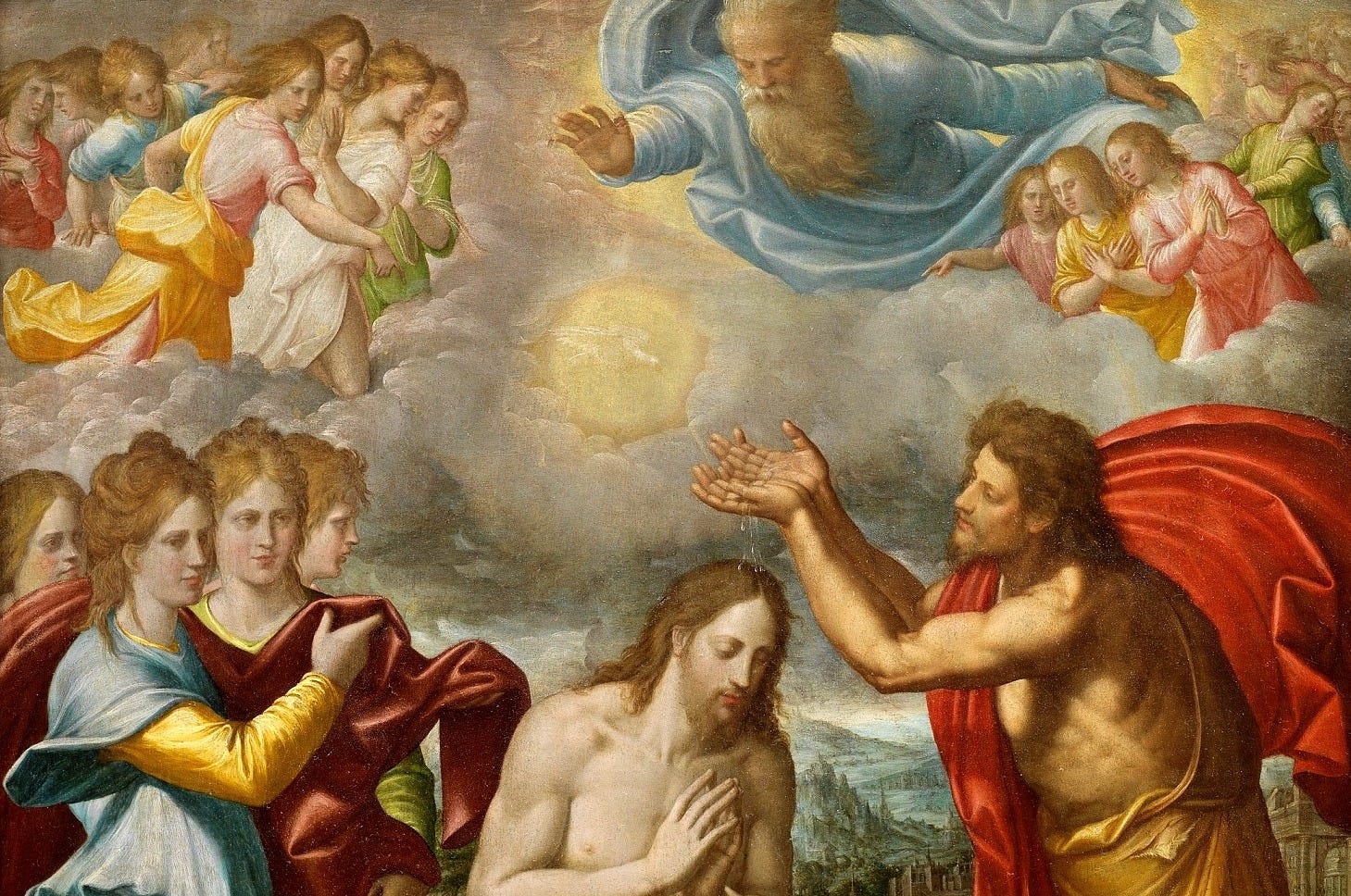
At the Jordan, heaven opened, the Holy Ghost descended, and the Father proclaimed his Son as the Saviour of men.
Editor’s notes
Before we proceed to the text: The WM Review’s Preparing for Total Consecration to the Blessed Virgin Mary series included Fr Aloysius Ambruzzi SJ’s meditation on the Baptism of Our Lord in podcast form. You can find that here:
For more context on this episode, see Part I.
In this part, Father Coleridge tells us…
How the opening of heaven revealed Christ as the living bond between God and man.
That the descent of the Holy Ghost manifested his anointing as head and source of grace.
Why the Father’s voice inaugurated his office as Mediator and giver of adoption.
He shows us that the Baptism of Christ publicly manifests the whole work of the Incarnation.
Baptism of Our Lord
From
The Ministry of St. John the Baptist
Fr Henry James Coleridge, 1886, Ch. III
St. Matt. iii. 13–17; St. Mark i. 9–11; St. Luke iii. 21–23;
Story of the Gospels, § 17
Mysteries at His Baptism
The accounts given by the Evangelists, when they are put side by side, tell us three principal things concerning this mystery.
In the first place, we are told that at the time of His Baptism (‘while He was praying,’ St. Luke adds, in accordance with one of the leading ideas of his Gospel), our Lord, ‘as He was going up straight out of the water,’ beheld the heavens opened; ‘the heavens were opened unto Him.’
Secondly, ‘He saw the Holy Ghost descending in bodily form like a dove, and abiding on Him.’
Thirdly, a Voice came from heaven, ‘Thou art My Beloved Son, in Thee I am well pleased.’ These, then, are the features in this mystery, on which Christian contemplation must feed itself.
The heavens opened
The opening of the heavens is said by the Evangelists to have been seen by our Lord; but this, as well as the visible descent of the Holy Ghost and the Voice from heaven, may have been perceptible to others also, as we certainly know to have been the case, at least as to the descent of the Holy Ghost, with St. John himself.
The other manifestations must be understood as implying each a particular spiritual truth with regard to our Lord’s office in the kingdom of God. To His beatified Soul, the heavens were always open: He was always living in the full possession of the vision of God, nor could heaven ever have been closed to Him from the moment of the Hypostatic Union.
The opening of the heavens must therefore be considered either as a manifestation of what always had been the case, and of this He Himself, to Whom the manifestation was primarily made, could have had no need; or it must have had reference to some power and privilege conferred upon Him with reference to the office which He was then taking upon Himself, and thus there would be a reason why such a visible declaration should have been made at that time.
His Sacred Humanity was the connecting link between heaven and earth: there could no longer be any division, any shutting out from the earth of the sight of heaven, when God was Incarnate upon earth, and a human soul and body personally united with the Godhead.
Jacob’s vision
There had been a vision of old, of one of the ancestors of our Lord, in which a ladder had been seen reaching from earth to heaven, and making a pathway along which the angels of God passed to and fro, ascending with prayers from earth and descending from heaven with blessings.
Such a ladder our Lord soon after this time declared that He, the Son of Man, was to become: ‘Ye shall see the heavens opened, and the angels of God ascending and descending upon the Son of Man,’ as upon the ladder of Jacob.
This union of the two natures in His Divine Person is the foundation of the other mysteries which were sensibly represented in the further unfolding of this wonderful manifestation. The Humanity of Jesus Christ opens heaven, not to Himself alone, but to all those to whom the fruits of the Incarnation are communicated by the exercise of His Mediatorial Office.
The descent of the Holy Ghost
The descent of the Holy Ghost in a visible shape upon Him was a manifestation of the same kind as the opening of the heavens. From the first moment of the Union, the Soul of Jesus Christ had been filled to overflowing and without measure by the Holy Ghost.
It was not possible that this fulness could be increased at any time, any more than that it could begin at any moment later than that of the Union or ever cease. But here again, without being merely a manifestation symbolising what always had been the rich endowments of His Soul, the visible appearance of the Holy Ghost at this moment signified that the anointing and consecration of our Lord had been for the special purpose of the office of which He was now about to undertake the external functions.
‘Jesus of Nazareth, how God anointed Him with the Holy Ghost and with power,’ were the words in which St. Peter afterwards spoke of our Lord and His work to the first Gentile converts.1
This was the visible fulfilment in Him of the twofold prophecy of Isaias,2 that the ‘Spirit of the Lord should rest upon Him, the spirit of wisdom and understanding, the spirit of counsel and fortitude, the spirit of knowledge and piety, and He shall be filled with the spirit of the fear of the Lord,’ and that other which He Himself quoted in the synagogue at Nazareth, ‘The Spirit of the Lord is upon Me, because the Lord hath anointed Me, He hath sent Me to preach to the meek,’ and the rest.
This descent of the Holy Ghost represents that fulness of His of which we have all received, the grace first bestowed upon Him in order that from Him it may overflow to all others who are joined to Him. And the outward form of the dove seems to have represented the tenderness, simplicity, and gentleness which are the characteristic qualities of the dispensation of the Incarnation and of the first advent.
The Voice from heaven
The Voice from heaven which declared our Lord to be the well-beloved Son of the Eternal Father, in Whom He was well pleased, did not, of course, confer any new Sonship or adoption upon our Blessed Lord.
As to this again, all had been perfectly accomplished at the moment of the Hypostatic Union, when the human nature was assumed by the Son of God. What took place now was a solemn declaration of His Sonship, but a solemn declaration which was at the same time the inauguration of His Office as Mediator, whereby He was to be the author and giver of the adoption of sons to those who belong to Him.
‘For to as many as received Him, to them gave He power (authority3) to become the sons of God,’ the Eternal Sonship was communicated to them in such a way as it was possible for it to be communicated. He imparted to them His own relationship to the Father in such a manner as it is possible for sons of adoption to share that filiation.
Thus, to open heaven to mankind by means of His own Humanity, to be anointed with the fulness of the Holy Ghost as the Head of mankind, the new Adam, the source from which the graces of the Holy Ghost were to be communicated to men, and to place them in the dignity of the relation of sons to the Eternal Father, were three prerogatives of His mediatorial office which were solemnly confessed, manifested, and proclaimed in the mystery of His Baptism.
Baptism of Our Lord
From Fr Henry James Coleridge, The Ministry of St. John the Baptist
Here’s why you should subscribe to The Father Coleridge Reader:
Coleridge provides solid explanations of the entirety of the Gospel
His work is full of doctrine and piety, and is highly credible
He gives a clear trajectory of the life of Christ and all its stages.
If more Catholics knew about works like Fr Coleridge’s, then other works based on sentimentality or dubious private revelations would be less attractive.
Sourcing and curating the texts, cleaning up scans, and editing them for online reading is a labour of love, and takes a lot of time.
Will you lend us a hand and hit subscribe?
Read next:


Follow our projects on Twitter, YouTube and Telegram:
Twitter (The WM Review)
Acts x. 38.
Isaias xi and lxi.
ἐξουσίαν, St. John i. 12.