

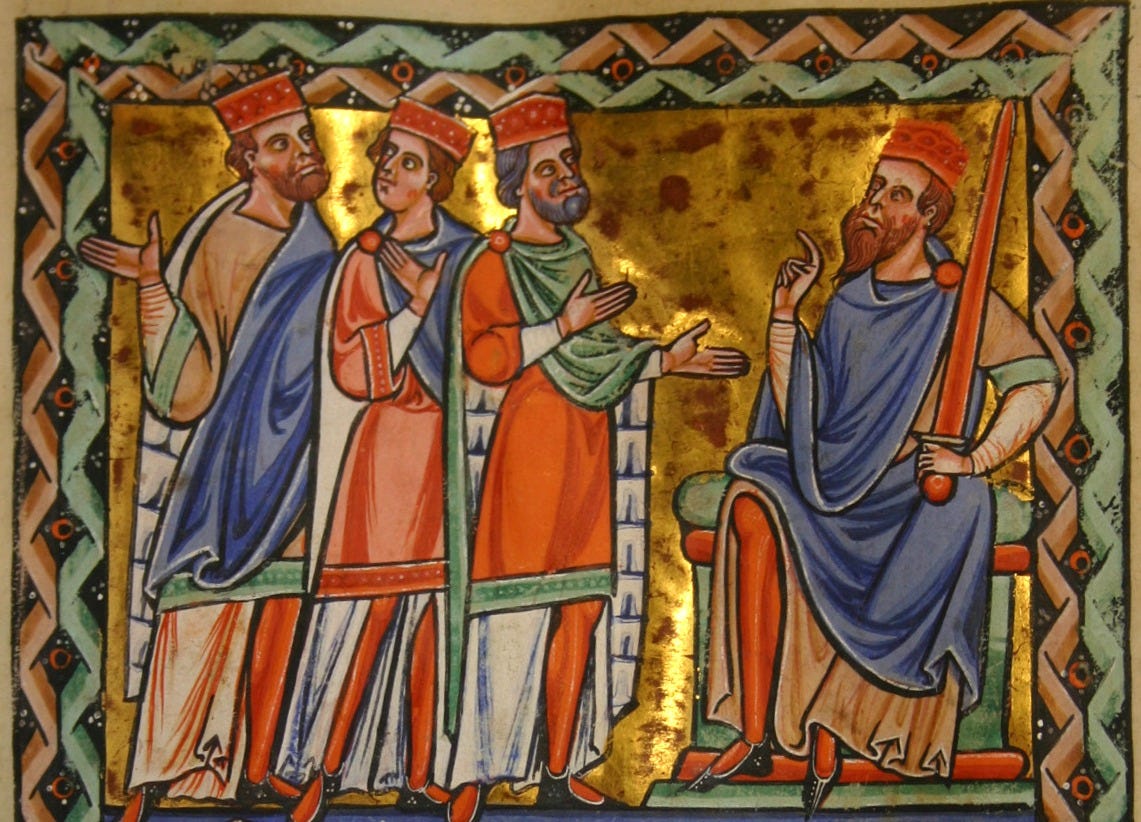
The Magis’ candour leaves them exposed to human malice, and yet God leads them through danger – into a joy no earthly power can give.
Editor’s Notes
Epiphany is one of the great feasts of the Church. It is not simply the end of Christmastide and the beginning of a “waiting game” before Septuagesima. It represents, in some ways, the culmination of the entire liturgical cycle, and also the culmination of time.
Historically, it was understood to commemorate not just the visit of the Wise Men, but also the Baptism of Christ and the Wedding at Cana. This is very clear in Eastern liturgical texts, although it is more muted in the Roman rite. Nonetheless, the Divine Office draws these three event together:
Benedictus Antiphon
This day is the Church joined unto the Heavenly Bridegroom, since Christ hath washed away her sins in Jordan; the wise men hasten with gifts to the marriage supper of the King; and they that sit at meat together make merry with water turned into wine. Alleluia.
Magnificat Antiphon
This day we keep a holiday in honour of three wonders, this day a star led the wise men to the manger; this day at the marriage, water was made wine; this day was Christ, for our salvation, pleased to be baptized of John in Jordan. Alleluia.
Exactly why the Church links these three events is discussed elsewhere:

However, in this mini-series, we will be considering the event which occurs first in Christ’s life – namely, the coming and adoration of the Magi.
Although the Presentation takes place nearly a month after Epiphany, Coleridge refers to the Presentation in the Temple as already having taken place. Earlier in the text, he discusses when the Magi arrived, and places this event approximately one year after the Nativity – but certainly after the Purification.
Is this strange? No more strange than the feast of the Holy Innocents taking place before the feast which commemorates the Magi. It is interesting to note that Annibale Bugnini, the “Grand Architect” of the liturgical reform, was himself troubled by this disconnect between the liturgical commemorations and the historical events, as can be seen in an article translated by Peter Kwasniewski.
Naturally, Bugnini wanted to rationalise the calendar in order to conform it to the historical events. However, this is an unsound and unnecessary anxiety, and there is no need for these feasts to be in strict chronological order, as if they were intended to re-live the life of Christ in a performative way.
In this passage, Fr. Coleridge tells us:
How the Magi’s simplicity exposed them to danger, yet left them entirely in the hands of God’s providence.
That God used both the malice of Herod and the authority of Jerusalem to bear public witness to Christ’s birth.
Why their faith was tried by coldness, delay, and obscurity before being crowned with overwhelming joy.
He shows us that God often permits His servants to pass unprotected through human treachery, so that their trust may rest wholly in Him and their joy be unmistakably divine.
The Epiphany
The Thirty Years—Our Lord’s Infancy & Hidden Life
Chapter X
St. Matt. ii. 1—12; Vita Vitæ Nostræ, § 12.
Burns and Oates, London, 1885. (1915 edition).
Headings and some line breaks added.
Simplicity of the Princes
The great simplicity of the holy Princes made them the easy dupes of the astute craft of Herod, though God had determined in His providence not to allow them to be injured by their candid openness with the tyrant, who was to be baffled by his own devices.
He had probably intended to lay violent hands on them as well as on the Child Whom they came to visit, and he thought it better to leave their homage to be paid without notice or molestation. He carefully informed himself, by the questions which he asked them, as to the length of time which had elapsed since the apparition, or apparitions, of the miraculous star. We have seen what may have been his purpose in this, and it is easy to understand how full he must have been of anxious curiosity as to every detail which concerned the Infant King.
It was by this questioning of the Wise Princes that he arrived at the conclusion on which he afterwards acted, in the massacre of the Innocents, that the Child might be less than one year of age, and could not be as much as two. In explanation of this something has already been said.
They leave Jerusalem
These blessed Sages had no suspicion, as it appears, of the snare that was being laid for them. It is the privilege of simplicity to think others as simple as itself, to imagine no evil, to trust all and be open with all, and at the same time to be preserved, by the providence of God, from all the dangers which beset the unguarded and unsuspicious in a world such as this.
If Herod had had an Achitophel by his side, he would probably have been counselled not to let them go away unattended. If he had sent an armed guard with them, he might have at once seized on the Holy Child. Perhaps, if he had been himself a counsellor under such circumstances, he would have given the same advice. But he was blinded by the providence of God, watching over the Child and His visitors alike.
So the holy pilgrims set out, perhaps amid the sneers or the silent criticism of many of the inhabitants of the Holy City, to find their way over the few miles which separate Bethlehem from Jerusalem. The King turned to his banquet or the luxurious amusements of his palace. The priests and scribes went home or to the Temple, without much thought about the strange witness they had just borne to the truth.
Or perhaps if they were aroused from their worldly lethargy by the presence of the strangers, they feared to compromise themselves with Herod if they took any active part in the adventure on which these strangers were engaged. Some laughed at their credulity, others wondered how Herod had let them go so cheaply, others speculated on the measures on which the crafty tyrant must be brooding for their destruction. The people of Jerusalem knew their master, and were not inclined to brave the outburst of his unscrupulous anger.
Interview with Herod
The story of St. Matthew is so concise, so entirely confined to the necessary features in the mystery, that there may, and indeed must have been, a number of incidents in the stay of the holy Princes in the city before their departure, of which we have no account. We only learn that they were admitted to the King’s presence and carefully examined by him, from the necessity which required the mention of this interview when the Evangelist has to explain the reason for the precise order given by Herod as to the massacre of the holy children, after the strangers had departed.
We know that there were at least some in Jerusalem who had themselves seen the Holy Child, and who were partners in the Divine secret of His Birth and Mission. Simeon could hardly have failed to be among the scribes and priests who had been summoned to the palace to give the authoritative answer as to the appointed place of the Birth of the Messias. The sensation produced in the city by the appearance of these remarkable strangers could hardly have been unknown to Anna and the little band of devout worshippers in the Temple, who were expecting the consolation of Israel.
It is very possible that the Wise Princes had some communication with some of these persons, and have been rejoiced to learn from them that the Holy Child had been seen in the Temple. But we are not told that they knew from whence He had come, much less that they could give any information as to His present abode.
Providence of God
It was the ordinance of God, for many holy purposes of His own, that the Princes should not learn the place of the Birth of our Lord by any private information, but by the most solemn and authentic witness of the Jewish Church itself, elicited at the formal request of the secular power then in possession of the throne.
But it is pleasant to think that there may have been at least a few chosen souls in that sacred city who cordially sympathized with the strangers in their devotion to the new-born King, that He was not left without some kind of witness when it might have been looked for with the greatest certainty, at this most important moment of the unfolding of the designs of God as to His Person and His Mission.
The visit of the Kings must have been very short. They would be anxious to accomplish their quest, and Herod would be equally anxious not to let them stop in the city to spread the report of the Birth of the promised Messias.
The priests would look on them as intruders, who could have nothing to do with the King of the Jews if He had come, and whose devotion and faith were rebukes to their hardness and worldliness of heart.
The Magi without curiosity
The day may have been far advanced, when the little caravan of the Wise Princes passed out of the Jaffa Gate, as it is now called, on the way to Bethlehem. They hoped to reach the little city before it was deep in the night. Their eager devotion made them press on. There was little in Jerusalem to attract them in comparison with the one great object of their journey, and, however magnificent may have been the Temple with its services and its sacrifices, they were not proselytes, and had perhaps little knowledge of the ceremonial and sacrificial system of the Mosaic Law.
In any case, Jerusalem and the Temple might be left, and might be visited on their return, for they had engaged with Herod that they should come back to give him an account of what they found. So they went on their way, happy and without fear. They had but one thing to do, and they thought of little else. Bethlehem was not a large city, and there, at all events, they might expect little difficulty in finding the marvellous Child.
He was evidently unknown, as yet, in Jerusalem, but wonders sometimes make their way but slowly in the public knowledge. Bethlehem would be full of Him, and they would not be received with the strange coldness and surprise which had greeted them in the capital.
The Star again seen
Such may have been their thoughts, and then, as they went on their way, and were drawing near to the end of their journey, a bright light shone out in the darkening heavens. The star which they had seen in the East was flaming over the hill on which Bethlehem stood. As has been said, we are not told that it had led them on the way, but only that they had seen it in the East.
It may have been visible, not only at the time of the Incarnation and of the Nativity, but at the outset of their journey. At all events, they had lost sight of it when they came to Jerusalem. Jerusalem was the seat of authority, the Synagogue was in many respects in the place now filled by the Catholic Church, and so it belonged to the priests there to interpret the prophecies, by which the birthplace of the Messias had been fixed. It was from them, then, that the Princes were to learn the exact spot of the Birth of the Child.
But Jerusalem had done its office for them, and it only remained for them to find the blessed spot in Bethlehem hallowed by His presence. There could be no official witness as to the house where the Child was to be found, and God chose to lead them to His feet by the same miraculous guidance which had given the first impulse to their adventure.
The great joy
“And seeing the star, they rejoiced with exceeding great joy.”
Their faith had had its trial in the cold reception which had met them at Jerusalem. It was not that they themselves were made light of, almost laughed at, as having taken so much pains on an uncertain errand. It was rather that at Jerusalem, if anywhere, they might have hoped to find, not only sympathy for themselves, but, what was far more important, a living and enthusiastic faith in the new-born King and in the work which He was sent on earth to do. This had been wanting in the very centre and capital of that chosen nation out of which the blessing of the universal world was to come.
Their simplicity and candour kept them from losing their faith or courage substantially, and perhaps they hardly knew how much the external circumstances which they had encountered had affected their spirits, until the reappearance of the star roused up in their hearts this exceeding great joy. Their joy was the intense spiritual joy with which God can overwhelm the soul when He chooses to pour into it His consolations, to caress it, and shower on it His endearments after a time of desolation and trial.
All men are naturally joyous when they see the end of a long enterprise, the success of an undertaking which has cost them much, especially if the result, which is now close at hand, is a great blessing and a great delight. But beyond this natural joy, we must suppose that the words of the Evangelist signify a joy not simply human, but Divine, a spiritual elevation and happiness which no one but God can give, and which He gives in very large measure indeed to those whom He deems worthy of it. For the saints of God have constantly felt themselves even overstrained, and taxed beyond their power, by the excessive delights with which their souls are visited on such occasions as these.
They have been fain to cry out to God to moderate His overpowering visitations, that they may be able to bear them, if it is not His will to take them altogether out of the world to a new state of being, where they may be more fit for such favours.
The Epiphany
Here’s why you should subscribe to The Father Coleridge Reader and share with others:
Fr Coleridge provides solid explanations of the entirety of the Gospel
His work is full of doctrine and piety, and is highly credible
He gives a clear trajectory of the life of Christ, its drama and all its stages—increasing our appreciation and admiration for the God-Man.
If more Catholics knew about works like Coleridge’s, then other works based on sentimentality and dubious private revelations would be much less attractive.
But sourcing and curating the texts, cleaning up scans, and editing them for online reading is a labour of love, and takes a lot of time.
Will you lend us a hand and hit subscribe?
Follow our projects on Twitter, YouTube and Telegram:
Twitter (The WM Review)