

The Baptism of Christ was the opening of his ministry – here’s what happened just before.
Editor’s notes
The octave day of Epiphany traditionally emphasised the Baptism of the Lord by St. John the Baptist. In later times, this day – 13th January – has come to be treated as the feast (or commemoration) of this event. The Gospel reading at Mass for this day highlights St. John’s direct identification of Christ as the Messias. Here, however, we present Fr. Coleridge’s commentary on the baptism itself – as well as his departure from Our Lady.
But before we proceed to the text: The WM Review’s Preparing for Total Consecration to the Blessed Virgin Mary series included Fr Aloysius Ambruzzi SJ’s meditations on both his departure and the Baptism of Our Lord in podcast form. You can find them here:
The Baptism of Christ in the Liturgical Year
The links between the Baptism and the Epiphany are illustrated in the Roman Liturgy in an intriguing way. While the octave day is connected to the Baptism of the Lord through the texts of the Divine Office and the Gospel reading about St. John the Baptist, the Mass propers only indirectly reference the baptism, consisting of repetitions from the feast of Epiphany. This seeming omission does not downplay the baptism but rather emphasises its “epiphanic” nature and its liturgical connection with the manifestation of Christ's divinity at Epiphany.
For this reason, the octave day and commemoration of the Baptism liturgically stand as the culmination of the Christmas period and the full inauguration of Epiphanytide.
It is also a fitting thematic conclusion to the Advent-Christmas-Epiphany cycle. The Advent lectionary of the Traditional Latin Mass prominently features St. John the Baptist as the Forerunner, calling for repentance and pointing to the coming Messias. Interestingly, the Advent Gospel readings follow a reverse chronological order:
The last witness of St John the Baptist (and Our Lord’s witness to him)
St John the Baptist’s declaration of his mission under inquiry
At Christ’s Baptism, John’s mission reaches its fulfilment as he identifies Jesus as the Lamb of God. This moment reveals the glory prepared during Advent, manifesting Christ publicly as the Son of God and inaugurating His public mission. Thus, the octave of Epiphany and the Baptism of the Lord fittingly conclude what was begun in Advent and point forward to the coming seasons of Septuagesima, Lent, Passiontide, and Eastertide.
This progression also highlights the central role of the Forerunner, St. John the Baptist, during this sacred period. A deeper appreciation of his role may help rekindle devotion to him, of whom Our Lord said:
“There hath not risen up among them that are born of women a greater than John the Baptist.”
In this part, Father Coleridge tells us…
Why Christ’s Baptism marked a pivotal moment in His public ministry and redemptive mission.
How the manifestations at His Baptism revealed the Triune God and established the foundation of the Sacrament of Baptism.
What spiritual truths underlie Christ’s humility in receiving John’s baptism and His solemn anointing as Mediator and Redeemer.
He shows us that the Baptism of our Lord was not only an act of humility but also the beginning of his mission, unveiling His role as the source of grace, the sanctifier of creation, and the beloved Son of the Eternal Father.


Baptism of Our Lord
From
The Ministry of St. John the Baptist
Fr Henry James Coleridge, 1886, Ch. III
St. Matt. iii. 13–17; St. Mark i. 9–11; St. Luke iii. 21–23;
Story of the Gospels, § 17
Expectation created by St John’s preaching
The preaching and baptism of St. John had continued, as it seems, for several months and must have moved a large portion of the Jewish nation, at all events to a temporary return to God from sin, and to a more eager expectation of the coming Messias, of whom the Baptist had spoken so plainly.
Powerful as was the impulse given by St. John to all the better and higher elements in the public mind, he was yet in great measure and professedly only a teacher who was preparing the way for One greater than himself, by the perfect innocence and lofty purity of his example, as well as by his preaching of penance and administration of baptism.
The expectation and longing desire of so many souls was now to be answered, but in the way which characterises the great works of God. There was to be a great manifestation, and yet it was to be a manifestation which it required purity of heart and a discernment of spiritual greatness to recognise: a manifestation which, like those which had preceded it in the economy of the Incarnation, was to be addressed to those only who could, to some extent, weigh things in the scales of heaven.
St. Paul more than once speaks as if it were the counsel of God that the mysteries of our Lord and of His Church should be unfolded before the angels for their wonder and instruction as much as, if not more than, to men,1 and we may certainly believe that the true greatness and magnificence of the manifestation which was now to take place on the banks of Jordan were far more truly understood and adored by the angels who witnessed the mystery than by any others, unless we except the blessed Baptist himself, who was the minister in this great work of God.
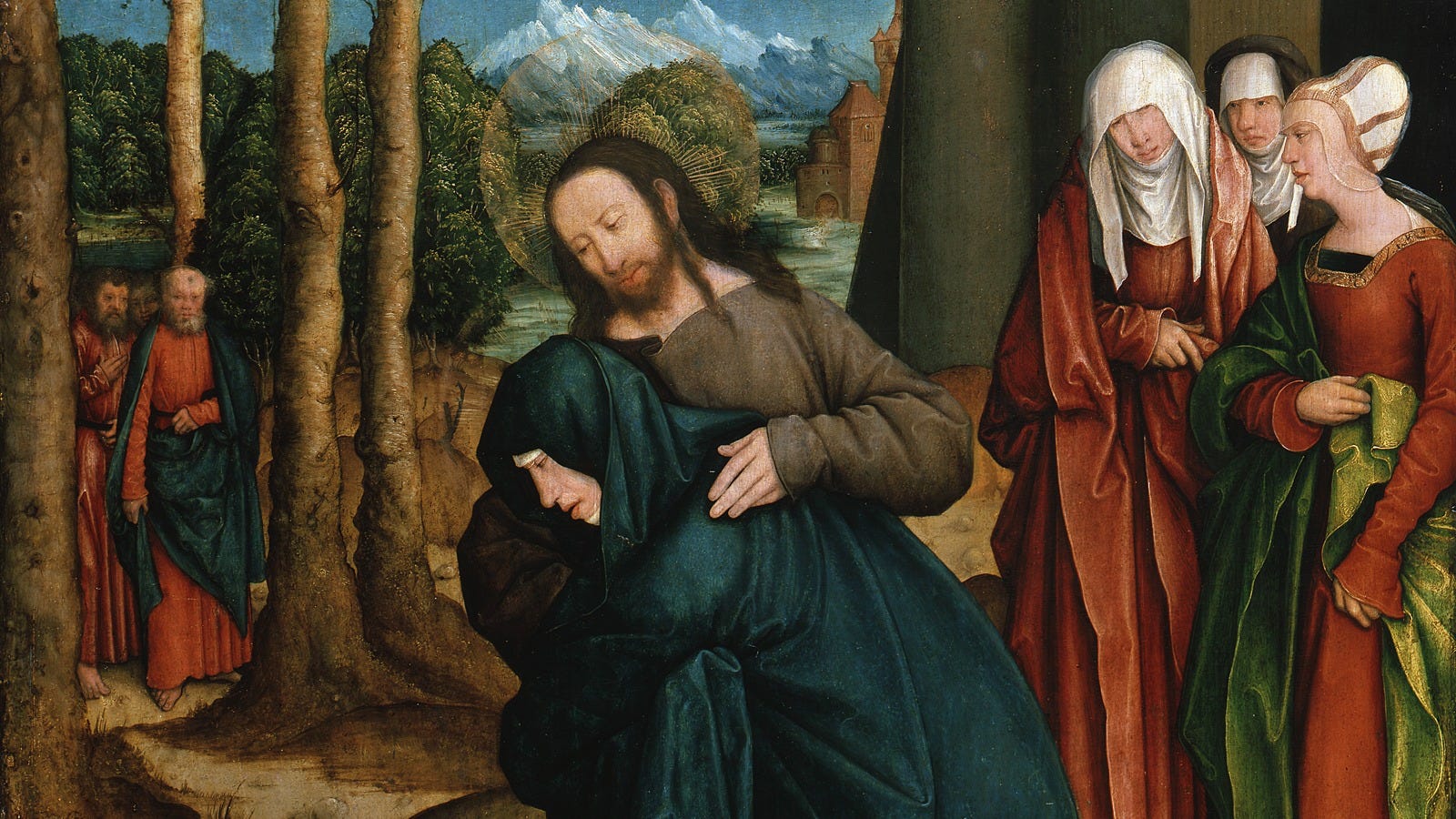
Our Lord leaving Nazareth—parting from Our Lady
Holy contemplative souls have often loved to dwell on the leave-taking which passed between our Lord and His Blessed Mother at Nazareth, when the moment had come at which it was the will of the Father that Jesus Christ should take His departure from the home where He had so long dwelt in humility, obedience, and obscurity.
Our Lady was now alone; her Blessed Spouse had some time before breathed out his soul in the arms of Jesus, and with Mary praying by his side, dying the most blessed of deaths, and winning, by his perfect resignation to the sacrifice entailed on him by such a parting, the prerogative which belongs to him in the Church as the patron and father of all holy deaths.
Many of our Lady’s relations lived in Nazareth, and it seems as if that family of cousins of our Lord, who go in the New Testament by the name of His brethren, either now or before this had come to live with her or near her. What we know about her at the departure of our Lord rests upon the pious instincts of the Christian imagination as well as on the theological belief of all ages as to our Blessed Lady’s consummate perfection of sanctity, and the absolute union of her will with that of God.
But on neither ground are we to conclude that the separation was not a matter of intensest pain, or that our Lady’s heart was steeled against the suffering natural on losing the constant companionship of a Son between Whom and herself there was a bond of love, the tenderness of which was in proportion to the sanctity and lovableness of both, or against the apprehension of what might happen when He was exposed to the rude indifference of men who knew Him not.
Now was the time for the fulfilment of Simeon’s prophecy of the sword which should pierce her heart, or rather that prophecy had already had its fulfilment in anticipation when our Lord had remained alone in the Temple.
The three days during which our Lord had left her when He was a lad of twelve years had prepared her for this parting. The three days were to become three years—not indeed of separation, for she was constantly with Him, and her heart was most closely united to His—and then she was to see Him, not in the full beauty and vigour of perfect manhood, passing with grave joy along the path over the hills which led towards the Jordan valley, but hanging in the agony of death and in the extremest dishonour and suffering upon the Cross, which was the instrument of the redemption of the world.
Bethany beyond Jordan
‘Bethany,2 beyond Jordan,’ the spot where St. John was baptising, seems to have been near the fords by which travellers passed from the eastern bank to the neighbourhood of Jericho, on their way to Jerusalem.
As this was the common and easiest route even from Galilee, and much more from Peræa, to Jerusalem, it was a convenient spot for the multitudes who came to St. John from all parts, as we cannot doubt, though the Evangelists speak directly of Jerusalem and the region of Judæa only.
From what we know of the disciples of St. John, among whom were numbered many who had certainly come to him from the distant part of the Holy Land in which Nazareth lies, we gather that the fame of the new preacher had reached Galilee, and that our Lord may not have been alone in the pilgrimage to the Jordan.
The Evangelist speaks as if He approached the Baptist in the midst of the crowd. He presented Himself, like any one else, but the spiritual discernment of St. John at once recognised Him, ‘I have need to be baptised by Thee! and dost Thou come to me?’ But Jesus answering, said to him, ‘Suffer it now; for thus doth it become us to fulfil all justice. Then he suffered Him.’
His modesty and humility
St John’s perfect intelligence concerning the dignity of Him who thus came to receive baptism at his hands cannot be questioned.
The words show that he recognised the universal necessity of the baptism which our Lord was to establish and administer—a necessity arising out of the positive arrangement of God, as well as from the immense spiritual benefits which He had attached to Christian baptism as their ordinary and appointed vehicle.
St. John had been sanctified and filled with the Holy Ghost even in his mother’s womb, but this did not exempt him from the general law as to baptism. We may notice also the modesty and gentleness of his humility, remonstrating with our Lord rather by a simple question than in the abrupt, positive manner afterwards used by St. Peter when he refused to let our Lord wash his feet at the Last Supper.
Nothing more was required to make him yield to perform an office in itself so repugnant to his knowledge of his own lowliness and of the high dignity of our Lord, than the simple words which the latter addressed to him:
‘Suffer it now! It is true, as thou sayest, that I have to baptize thee, that I am above thee and before thee, that thou art My minister, and that any rite or gift that confers or represents sanctification ought to pass from Me to thee and not from thee to Me. It is true that I am He that baptizeth in the Holy Ghost, and that thou must be made partaker of My baptism. But this which thou art to do is what is becoming and right in order that we may fulfil all justice—that nothing may be omitted which perfect obedience to My Father and the practice of perfect virtue under our circumstances make requisite.’
Baptism of Our Lord
From Fr Henry James Coleridge, The Ministry of St. John the Baptist
Here’s why you should subscribe to The Father Coleridge Reader:
Coleridge provides solid explanations of the entirety of the Gospel
His work is full of doctrine and piety, and is highly credible
He gives a clear trajectory of the life of Christ and all its stages.
If more Catholics knew about works like Fr Coleridge’s, then other works based on sentimentality or dubious private revelations would be less attractive.
Sourcing and curating the texts, cleaning up scans, and editing them for online reading is a labour of love, and takes a lot of time.
Will you lend us a hand and hit subscribe?
Read next:


_-_Christ_Taking_Leave_of_His_Mother_-_1197A_-_Gem%C3%A4ldegalerie.jpg)
Follow our projects on Twitter, YouTube and Telegram:
Twitter (The WM Review)
Tim. iii. 16 (ὤφθη ἀγγέλοις). Eph. iii. 10.
Bethany, the reading of the Vulgate, is now generally received as the better reading on the authority of the uncial manuscripts. The meanings of Bethany and Bethabara—which used to be the received name—apply equally well to the place, as the first is ‘the house of the ship,’ or ferry-boat, the other ‘the house of the ford.’