

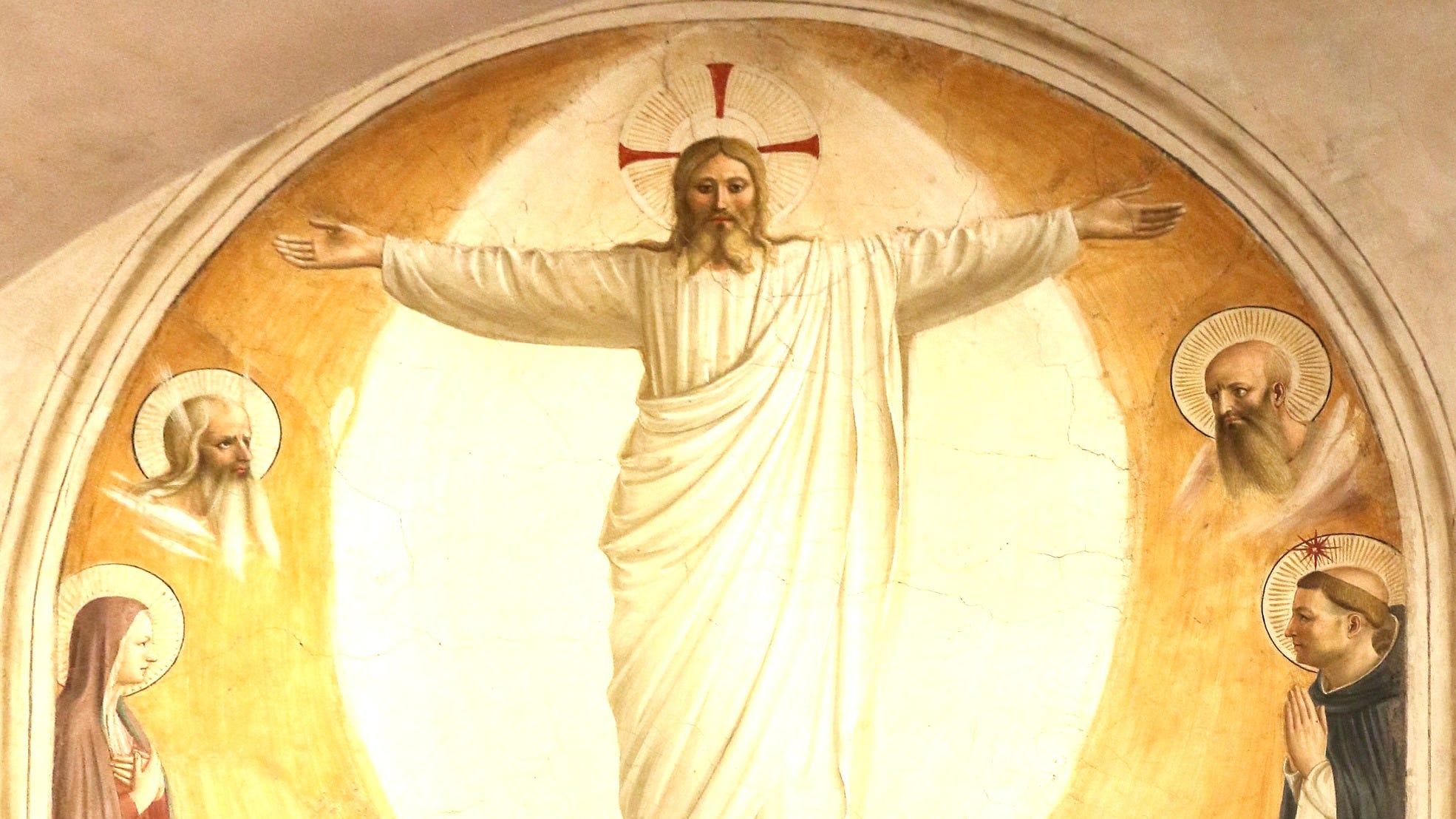
God the Father puts his seal on Christ's mission at the Transfiguration.
Editor’s Notes
Continuing the series on the Transfiguration, started in Lent.
In this piece, Fr. Coleridge tells us…
How the Transfiguration reveals Christ’s divine Sonship through the Father’s testimony.
That this revelation confirms Christ as the fulfilment of the Old Testament Law and Prophets.
Why the Father’s command to ‘hear ye Him’ marks Christ as the definitive Teacher of mankind.
He shows us that Christ is the chosen instrument of divine grace, and in him alone is our salvation.
For more context on this episode, its significance and its place in the Roman Liturgy, see here:

The Transfiguration
The Preaching of the Cross, Part I
Chapter III
St. Matt. xvii. 1–13; St. Mark ix. 1–12; St. Luke ix. 28–36
Story of the Gospels, § 83
Burns and Oates, London, 1886
Headings and some line breaks added.
Sung on Ember Saturday of Lent, the Second Sunday of Lent and the Feast of the Transfiguration (August 6)
Why did Christ reveal his transfigured glory before the Passion?
Why is the Transfiguration placed at the turning point of Christ’s public life?
Why did Christ command secrecy about the Transfiguration until after Easter?
The bright cloud and the voice
‘And as he was yet speaking these things, there came a bright cloud and overshadowed them, and they were afraid when they entered into the cloud. And lo a voice came out of the cloud, saying, This is My Beloved Son in Whom I am well pleased, hear ye Him. And the disciples hearing fell on their faces and were very much afraid. And whilst the voice was uttered, Jesus was found alone. And Jesus came and touched them, and said to them, Arise, and fear not. And immediately looking about they saw no man any more, and lifting up their eyes, they saw no one but only Jesus.’
It is clear that this part of the manifestation is altogether distinct from the other. The display of glory in our Lord’s Human Body and in those of the two ancient Saints passes away, and gives place to another mystery which forms one of the two great manifestations of the Ever Blessed Trinity which are related in the Gospels. Our minds are at once carried back to the Baptism of our Lord, with which this scene is directly connected by the Words of the Father. The order of what is here related seems to have been, that while St. Peter was speaking about the three Tabernacles, the bright cloud gathered, as it were, in the air, and enfolded in itself our Lord and the two ancient Saints, while at the same time it overshadowed the three disciples, and in some measure tempered the excessive brightness which dazzled their eyes.
In the words of St. Luke, the distinction is made between the two sets of three. The fear of the disciples is attributed to the entrance of the ‘others’ into the cloud. After this comes the voice from Heaven, on hearing which the disciples prostrate themselves, as in the presence of God, and then after awhile, our Lord comes and touches them, and they find themselves alone with Him.
Clouds in the Old Testament
The cloud of which the Gospels speak is connected by many of the Catholic writers with the cloud out of which God spoke to Moses and to the people of Israel at the time of the giving of the Law, and especially at the time when the promise was made of the Prophet who was to be raised up like unto Moses. Indeed, it is common in the Old Testament to find God speaking to those whom He so favours out of a cloud. Thus the appearance itself of the cloud may have prepared the disciples for some further communication as from God Himself. And this may have added to their fear.
This cloud is said by St. Mark to have been bright and shining, and some of the Fathers see in this a distinction to be noted between the New and the Old Testaments, the cloud on Mount Sinai having been dark. St. Peter, from whom St. Mark must have had his description, speaks of the cloud as the ‘excellent glory,’1 as if there had been something very splendid and glorious about the appearance. St. Paul, in the second Epistle to the Corinthians, has a great passage in which he contrasts the ministries of the two Testaments respectively on this particular point of glory.
He reminds the priests of Corinth, to whom he is writing, of the glory of the Old Covenant, how the children of Israel could not steadfastly behold the face of Moses, for the glory of his countenance, which, he says, ‘is made void,’ and he argues, ‘ How shall not the ministration of the Spirit be rather in glory?’ that is, more glorious than the ministration of the letter. Then he goes on to say that Moses had to put a veil on his face that they might be able to bear its splendour thus veiled, and he says that the Jews have still that veil upon them when Moses is read to them, but on the other hand:
‘We all beholding the glory of the Lord with open face, are transformed into the same image from glory to glory, as by the Spirit of the Lord.’2
Fear of the Apostles
‘And they were afraid as they entered into the cloud,’ both from the awfulness of so much glory, and also perhaps at finding themselves separated from the others, for our Lord, with Moses and Elias, was enfolded in the cloud from which they were themselves excluded.
The Voice from the cloud was the Voice which had been heard from Heaven at the time of our Lord’s Baptism, spoke in the Person of the Eternal Father Himself, and gave the same testimony to our Lord in words almost identical with those which had then been heard, at least by St. John Baptist, if not by others, among whom it is not impossible that his disciples may have been, among whom these three Apostles had been numbered at the time.
On the former occasion the words seem to have been in the first instance addressed to our Lord Himself, ‘Thou art My Beloved Son,’ and the rest, and afterwards repeated for others, ‘This is My Beloved Son.’ At the time of the Transfiguration there seem not to have been any words directly addressed to our Lord. On the other hand, the injunction, ‘Hear ye Him,’ occurs on this occasion alone.
The rest of this part is for paid annual/monthly subscribers.
Father Coleridge Reader is a labour of love. But curating, cleaning up and publishing these texts takes real work.
To keep this project going, and to make more of this treasury available, we rely on reader support. Some posts are reserved for members to sustain this mission.
We’re trying to keep something precious alive.
If you’ve benefited, consider joining us as a subscriber. It makes a real difference.