

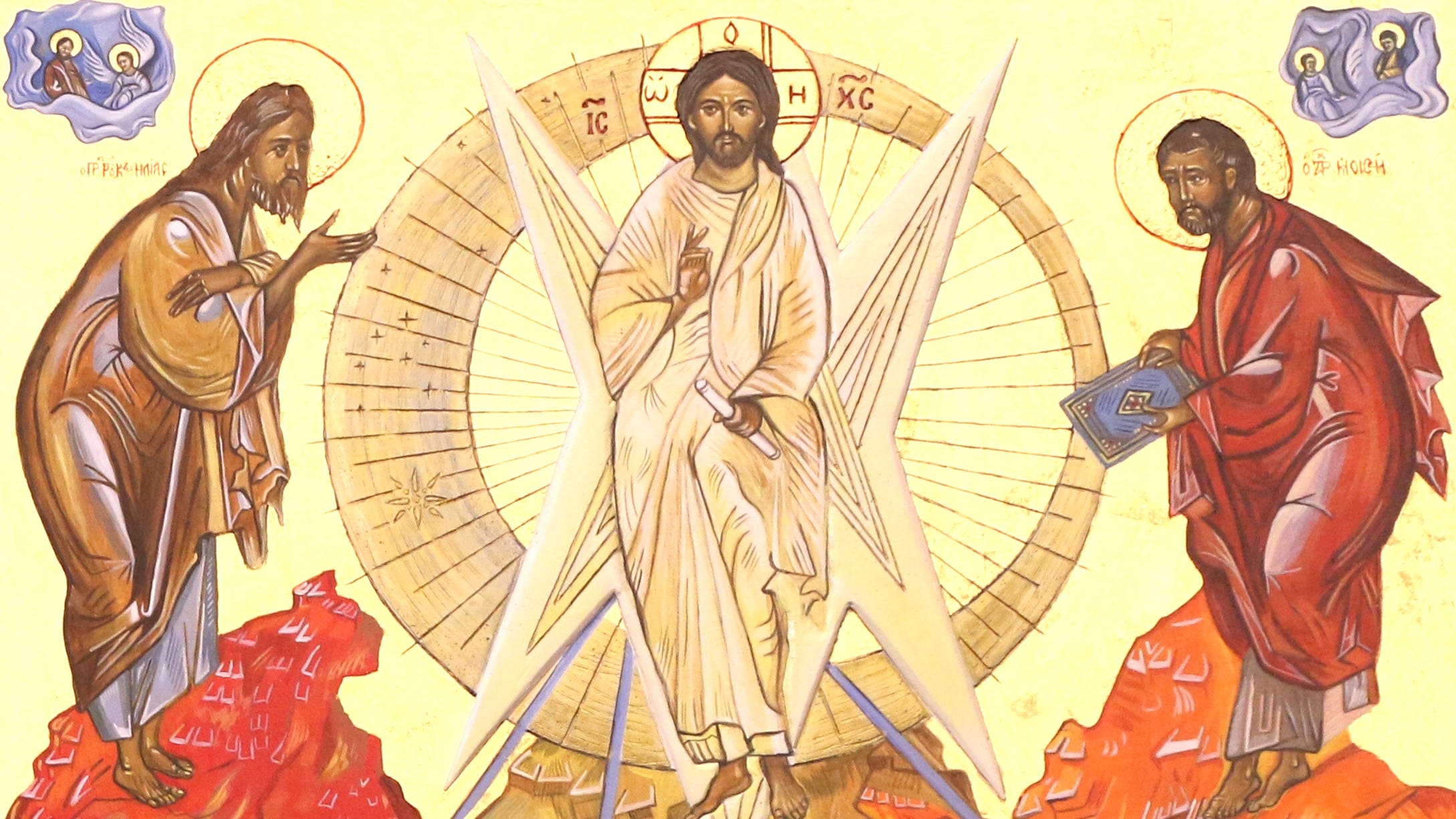
The presence of these two representatives of the Law and the Prophets points to their fulfilment in Christ.
Editor’s Notes
In this piece, Fr. Coleridge tells us…
How the presence of Moses and Elias at the Transfiguration confirms Christ’s mission and doctrine
That these two saints represent the Law and the Prophets, testifying to Christ’s divine authority
Why their discussion of the Passion reveals the Cross as the path to glory.
He shows us that the Transfiguration was not merely a vision of glory but a confirmation of the necessity of the Passion, foreshadowing the triumph that follows suffering.
For more context on this episode, its significance and its place in the Roman Liturgy, see here:

The Transfiguration
The Preaching of the Cross, Part I
Chapter III
St. Matt. xvii. 1–13; St. Mark ix. 1–12; St. Luke ix. 28–36
Story of the Gospels, § 83
Burns and Oates, London, 1886
Headings and some line breaks added.
Sung on Ember Saturday of Lent, the Second Sunday of Lent and the Feast of the Transfiguration (August 6)
Why did Christ reveal his transfigured glory before the Passion?
Why is the Transfiguration placed at the turning point of Christ’s public life?
Why did Christ command secrecy about the Transfiguration until after Easter?
Moses and Elias
There must have been a special intention in the Divine counsels in consequence of which the two Saints of the Old Testament were summoned from their repose to bear a part in this wonderful vision.
It does not seem to be the belief of the Church that the presence of Moses and Elias was merely apparent and not real, at least as to the souls of these great saints, and as to the body in which Elias was seen. There is only question as to the actual resurrection of the body of Moses from the dead, and the reunion of his soul with his body, which, in that case, must probably have returned again to the grave after the mystery. Moses and Elias were really present with our Lord.
Considering them simply as saints of the Old Covenant, they would represent the truth that the glory of our Lord was, as has been said, to be communicated to the bodies of the saints hereafter, whether of the New Testament or of the Old. But the presence of these two saints in particular may seem to require some special explanation.
Many of the Fathers consider them as chosen because they would naturally represent the Law and the Prophets. Thus the truth of our Lord’s Mission and Kingdom would be testified to by the chief person in each of these dispensations. There could be no longer any ground for hesitating as to the claims of our Lord in general, or in particular, as to that doctrine of the Cross which He had lately been teaching, when He was seen in glory in company with these two greatest of the saints.
Moses had spoken in particular of the Prophet Who was to be like himself and to come into the world. We know that the coming of the one great Prophet was expected by the Jews, from the question that had been formally put to St. John Baptist by the priests of Jerusalem, asking him whether he were the Christ, or Elias, or the Prophet.1
The mention of Elias in the same question shows us a reason for his presence also, for our Lord is thus accompanied by the two whose testimony could be of most force, Moses who had predicted Him, and Elias who was expected to go before Him. We find the Apostles themselves asking, on their way down from the mountain, why the Scribes said that Elias was first to come? And his appearance in the mystery must have suggested the question which our Lord took the opportunity of answering.
Both had fasted forty days
Another reason for the appearance of these two saints may be found in their history, especially in the fact that of them alone, among all the saints, is it recorded that they anticipated our Lord in His long fast of forty days and nights. It seems to be for this that the Church sings the Gospel of the Transfiguration on the second Sunday in Lent, having used for the first Sunday the Gospel of the Fasting and Temptation of our Lord.
In this way there may possibly be some reference to the example of these saints in their selection as witnesses now, as if, though they had not typified our Lord in any actual passion or suffering unto death, they had won the right to be considered as patterns of those who bear their daily cross after Him, and so might naturally be considered as fit to be placed by His side in this mystery, in which the merit and reward of such suffering is set forth in the glory which is purchased thereby.
These seem to be the reasons which may be given for the presence of Moses and Elias in particular on this great occasion.
The rest of this part is for paid annual/monthly subscribers.
Father Coleridge Reader is a labour of love. But curating, cleaning up and publishing these texts takes real work.
To keep this project going, and to make more of this treasury available, we rely on reader support. Some posts are reserved for members to sustain this mission.
We’re trying to keep something precious alive.
If you’ve benefited, consider joining us as a subscriber. It makes a real difference.