

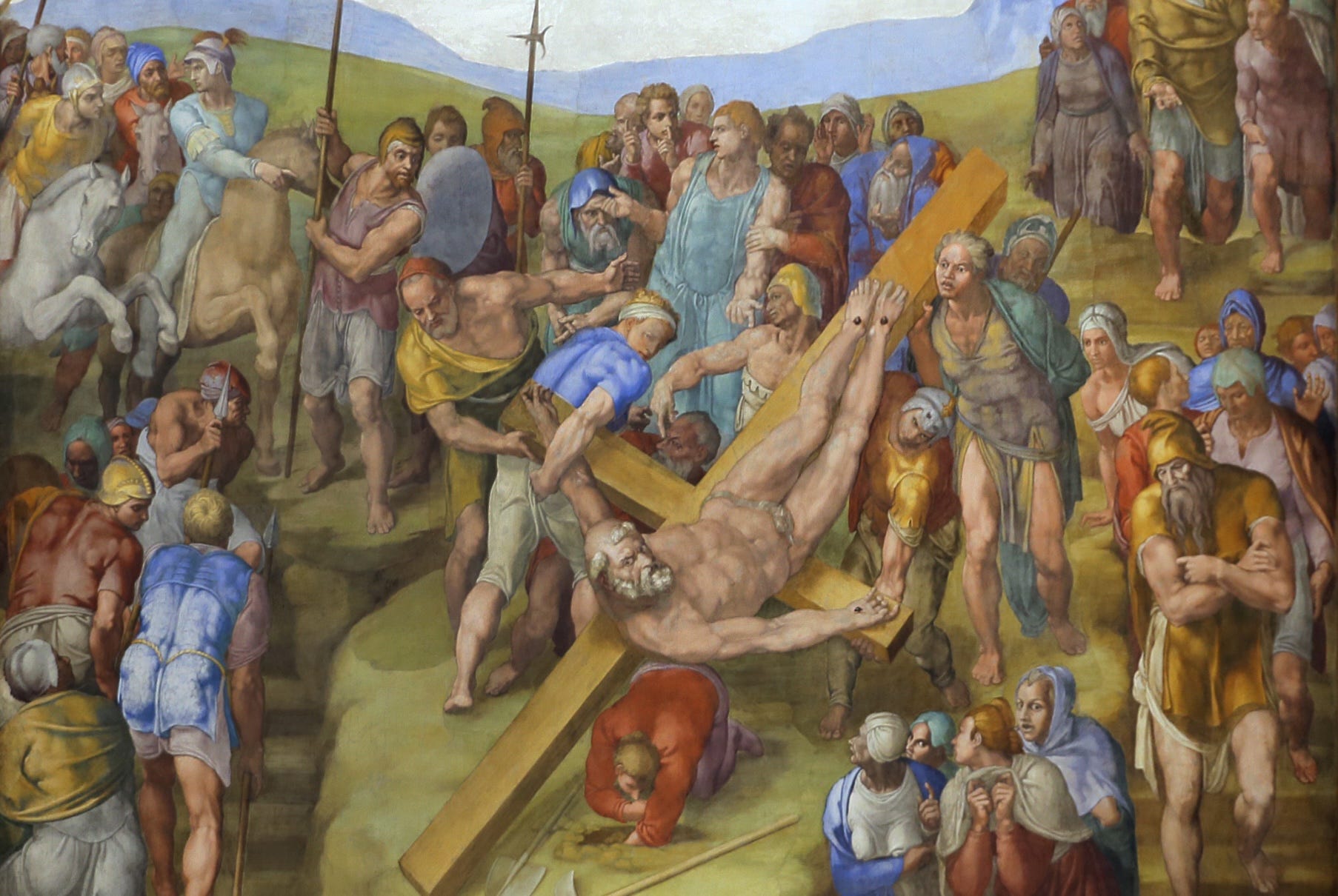
Christ overturns the worldly conceptions: true greatness is service, humility, and readiness to die for one’s subjects and dependants.
Editor’s Notes
In this first part, Fr Coleridge tells us…
How Christ shows that greatness entails service, not domination or honour
That true rulers in the Church govern with humility and care for souls.
Why the Shepherd must be ready, if needed, to give his life.
He shows us that authority in his Kingdom is measured by service, sacrifice, and humility – and emphasises Our Lord’s kindness and appreciation of the goodwill in the Sons of Zebedee.
For more context on this piece, see Part I.
The Sons of Zebedee
The Preaching of the Cross, Vol. III
Chapter XII
St. Matt. xx. 17–28; St. Mark x. 32–45; St. Luke xviii. 31–34
Story of the Gospels, § 128
Burns and Oates, 1182
Quinquagesima Sunday
Ss James and John’s request to sit at Christ’s right and left
Why Jesus promises the chalice to St James and John, but doesn’t grant their request
Why greatness in Christ’s Kingdom means humility and service, not mere power
Character of the Kingdom
This incident gave our Lord an opportunity of declaring the character of His Kingdom, in which these Apostles had sought to obtain the first seats, and thus instructing not them alone, but the rest of their company, as to what should be to them the true object of ambition.
‘And the ten hearing it were moved with indignation against the two brethren, began to be much displeased with James and John. But Jesus calling them to Him, saith to them, You know that the princes of the Gentiles, they who seem to rule over the Gentiles, lord it over them, and the great exercise power over them.
‘But it shall not be so among you, but whosoever will be great among you, let him be your minister, shall be your minister. And whosoever will be first among you, let him be your servant, shall be the servant of all. For the Son of Man also is not come to be ministered unto, but to minister, and to give His life as a redemption for many.’
These words are not so much an instruction how to obtain high authority in the Kingdom of God, as how to use that authority, and how to behave themselves when in authority. For it is certain that those alone can bear themselves in accordance with this instruction who are, like our Lord, meek and humble of heart, and that, where such meekness and humility are found, there will be the qualities which make it beneficial to the Church that such persons should be placed in authority. And persons of this character will be quite certain not to be ambitious.
But our Lord provides the Apostles, and in them, all Christians, with a rule, which if carried out, will secure the Church from the danger of ambition in seeking the highest places, as well as from the other danger of what St. Peter calls lording it over the flock. As a matter of fact, wherever the true spirit of the ruler is to be found, there will be with it a sense of responsibility for the souls which are committed to the charge of such persons, which will make them afraid of seeking such authority before they have it, and of misusing it when they have received it.
St Peter’s language
We may remember how fully this lesson was learned by the blessed Prince of the Apostles himself, whose instruction in his first Epistle seems as if it had been written to illustrate this passage.
‘The ancients therefore that are among you I beseech, who am myself also an ancient and a witness of the sufferings of Christ, as also a partaker of that glory which is revealed in time to come, feed the flock of Christ which is among you, taking care of it, not by constraint, but willingly according to God, not for filthy lucre’s sake, but voluntarily, neither lording it over the clergy, but being made a pattern of the flock from the heart.
‘And when the Prince of Pastors shall appear, you shall receive a never-fading crown of glory.’1
His words about being a pattern of the flock seem to refer to the words of our Lord in which He says that the Son of Man did not come to be ministered unto, but to minister, and so the method of our Lord’s teaching, which was always to do first Himself what He laid down for others to do. And the language of our Lord about giving His life as a redemption for many seems to have their echo in the Apostolical instinct which we see in St. Paul, St. Peter, St. John, and others, who have had their worthy successors in a long line of Pontiffs and Prelates of the Church down to our own time, who have seen that it was required of them, if it were necessary, to give even their lives for the peace and security of the flock of Christ.
Thus again in this incident we have an instance of the manner in which our Lord made everything that occurred and the circumstances, and even the scenery in which he found Himself, serve the purpose of furnishing Him with food for the souls of those among whom He was.
Out of the mistaken ambition of the sons of Zebedee, He took occasion to weave quite a chain of most beautiful and salutary instructions, for the benefit of the Apostles first, and then in them and through them, of their successors in high commissions and of His whole flock to the very end of time.
The Sons of Zebedee
Ss James and John’s request to sit at Christ’s right and left
Why Jesus promises the chalice to St James and John, but doesn’t grant their request
Why greatness in Christ’s Kingdom means humility and service, not mere power
Here’s why you should subscribe to The Father Coleridge Reader and share with others:
Fr Coleridge provides solid explanations of the entirety of the Gospel
His work is full of doctrine and piety, and is highly credible
He gives a clear trajectory of the life of Christ, its drama and all its stages—increasing our appreciation and admiration for the God-Man.
If more Catholics knew about works like Coleridge’s, then other works based on sentimentality and dubious private revelations would be much less attractive.
But sourcing and curating the texts, cleaning up scans, and editing them for online reading is a labour of love, and takes a lot of time.
Will you lend us a hand and hit subscribe?
Follow our projects on Twitter, YouTube and Telegram:
Twitter (The WM Review)
1 St. Peter v. 2–4.