

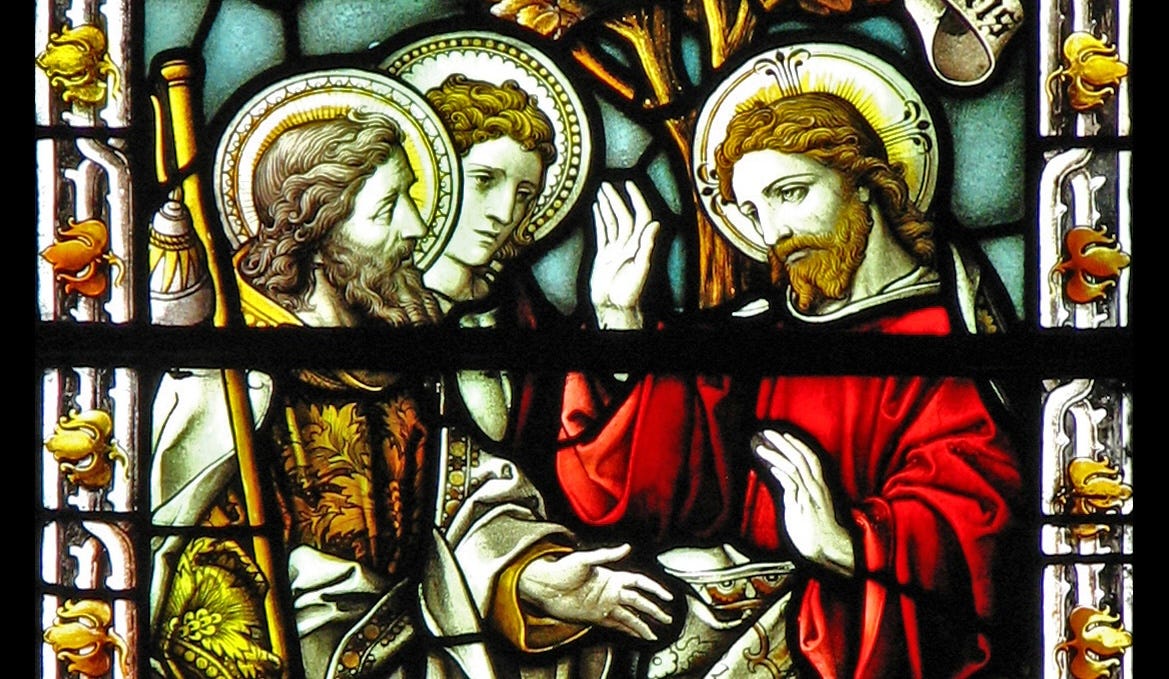
This incident was perhaps not how it is commonly imagined by film producers today.
Editor’s Notes
In this first part, Fr Coleridge tells us…
How the sons of Zebedee want to be close to Jesus, but do not yet grasp the cost.
That Our Lord turns ambition toward the mystery of baptism, the chalice and the Cross.
Why their willing but imperfect courage reveals both zeal and human weakness.
He also explains why the Gospels suggest that Our Lord saw more good in this encounter with the two Apostles than is normally considered.
For more context on this piece, see Part I.
The Sons of Zebedee
The Preaching of the Cross, Vol. III
Chapter XII
St. Matt. xx. 17–28; St. Mark x. 32–45; St. Luke xviii. 31–34
Story of the Gospels, § 128
Burns and Oates, 1182
Quinquagesima Sunday
The Sons of Zebedee and their mother
‘Then came to Him the mother of the sons of Zebedee with her sons, adoring and asking something of Him. Who said to her, What wilt thou? She saith to Him, Say that these my two sons may sit, one on Thy right hand, and the other on Thy left, in Thy Kingdom.’
That is the account of St. Matthew. St. Mark tells us that the two Apostles made the same request in their own person.
‘And James and John, the sons of Zebedee, come to Him, saying, Master, we desire that whatsoever we shall ask, Thou wouldst do for us. But He said to them, What would you that I should do for you? And they said, Grant to us that we may sit, one on Thy right hand, and the other on Thy left hand, in Thy glory.’
It would appear that the minds of the Apostles had been excited by the great promise which had been made in answer to the question asked by St. Peter, as to the reward of those who had left all and followed Him. The Apostles had been told that they were to sit on twelve thrones, judging the twelve tribes of Israel. The loving hearts of the sons of Salome had been struck by the ambition that they might be as near as possible to our Lord, and they conceived the thought that they might ask to sit on His right hand and on His left, either forgetting that this implied some kind of superiority and preference before others, or at least not seeing the imprudence and apparent selfishness which such a request contained.
Perhaps it was the mother’s idea, as she seems to have asked Him first, and this may have been an excuse for St. James and St. John, that the mother whom they had abandoned for His sake would rejoice, and to some extent, share in, their pre-eminence.
Character of the brothers
Our Lord did not answer Salome, after she had made her petition. He made the two brothers put themselves forward, as if to show that He allowed no favour or personal intercession in the management of His Kingdom. Thus St. Mark passes over the petition of Salome, and the answer of our Lord is directed, in both the Evangelists, to the sons alone.
These two were strong fervent souls, as we cannot doubt, although the elder of them has left behind him no certain records of his character beyond the few words of the Gospels which relate to him, and Sacred Scripture has told us nothing about him after the Day of Pentecost except his early martyrdom at the hands of the younger Herod. We know that the two were named by our Lord ‘sons of thunder,’ by which it seems to be implied that their preaching was remarkably powerful and full of fire and energy.
Then we have the anecdote of their wishing to call down fire from heaven on the Samaritan town which would not receive our Lord and His company on their way towards Jerusalem.1
Tradition adds wonderful things concerning the preaching of St. James in Spain, and his special devotion to our Blessed Lady. Such being their character, their nearness to our Lord after the flesh, and their position among the Apostles, which made them next after St. Peter, they were moved by this kind of ambition to ask Him as a favour the boon of which mention has been made.
Our Lord’s question
‘And Jesus answering said to them, You know not what you ask. Can you drink of the chalice which I drink of, or be baptized with the baptism wherewith I am baptized? But they said to Him, We can.’
No doubt the Apostles spoke with perfect truthfulness as to their own state of willingness. We need not suppose that our Lord’s warnings about counting the cost of following Him, and the like, had been lost upon them. They did not know how willing the spirit might be, and the flesh how weak. But we may so think of them as having to some extent taken in the doctrine of the Cross, and of its necessity in those who would be His disciples.
They may have been overconfident, but they were serious and thoughtful men, and by this time they had come to understand that there must be much suffering in those who would be near Him, at least much suffering for a time. We must never underrate the immense devotion and enthusiasm which must have been kindled in their hearts by the continual privilege of close personal intercourse with Him, their familiarity with His character, His teaching, His miracles, His conversation, His whole manner and methods of dealing with the people and with themselves.
It was almost inevitable that nothing should seem to them to be difficult in His service, especially when He put it in His own gracious way, not of suffering for Him, nor dying for Him, but of drinking the chalice which He was Himself to drink, and of being baptized with the baptism with which He was to be baptized.
Though they showed like the other Apostles some weakness at the time of the Passion, still the answer which they gave to Him when He asked them whether they could do this was not, by His mercy, falsified by the event. For they did indeed drink of the chalice of which He was to drink, and they were indeed baptized by the baptism with which He was baptized. Their goodwill was received by Him, crowned by Him, notwithstanding many imperfections with which it was for the present surrounded. So it is often in the ways of God. Persons seem to be rash, and they are perhaps too venturesome, and they undertake great vocations, of the difficulty of which they have but an imperfect idea.
And though our Lord allows them for a moment to feel their own weakness, and perhaps be on the brink of failure, still He supports them, especially when they have once discovered their own impotence, and He brings them through trials of which they had never dreamed, holding them up day by day through the successive changes of their conflict, until they find themselves at last safely landed on the eternal shore, where the crown of their happy venturesomeness awaits them.
‘We can’
That there was no extreme self-confidence about these two brethren seems to be evident from the answer which they received from our Lord. A little later than this, Peter was to say, ‘Though all men should be scandalized in Thee, yet not I,’ and was to hear the reply of our Lord, ‘Amen I say to thee, to-day, even on this night, before the cock crows twice, thou shalt deny Me thrice.’
If our Lord had seen anything of the same overweening confidence in St. James and St. John, when they made answer, ‘We can,’ it is probable that He would have answered them in some such manner, instead of making the gracious reply He did make.
The Sons of Zebedee
Here’s why you should subscribe to The Father Coleridge Reader and share with others:
Fr Coleridge provides solid explanations of the entirety of the Gospel
His work is full of doctrine and piety, and is highly credible
He gives a clear trajectory of the life of Christ, its drama and all its stages—increasing our appreciation and admiration for the God-Man.
If more Catholics knew about works like Coleridge’s, then other works based on sentimentality and dubious private revelations would be much less attractive.
But sourcing and curating the texts, cleaning up scans, and editing them for online reading is a labour of love, and takes a lot of time.
Will you lend us a hand and hit subscribe?
Follow our projects on Twitter, YouTube and Telegram:
Twitter (The WM Review)
1 St. Mark xiii. 10; St. Luke ix. 54.