
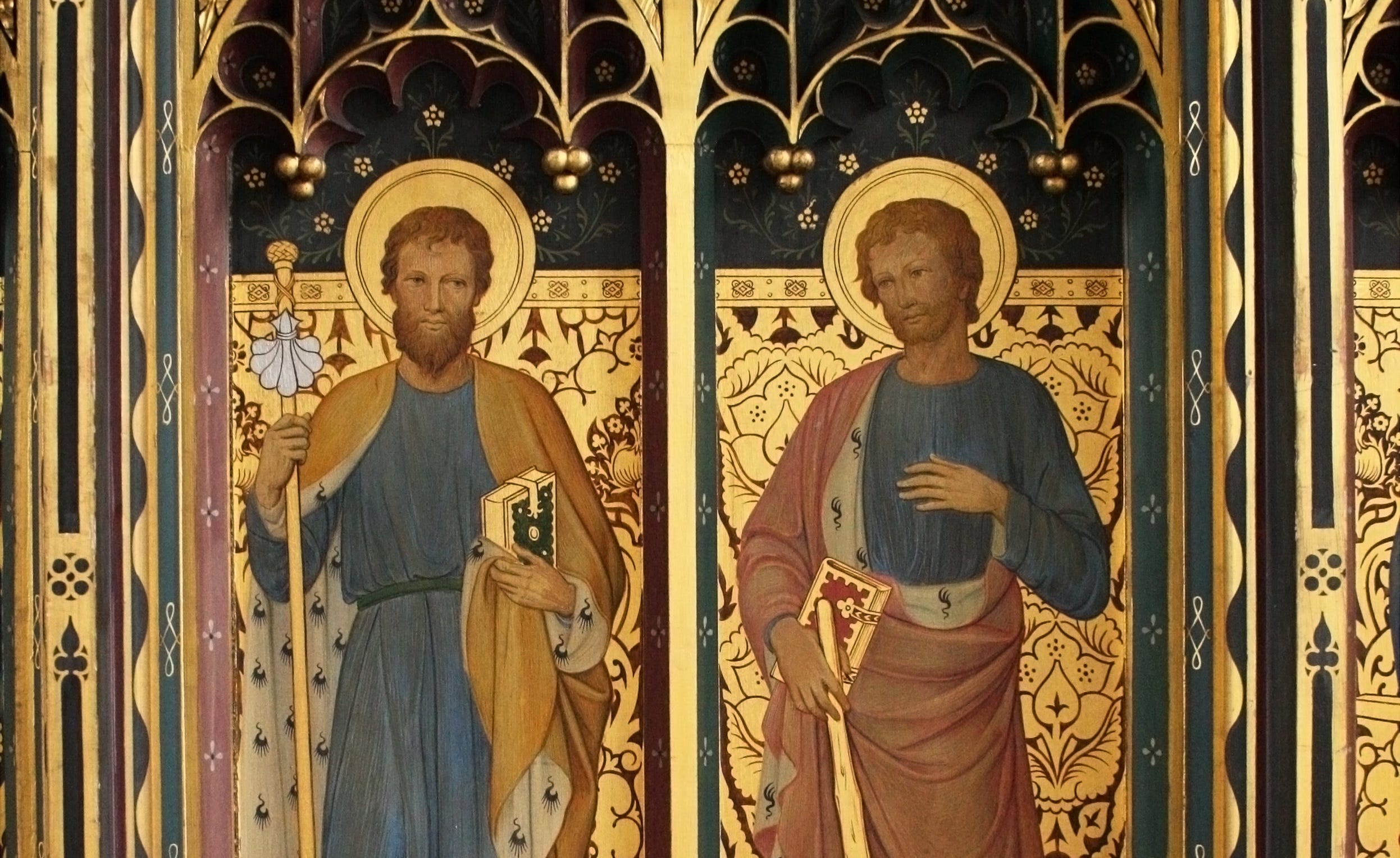
Jesus’ reply to the Apostles isn’t what we might expect.
Editor’s Notes
In this first part, Fr Coleridge tells us…
How Our Lord confirms that James and John will share his chalice of sacrifice and suffering
That faith moves forward without foreseeing every trial or cost.
Why honours in the kingdom belong to the Father’s eternal providence.
He shows us that courage in suffering pleases him, but ambition must yield to the Father’s will. He also emphasises Our Lord’s kindness and appreciation of the goodwill in the Sons of Zebedee.
For more context on this piece, see Part I.
The Sons of Zebedee
The Preaching of the Cross, Vol. III
Chapter XII
St. Matt. xx. 17–28; St. Mark x. 32–45; St. Luke xviii. 31–34
Story of the Gospels, § 128
Burns and Oates, 1182
Quinquagesima Sunday
Ss James and John’s request to sit at Christ’s right and left
Why Jesus promises the chalice to St James and John, but doesn’t grant their request
Our Lord’s reply
‘And Jesus saith to them, You shall indeed drink of the chalice that I drink of, and with the baptism wherewith I am baptized you shall be baptized, but to sit on My right hand or on My left, is not Mine to give to you, but to them for whom it is prepared of My Father.’
This reply of our Lord naturally divides itself into two parts. First, there is the assurance that they shall indeed do what they have undertaken. They shall drink of His chalice, and be baptized with His baptism. Secondly, there is the declaration, that to sit on His right hand and on His left hand is not His to give, ‘but shall be given to those for whom it is prepared by My Father.’
We will take the first part first. Our Lord confirms what they had said about the chalice and the baptism. He could look forward through the comparatively short space of time which was to be occupied by the preaching of St. James in Spain and in the Holy Land, and see how zealously and devotedly the elder of the two brothers was to drink his chalice. He could foresee his return to Jerusalem, his martyrdom by the sword of Herod. The sacrifice was to be perfectly and nobly made, and thus one of these loving brothers was to be ‘consummated’ in a short time.
He could see also the long protracted years of St. John, who was to be parted first from his brother by his martyrdom, then from the companionship of the Apostles by their dispersion, then from our Blessed Lady by her death and Assumption, and then to last out almost through another lifetime, to see the Church persecuted, the heresies and schisms arise, and to be left alone of all the Apostolical band during that long delay. In each case the sacrifice was perfect in companionship to His own sorrows and its imitation of His own utter abandonment.
Venturesomeness of the Saints
These blessed and glorious saints did not know what the Providence of the Father had in store for them, nor was it necessary that they should know it. The ventures of faith are made without that particular forecasting of the details which our Lord had of His own Passion. He drank the chalice beforehand in knowledge, as well as in action when the time came. It is enough for His saints to place themselves in His hands.
It was, then, not altogether rash or presumptuous to say, ‘We can.’ They did not trust in their own strength, but in His. All great sacrifices and achievements in the Church have been offered to God in a similar spirit. Each day of a long life may bring its new trials and dangers and fears, and if they were all to be looked at once and embraced at once, perhaps they would never be ventured on.
But each day brings with it the grace and strength for its own trials, and in that sense we may say, as our Lord bids us, sufficient to the day is the evil thereof, and we shall find the grace of the day enough for the evil of the day. Each day, too, leaves behind it its own experience of the goodness and faithfulness of God. Who could make a solemn vow for life if this were not so? And it is the same with all the heroic deeds of which the lives of the saints are full. They are all enterprises far beyond our strength, nor do the saints themselves know beforehand all that they involve.
But in confidence, not in themselves, but in our Lord, they say, ‘We can.’ If it is His work, and if He calls them to it, they fear nothing, neither the want of means nor the uncertainty of life, which might excuse them from venturing, nor the many years of labours which they may be undertaking, nor their own weakness, nor the power of temptation, nor the scorn of the world.
On the other hand, could it have been so pleasing to our Lord, if they had said, ‘We cannot’? He had but lately, in their hearing, offered a high vocation to the young ruler, who had great possessions, who had shrunk back in alarm. He had put before him a great sacrifice, to give all to the poor, and a great reward in return, treasure in Heaven, and He had given him the blessed invitation to come and follow Him. That invitation implied the promise of our Lord’s perpetual help, and the things that are impossible with men are possible with God.
This, perhaps, was the secret of the boldness of St. James and St. John, that the chalice was bitter and the baptism was terrible, but still it was His chalice and His baptism.
There was imperfection in their ambition, especially in its exclusiveness, but there is no imperfection in their courageous readiness to face all trials and hardships in company with our Lord. And our Lord was, at all events, pleased with their courage, and rejoiced to see that they had in some measure understood His language, which implied that it was not the time for thinking about the seats on the right hand or on the left, but rather for anticipating the Cross.
Not mine to give
With regard to the latter part of our Lord’s sentence, some strange difficulties have been raised as to His words, as if He had meant to say that He had no power to confer authorities or dignities in His Kingdom. This would seem to contradict His own words at the Last Supper as related by St. Luke, ‘I dispose unto you, as My Father hath disposed unto Me, a Kingdom, that you may eat and drink at My table in My Kingdom, and may sit in twelve thrones, judging the twelve tribes of Israel,’1 as well as those which He had lately uttered.
But the words here really mean that to sit on His right hand or on His left was His to give only to those for whom it had been prepared by the will of His Father, which was the same Divine will, which was one in Him and in His Father. The whole Providential arrangement of the Kingdom of God is habitually attributed by our Lord to His Father. The first seats in that Kingdom were a part of that arrangement, and were not to be given according to any other rule, not according to human interest or favour, or the tender claims of relationship or of personal predilection.
These were the grounds on which these sons of Zebedee sought to obtain what they desired. If the Father had prepared it for them, they might have it, but not in the way by which they sought to obtain it now.
The Sons of Zebedee
Ss James and John’s request to sit at Christ’s right and left
Why Jesus promises the chalice to St James and John, but doesn’t grant their request
Here’s why you should subscribe to The Father Coleridge Reader and share with others:
Fr Coleridge provides solid explanations of the entirety of the Gospel
His work is full of doctrine and piety, and is highly credible
He gives a clear trajectory of the life of Christ, its drama and all its stages—increasing our appreciation and admiration for the God-Man.
If more Catholics knew about works like Coleridge’s, then other works based on sentimentality and dubious private revelations would be much less attractive.
But sourcing and curating the texts, cleaning up scans, and editing them for online reading is a labour of love, and takes a lot of time.
Will you lend us a hand and hit subscribe?
Follow our projects on Twitter, YouTube and Telegram:
Twitter (The WM Review)
St. Luke xxii. 29.