

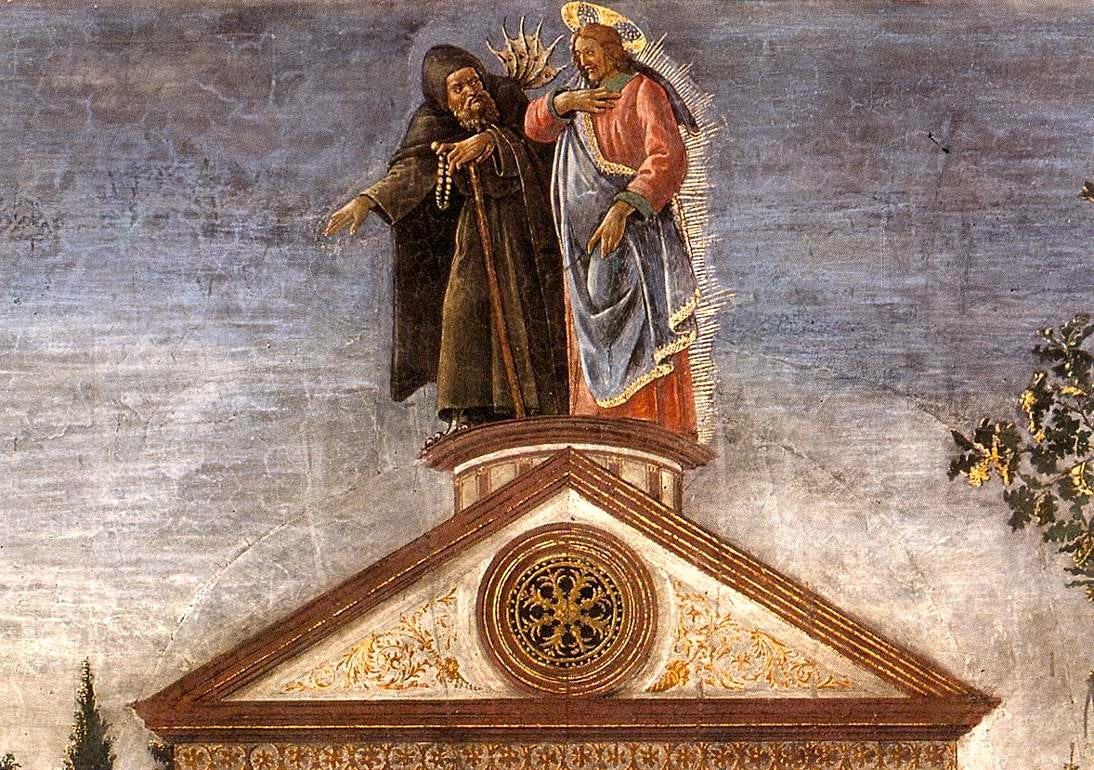
Knowing how God treats who presume upon his mercy, the final temptation was in fact a suggestion towards destroying himself.
Editor’s Notes
In this part, Fr Coleridge tells us…
How the final temptation crowns the conflict – and represents Satan’s hatred towards Christ
That even those who labour for God remain at risk of pride
Why we must guard ourselves, with God’s grace, against these assaults of the devil
He shows us that Christ’s victory in temptation is our consolation, strength, and sure example.
For more context on this episode, see Part I.
Temptations of our Lord
The Ministry of St. John the Baptist
Chapter V
St. Matt. iv. 2–10; St. Mark i. 13; St. Luke iv. 2–12.
Story of the Gospels, § 18
Burns and Oates, London, 1888
Headings and some line breaks added.
Sung on First Sunday of Lent
Increased audacity of the third temptation
In the third and last temptation Satan went further in two ways than he had ventured in the former, and thus—if such be the true order of them, as to which there can be no perfect certainty—this temptation is a sort of climax to which the others lead up.
In the first place, as has been mentioned, he no longer led our Lord, as to the mountain, but he must have transported that sacred Body through the air by an exercise of preternatural power, and our Lord must have submitted to this, knowing that such was the will of His Father, as He afterwards allowed Himself to be crucified, as ancient writers say, by the members of the devil.
In the second place, he ventured, as it were, to attempt to turn our Lord’s weapons against Himself, and pervert Holy Scripture to the purposes of his temptation. For Satan is not deprived, as has often been said, of those powers which belong to him by nature, and although in their use as in everything else he is simply permitted to do what God allows him, still that permission is very often extended, as we see in the history of Job and in this instance in the Person of our Blessed Lord Himself, to limits very far indeed beyond what is ordinarily supposed.
It would seem as if our Lord’s conflict with Satan, and His victory in our human nature over him, would not have been so complete as they are, nor so full of consolation and strength to His children, if the enemy had not been allowed in His case what is permitted to him in the case of others, though not ordinarily. As it is, Satan runs through, in the course of the three temptations, the whole range of his power of suggestion, of illusion—for the vision of all the kingdoms of the world must have been preternatural—and of actual violence.
Something of the same sort may also be said as to his use of Scripture in this last temptation, which is full of meaning to those who seek to interpret the Word of God for themselves, and so incur the most dangerous temptation possible, that to misbelief. For Holy Scripture is an authority which can be used for evil as well as for good, and has often been alleged to sanction what is erroneous in doctrine as well as what is wicked in practice.
The pinnacle of the Temple
‘Then the devil took Him up into the Holy City and set Him upon the pinnacle of the Temple, and said to Him, If Thou be the Son of God, cast Thyself down, for it is written, that He hath given His angels charge over Thee, and in their hands shall they bear Thee up, lest perhaps Thou dash Thy foot against a stone.’1
The ‘pinnacle’ is spoken of by both Evangelists as some well known part of the Temple, and Josephus has mentioned two such lofty points, one over the valley of Kedron, on the southern front, and another the summit of Solomon’s Porch, which is said to have been the spot from which St. James was thrown by the Jews.
Confused fury of Satan
There are clear traces of fury, anger, and confusion in the challenge made to our Lord by the tempter, for though it might have served his purpose as to the discovery of our Lord if He had in truth thrown Himself from the pinnacle and been borne up in the air by the angels of God, still this would have tended to the defeat and shame of Satan himself, who, moreover, hates the good angels with a peculiar hatred as the instruments of God in his chastisement and in the prevention of his mischievous designs against men.
Yet it is in keeping with the object which Satan had in view all through, that he should even thus be content to find out whether our Lord were the Son of God or not. The other purpose which he pursued in all the temptations, that of inducing our Lord, if possible, to sin, is more palpable and evident in this his last assault. Every one of his temptations suggests some disrespect and insult to God, and in this case it would clearly have been taking a rash liberty with Him for any one wantonly to throw himself off a pinnacle, at the risk of certain death, unless God were to interfere miraculously by means of the angels to save him from the natural consequences of his rashness.
If such a thing had been possible for the Son of God, it would have been ostentatious and vainglorious, in accordance with the character of Satan himself, to make an unnecessary exhibition of such a kind. It would have been the sort of sign which the Jews were so often to ask of our Lord, the kind of miracle, perhaps, which Herod had hoped to see Him perform at the time of His Passion.
And in any ordinary case it would not only have been ostentatious and presumptuous, but it would probably have issued in the death of any one who had committed such a fault. God would not have allowed the angels to support him, and Satan’s suggestion was therefore to suicide.
Misquotation of Scripture – and Our Lord’s answer
Holy writers have remarked that although Satan quoted the Psalms in this temptation, he did not quote the passage fully or correctly. For the Psalm speaks of the angels having charge over the man of God, ‘to keep thee in all thy ways,’ which words do not surely mean that if men cast themselves into extraordinary and unnecessary dangers the angels will protect them.
But this is left out by the tempter, as well as the verse immediately following what he quoted, in which his own defeat is spoken of, ‘Thou shalt walk upon the asp and the basilisk, and thou shalt trample under foot the lion and the dragon.’
Our Lord’s reply was again a simple quotation from Scripture, taken from the same passage in Deuteronomy which He had cited before, ‘It is written again, Thou shalt not tempt the Lord thy God.’2 The text adds, ‘as thou temptedst Him in the place of temptation’—and the reference seems to be to the conduct of the Israelites, at the encampment at Rephidim,3 where there was no water for them to drink, and they showed some sign of distrust of God in chiding Moses for having brought them out of Egypt to die of thirst, as if God could not or would not relieve them in due time.
The fault of the people seems to have been an unbelieving impatience and want of confidence in God, coupled with a sort of arrogance, as if they thought they had a right to demand that their wants should be attended to at their own choice, as if God, Who had just given them the manna, was bound at once to furnish them with water, and that if it were not so, they might find fault with the leaders whom He had given them for bringing them out of Egypt. Such is the presumptuous dealing with God against which the words quoted by our Lord warn us.
We see again how our Lord here also corrects the liberty taken with God by the insinuation that His preternatural aid might be called upon at any moment, however wantonly, and how again He baffles the tempter in his design to draw out the secret as to the Divine Person Whom he was addressing.
Our Lord’s temptations and our own
Our Lord’s temptations are our consolation, our strength, and our instruction. Our consolation, because they comfort us when we are under the like interior trials; our strength, because He has won for us all the graces which are needed to enable us to triumph, and our example, because He teaches us how to contend with temptations calmly, confidently, resting on our faith and trusting in God.
It may be asked whether, as to the particular temptations which are here recorded as undergone by our Lord, there is any analogy or resemblance to the ordinary temptations which beset ourselves? It is not difficult to see that the three great concupiscences, the love of pleasure, the love of possessions, and the love of honour, are appealed to by Satan in his successive assaults, and that the principle conveyed in our Lord’s three answers are adapted to guard us against these three concupiscences.
For the truth, that ‘not in bread alone doth man live,’ raising us to the thought of a nobler sustenance and higher pleasures than any that have to do with our ordinary appetites, is enough to quench all the fires of sensuality. ‘To adore God alone and serve Him alone’ is the key to the true and indifferent use of all the good and great things in this world, and the principle never to tempt God is the proper safeguard against the inordinate love of honour and praise, for all honour and all glory belong to Him, and to seek or take any for ourselves is to tempt Him and provoke His jealousy.
But if we are to consider our Lord’s three temptations as particularly representing the dangers of any one class of men more than others, that class would be those who have in any degree a share in the work which He was about to begin, and for which He had just received His solemn unction, when He was driven by the Spirit into the wilderness. For spiritual men, and men who have to work for God in preaching or in other sacred ministrations, are particularly assailed by three temptations, one of which allures them to bodily comforts and a refined sensuality, another of which puts before them the bait of influence, personal power, wealth to be used for good purposes, and the like, while the third, which has often led to the greatest falls, attacks their personal vanity and pride through the applause which waits upon their success.
Temptations of Our Lord
Read Next:

Here’s why you should subscribe to The Father Coleridge Reader and share with others:
Fr Coleridge provides solid explanations of the entirety of the Gospel
His work is full of doctrine and piety, and is highly credible
He gives a clear trajectory of the life of Christ, its drama and all its stages—increasing our appreciation and admiration for the God-Man.
If more Catholics knew about works like Coleridge’s, then other works based on sentimentality and dubious private revelations would be much less attractive.
But sourcing and curating the texts, cleaning up scans, and editing them for online reading is a labour of love, and takes a lot of time.
Will you lend us a hand and hit subscribe?
Follow our projects on Twitter, YouTube and Telegram:
Twitter (The WM Review)
Psalm xc. 11, 12.
Deut. vi. 16.
Exodus xvii. 1–7.