
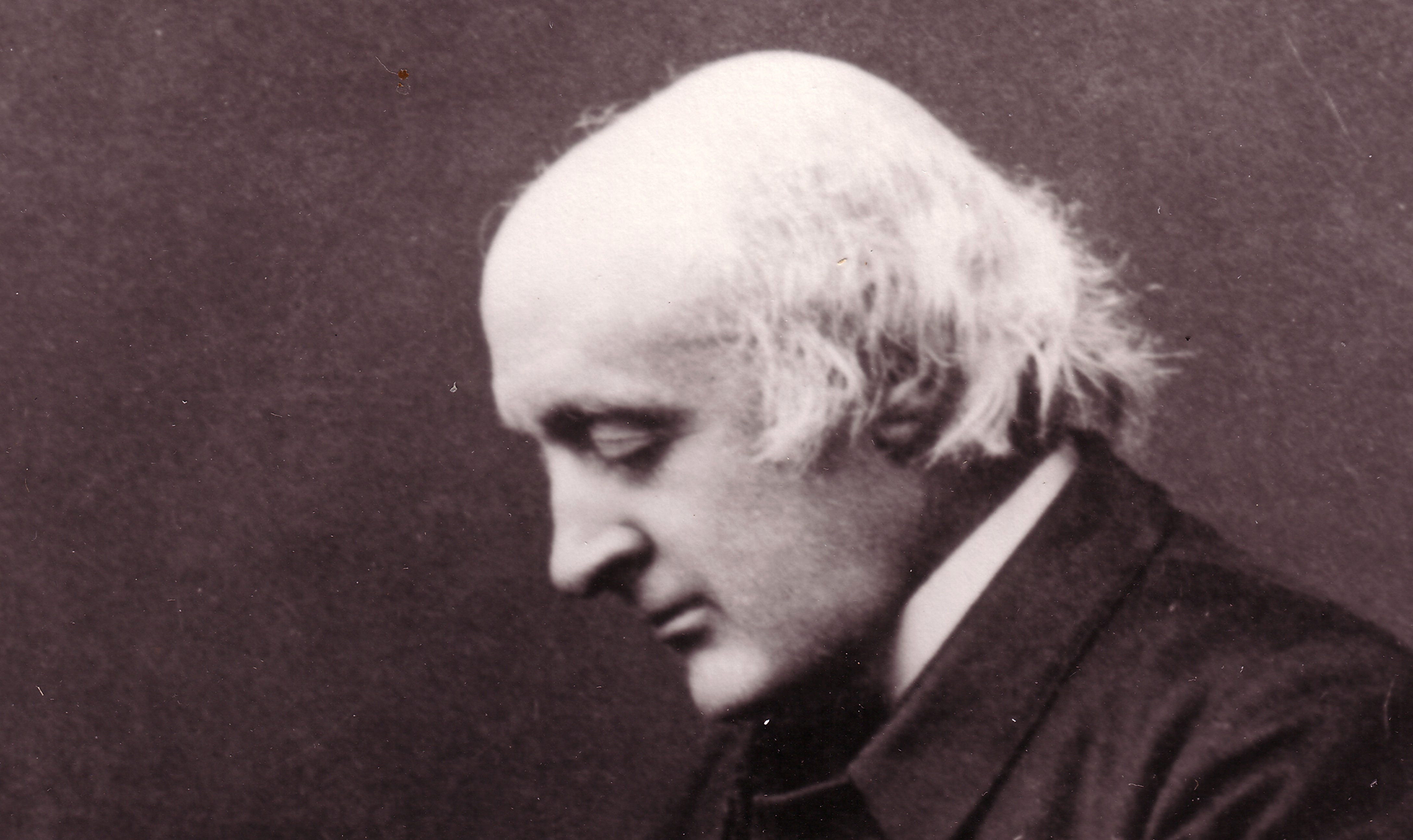
Following Fr Henry James Coleridge SJ’s death on 13 April 1893, Fr Richard F. Clarke SJ, his successor as Editor of the Month, wrote a memorial about the late Jesuit’s conversion and life as a priest.
Editor’s Notes
As readers will have noticed from yesterday, we at last managed to obtain a portrait of Fr Henry James Coleridge SJ, and secured the kind permission of the British Jesuit Archive to use it in that article; we similarly gained permission to use a second photograph in this one.
We have previously published Fr Coleridge’s initial obituary in The Month. To mark the anniversary of his death on 13th April, we published a second, lengthier tribute to the Jesuit priest by Bishop James Laird Patterson, from the same publication. This was accompanied by another lengthy obituary by Fr Coleridge’s successor as Editor of The Month, Fr Richard F. Clarke SJ. This is the article which is below.
Fr Clarke is perhaps most known today as the editor of Fr Franz Spirago’s The Catechism Explained. He was another convert from Anglicanism, and was sent to Fr Coleridge for instruction by Cardinal Newman. He wrote many small booklets, as well as a book on Logic for the Manuals of Catholic Philosophy Stonyhurst Series.
Fr Clarke’s recollections deal more with Fr Coleridge’s conversion and career as a Jesuit. Most intriguing, perhaps, is the account Fr Clarke provides of Fr Coleridge’s interview with Mélanie Calvat, the seer of La Salette, which took place on Coleridge’s journey to Rome for priestly studies. His general account of Coleridge’s virtue is most edifying.
We hope that his tribute contributes to the estimation of Fr Coleridge as a man and a priest amongst our readers. Please remember the repose of his soul in your prayers.
Recollections of Henry James Coleridge – Fr Richard F. Clarke SJ
The Month, Vol. 74, No. 348, June 1893
No. 348, June 1893, pp. 153-167.
Headings and some line breaks added for ease of reading online
Recollections of Henry James Coleridge by the Lord Bishop of Emmaus
Recollections of Henry James Coleridge by the Editor (of The Month, Fr Richard F. Clarke SJ)
See also:
Compiler of Recollections
I fear that my share in the contributions towards a sketch of Father Coleridge must be those of a compiler rather than of an original contributor. For though my acquaintance with him dates from nearly a quarter of a century ago, and I have lived in close personal relations with him for several years, yet the period of my friendship with him was the most eventless period of what was throughout an uneventful life, one in which he lived a life of great seclusion, and was occupied almost entirely with his books and his prayers.
Perhaps my best plan will be to marshal in historical order the information that I have gained from others, adding and inserting such details as I am able to furnish from my own personal knowledge as I proceed.
“My first acquaintance with Henry Coleridge,” writes one of his contemporaries, “was when he entered Eton, at the house of Mr. Harry Dupuis, who was one of the assistant masters. He (H.J.C.) must have been then about fourteen years of age, his physique was frail and feeble in the extreme, and there was something sad and pensive in his manner and bearing, but his features were attractive and intelligent.
“He was placed high in the school for his age, and soon gained a reputation among the boys as ‘a clever fellow.’ In spite of his frail physique, he was a good cricketer and was in the eleven, and played all games well that did not require great bodily strength.”
Coleridge’s purity of soul
Perhaps it is not inappropriate to these early days to speak of a trait of character, or rather I should perhaps say, a grace from God that was very remarkable in him, and that was the extreme purity of his soul. He had the strongest dislike of anything coarse or indelicate, and this seems to have protected him from the dangers of a big public school.
I have heard the moral condition of the Protestant public schools spoken of in his presence, and he was always quite eager in his defence of Eton in his day. “I dare say there was evil,” he would say, “but thank God, I never saw anything of it in the set in which I was.” When some one in a pamphlet described the Protestant schools as “sinks of iniquity,” he got quite angry, and declared that from his own personal knowledge, he could contradict the statement.
“No one could know him well,” writes a friend of his youth, “without being convinced how morally straight he was,” and it was not necessary to have known him in his early days to be able to bear witness to his blameless life. When quite an old man, the sweet savour of his purity of soul still clung to him, imparting to his manner and to his words a sort of childlike simplicity and grace which is one of the privileges of the clean of heart.
Coleridge’s time at Oxford
But we must continue our historical account:
“Father Coleridge was elected a scholar of Trinity College, Oxford, while still a boy at Eton, and went up to Oxford in the ordinary course. At the University he was a hard-working and industrious student. He became much attached to Mr. Isaac Williams, one of the tutors of his College. By him he was initiated in what was called the ‘Oxford’ or ‘Tractarian movement,’ which was then assuming large proportions. Mr. Isaac Williams afterwards wrote and published a Harmony of the Gospels, containing much erudition and scholarship. The subject took possession of the young scholar, and gave a direction to his mind and studies in which he persevered to the end of his life.
“Before he became a Catholic he had already begun to utter aspirations as to publishing a Life of Christ, based upon a Harmony of the four Gospels. Father Coleridge has written on an infinite variety of subjects, articles in magazines, lives and letters of saints, devotional books, &c., but all his literary work, all his studies and teaching, have centred round his Life of Christ, which is the book by which he will be remembered.
“In due time he took his B.A. degree and a first class, and was afterwards elected to a fellowship at Oriel. By a singular coincidence, Father Christie took part in his election a short time before resigning his own fellowship, and the tie which bound them together in the society which at that time took the lead in Oxford, was a sort of anticipation of their subsequent fellowship in another and still more distinguished Society, and of their associated labours for nearly a quarter of a century in those literary and ministerial labours which owed much of their success, from the human side, to their life at Oxford.
“At Oriel Coleridge [he] found Newman (the late Cardinal), Church (late Dean of St. Paul’s), Charles Marriott, Eden, and a heterogeneous host of men of talent and various acquirements. The Guardian newspaper was started as an organ of the soi-disant Catholic party, by Sir Frederick Rogers (an Oriel man), now Lord Blachford. It was published in London, and was conducted by one staff in London, and another at Oriel. Coleridge was on the Oriel staff. His special department was the reviewing of books, but he entered into the general plans and counsels of the editors, and sometimes contributed articles on other subjects.
“Oxford was then much agitated by the ‘Tractarian movement,’ which spread beyond the limits of the University, and seemed to take hold of the country. Indeed there was a moment later on, when, until a reaction set in, it almost seemed likely to lead to a national secession to Rome.
“In 1847 a ‘Brotherhood’ was started in Oxford, composed of Fellows, Tutors of Colleges, and undergraduates, numbering about thirty. It had no rules or organization, and was merely social and devotional. The members met alternately in the rooms of one another on every Friday, and recited a portion of the Divine Office in common. They used Catholic books of devotion, and sought, in the union of the Brotherhood, sympathy and support in maintaining a Catholic spirit. Father Coleridge was one of this ‘Brotherhood.’”
In 1848 he took Orders, and left Oxford for parochial work in Devonshire.
Father Coleridge, like most Oxford men, had a filial and devoted love of his Alma mater. He was conscious of the solid and lasting good that he had gained from his time of residence there. Perhaps he idealized Oxford somewhat, and judged of it rather from the companions whom he chose for himself, than from a thorough knowledge of the University at large. He was in a good set in a good College, and seemed to forget that there were also to be found bad sets and Colleges utterly inferior to Trinity.
I well remember his indignation at a book written by one of his contemporaries at another College, in which a somewhat unfavourable picture was drawn of Oxford society in the writer’s day. Father Coleridge was quite angry and declared it most unfair that a man who was in one of the worst sets at one of the worst Colleges should describe the University at large as if it was of the same kidney with the men among whom the writer lived.
Coleridge’s time at Ottery St. Mary, and his conversion
During the years that elapsed between the time of his leaving Oxford and his reception into the Church, the seed that had been sown at Trinity and Oriel was springing up and growing to its full perfection. In his peaceful little parish in his beloved Devonshire, surrounded by those he loved, and engaged in the congenial work of the Christian ministry, he enjoyed an earthly happiness which made his obedience to conscience and the great sacrifice that it entailed all the more meritorious in the sight of God.
But all the charms of Ottery St. Mary and its happy and peaceful life disappeared in presence of the Voice that, in the beginning of 1852, bade Henry Coleridge go forth from the country that he loved, and from the kindred that he held so dear, and out of his father’s house that had been so happy a home to him from his childhood upwards, and turn his steps to the unknown land which God was showing him.
“In the spring of 1852,” writes the friend and contemporary whom I have already quoted, “I had been a Catholic for two and a half years, and was living at my father’s house in Portman Square, when I received a message from Father Coleridge asking me to call upon him. I found him in a most prostrate and helpless condition. He had fully resolved to seek admission into the Church, and had detached himself from all his connections and obligations at Oxford and elsewhere, and had announced his intention to his family. But he knew nothing of the existing Church in England, and did not know how to act, or which way to turn, in order to effect his purpose.
“At my suggestion we made an eight days’ retreat together under Father Douglas, during which Father Coleridge was received into the Church and had time and quiet to review his position. The retreat ended on Sunday morning, and on Saturday Father Petcherine (a Russian Redemptorist, a fervent and eloquent preacher, who had been preaching in Ireland) returned to Clapham, and nothing would satisfy him but that Father Coleridge should kneel during the High Mass on a prie-dieu in front of the altar, and that he (Father Petcherine) should preach his panegyric.
“The panegyric was of the most fervent kind. It began with a description of the sudden passage from winter to summer, from ice and snow to exuberant vegetation, in the climate of Russia (the preacher’s native land). ‘Such, my brethren, is the state of England; the ice and snows of Protestantism are melting away, and a vigorous and flowery vegetation at once bursts forth. Here I have before me (pointing to Father Coleridge) one of the first flowers, which we accept as the earnest of a glorious summer,’ &c.
“The panegyric certainly amused Father Coleridge, and probably edified the congregation. This stay at Clapham was one of the few occasions upon which Father Coleridge seemed to be entirely happy—his countenance beamed as if irradiated by reconciliation with the God of all joy and gladness, and in after life an allusion to Father Petcherine and the ‘Russian spring’ would always provoke a smile from him, even in the fits of his constitutional sadness; and he contracted an intimate friendship with Father Douglas (who is now Superior of the Redemptorists in Rome), whom he chose as his director during the whole of his residence in Rome.
“Father Coleridge was received in private, but his conversion was soon known, talked about, and got into the newspapers. Cardinal Wiseman claimed him as his subject, and prevailed upon him to attend Mass in his private chapel, after which Father Coleridge received Confirmation, and then a select party of Catholics met at breakfast in the Cardinal’s house. Father Coleridge asked me many questions, amongst others, what my own intentions were for the future. I had made a year’s study of philosophy at the Roman College, had come over to England on necessary business, and was about to return to Rome in the autumn to continue my studies. He proposed to accompany me to the Eternal City.
“In the beginning of September, 1852, I met Father Coleridge by appointment in London, and we travelled together to Paris. Louis Napoleon had made his coup d’état, and was awaiting the issue of the plebiscite before proclaiming himself Emperor. There was some military display as we passed through Paris. Father Coleridge sympathized with Napoleon, and said that the French were an ‘Imperial race.’ On our way south from Paris to Lyons, we made the acquaintance of a French priest (the Abbé Pottier) who was bound for Algeria in order to join the African Mission, and we agreed to be fellow-travellers as far as our routes lay in the same direction.
“We started from Lyons in his company for La Salette, where the recent apparition was the subject of discussion far and wide. In approaching the mountain we fell in with M. and Madame Roquefeuille, who were travelling thither from l’Aveyron, en action de grâces for a cure obtained by the latter through invocation of Notre Dame de la Salette. We joined them, and made the ascent of the mountain together.
“The accommodation afforded by the missionaries on the scene of the apparition was primitive and rough in the extreme, but Masses were going on all the morning, and the anniversary of the apparition, which had occurred the previous day (the same day that the voting took place for Napoleon’s plebiscite), had brought twenty thousand people to pass the day and night on the summit of the mountain.
“From La Salette we went to Grenoble, where Melanie (the girl of the apparition) was living with the Sisters de la Providence. We called on the Bishop, who received us most courteously and at once gave us a note which secured for us admission to the convent and an interview with Melanie. The Abbé Pottier acted as interpreter, and Father Coleridge put her through a searching cross-examination like the hereditary lawyer that he was. There was no flaw in the girl’s evidence, and the different parts of her story hung together very well. From Grenoble we went to the Grande Chartreuse on the eve of the feast of St. Bruno, and kept St. Bruno’s day—the only day in the year on which their rule of silence is relaxed—with the Carthusian monks. Crossing the Alps by the Mount Cenis to Turin, we proceeded to Rome.
“At Rome, Father Coleridge at first entered the English College, then moved into the Collegio Pio, and finally settled at the Accademia. The majority of the community at the Accademia were Italians, all, or nearly all, of whom have since become Cardinals, but there were among them a German, a Frenchman, and several Englishmen, the late Cardinals Manning and Howard, the present Cardinal Vaughan, Mgr. Talbot (Warwick Street), and one or two more. Father Coleridge appeared contented here, but very reserved. E uomo di studio, the Italians said, and they left him to his thoughts and his studies.
“But he was more than a mere student, and it cost him little time or labour to keep abreast of the theological lectures at the Roman College which he attended regularly; he kept up his intercourse with Father Douglas, whom he took for his director, and made himself acquainted with works of asceticism, hagiology, and devotion, many of which he afterwards published in English in the Quarterly Series.
“But, as usual, the centre of his thoughts, to which everything else gravitated, was the Life of Christ and the four Gospels. His favourite book was the Life of Christ by Ludolph the Saxon, and this, he maintained, was the book which was the means of the conversion of St. Ignatius at Loyola when he was recovering from the wound he received at Pampeluna. I never heard him give his evidence for this opinion, but he held it, and said he could prove it.
“There is little variety and few events in the life of a student. When the schools were closed in August, Father Coleridge generally left Rome and visited some interesting spot during a portion of the vacation. One year he spent a month at Loreto, another year he did the same at Naples. And the Accademia possessed a villa at Tivoli, where he made several short visits. It was near Tusculum and the Sabine farm of Horace, and was a point from which Vico Varo and Subiaco could be visited.
“The order of the day at the Accademia was as follows: Rise at 6 a.m. Half an hour’s meditation. Mass at 7. Breakfast. Morning schools at the Roman College. Repetitore. Dinner at 1 p.m. Half an hour recreation. A short siesta. Afternoon schools at Roman College. A walk before sunset. Supper, 9 p.m. in winter, 10 p.m. in summer.
“After four years’ study of theology, Father Coleridge was ordained priest in 1856, and, half a year later, took his degree of Doctor of Theology in the beginning of 1857. He left Rome in May of that year, and on the 7th of September, 1857, entered the S.J. Novitiate at Beaumont. There is little to record of him in his novitiate, except that he was edifying and observant in all the virtues and practices of a novice. As he entered the Novitiate as a priest, only one year was allowed for his novitiate, and in his second year he made his tertianship, devoting himself to the study of the Institute.
“In September, 1859, he took his vows, and was sent to St. Beuno’s, where he was made Professor of Holy Scripture, and simultaneously reviewed his Moral Theology. As Professor he treated on the four Gospels. He was also Minister at St. Beuno’s for about eighteen months. He did not like teaching, and was always urging the establishment of a literary organ of Catholic opinion. This came to him in 1865, when he left St. Beuno’s for Farm Street as operarius and ‘Editor of The Month.’ In 1868 he made his long retreat at Milltown Park, near Dublin, and on the 15th of August in the same year he was professed of the four vows.”
Fr Clarke’s own conversion and instruction by Fr Coleridge
It was in the following year that I myself first made his acquaintance. At the end of the summer term of 1869 I felt that the time had come when I ought to act on what had long been a growing conviction and had at length ripened into a certain assurance, and join myself to that Church whither God had for many years been leading me. I had always had a great admiration for the Society of Jesus, and by a Jesuit I desired to be received. I accordingly asked Dr. Newman for a line of introduction to one of the Jesuit Fathers in London, and to Father Coleridge he sent me, describing me as “one who already has a great devotion to your Society.”
I have no very special reminiscences of my intercourse with him previously to my reception, except that he treated me with the greatest kindness, and took in the situation at once. He gave me the penny Catechism to read through carefully, telling me that if I believed it all, there was nothing for me except to become a Catholic without delay. When he saw how fully convinced I was, he advised me to lose no time, warning me that the grace of God “is not like something that you can put away in a drawer and go and take out at any time convenient to you.”
After my reception I went abroad for a few months, and then returned to Oxford and continued the work of tuition there as a private “coach” for a time, while I was making up my mind as to my future career. At this time the presence of Catholics at Oxford was strongly discouraged, if not forbidden, and Father Coleridge was quite amusingly divided between his love for Oxford and his wish to fall in with a proposal which was under the circumstances a prudent one, on the one hand, and his fear of saying a word that might seem to be disloyal to the directions of authority on the other.
He solemnly warned me of the perils of a Protestant University, and of the responsibility of co-operating with its teaching by taking pupils there, but all the time I read, or thought I read, between the lines, a secret approval on his part of the step I contemplated. It reminded me of Mr. Winkle’s instructions in the celebrated duel scene in Pickwick. At all events, back to Oxford I went, and I have never seen reason to regret it.
Living with Fr Coleridge
From time to time I saw Father Coleridge during the first decade of my life in the Society, but in 1881 I came to London and was brought into continual intercourse with him. Yet I can find but little to record that would be of any general interest. He lived a student’s life, almost always in his room and always at work. All the morning through, and often for a good part of the rest of the day, the unceasing click click of his typewriter told of his unceasing industry.
But he was always ready to sacrifice any amount of time to any one who needed his help or advice. His gentleness and courtesy always touched me, and his extreme desire not to wound. He had a most tender and affectionate heart, and no one valued more than he did any mark of confidence or friendly approach, and this all the more on account of a certain shyness of manner which is supposed to be one of the inheritances of the Englishman, and which made others sometimes a little afraid of him.
“He was a very firm and faithful friend,” writes one who worked with him on THE MONTH for some years, “and one of those who improve on acquaintance, and whom to know intimately is to love. Those who met him in some uncongenial atmosphere or knew him slightly, often thought him unsympathetic. Lady Georgiana Fullerton prized his friendship as a special grace bestowed by God. Cardinal Newman admitted him to his close friendship, and with something of admiration as well as affection. He spoke of Father Coleridge’s treatment of the Beatitudes as having given him the greatest pleasure.
“His care of his spiritual children when suffering from ill-health or any other cause was beyond all praise. He never spared himself. More than one appeal reached him from within an Anglican convent, and the charity and prudence and power with which he assisted the petition, avoiding all that could give reasonable offence, but never resting till the cause was gained, were enough to mark him out as having an influence of no common kind. He was always gentle in his judgment about the good faith of those who had not found their way into the Church.
“As editor he sometimes intervened to tone down unnecessary fierceness about ‘heretics.’ He was most cautious in all that touched upon doctrine, and though his own intuitions were very safe, for he had Catholic instincts, he always caused every word to be carefully examined by a Professor of Theology, and either struck out or modified with the docility of a child anything which was considered by his adviser to be weak or doubtful. It is one of the faults of his style that he puts in too many qualifying clauses in his unwillingness to make strong assertions.”
Vice-Rector of Farm Street – an amusing anecdote
In the same year in which he ceased to edit The Month he became for a time Vice-Rector of Farm Street. In this post he showed a consideration for others and a conciliatory spirit that those who knew him superficially had scarcely expected. His quiet manner and a certain habit of making playfully severe remarks on the foibles of others made men fail to appreciate or realize his great spirit of charity towards all around him. But there was always a good-humour and jocular tone even in his sharpest sayings that prevented them from inflicting any wound.
A good sample of his “attic salt” occurred on the occasion of the visit of some Father who was continually belauding the virtues of his mother. Day by day, those who associated with him were forced to listen to a panegyric of her virtues, until at length Father Coleridge remarked, during a pause in the harangue, “Father X——, don’t you think it would be a good plan if you were to write a Life of your mother, and then all who wished to do so could read it.”
In his quiet way he was full of fun, and had a great insight into character. He found out the Nun of Kenmare long before her final defection, and characterized some letters she wrote him as “most impudent.” As Rector he showed great tact in his intercourse with the authorities of the diocese, and obtained leaves and privileges from them that were never granted to any one else. During his time of office the Jesuits were invited to give missions in the diocese, and Cardinal Manning himself came and preached the panegyric of St. Ignatius in Farm Street Church.
He was also, while acting as Rector, always most ready to listen to the advice or representations of any of his subordinates. He was slow in arriving at an opinion, and did not do so without due consideration, and when his opinion was once formed, it might generally be relied upon. He knew this, and from his persistency in a decision thus arrived at, some came to regard him as obstinate.
But this he never was. A Father who was acting under him during this time was at variance with him as to the dedication of a new altar that was to be erected, and desired to see it dedicated to St. Aloysius, while Father Coleridge had the idea of an altar to be called the altar of the Crucifix. It was represented to him that in a Jesuit church the altars should be distinctively Jesuit, and that this was the prevailing feature of the churches of the Society on the Continent. Father Coleridge listened and thought over the matter, and presently said: “I have quite come round to your view;” and the altar was accordingly dedicated to St. Aloysius. It was Father Coleridge who superintended the building of the Farm Street house, though it was not he, but Father Porter, who decided on its erection.
All those who have lived in it can bear witness to the extreme care that has been taken to provide for its warmth and suitability for its purpose, and if this is mainly due to the ability of the architect, we must not forget that his choice and the directions he received were the work of the then Superior.
Happier writing than governing – his ‘apostleship of good books’
But Father Coleridge was far more at home as a writer than as a Superior, and was very glad when the return of Father Porter enabled him to get back to his books. His great work, over and above the books that he himself wrote, was the formation of a house of writers. This he kept steadily before himself from his first coming to Farm Street.
He felt most keenly the deficiencies of Catholic literature, and with his usual quiet and steady persistency, set himself to the inauguration of some plan by which the want might be supplied. He showed his prudent sagacity in the policy he adopted. He knew that literary work is as a rule very unremunerative for Catholic writers, and that the house of writers would never permanently flourish without some available funds. So he set to work to gather together some sort of foundation, and also to provide, by availing himself of all the literary talent within his reach, a set of books which should be at the same time standard books of permanent value, and a steady source of income to the literary body who were to compose the staff of the new house.
It was his constant dread that he would die with this undone. When Superiors encouraged the work he was in high spirits, when they seemed to be willing to disband the writers in order to supply more immediately pressing demands he grew sad at the thought. His persistent energy had many a battle to fight and many a trial to endure, but he carried his point, and has left behind him a flourishing house of writers whose publications have a wide and steady sale, and among them none are more widely spread or in more continual demand than what he himself wrote, and especially than his Life of our Lord. I was astonished when travelling in America to find that every Bishop, and every priest of any literary turn, almost invariably had on his bookshelves some of the works of Father Coleridge, and the red covers of his Quarterly Series had found their way into every good library.
In this respect his work, like that of most men who undertake a really great enterprise, did not in his lifetime bear more than the first-fruits, with however the promise of a glorious harvest to come. It was also Father Coleridge who, by an article in The Month, first suggested the idea of the Manuals of Catholic Philosophy, which have a large and steady sale both in England and America, as well as the idea of other similar series not yet realized.
Clarke’s views as Coleridge’s successor at The Month
Of Father Coleridge’s success as Editor of The Month there is no one more competent to speak than his successor in that responsible and difficult post. It is to Father Coleridge that is due its present high repute and the position which it occupies in our periodical literature. His own classical training, his wide range of information, his scholarly and exact mind, his literary taste, his theological knowledge, and the useful experience he had gained as a constant contributor to, and as the Oxford sub-editor of, the Guardian newspaper, made him excellently qualified for the work.
The mere fact that he continued to carry on the editorship for fifteen years without intermission, and handed to his successor a task rendered comparatively easy by the system and order that he had established in its issue, testifies to successful labours which claim the gratitude of all those interested in Catholic literature.
The last article ever written by Father Coleridge was that on Cardinal Newman, entitled “A Father of Souls,” in The Month for October, 1890. It carries with it the marks of the intense affection that he entertained for the great master who broke down the barriers that had kept so many outside the Church. It is written in his best style; he was always strongest in biographical articles, and he had in his friend and teacher a theme to inspire his pen.
For some time subsequently to this he continued his Life of our Lord, and he laboured on assiduously as long as his active brain was able to think, and long after he was unable to hold a pen or write a line. Even when his failing powers rendered it impossible for him to produce anything for publication, he still read largely, and took the keenest interest in all that bore directly or indirectly on the Tractarian movement and the conversion of Anglicans.
Coleridge’s industry
We cannot attempt in the present article any account of his magnum opus, the Life of our Lord. It is in itself a work for a lifetime, and if he had written nothing else, his life would indeed have been well spent. But it was in quantity only a fraction of what was produced by his industrious and untiring pen.
“He was immensely industrious. His pen was always at work, and he wrote readily and without much correcting. This was partly due to facility in finding the right word without delay, but it was also partly due to a certain carelessness about minute graces of style: curiosa felicitas was not an object of his ambition. The form in which he cast a sentence was not a matter to detain him long. He did not retouch and improve, and sometimes would not even care to correct palpable faults. When his mind was saturated with some subject familiar and freshly thought over, he seemed literally to fling his mind upon the paper, and the rapidity of composition was extraordinary.
“He was very sensible of the trouble given to his friends by his illegible writing, and bravely in his old age learned type-writing for their sake. This was quickly rewarded, for when his right arm was paralyzed he could still work on with his left hand at the printing, and the last two volumes of his great work were prepared in this manner. The last volume shows many signs of failing power, but in the last but one he is still quite himself. Indeed it is a specially interesting volume, containing as it does several of his most carefully weighed conclusions, which he had waited many years before he ventured to express.
“As an instance of this was his conviction that Judas was not the first example of a sacrilegious communicant. He maintained that such an opinion had no excuse, that it went directly against the text of the Gospel. Judas, he said, left the supper-table before the institution of the Blessed Sacrament, and was consequently neither a priest nor a bad communicant.”
Though he finished his last volume of the Life of our Lord at Roehampton, his work was practically over when he left Farm Street. The two years spent at the Noviceship were years of patient suffering and waiting for the day when he should receive his well-earned reward in Heaven.
His retirement and life after the stroke
During his retirement there his interest in earthly things was merely in their relation to things spiritual. During the last year of his life the entire occupation of his thoughts with the things of Heaven became more marked than ever. He rarely asked for anything or any one except for the Life of our Lord, for the Blessed Sacrament, and for his confessor. He had a special devotion for the Miserere, and used always to recite it as a preparation for Holy Communion. The Lauda Sion was also a great favourite with him, and often brought tears to his eyes. Night and day his beads were in his hands, and his crucifix was ever by his side.
On Holy Communion mornings, during the last few months, when his mind was wandering, it was always enough to put his crucifix to his lips in order to recall his thoughts. He used continually to kiss it with the liveliest sentiments of sorrow, patience, love, gratitude, and desire, and often shed copious tears of emotion. Unless absolutely unable to rise, he would never miss hearing Holy Mass. When he could not hear Mass, he would read it over to himself, and he struggled to say his Office as long as he could hold a book.
He was to the last full of gaiety and quiet fun, very contented with whatever was given him, never yielding to any sort of grumbling or finding fault, in spite of the trying character of his helpless life. He was always sociable and glad of a chat, and grateful to any one who would come and sit with him for half an hour, and most thankful for all the little services rendered him by the novices and brothers. To his Superiors he showed a love that is one of the marks of a true son of the Society, yielding always to anything proposed to him, however repugnant he was to it naturally, if he was told that the Rector or his confessor wished it.
Towards the end of his life, when in his wandering hours he was sometimes difficult to manage, the expression of the wish of his Superior always recalled him to himself and to ready compliance with what he was asked to do.
During the last six or eight months his thoughts were continually fixed on Heaven and the Beatific Vision. When the first attack of mental wandering came on some six months since, he tried again and again to find some favourite passage of his in Suarez on the subject. When at last it was found for him, he had it read to him over and over again, and meanwhile the tears were flowing fast as he listened.
It was just the same to the last. His thoughts were always on the things of Heaven, and even when his mind was wandering the most, he clearly showed by the words that fell from his lips, how things spiritual entirely occupied his thoughts.
His lasting impact
Father Coleridge will leave his mark behind him. He was one of the last of the Tractarian school, properly so called, before the element of Ritualism had begun to intermingle with it.
He will also be remembered as one of the most hard-working and successful literary men among modern Catholics. As practically the founder of The Month, and as the originator of the Quarterly Series, he will always live in the grateful memory of English Catholics. Many will treasure up the recollection of him as a most kind personal friend and most prudent adviser.
All, whether Catholics or Protestants, cannot fail to admire and respect his great ability, his generous sacrifice for conscience’ sake, his indefatigable industry, his literary power, his affectionate heart, and his spirit of loyalty and unswerving obedience to all through whom he recognized the voice of God speaking to him.
R. F. C.
Recollections of Henry James Coleridge
Recollections of Henry James Coleridge by the Lord Bishop of Emmaus
Recollections of Henry James Coleridge by the Editor (of The Month, Fr Richard F. Clarke SJ)
See also:
Here’s why you should subscribe to The Father Coleridge Reader and share with others:
Fr Coleridge provides solid explanations of the entirety of the Gospel
His work is full of doctrine and piety, and is highly credible
He gives a clear trajectory of the life of Christ, its drama and all its stages—increasing our appreciation and admiration for the God-Man.
If more Catholics knew about works like Coleridge’s, then other works based on sentimentality and dubious private revelations would be much less attractive.
But sourcing and curating the texts, cleaning up scans, and editing them for online reading is a labour of love, and takes a lot of time.
Will you lend us a hand and hit subscribe?
Follow our projects on Twitter, YouTube and Telegram:
Twitter (The WM Review)
A very beautiful tribute by Fr Clarke S.J. I am delighted to find out who Fr. Clarke is, as I have read "The Catechism Explained" translated by Fr. Clarke for years.
What a holy man. Have the Jesuits ever pursued opening his cause?