

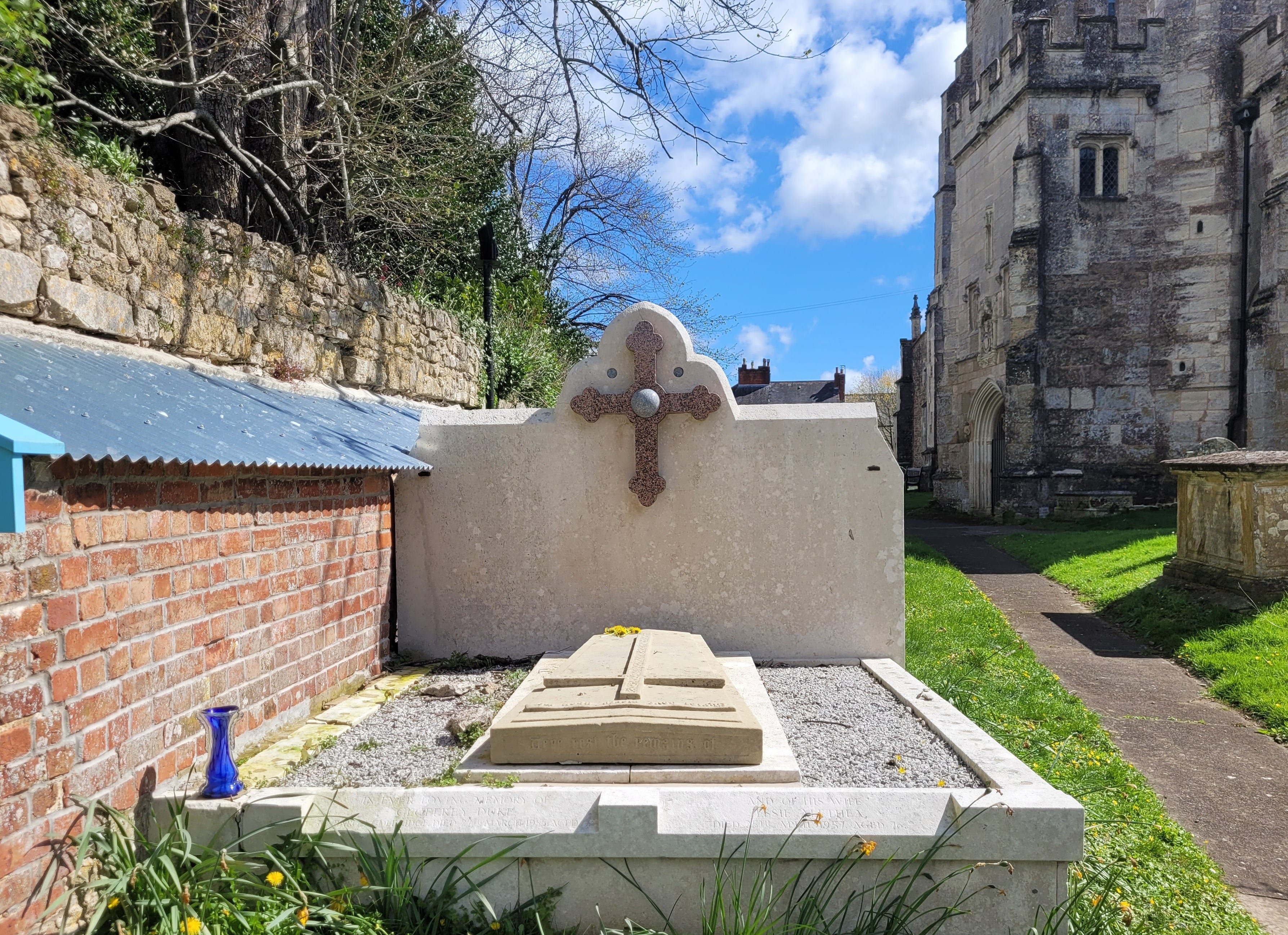
To mark the anniversary of Fr Henry James Coleridge SJ’s death, I took my family to Ottery St Mary, Devon, in search of the great man’s grave.
Where is he?
The WM Review published its first text from Fr Henry James Coleridge in November 2022 – taken from his classic work on Purgatory, The Prisoners of the King. From there, we began posting his commentaries on the Gospels and events of the Life of Our Lord, until what became a regular feature took on a life of its own in September 2024 with this website, Father Coleridge Reader.
Since then, we have published nearly 400 articles – including commentary on the Gospels for every Sunday of the liturgical year.
Fr Coleridge is a forgotten hero, praised by some of the highest-ranking men of the Church, and ranked by them among men such as Newman, Manning, Faber, Challoner and Butler. In 1908, Cardinal Gibbons referred to a group of ten such men – including Fr Coleridge – as “household names” among American Catholics.
In 1852, seven years after Newman’s conversion, Coleridge followed. He was 30 years of age. He entered the Jesuit novitiate in 1857, and maintained a friendship with Newman as a Catholic.
He was an utterly prolific writer, in support of what has been called “the Apostleship of Good Books.” In addition to over 20 volumes of highly readable commentary on the Gospels, he was responsible for:
Lives of saints (notably St Francis Xavier and St Teresa of Avila)
Translations of rare and unusual devotional texts (e.g., Ludolph of Saxony’s Life of Christ)
Editing The Quarterly Series of Catholics books
Taking the lead on The Month and another journal.
This was in addition to the many hours he spent in the confessional in the Jesuit Church on Farm Street, London. He went to his reward in 1893, and is buried in Ottery St Mary in Devon, England.
Our goal with Father Coleridge Reader is as follows:
To make Our Lord and Saviour Jesus Christ better known and loved…
… and to make Fr Henry James Coleridge SJ a household name amongst Catholics once more.
To mark the anniversary of his death on 13th April 1893, I decided to go with my family to the town in South-West England where he was buried, and to try to find his grave, pay our respects and pray for the repose of his soul.
Finding the grave
This was something of a mission, and I’m pleased to say it was a successful one.
Fr Coleridge was buried in Ottery St Mary, a town in Devon, South-West England. But beyond this, information online was sparse and contradictory. The Find a Grave website said that he was buried in Ottery St Mary – which was not news – but also specified the cemetery. I wrote to the local council to ask for further details, and they advised me that there were no records of the grave there, and advised that we consult the parish church.
I did indeed write to a churchwarden, but received no reply.
In the Grokipedia article on Fr Coleridge, I found an uncited reference to him being buried in the Coleridge family vault. Once again, information was sparse – although a website dedicated to the history of the British Empire featured a picture with the following description:
“The Coleridge family vault in the churchyard, marking the resting place of several members of the wider family connected with the parish.”
The monument had visibly deteriorated, and it was impossible to tell from the picture who was buried there. Armed with this information, some paper and pencils (to try and produce a rubbing of the grave if the engravings were illegible) and some prayer and optimism, we set out on the two hour drive to Devon.
I hadn’t been to Ottery since 2008 or 2009 – more on that later. But we arrived and parked up outside the parish church.
I showed the kids the image from the British Empire site, and we set about looking for it. Fortunately, it was a distinctive monument, and the picture showed it to be next to a small corrugated roof – and it proved very easy to find.
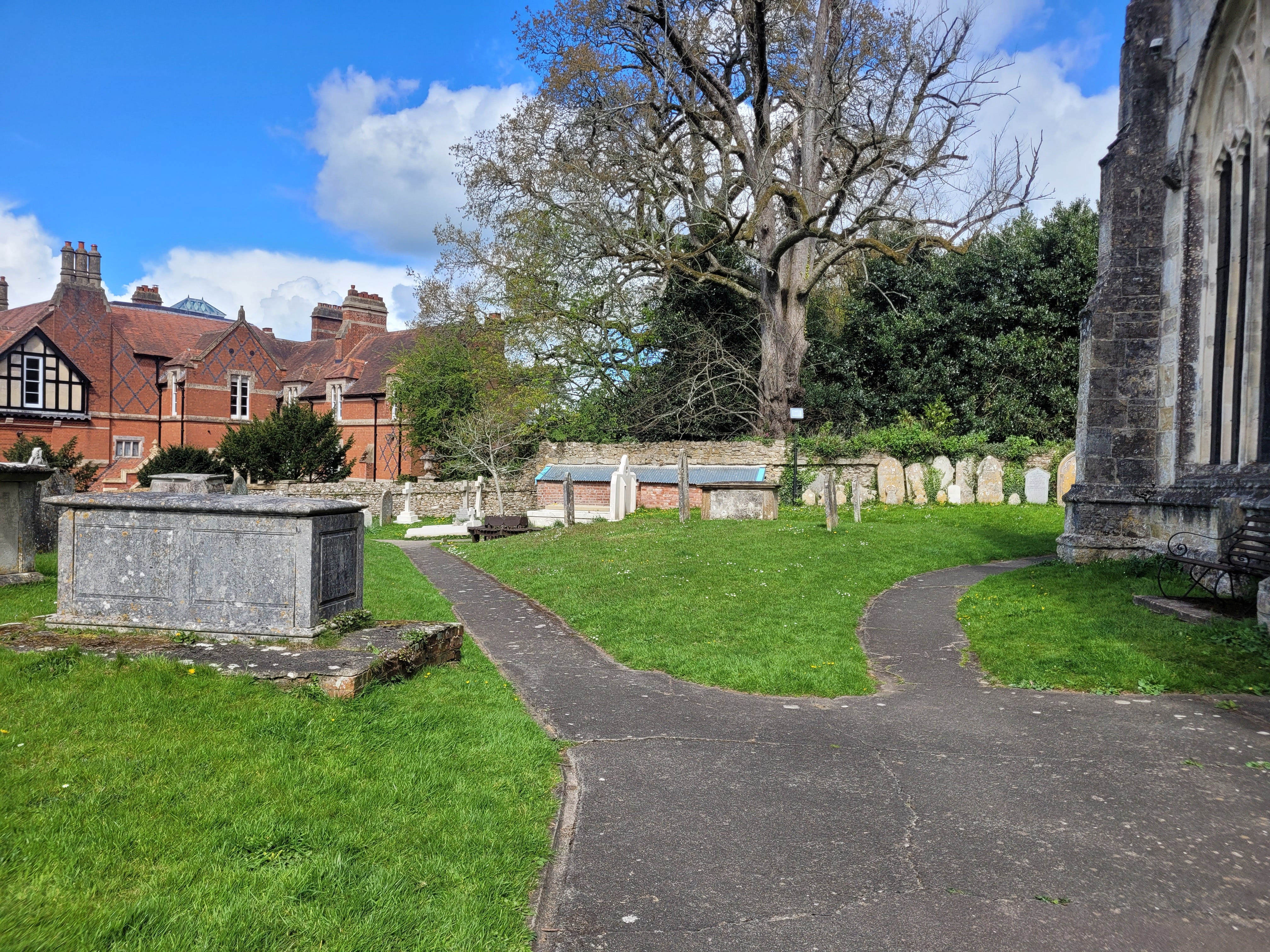
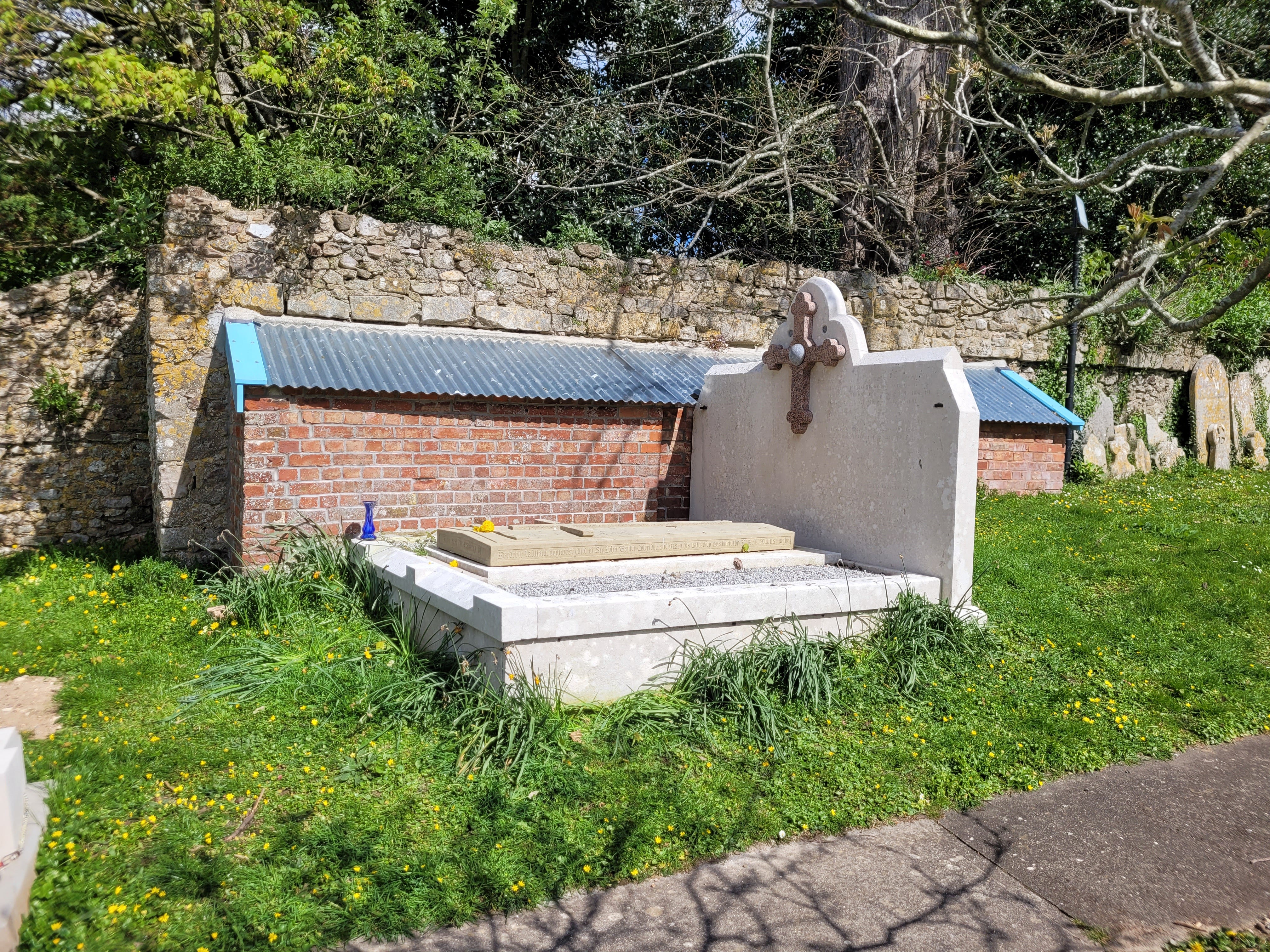
But now the real question arrived: was Fr Coleridge really among those buried here?
As expected, the writing was very difficult to read – and the stone was so rough that no amount of pencil rubbing would help.
However, a few sections of the most eroded part of the monument caught my eye. Can you see them?
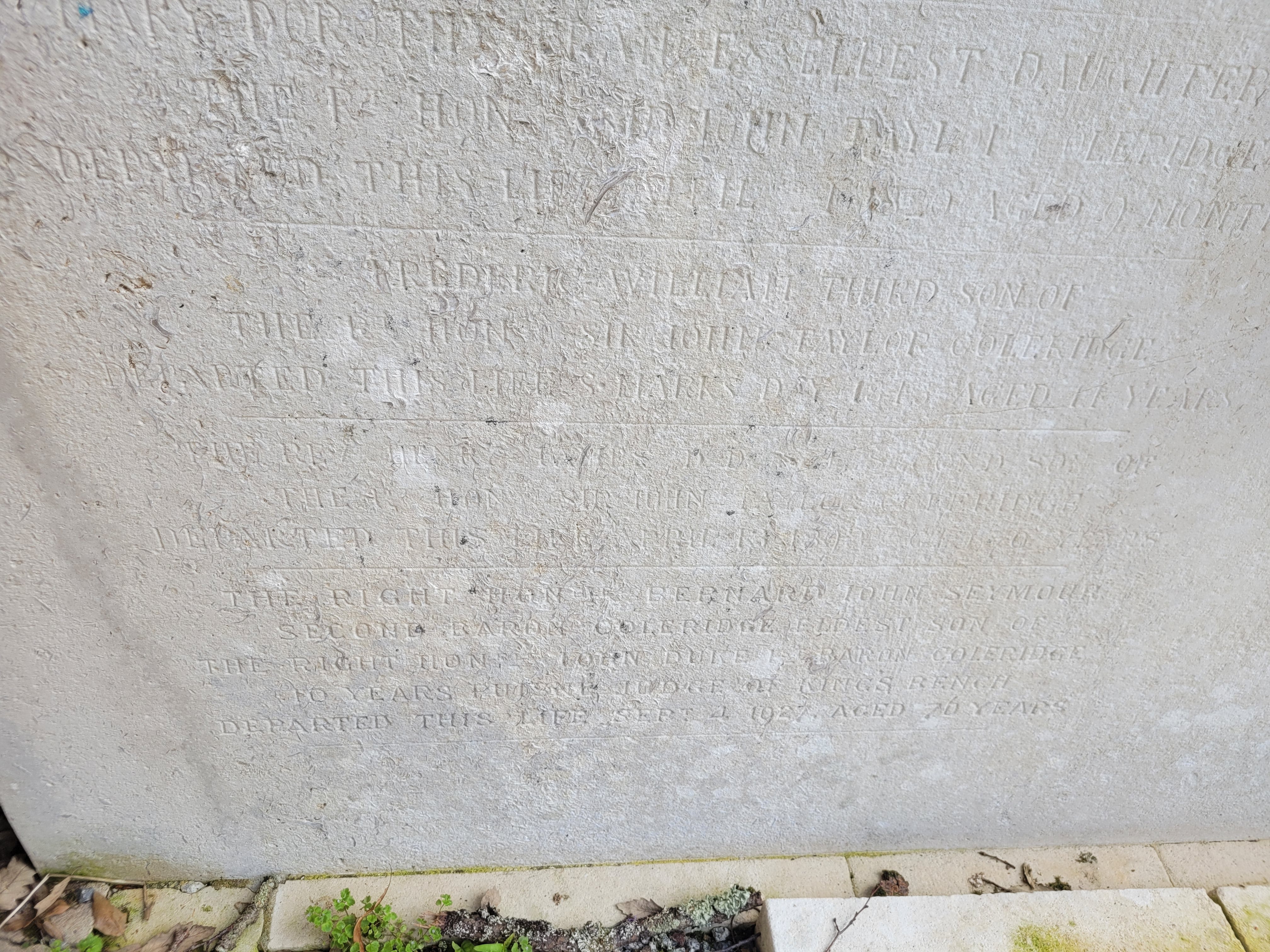
I took a closer look. I could make out parts of it, just as “REV HENRY ~~~ES” – no “COLERIDGE” after them, but the other names on the monument were set in the same way. As I looked harder I could see “SECOND SON”, “SIR JOHN TAYLOR COLERIDGE”, “DEPARTED”, AND “~PRIL 13 18~3”.
Here is an enhanced image – see the third section down:
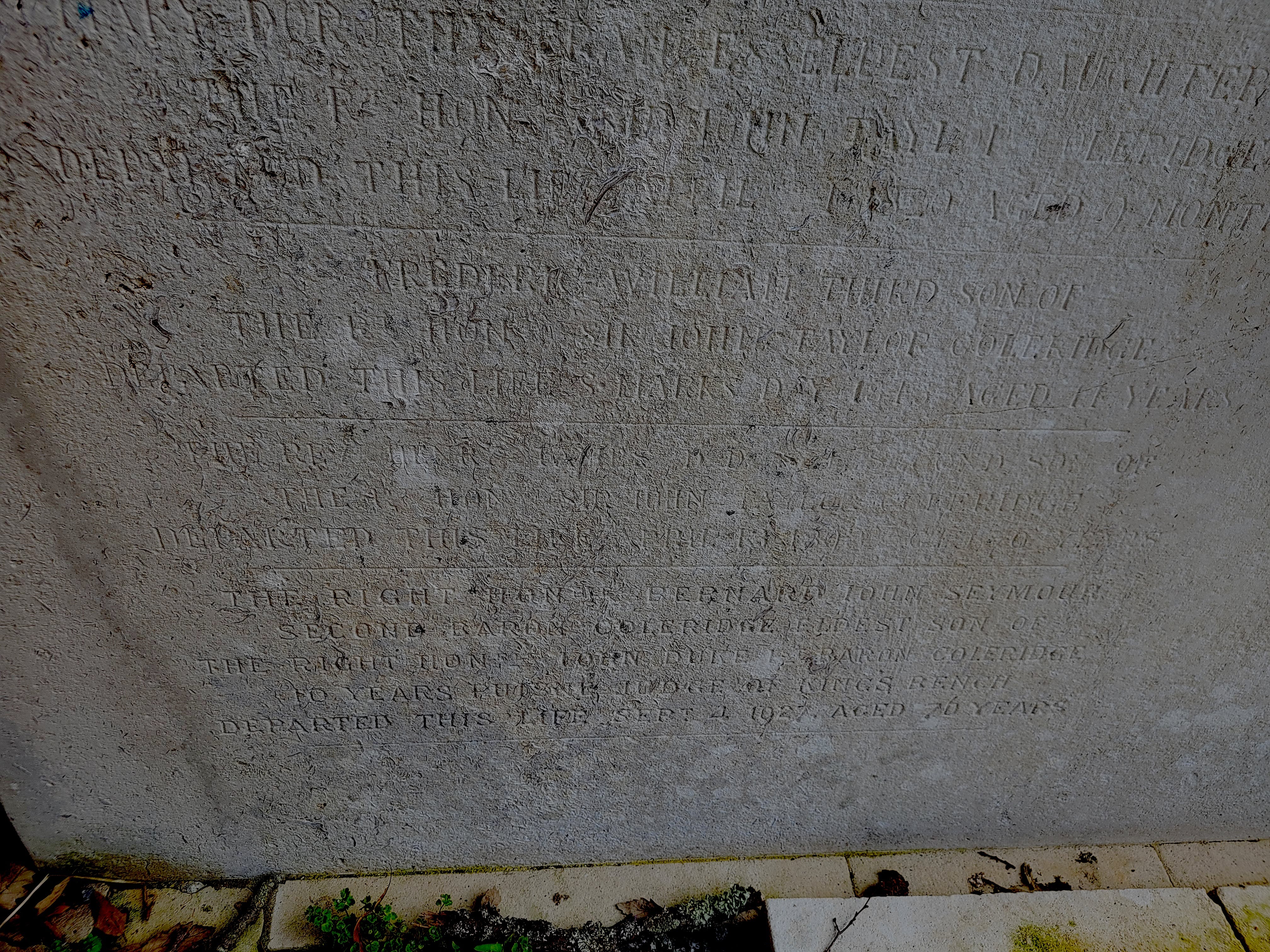
The light was terrible, and even the enhanced image is not great.
But on an even closer inspection, tracing the inscription with our fingers, more letters became legible to me and my son, and it became clear what the engraving said:
THE REV HENRY JAMES, D.D., THE SECOND SON OF
THE RT HON. SIR JOHN TAYLOR COLERIDGE
DEPARTED THIS LIFE APRIL 13 1893 AGED 70 YEARS
We had found him. Deo gratias!
My children gathered a few dandelion flowers, and we said a decade of the Rosary for the repose of Fr Coleridge’s soul, and for any Holy Souls whose bodies lay in this churchyard.
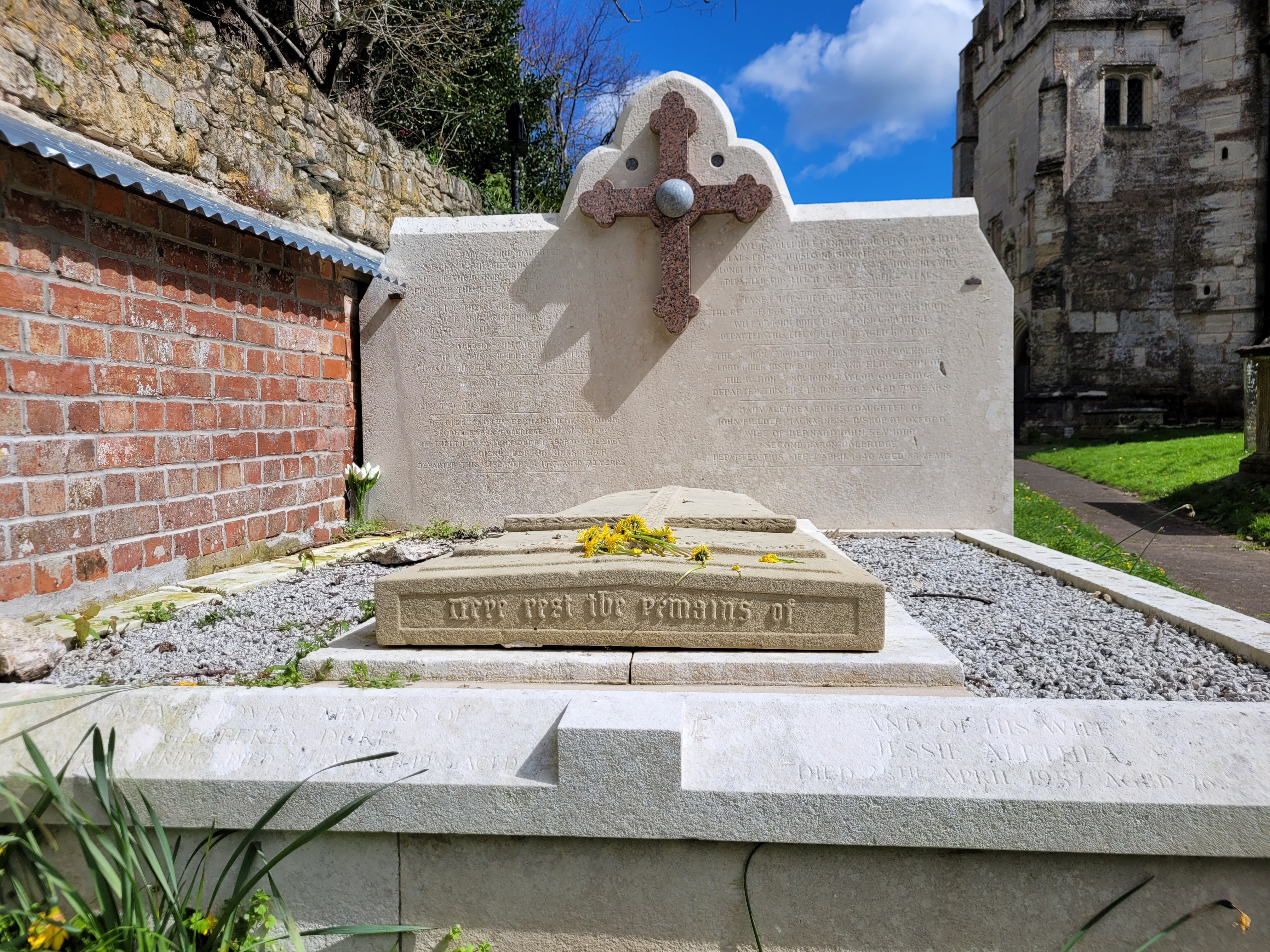
After a picnic, we also laid some white tulips, and prayed for readers of Father Coleridge Reader and The WM Review.
The WM Review focuses on explaining traditional points of theology, and using them to approach contemporary questions in the Church. But its more fundamental purpose is to strengthen what remains – to help Catholics strengthen their faith in the darkest crisis of all time, and to give them what they need to remain Catholics, within the bosom and unity of the Church, outside of which there is no salvation.
Important as theology and polemics certainly are, they are not the whole story. They cannot be the whole story.
That’s why Father Coleridge’s comprehensive work is such an important part of The WM Review’s work. And that’s also why it was wonderful to be able to visit the forgotten resting place of this man to whom I owe so much. I hope to visit it again in the future – perhaps as an organised event with readers of this publication.
Please say your own prayer for the repose of his soul.
The parish church
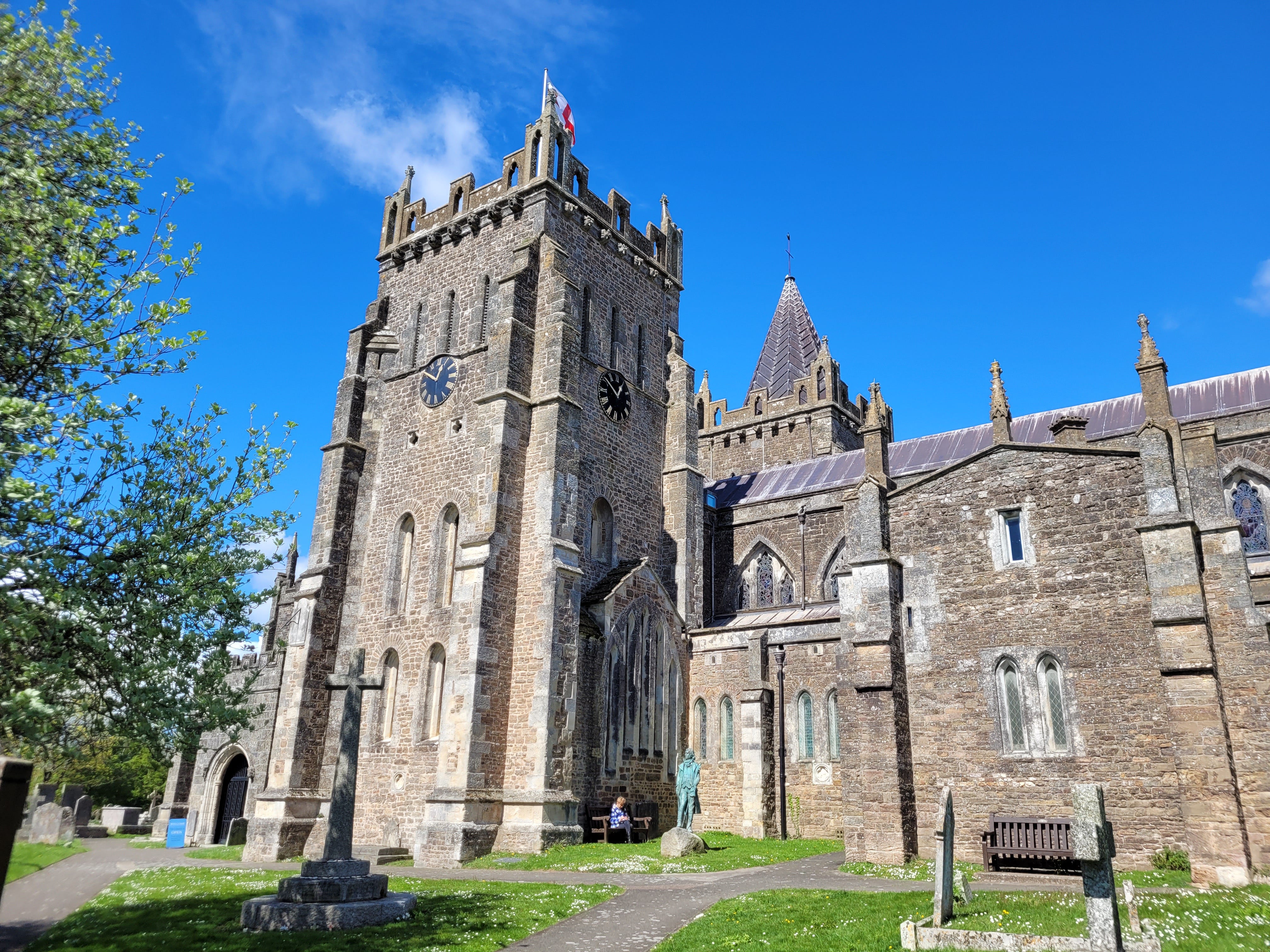
Taking our leave of Fr Coleridge and his family, we also visited the thirteenth century parish church (now in the hands of the Church of England). A picture of the exterior is above; the interior was magnificent:
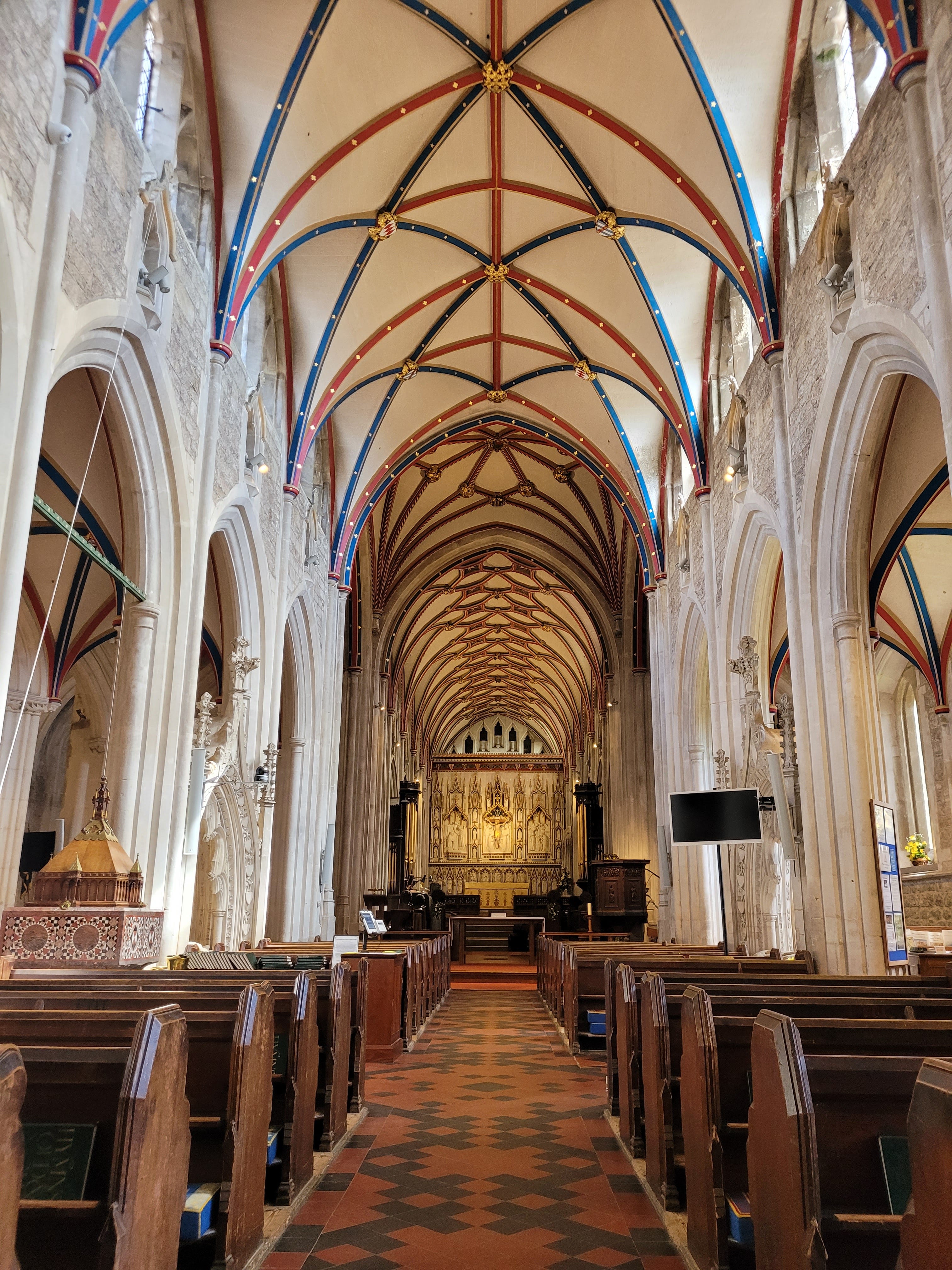
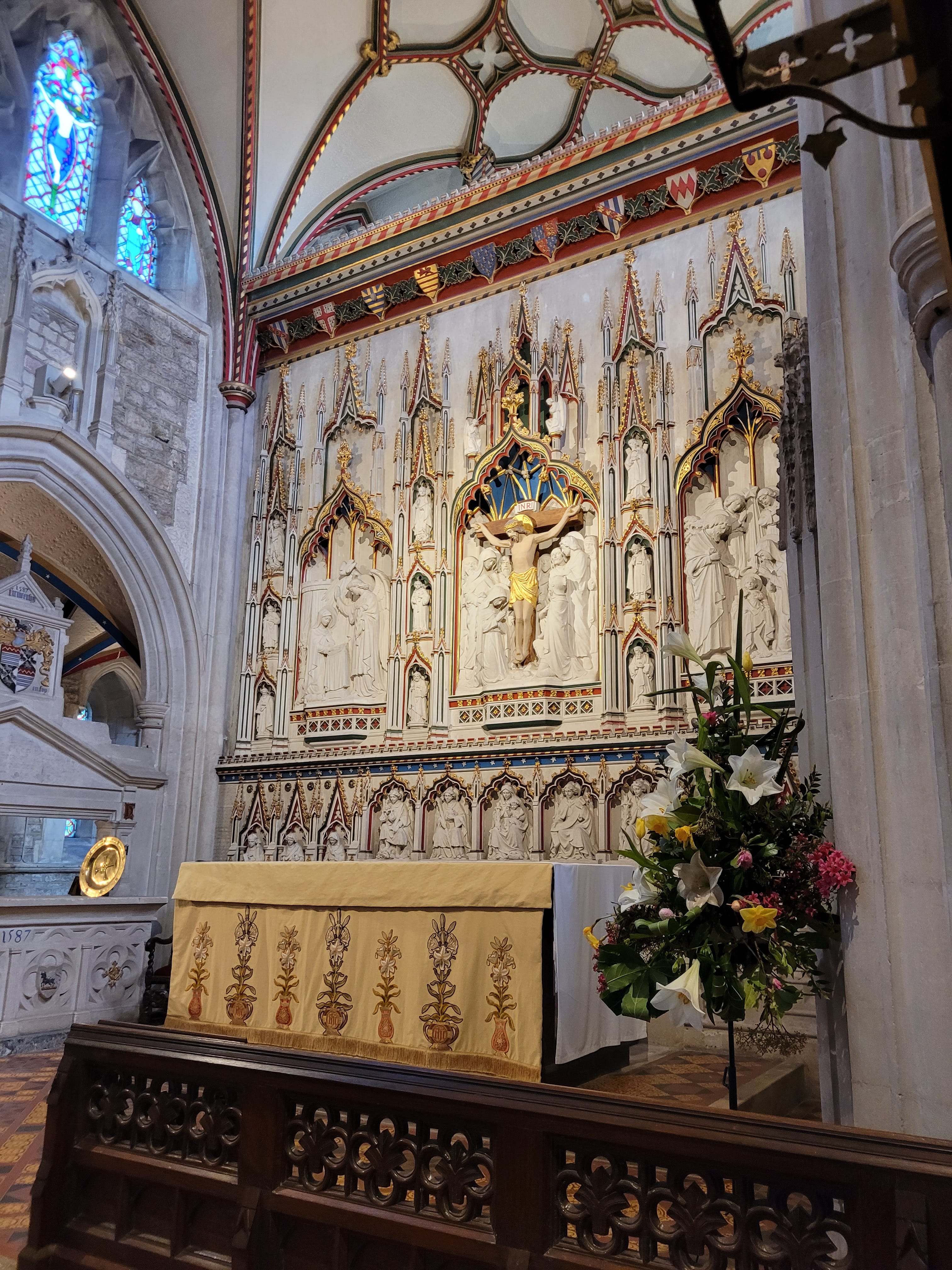
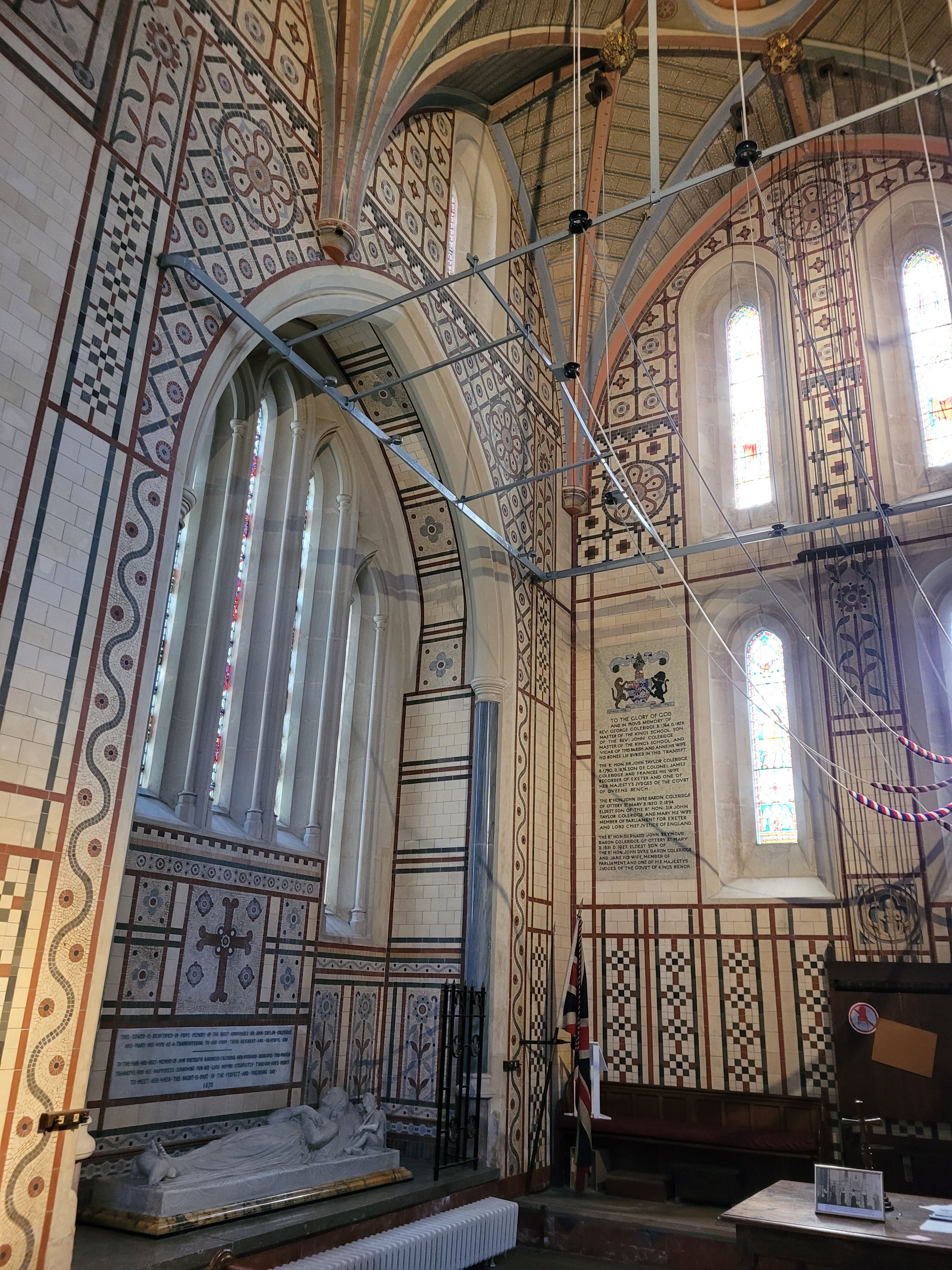
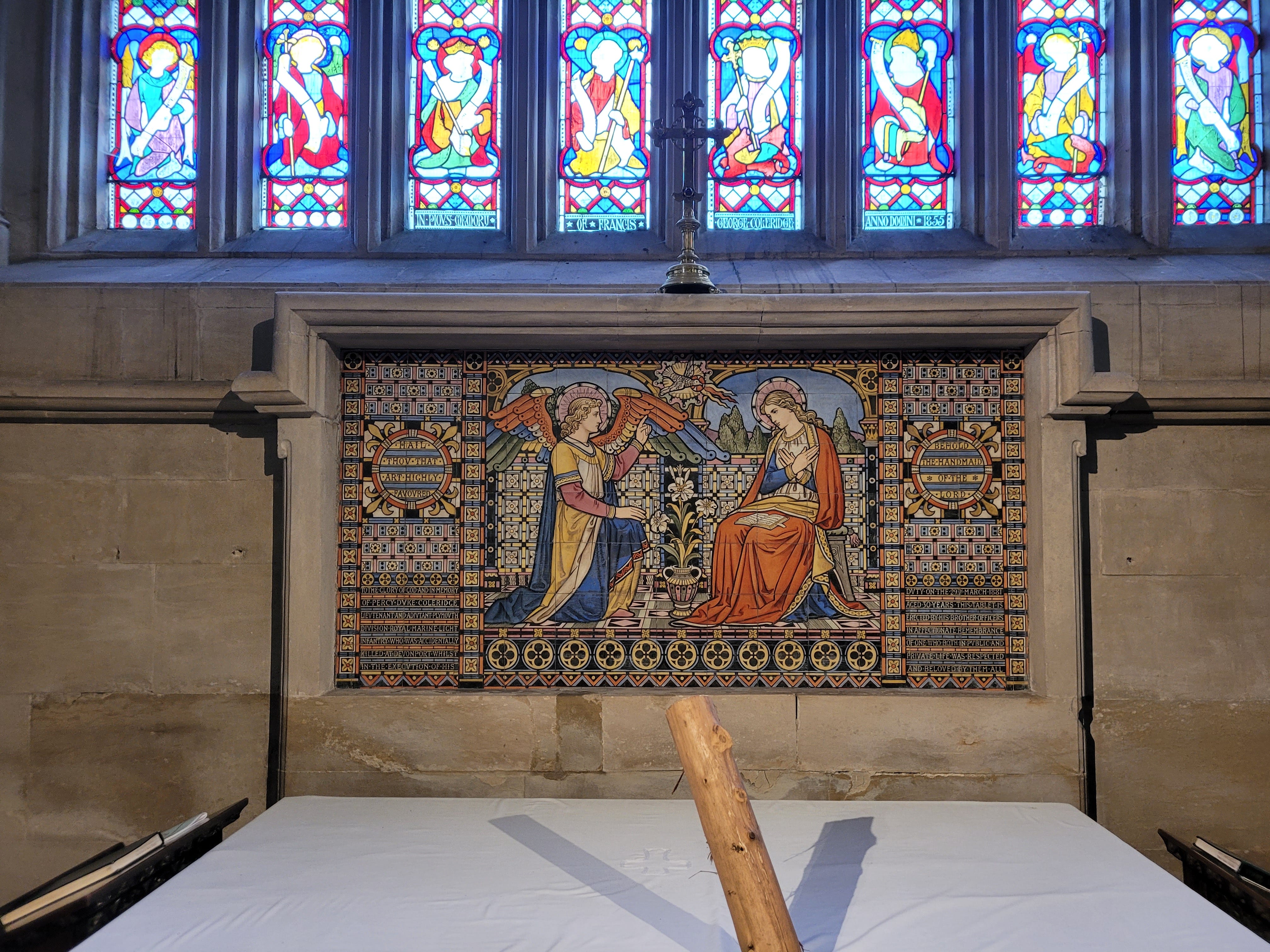
Unfortunately, the parish church was full of children’s toys, both in a large play area and even at the front of the sanctuary. It is understandable that people want to make their churches welcoming to children, but it detracted a lot from the magnificence in the pictures of above. I think that many readers of this website will agree that we should be seeking to raise our children up as much as is possible, rather than bringing things down to their level.
About Ottery St Mary
This town is at least around 1,000 years old, being recorded in the Domesday Book in 1086. Its parish church has one of the oldest mechanical clocks in England – a fourteenth astronomical clock based on a geocentric cosmology.
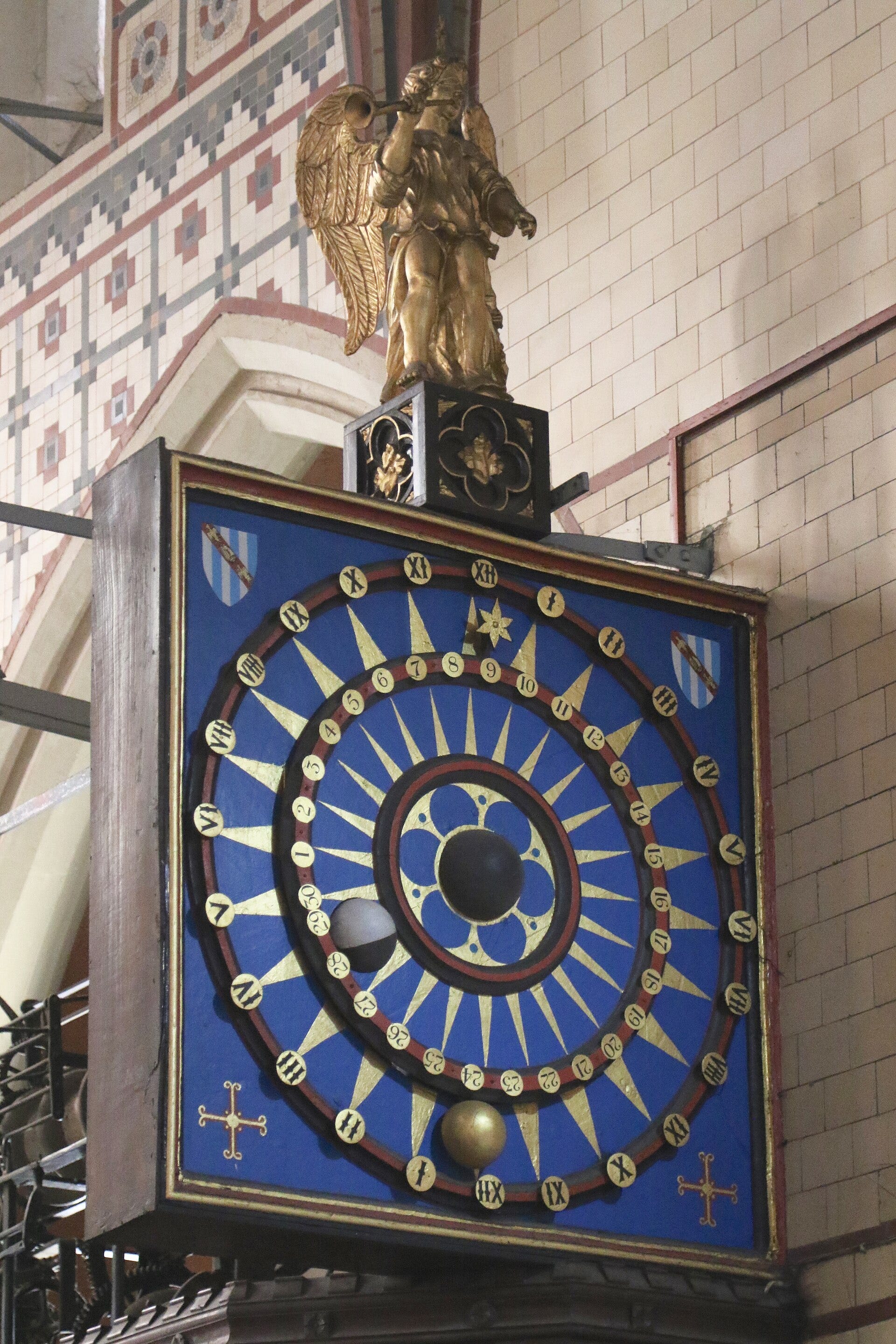
Ottery St Mary is known for two main reasons today.
The first notable feature of Ottery St Mary is its unusual annual “Burning Tar Barrels” tradition, dating back to the seventeenth century, in which 17 barrels soaked in tar are set alight outside the town’s four pubs, and carried around on the back of a resident at speed. I attended one of these events in 2008 or 2009, and it was wild. The streets were packed and you could feel the heat from the burning barrels.
(For our American readers: This is just the sort of totally normal thing English people get up to for fun.)
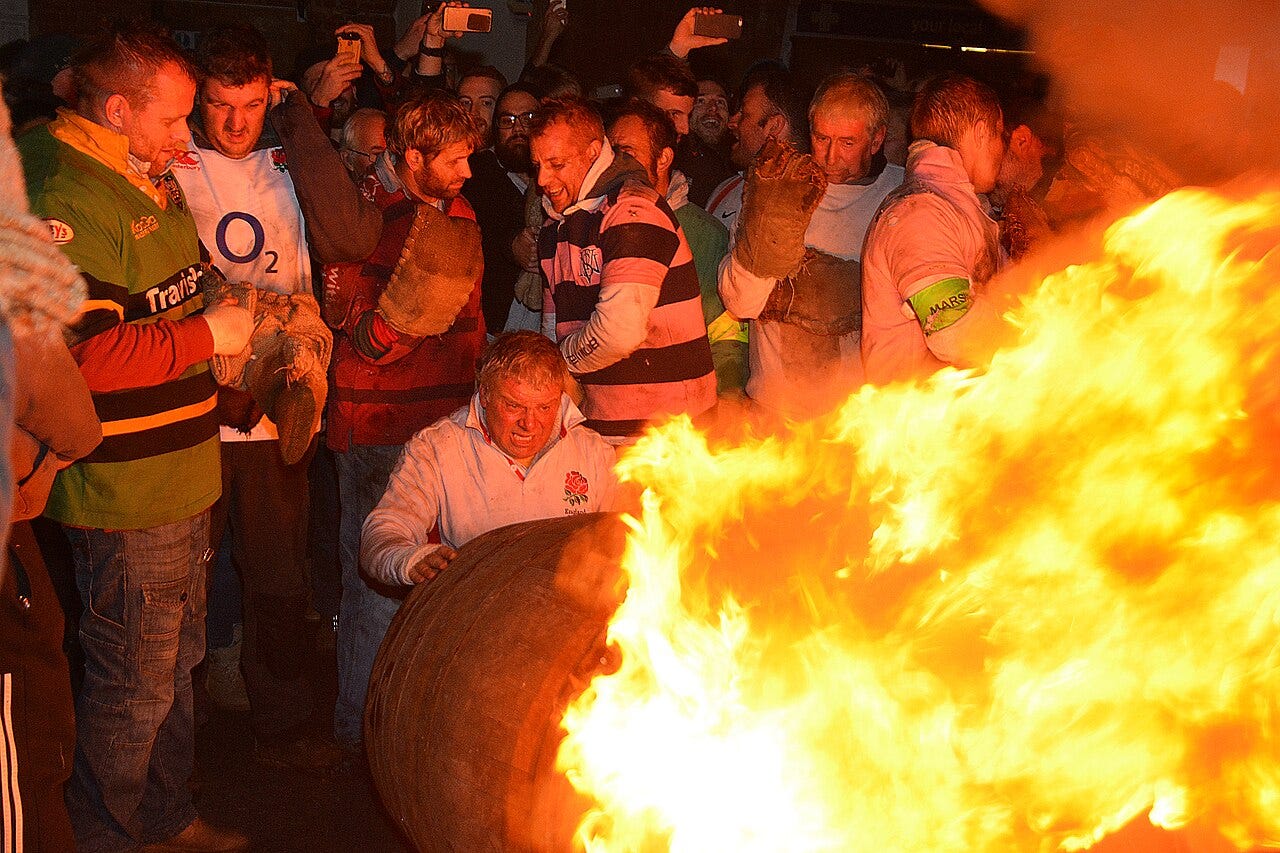
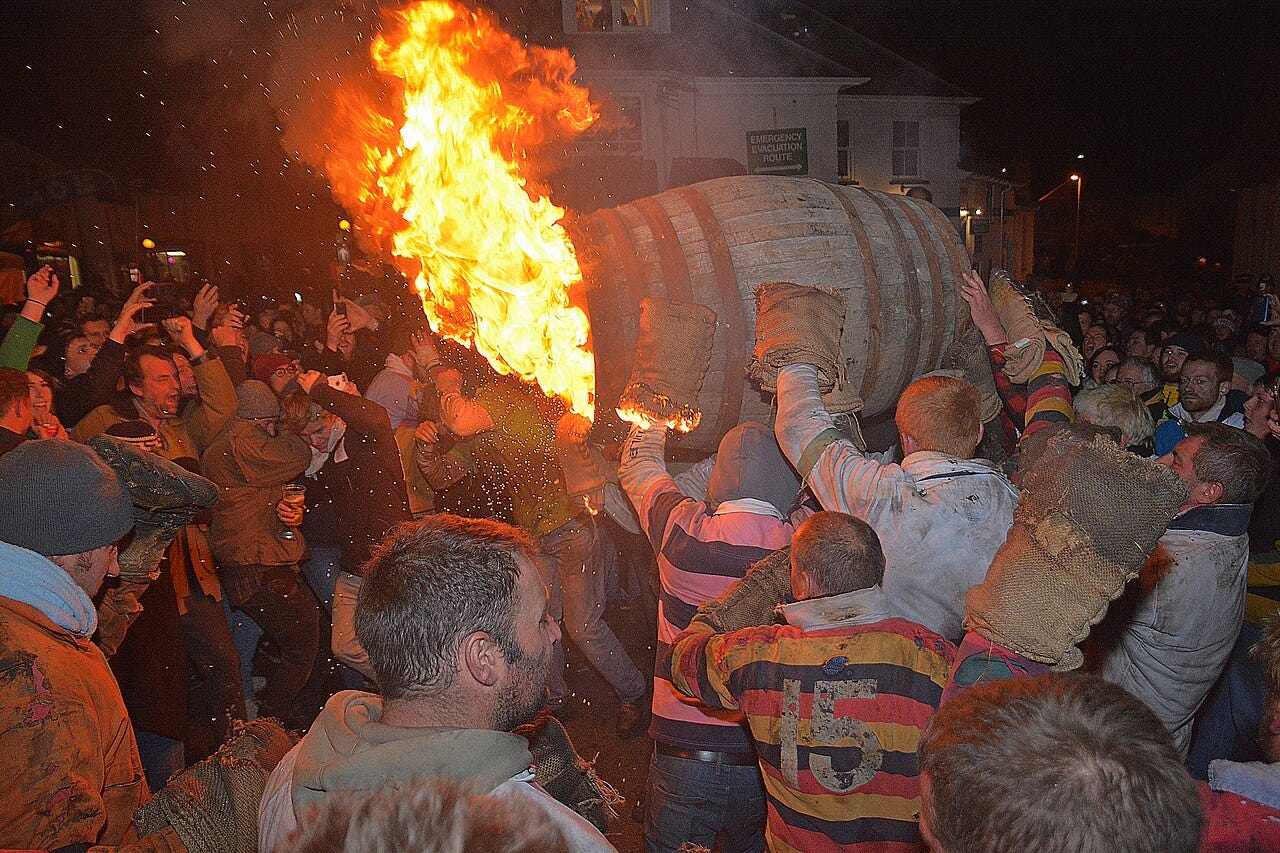
The second reason the town is known today – and perhaps the more high-brow one – is that it was the birthplace of Samuel Taylor Coleridge, the poet and great-uncle of Fr Coleridge. There are a number of monuments to the poet throughout the town.
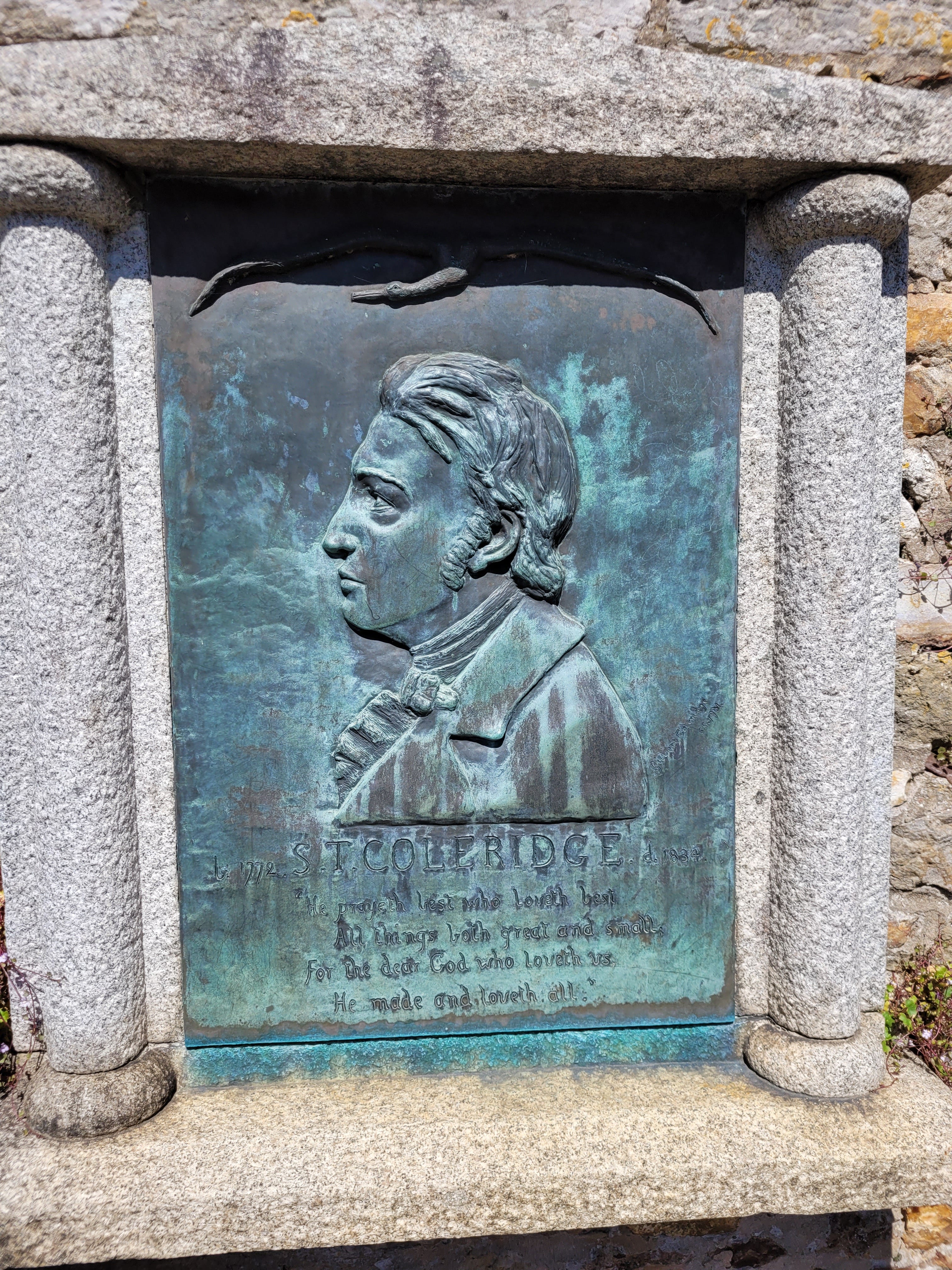
The Coleridge family have been an important part of the town since Samuel’s father was appointed the vicar of the parish church in 1769. Fr Coleridge was born there in 1822, the second son of Sir John Taylor Coleridge – the poet’s nephew.
After Fr Coleridge’s time at Oxford, he went to Ottery as the curate of a newly established curacy in the parish. Sir John built a church and parsonage for his son (seemingly that of St James and St Anne’s, Alfington – not the main church of Ottery). Sir John was later the judge in Newman’s libel case.
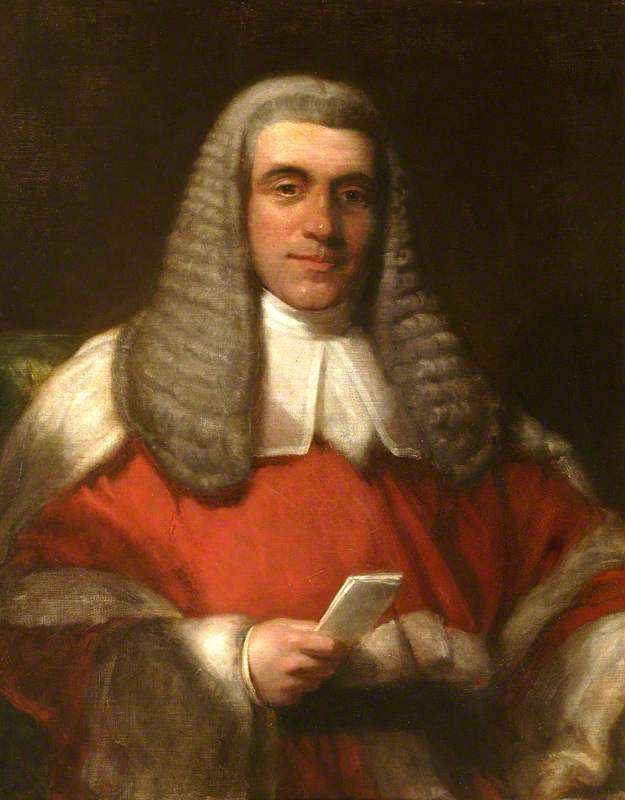
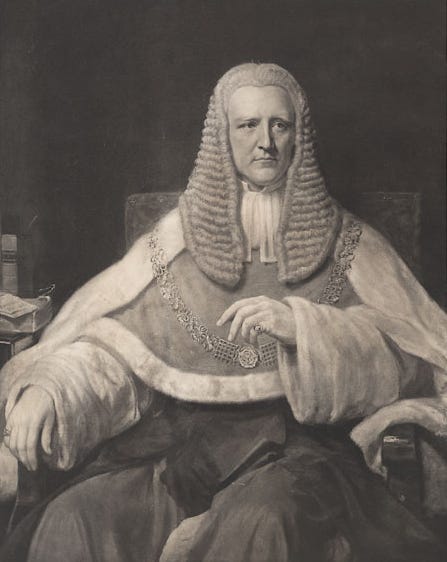
His son John Duke Coleridge (Fr Coleridge’s brother) followed his father into the judiciary, became the Lord Chief Justice of England, and was made the first Baron Coleridge in 1874. He and Fr Coleridge remained close throughout their lives, although Lord Coleridge found himself embroiled in matrimonial scandals which became painfully public, as recounted by Tom Hughes in his recent book A Shattered Idol: The Lord Chief Justice and his Troublesome Women.
The Barons Coleridge held their ancestral home in Ottery St Mary until 2006.
Conclusion
I first discovered Fr Henry James Coleridge SJ years ago, when I read an article by John Daly about a problem facing many Catholics – a lack of “familiarity with Our Lord Jesus Christ.”
Many Christians today pray, confess, study doctrine, and strive to live by the moral law. Yet even with all this, something feels absent – a dryness, a distance, a lack of real knowledge of Our Lord and love for him.
We know about him, and his Gospel – but we do not yet dwell with him, walk beside him, follow him step by step through his life on earth.
We are all aware of St Jerome’s famous maxim, that ignorance of the Scriptures is ignorance of Christ. Christ is, after all, the reason wanting to learn theology: and true theology is nothing more or less than his doctrine expressed in a systematic, scientific way. Frank Sheed expressed the same idea:
“We all respond to different elements in Christ, but we have to find them for ourselves. The student, like the teacher, should be soaked in the Gospels. He cannot meet our Lord anywhere else, not as He lived and moved and talked: that is where He is.”1
Daly makes the same point, saying that the Gospels “should be read again and again.” However, he adds that they can and should be “fleshed out by the perusal of more detailed works.” He writes:
“The personality of Our Lord can only become known to us through careful study of His words and deeds. When we truly know Christ, we cannot fail to admire and love Him, to be charmed by Him and to desire to follow Him. Our own values and characters will be transformed by Him to the extent that we pass our time in His divine company. Catholicism without familiarity with Jesus is but dry bones.
“As well may we try to learn to swim from a book without getting our feet wet as to try to practise seriously the religion founded by Christ to bring men to know and love Him without immersing ourselves in the records He has left us of Himself.”
The article went on to list seven authors whose works he recommended, including Fr Coleridge:
6. Fr. Henry James Coleridge S.J., The Life of Our Life, (twenty-six volumes).
Fr. Coleridge’s achievement leaves one gasping: a very complete life of Our Lord in twenty-six independent volumes, filled with information, with piety and with orthodoxy, answering every doubt, supplying every need, and doing so without concession to the wave of modernising scriptural interpretations which was already washing across Europe in the nineteenth century.
Yet the work’s renown seems to be inversely proportional to its merit – hardly anyone seems to have heard of it!
I am glad to say that this is no longer the case. Even Elon Musk’s Grokipedia features a lengthy account of Fr Coleridge’s life and career, drawing on the work of Father Coleridge Reader, and ending with the following remark:
“Today, Coleridge remains underappreciated relative to contemporaries like Newman, yet his contributions to pre-Vatican II ecumenism—through thoughtful engagements with Anglican traditions—and social Catholicism, advocating Gospel principles for societal renewal, continue to resonate. Modern recognition has grown via initiatives like the 21st-century Father Coleridge Reader project, which digitizes and audio-formats his texts to reintroduce his "apostleship of good books" to new audiences, countering superficial devotional trends with rigorous, pious scholarship.”
At a time when so many are tempted by shallow piety or sensational claims, Coleridge offers clarity, reverence, and truth. His work contains no sentimental excess, no theological compromise, and no modernist uncertainty. It is rooted in the faith of the Church and nourishes that faith in others.
It’s a fact that if more Catholics knew about authors like Fr Coleridge, many of the errors and distractions of today would lose their hold.
And this is why he must be restored to his position as a household name.
If you want to see what I mean, take a look at how far we have got through his Life of Our Lord series – and the incredible richness, depth and diversity in his writing:

If you believe Catholics need serious, doctrinally sound spiritual writing, then subscribe to emails today – or even join us as a monthly/annual subscriber:
You can also support Father Coleridge Reader by making a one-time donation to The WM Review:
One final way is by giving a gift subscription to your friends and family:
Regardless of whether you are a monthly/annual subscriber or not, thank you for signing up to receive Father Coleridge Reader emails. Fr Coleridge’s voice deserves to be heard again – and with your help, it is being heard.
PS: We will be continuing our commemoration of his anniversary this week with two further in memoriam articles written at the time of his death. Hit subscribe to make sure you don’t miss them:
PPS: In your charity, please remember the repose of Fr Coleridge’s soul in your prayers.
PPPS: A few months ago we launched a range of mugs for The WM Review. We make a small commission on them, but they are fun, and a good way of starting conversations with your guests. The Father Coleridge Mug is here:

Follow our projects on Twitter, YouTube and Telegram:
Twitter (The WM Review)
Frank Sheed, Are we really teaching religion? 1953. Available at EWTN at https://web.archive.org/web/20220109233505/https://www.ewtn.com/catholicism/library/are-we-really-teaching-religion-4068
Thank you for this story, which I enjoyed very much! After reading it, I have made a belated "New Year's Resolution" to read at least one Fr. Coleridge article each day.
Finally another pilgrimage!
Thank you for this wonderful post and for the Father Coleridge Reader. You are doing a great service to the Faith!