
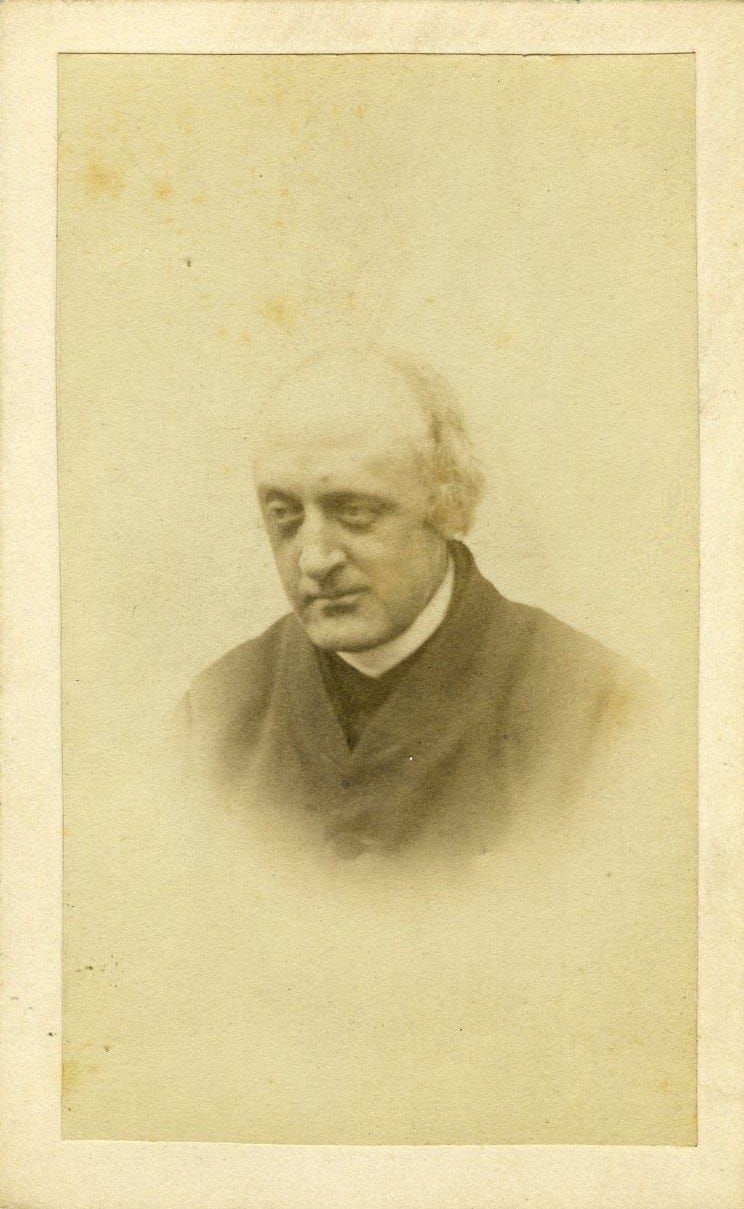
Following his death on 13 April 1893, Fr Henry James Coleridge SJ’s old friend James Laird Patterson, Bishop of Emmaus, wrote the following tribute.
Editor’s Notes
As readers will notice, we have at last managed to obtain a portrait of Fr Henry James Coleridge SJ, and secured the kind permission of the British Jesuit Archive to use it in this article. We are very glad that his portrait has been made public for the first time in many years. (The painting which we have used hitherto is supposedly of Fr Coleridge, although we have never had great confidence of this, and depicts a man probably at a much younger stage of life than he would have been as a Catholic and priest.)
We previously published Fr Coleridge’s initial obituary in The Month. On this anniversary of his death, we are publishing a second, lengthier tribute to the Jesuit priest by Bishop James Laird Patterson from the same publication, a few weeks later. This was accompanied by a second lengthy obituary by Fr Coleridge’s successor as Editor of The Month, Fr Richard F. Clarke SJ (which we will publish tomorrow).
As the memorial makes clear, Patterson was a contemporary of Coleridge’s at Oxford. He became a Catholic in 1850, two years before Coleridge. Nonetheless, Coleridge played and continued to play an important influence on Patterson. Here is a photo of Bishop Patterson:
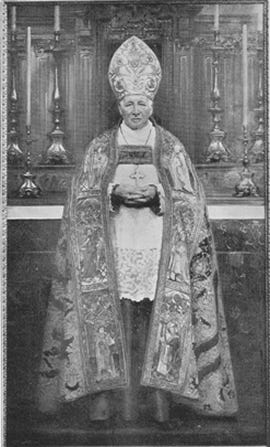
Patterson was later made an honorary chamberlain to Pope Pius IX, and the President of St Edmund’s College, Ware. He was consecrated a bishop in 1880, having been appointed to the diocese of Northampton – although his health made this impossible, and he was instead made the titular bishop of Emmaus (which was fitting given his tours of the Holy Land earlier in his life), and served as an auxiliary for the diocese of Westminster. He himself died in 1902.
Reading the memorial, one cannot help be struck by two key points.
First, the goodness and virtue of Fr Coleridge himself. This website is not dedicated simply to good writing, but to good writing by a good man, who loved Our Lord and sacrificed himself for his glory.
Second, the nature of the sacrifices which he made in becoming a Catholic, and the struggles which he faced in this process. The Bishop of Emmaus’ description recalls the situation facing many today. The refusal the Anglican Establishments apologists to engage with serious arguments, the hostility of many of its ministers towards those seeking to live as Catholics within its borders, the stark reality of stepping away from the comforts of the Anglican establishment and into the unknown world of “Romanism”, and the “extreme art” with which the Anglican religion sought to present itself as the true Church – all these are very familiar phenomena which continue today.
We hope that his tribute contributes to the estimation of Fr Coleridge as a man and a priest amongst our readers. Please remember the repose of his soul in your prayers.
Recollections of Henry James Coleridge.
The Month, Vol. 74, No. 348, June 1893
No. 348, June 1893, pp. 153-167.
Headings and some line breaks added for ease of reading online
Personal Recollections
It was in 1841 that the writer of these lines first had the happiness of knowing Henry Coleridge.
He had come into residence at Trinity College, Oxford, as a scholar on the Blount foundation, and was elected to a full scholarship of that house on Trinity Monday, 1841. He soon became a prominent member of the set who, as scholars of Trinity, and subsequently as Fellows of that, and of other colleges, occupied an honourable place in the social and academic life of Oxford.
He had come to us from Eton, and was a charming specimen of the Etonian of that time; scholarly, cultivated, full of interest in the classical literature of the ancients and of his own tongue, but with a strong current of acquaintance with the larger world without, especially the world of sports, and the world of politics. He could tell you, for instance, what horse had won the Derby year by year ever since the Derby was run, and a great deal concerning the successive Ministries from the days of the Chathams to our own.
His wit was of a most refined kind and his taste in literature and art fastidious. He had the reputation of being a man, or as old people would say, a youth, of much thought, though owing to some little defect in speech and a sensitive shyness, he did not come out as a speaker at the Union, or the other debating societies to which he belonged.
His natural bent was to a critical and ironical tone, and socially he was exclusive, and consequently not generally popular: but beneath the surface, those who were admitted to his intimacy, found a warm and affectionate friend, full of generous and confiding feeling.
His religion as an Anglican
Such, in general outline, was Henry Coleridge at the age of eighteen, so far as his natural character is concerned. There remains, to complete this rough sketch, a word to be said as to his inner being and life.
This was very quietly and unobtrusively, but very profoundly and consistently, Christian and devout. At the time of which we are speaking, the religion of this country was in a state of rapid transition. The great “Evangelical” revival had indeed infused into the minds of many a strong sense of personal religion, but to the educated classes this movement of the will and affections failed to afford any rationale of religious belief, and the old-fashioned High Churchmanship of the previous generation had become too colourless and inactive to supply the need to the people.
The few only had at first been drawn to the theory which, barely seven years before the time of which we are now writing, had been elaborated in the minds, and published in the works of the writers of Tracts for the Times, but of these few were the family and friends of Henry Coleridge, and when he came up to Oxford he was already in possession of a distinct ideal of religious belief and conduct, as were others of the set to which we belonged. Among our College tutors were the friends and disciples and co-operators of John Henry Newman, formerly scholar of Trinity, and then Fellow of Oriel, and still Vicar of St. Mary’s. We had therefore in College, in the persons and influence of our tutors, Isaac Williams, John W. Copeland, Arthur Kensington, and Arthur West Haddan, living sources of a system of religious belief which had already put on to us the character of a tradition.
We were all, no doubt, in different measure affected by this “new learning.” At that time none of us had any doubt as to the Anglican Church. Our frame of mind and practice of religion were as nearly as possible such as are reflected in Keble’s Christian Year, and we found ourselves quite at home and quite satisfied in the historical and religious attitude of the seventeenth century ecclesiastical writers. We wore oak-leaves on the anniversary of the Restoration of King Charles II., in memory of the Boscobel oak; we prayed the prayers of Bishop Andrewes, and Ken, and Jeremy Taylor, we attended our College chapel morning and evening, and treated ourselves to a choral service at New College, and at Magdalen very often besides. Isaac Walton, and Donne, and George Herbert were among our favourite authors, and we were, in politics at least, non-jurors and firm believers in the “Divine right” of kings.
Once Henry Coleridge had to read an essay on such a subject, and our tutor, the once well-known, kindly “Tommy” Short, a survival of the old “port-wine” school of High Churchman, characterized it as Toryism run mad, to the indignation of our set.
Coleridge was already a finished writer in Latin, and a master of his own tongue, as his many works in later years testify, and also an earnest and acute reasoner on what was commonly called “science,” by which was chiefly, if not exclusively meant, the mental philosophy and natural theology of Aristotle and of Butler.
Looking back half a century to those days, and recalling with gratitude and respectful affection the examples of virtue and of piety which then surrounded him, the writer of these lines discerns one among that group of friends and companions whose influence over him was paramount and enduring, and that one was Henry Coleridge; the thoughtful, reasoned grace and refinement of his mind, the retiring modesty, and absolute purity, which breathed in his whole bearing and conversation, were attractive in a singular degree, and were, under God’s good Providence, powerful factors in the formation of others.
An impulse in that direction was indeed given by another contemporary, who seemed to have been preserved for that intent, for he was removed by a strange catastrophe from this world, during the summer vacation of that year (1841). From that time, for the next four years, Henry Coleridge became the constant companion, “guide, philosopher, and friend” of the present writer.
Growing awareness
In 1844 he took the highest honours in the classical schools, and was elected to a Fellowship at Oriel, then the blue ribbon of the University, but our friendship remained as intimate as before, and we saw almost as much of each other as we had done when he was still at Trinity. In that year, however, a marked change had come over us in regard to the great question of religion. We had not come into personal contact with the authors of the “Oxford movement” in such sense as to have imbibed directly from them any definite attitude of mind on the great question of the Church.
Nevertheless, our condition had changed. Up to that time, as has been said, we had accepted without doubt and without inquiry, as a fact, the implicit conclusion that “the Church,” on whose authority we based our religious belief, was certainly the Church of our country, as by law established, and in possession of the style and title of “Church of England.” But there came a time when the security of this postulate was challenged by the events which were occurring around us. Up to this time there had been few converts to the Catholic Church, and those personally unknown to us.
We were accustomed to regard our position as impregnable. Were we not the only consistent representatives of true “Church principles,” and as greatly removed from Roman doctrines as we were from those of the Low Church people and the Dissenters, and had we not sworn at matriculation that we “willingly and ex animo received and adhered to the Thirty-nine Articles and the whole Prayer Book and Homilies of the Church of England”? When any one gave up these positions we were wont to suppose that such a defection could only arise from an error of judgment, or some moral cause which we could only guess at, and had better not inquire into.
But when the great leader of the movement, whom we had so often heard preach his parochial sermons in St. Mary’s, and at whose hands we were wont to receive Communion in that quiet old-fashioned, unrestored and undecorated chancel (for as yet Ritualism was not),—when John Henry Newman withdrew, without word or sign, to Littlemore, we were as it were awakened from the placid complacency of our security, and for the first time became practically aware that there was such a thing as the “Roman Question.” We were in those days very conscientious and loyal to our Church authorities.
For instance, we considered the University statutes as binding in conscience, and one of them was that under the heading, De conventiculis non intrandis, and so we never entered any church or chapel except those of the Church of England, and, it may be added, that we never knew any English Catholics and had no opportunity of knowing any.
But now (in 1843–4) we began to find out that our interior life was not altogether in harmony with that which was commonly considered the “Church” spiritual tone. We had been praying, fasting, and giving alms, and now we had come to need and to ask for a guidance in those practices, which was not to be had in our own College, and especially we were feeling the need of confession.
The callousness of the establishment ministers
The first subject of our doubt and inquiry was the lawfulness of confession, and this, which seemed a necessity (as in truth it is) of the interior life of the soul, led us into the whole question of the meaning and authority of the Thirty-nine Articles which we had (so to say) swallowed whole at our matriculation three or four years before.
What brought the question home to us more especially was the intention we both entertained of entering the ministry of the Established Church. Henry Coleridge was, however, as being the better informed, more independent in his line of thought and inquiry, and so far as the present writer can remember, he was still very firm, not to say combative, on the Anglican, or via media side in this and the next year. In October, 1845, Newman seceded from the Establishment, and though we both felt the shock, Coleridge seemed to be the least affected of the two, and we carried out our intention of presenting ourselves for ordination to the “diaconate” in December.
An incident which may serve as some illustration of his state of mind at that time, occurred at the first ordination held by Bishop Samuel Wilberforce. In his charge which he delivered to us with all possible solemnity of attitude and intonation, the Bishop alluded to Newman and his friends’ secession in the following words, which form the peroration of his discourse.
“They who have retired from the busy world to contemplation and a cell, have found ere now, too often, that the Satan whom they fled from in the crowd has travelled on before them to meet them in the waste. Self-confidence, fondness for speculation, love of singularity, separation from their brethren, and then the misty visions of the darkening eye, the eager throbbings of the narrowing heart, heresy, schism, unbelief, and apostacy, these are the special dangers of the unwatchful student.
“How deeply, but as yesterday, some have thus fallen even by our side, is known to all of us. They are set as beacons to us, if such is our path, that we ‘be not high-minded, but fear,’ lest like them we too be led hereafter deliberately to adopt errors which we have been permitted ere while to expose with a clearness withheld from others, and at last, to fly on the wings of an unbounded scepticism into the bosom of an unfathomed superstition.”
As we left the chapel after this remarkable explosion, one of us at least was greatly moved and felt very sad at hearing such talk about such men, and not a little fear of the “misty vision,” which had seemed to him to be rather applicable to the Thirty-nine Articles than to himself, until the orthodox sagacity of the prelate had ascribed it to its real source in the perverted mind of Newman, whence it might, he thought, possibly have descended to the present writer.
Coleridge, however, took a different view, and merely said, with a little sniff, which was habitual when he spoke with irony, “‘Unbounded scepticism’ I take to be Trench’s (who was then chaplain to the Bishop), and ‘fathomless superstition’ was the Bishop’s own.”
In truth, the note struck by Dr. Wilberforce was one we often had to hear at that period. Our seniors were constantly meeting our distressful calls on them for some intelligible explanation of the manifold inconsistencies and downright heresies of our formularies, with exhortations to do anything rather than look them fully and fairly in the face. “Contemplation and a cell” were certain, in the philosophy of those good people, to lead to a row of most unpleasant results, and were generally prescribed and banished as dangerous and unsettling.
This line was certainly safer than argument, but though we were again and again put off in this way, the doubts and the anguish of conscience recurred and would not be silenced by any such expedients. Sometimes the advice took the form of an ingenious confession that the adviser had himself gone through a period of misgiving, but had managed somehow to struggle through it and come out of “darkness” and “throbbings” into the full blaze of the Elizabethan light and peace.
On this palmary point, however, of the authority of the Church of England, our bona fides was certainly shaken before the time of our ordination. The Bishop “interviewed” each of us, and with a display of erudition and a great deal of rhetoric calculated to awe young men, sent us away silenced, if not satisfied.
Rejection as an Oriel tutor
Henry Coleridge had been urged by his friends to accept a tutorship at Oriel, but the sturdy and acute old Provost, Dr. Hawkins, had declined to allow him so to do, and it seemed to us that his case was at least one of those which the Bishop (himself an Oriel man) had in mind when he spoke of the special dangers of those who “retired from the world,” and became “unwatchful students.”
A long experience inclines us to believe that the most charitable judgment of our neighbour is also usually the most true. We will not therefore suggest that the warnings of our superiors were intended to reinforce any temptations which we had towards postponing or stifling conscientious doubts as to our religious position; but one may say that the bias of all that made life attractive and pleasant to us, was so distinctly in favour of remaining where we were, and the disadvantages and vague dread of an opposite course were so obvious, that we had no need, to say the least, of additional arguments in favour of acquiescence, and against inquiry.
That this was the case with Henry Coleridge is not a mere hypothesis. The extracts from his letters given below and written about this time, show that he was tried by very real and very specious temptations to give up the lines of thought which disturbed and tried him, and to fall back on a mode of life and on occupations which would presumably postpone, or even totally and finally remove, the consideration of the great religious problem which lay before him.
Time at Ottery St. Mary
The failure of his desire to become a tutor at Oriel had renewed the thought which he had previously entertained at intervals, of giving up residence at Oxford, and taking a country curacy, and circumstances lent themselves to the realization of this idea.
Part of the parish of Ottery St. Mary, where was, and now is, the home of his family, was erected into a separate cure, and Henry Coleridge was asked to become the first curate. The Judge was naturally desirous that he should be near home, and the church and parsonage were soon built with this view. Other circumstances combined to recommend this course to him.
At the beginning of 1846, our friends, Montague Bernard, afterwards Fellow of All Souls, professor of international law, and a Privy Councillor, Henry Coleridge, and others had planned and carried out the editing of a weekly newspaper which became, and still remains, the most able and accredited organ of the High Church party, the Guardian, and though it soon achieved a considerable success, it was perhaps partly on that account that he early felt a shrinking from continuing to write in the tone of ascertained, if not superior, hold of the truth on subjects on which he was already realizing that inquiry and investigation were leading on to doubt.
The sensitive sincerity of his nature shrank from affecting to be dogmatic without a distinct and final basis on which to rest such a pretension. In 1847, he wrote to this effect, but things went on much as they had done, in that in the succeeding year, when at last he made up his mind to leave Oriel, and take up his abode at Ottery and then at Alphington. In May of the next year, he sums up the state of his mind as follows. His departure from Oxford had left the present writer (who had a curacy there and could therefore leave but seldom) more on his own resources, and he had developed more rapidly in that atmosphere than Henry had done in the surroundings of his country home. He writes under date May 6, 1849:
“You have indeed a sore trial in those feelings” (of doubt as to the Anglican position), “as I have in a way, though I do not know the cost of a struggle because it is my way to yield. More blessed is your pain! I think of you often, and seem to see that you are sure to conquer, through God’s grace, and that your doubts will all tend to your perfection. It must be so, dear friend, for you fight under good guidance.”
This “good guidance” was that of Dr. Pusey.
“You know that I have often said with more than usual seriousness of intention, that I think you would be happier in a country cure, and that Oxford is not the place for you.”
“I told you I had made up my mind to let home and the country pair off against Oxford and the Brotherhood.”
This “Brotherhood” was a sort of religious confraternity or guild, which the writer and others had instituted for religious and benevolent objects akin to those familiar to Catholics in the Society of St. Vincent of Paul, and which afterwards took a wide development.
Comfort in his position – conditional on God’s will
Coleridge writes again about this time stoutly enough:
“Whether it be the effect of Dr. Pusey’s conversation and aspect, or of the not entirely unlawful fascinations of home scenery and home company, I am at present what is generally understood by the phrase ‘very comfortable,’ and can only hope that you in the fogs of Oxford will be able to understand and approve my state of feeling.
“To speak seriously, I am inclined to give up as unholy (almost) all attempts to unchurch the Church of England. For the existence of God’s grace with her is very clearly evident, and not only this, but it is, as Dr. Pusey says, closely connected with her sacraments and ordinances. Now of this phenomenon we can only give one account to ourselves: it is the work of God. The only other alternative is, that it is the work of His enemy, imitating for the destruction of His children His gracious operations.
“If then He be with us in the sacraments, or to speak more properly, in the Church, even if He gives this grace as a means to lead persons elsewhere (as He scattered fragments of truth and light over the heathen world), yet we can only follow surely where He would lead us by these means; by clinging closely to them and using them with all our heart.
“To doubt and criticize is at once, so far, to begin by losing our hold of His hand. Let us then cling to it, and it will lead us ‘a little further on’ if it be His will. Leaving controversy to those who can deal with it, let us try to make ourselves humble and holy… I give up my hostility to the Thirty-nine Articles as long as I am allowed to put a Catholic sense on them. My path is of course beset with difficulties and my present position full of temptations (don’t laugh at me, but pray for me), but I must do the best I can.
“See if you can comfort yourself with the considerations which influence me. You once said something which made me fear you attached far more weight to my opinion than you should… Now at present, with all the weight that much affection, at all events, can give to such an entreaty, I do pray you to dismiss your doubts. If I have done anything towards unsettling you, I hope I have at least demolished my own authority by this palinode.”
He ends this letter as follows: “God bless you, my dear friend… Scatter to the winds unfaithful doubts; if they are not unfaithful, they will come back again to us when we are more worthy of light.” These words were prophetic of us both, and so far as memory recalls, they and the others above concerning the third view which could be taken as to the character of graces received in the Church of England, sufficed to leave the door of uncertainty well open. In October, 1848, he writes:
“My chance of the Oriel tutorship is, as I expected, at an end; the Provost not being able to digest my views about the No. 90 interpretation [of the Articles] which he selected as points of examination. I have the great satisfaction of having had really no choice in the matter: that is, my answers were Dr. Pusey’s, not my own, and I did not select the subjects on which I had to declare myself, and I confined myself to them. The Provost [Dr. Hawkins] was very kind… The ——— are coming here to-day, I suppose their visit will complete the dissipating process with which I have been doctoring myself lately.”
These are specimens among many of the same tenor which sufficiently illustrate the fluctuations of mind and conscience through which Coleridge was gradually passing onwards at this period.
It was a trial which only those can fully appreciate who have had themselves to pass through it. On the one side there was that which he well describes, the interior spiritual history of the soul which was so knit up with the use of the Anglican ordinances that he could not deny their efficacy, and there was the respect for the virtue and supposed authority of seniors; on the other there was the studied ambiguity and frequent heresies of the Thirty-nine Articles, and indeed of the whole Prayer Book and Homilies of the Established Church, which we had again and again pledged ourselves to by oath as accepted by us “willingly and ex animo,” as being God’s very truth: and we had no one to give us the true solution of these antagonistic elements, to say, “You have no need to deny the truth of your interior life: those were indeed the promptings of God’s actual graces leading you on to the knowledge and the love of Him in His one and only kingdom.”
The extreme art with which the Anglican formularies were framed by the astute founders of the new Church, with the object of deceiving the greater number, and the halo of venerable names, and monuments, and institutions, which surrounded him at Oxford, and the tender memories of a home such as his in sweet Devonshire, full of the gentle pieties of domestic life and of a rare culture, these and so much more that we cannot here dwell on, combined to detain Henry Coleridge in the national religion.
But meanwhile his soul was not deserted by its Creator, and from time to time new circumstances stirred again the depths within him, and what he wrote in 1847, that his “doubts if not unfaithful would come back,” came to pass. His peaceful home and the loving pastoral care which he gave to his flock at Alphington, much prayer, many earnest Communions, a life of quiet austerity and self-denial, of high aspirations after the more excellent way at whatever cost of human ties and interests, in a word, the unreserved surrender of self; these were the sure ways which led him on to the perfect day.
But besides the order of causes, divers indeed, but intimate and cogent to him as the event showed, there were events occurring on a wider stage which formed occasions such as are usually required to shake the minds and wills of men out of any routine in which they may have been living more or less unconsciously.
The treatment of converts – and his own decision
The incident of the nomination of Dr. Hampden to the Regius Professorship of Theology at Oxford, the condemnation of Dr. Pusey’s sermon on the Eucharist, and his suspension in consequence from his office of Professor for two years, the condemnation and deprival of W. G. Ward, were all of this character; but the case of Mr. Gorham in 1850 was even more startling, and was the occasion of many conversions to the Catholic Church among the friends of Henry Coleridge. The present writer was one of these, and wrote from Jerusalem, where he and his friend, now the Rev. Father Wynne, S.J., were received into the Church, urging Coleridge to take the same step.
He was, however, not a man to be pushed on by the force of argument, or even of example, and his answers to such appeals were always such as to show that the work of conviction could only be wrought in him by the operation of his own thought in subordination to the grace of God.
In April, 1852, after long and patient prayer and the very gradual surrender of one position after another, and the painful trials involved in growing divergence from his revered and beloved father’s religious opinions, and the giving up, as this seemed to involve, of all home ties and of his personal interests, he submitted to the claims of the Catholic Church, and at thirty years of age began life anew.
God alone can know the merit of such sacrifices in each individual case; but the writer of these lines has reason to know that in his case they were very real and very great, both on account of his temperament and character, and also because of his position in the family and in the world. It is, however, perhaps needless to say that the reward was such as we cannot but expect: in this world a hundred-fold in peace and in joy in believing, besides all that awaited him in that which is now his.
During the preceding months he wrote repeatedly and at great length concerning his approaching reception into the Church; and the infinite pains which he took to spare pain and embarrassment to his parents and friends, and to secure himself against all possible illusion or undue compliance with any human motive of any kind, were so worthy of his pure and loving spirit, that the present writer has great difficulty in withholding these letters from publicity, nor does he withhold them save out of regard to the feelings of others. The following extracts are from letters dated in March, May, and June, 1852, and addressed to this writer at Rome:
“It was a sad thing for me not to see you while you were in England, but that was the beginning of many such lessons I have had to learn of the exceeding strength of those prejudices which possess the minds and to some extent, I fear, seal the hearts, of those who are by nature most kind and charitable.
“I have read your book with great pleasure, most of all the part about Jerusalem and Palestine… I have been trying not to write about myself, but you will wish so much to hear of your friend. I cannot quite tell when it was that I resolved that nothing should any longer hinder me from laying aside all that kept me from the Church of Rome, giving up Alphington and my fellowship, and, after a short interval of rest and quiet, doing what you have done.
“I have never been unhappy since; and though I have had much sorrow to go through (and may have some more) and have met with great opposition, all has only confirmed my conviction and strengthened my purpose… My sister had a most severe illness, and the trouble and anxiety of that time delayed me a little, as I did not wish my father should have so much on his mind at once.
“He has been the great cause of my staying so long at Alphington, and now it has been a most severe blow to him that I have gone. He has built (against my wish) a very nice house, school-house and school, close to the little church which you remember… Nothing could be more happy than my place there. I was so fond of the people and of their children, and they had thoroughly given me their hearts. However, I made up my mind to leave before Lent, and parted with them at Quinquagesima… Well, that parting is over, and another with my dear cousins at the Manor House, and here I am at home at last, where I mean to remain, not so much to make up my mind—that is already done—as to prepare myself by quiet and thought for a new life.
“The state of mind of my father and mother is a great grief to me, but prayer is a comfort, and I know that God’s ways are wonderful, and that He can change the most settled prejudices by the power of His grace. They wish me to go abroad, … but I do not wish to act in any way as if influenced by the better condition of (Catholic) things abroad, but only by the one fact that the English Church is not in communion with the centre of Unity.”
A few weeks later he writes that he has hopes that his cousin…
“… Coleridge Patteson, whom you remember at Balliol, may possibly succeed me at Alphington, as we have all been wishing. He is a most sweet and excellent fellow, and though his travels and sojourn at Rome has not made him a Catholic, he is such a modest, quiet person, that I can expect anything of him by and bye, by God’s mercy.
“Anyhow, he is the man of all others I wish to succeed me, for the sake at all events of the temporal wants of my dear people and children. I know he will go on quietly and plainly without troubling them with violent anti-Catholicism… Yesterday I resigned my fellowship: so they will put me in the Times soon… Will you thank Manning for his great kindness to us all?”1
About a month after his reception into the Church, Coleridge writes:
“My father was much hurt for some time because I could not join in family prayers, but now he seems much less put out, and can even speak without a sigh of my going to Mass or sermon.
“In fact it is not as he had expected, for he had conjured up all sorts of visions of conspiracies and dark designs against all the rest of the family which I was to be for ever practising; and he thought he himself would be publicly assailed as a Romanizer, whereas people take very little notice of the matter. I think the fuss about family prayers is rather a good thing; though it pains me to pain him in any way, it is a continual memento of the claims of the Church.”
He writes later:
“I am very happy as I am, but I have seen too little of Catholic things yet to be ‘acclimatized.’ Perhaps I may go abroad with Wynne. I remember meeting Mr. Manning once at Bath, and I thought him then very unlikely to be a Catholic. I suppose you will not come far northwards (in the summer), but we shall meet some day and somewhere, and at all events we are no longer the one inside and the other outside the Catholic Church: Deo gratias!”
Early days as a Catholic
In June, 1852, he writes that Newman had asked him to help him on the staff of the Catholic University in Dublin, but that he was now most desirous to study for the priesthood. This desire he carried out, and the present writer had the happiness to see him arrive in Rome for that purpose in the autumn.
There he was a fellow-student, in the Accademia dei Nobili, with a group of distinguished men, converts of that time and others, such as Cardinals Monaco, Manning, Howard, Vaughan, Mgr. Gilbert, Mgr. Talbot, Father William Eyre, S.J., and Father J. H. Wynne, S.J., Robert Isaac Wilberforce (lately Archdeacon of the West Riding), &c.
That was a time of singular charm and consolation to us Oxonians. We sat once more in the place of learners, and found again at Rome all the sense of intimate companionship and esprit de corps of our undergraduate days. Once more the pleasurable excitement of our successive examinations in the schools and gradual advancement in the career of Holy Orders, renewed our academic youth, and amply compensated for the anxieties and distresses of the past.
But that which gave the special and unprecedented happiness to us all was the sense of security and of having ventured all, and found all that we had ventured, and more than all, in the long sought haven of the Church. The stillness and rest of mind and of heart were indeed a contrast to the struggles and weary contentions of long years. There in Rome, the home of the soul, Henry Coleridge spent five peaceful years of preparation for the sacred ministry, with but brief intervals, and no doubt it was there that the call of God gradually made itself audible, so that when he returned to England as a priest in 1857, he was ripe for that great and final venture of faith which it was reserved for him to make in all the maturity of his great powers, and after full counting of the cost.
No doubt the leading of exterior circumstance, the advice of his spiritual guides, the special gifts of mind and culture, and the natural drawing towards literary work, had their weight in the bias which he felt towards the Society of Jesus, but it was far more the inmost and profoundest instinct (if one may use the word) of his spiritual being which found its ultimate and only adequate satisfaction in the bonds of the triple vows of that illustrious Company. In the autumn of 1857 he entered the Novitiate of the Society, and on the eve of so doing he wrote as follows:
“September 3, 1857. You know already where I am going and what I am to do, but I cannot go off to Beaumont Lodge without sending you a line to beg your special prayers, sure as I am that we shall always remember one another. It seems that our ways lie rather apart, and I could have wished it was not so, but they lead to the same end, and we have long ago agreed that there alone is the place for those who love one another so well, to have the full enjoyment of each other in the Bosom of our dearest Lord… Once more pray for me, my old and most dear friend, and believe me, ever your most affectionate friend.”
Final thoughts
That this resolve, which he carried out and adhered to with so much fruit and so much edification for the remaining thirty-six years of his earthly pilgrimage, was but the crowning in him of God’s work in his soul from the beginning, none who knew him will be surprised to hear.
His whole being was saturated with the love of his Divine Master, and that was the over-mastering passion of his soul, which as a lodestar guided and governed him in the way in ever-increasing light and fervour. Of no one could it be said more truly that “the boy was father of the man,” and that his “days were linked each to each by natural piety.”
As soon as he had passed through his noviceship he was sent to St. Beuno’s College, in North Wales, to teach theology, and after some five years he was transferred to the residence in London. What were his labours in the sacred ministry, what his extraordinary literary work, both as the Editor of The Month, and as the author of some twenty volumes of affective and ascetic theological works, no one who reads these pages is likely to be altogether ignorant. Our Divine Lord, His Church, His Mother and saints, were the unfailing theme on which he spent all the treasures of his thoughtful piety and ardent love, and they will be the enduring monuments of that most complete self-immolation to which God called him for His greater glory, and for his eternal reward.—R.I.P.
Tomorrow we will continue with Part II of these recollections, namely those of Fr Richard F. Clarke SJ, his successor as the Editor of The Month, perhaps most known now as the editor of Fr Franz Spirago’s The Catechism Explained. Fr Clarke’s recollections deal more with Fr Coleridge’s conversion and career as a Jesuit.
Here’s why you should subscribe to The Father Coleridge Reader and share with others:
Fr Coleridge provides solid explanations of the entirety of the Gospel
His work is full of doctrine and piety, and is highly credible
He gives a clear trajectory of the life of Christ, its drama and all its stages—increasing our appreciation and admiration for the God-Man.
If more Catholics knew about works like Coleridge’s, then other works based on sentimentality and dubious private revelations would be much less attractive.
But sourcing and curating the texts, cleaning up scans, and editing them for online reading is a labour of love, and takes a lot of time.
Will you lend us a hand and hit subscribe?
Follow our projects on Twitter, YouTube and Telegram:
Twitter (The WM Review)
Coleridge Patteson afterwards became Anglican Bishop of Melanesia, and was cruelly murdered by the natives in September, 1870.
I am amazed and impressed not only by the story of Fr. Coleridge, but also by the great detail and recollection of the past years from Bishop Patterson on the events that had transpired; a fine piece of writing about a remarkable subject.