

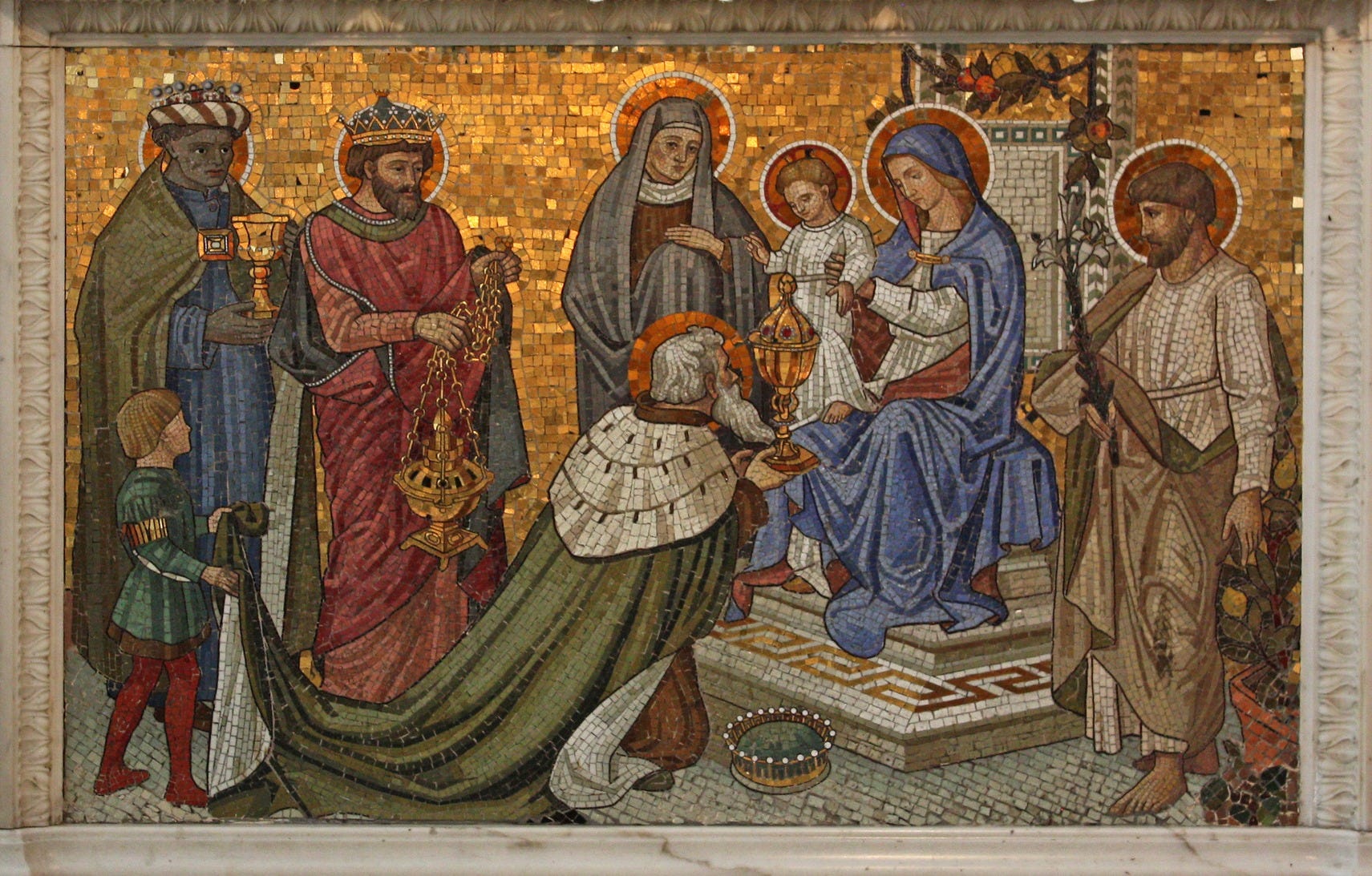
The Epiphany manifests God’s power, holiness, mercy, and faithfulness – as the nations are called to worship Christ in humility and truth.
Editor’s Notes
In this passage, Fr. Coleridge tells us:
How God’s power is shown more in the conversion of hearts than in the creation of a star.
That the calling of the Magi reveals several of God’s attributes
Why the Magi’s homage marks the first-fruits of the Gentiles entering Christ’s Kingdom.
For more context on this episode, see Part I.
The Epiphany
The Thirty Years—Our Lord’s Infancy & Hidden Life
Chapter X
St. Matt. ii. 1—12; Vita Vitæ Nostræ, § 12.
Burns and Oates, London, 1885. (1915 edition).
Headings and some line breaks added.
Display of power
Let us think a few moments on the attributes of God as shown in the Epiphany.
It will not take us long to find there the display of His power. In the first place, the manner in which the holy Sages were led to the cradle of our Lord was a work of great power.
In the physical order, a new star was created to perform with the utmost faithfulness the task of guiding and enlightening the Sages on their way. This was the work of the Creator of heaven and earth, and no one but Him.
But a greater work than the formation of this new star was the work of grace in the hearts of these Princes, the interior vocation corresponding to the outward invitation, enabling them to understand its meaning, to recognize in it the fulfilment of the prophecies, and an intimation that it was the desire of God that, as they had received this invitation, they should accept it at the cost of no light labours and difficulties, and betake themselves to the distant country where they might hope to find the Blessed Child, Whose Birth was thus announced to them.
When their journey was once begun, the power of God must have been constantly manifested as they went along, and at last, when they reached the holy city, it was the power of God, ruling the hearts of kings, even the most hostile to His honour, that brought about the witness of the Jewish Church to the oracles of prophecy, and which fixed beyond a doubt the actual spot where their quest was to meet its reward.
When they were once again on their road, there was a fresh manifestation of Divine power, in the reappearance of the star, and a far greater display of spiritual power in the graces which enabled the holy Sages to discern the Lord of Heaven and earth in His humiliation, and not to take scandal at all the many circumstances which must have been a trial to their faith.
We shall have to speak presently of the virtues displayed by the Princes as they knelt in homage before our Lord, all of which were marvellous instances of Divine grace working in their hearts.
Holiness
The holiness of God was displayed in this mystery, as in the Incarnation itself, of which it was the manifestation to men.
The Child Who was adored by the Princes was the Incarnate Holiness of God; the persons concerned in the mystery were all wonderful instances of the holiness which had been derived from the Blessed Child by them. The object of the revelation of His coming to the Gentiles was the sanctification of millions of souls by faith and other virtues founded thereon, and the means by which the ends of His coming were to be attained were all holiest in themselves.
And at the same time the whole dispensation was one of the most exceeding mercy, as well as of great faithfulness on the part of God. He could not forget that He was the Creator of all men made after His own image, and that by that title alone they had a large right to His fatherly care, notwithstanding their many excesses and rebellions against His law, the outrages which they had heaped upon His honour, the falsehoods which they had attributed to Him in their wild conceptions concerning Him.
He could not forget that He had promised this deliverance from the very beginning of the world, and that no unfaithfulness on the part of men should be allowed to cancel the bond which He had pledged Himself to observe.
If it was a great instance of His faithfulness that He had not utterly cast aside His care for His own chosen people, after so many rebellions and transgressions, it was an instance of still greater faithfulness that He retained His merciful designs for the nations who had wandered so far away from Him and outraged His laws so far more grievously.
Faithfulness
Any single manifestation of the faithfulness of God to His promises is a fresh confirmation of hope in all other promises of His which yet remain unfulfilled.
Thus, to the blessed inhabitants of Heaven, who know so well all that is contained in the predictions of Holy Writ, the vocation of the Sages of the East to the feet of our Lord was an earnest that all the glories of the Church, as promised in the Evangelical Prophet, were to have their accomplishment. Sparing indeed had been the selections made in the providence of God of those who were to be allowed to share in the privileges of the first worshippers of the new-born King.
The rich and the great of the Jewish nation had been passed over, and none but a few simple shepherds, Simeon and Anna, and some others with them, had been made aware of the existence upon earth of the Child of Mary. The chosen nation had been represented, but only by these few blessed souls. But now from the far East others are called to share the blessing with them, and they are the noblest, the wisest, and the most conspicuous even in the eyes of the world, of the people from among whom they are called.
They are allowed to bring the treasures even of this world in homage to the throne of Him Who, being rich with all the treasures of Heaven, became poor and despised for our sakes. They might well be considered as the first-fruits of a very glorious harvest indeed of redeemed souls, subjects of the new Kingdom.
Glory to our Lord
The glory which accrued to our Lord Himself from the presence of these loyal visitors was greater in many ways than any which He had received since His Birth, if we except the homage paid to Him by the angels, and the ineffably precious worship of our Lady and St. Joseph.
For these Kings came from a great distance, with at least some pomp and ceremony; they were personages of much consideration themselves; they attracted to Him the attention of many others also. Moreover, their gifts, very precious in themselves, perhaps, were significant of a faith which confessed Him as King and God, as well as Man.
The adoration which they paid Him was all the more significant because of the very humble circumstances in which they found Him. It was as a sort of compensation for the neglect with which He had met at Bethlehem, and therefore it was very fitting that where He had been driven to shelter in a cave and stable, there also He should be worshipped and honoured in the most striking manner by the Kings who came from afar.
Bethlehem was to give Him honour in another way as a consequence of this very act of homage now paid to Him. For it was this visit of the Eastern Princes that brought about the sacrifice of the first flock of the martyrs, as the Church sings, in the Mass of the Innocents.
The honour thus done to the Son could not but be reflected on His Blessed Mother, and, as has been said, if these Sages inherited the traditional promise made to the first parents of mankind in Paradise, the language of that promise would have prepared them with some knowledge of the eminent greatness of the Mother in the Kingdom of her Son. She was the woman between whom and Satan enmities were placed by God.
We may thus consider the Epiphany as a mystery in which very great honour was done to God by the reflection and acknowledgment of so many of His great attributes.
The Epiphany

Here’s why you should subscribe to The Father Coleridge Reader and share with others:
Fr Coleridge provides solid explanations of the entirety of the Gospel
His work is full of doctrine and piety, and is highly credible
He gives a clear trajectory of the life of Christ, its drama and all its stages—increasing our appreciation and admiration for the God-Man.
If more Catholics knew about works like Coleridge’s, then other works based on sentimentality and dubious private revelations would be much less attractive.
But sourcing and curating the texts, cleaning up scans, and editing them for online reading is a labour of love, and takes a lot of time.
Will you lend us a hand and hit subscribe?
Follow our projects on Twitter, YouTube and Telegram:
Twitter (The WM Review)
Signs were noticed by them which were too coincidental to be mere 'coincidences'. This is not unknown; but the proper disposition is necessary. Seeking the truth.