

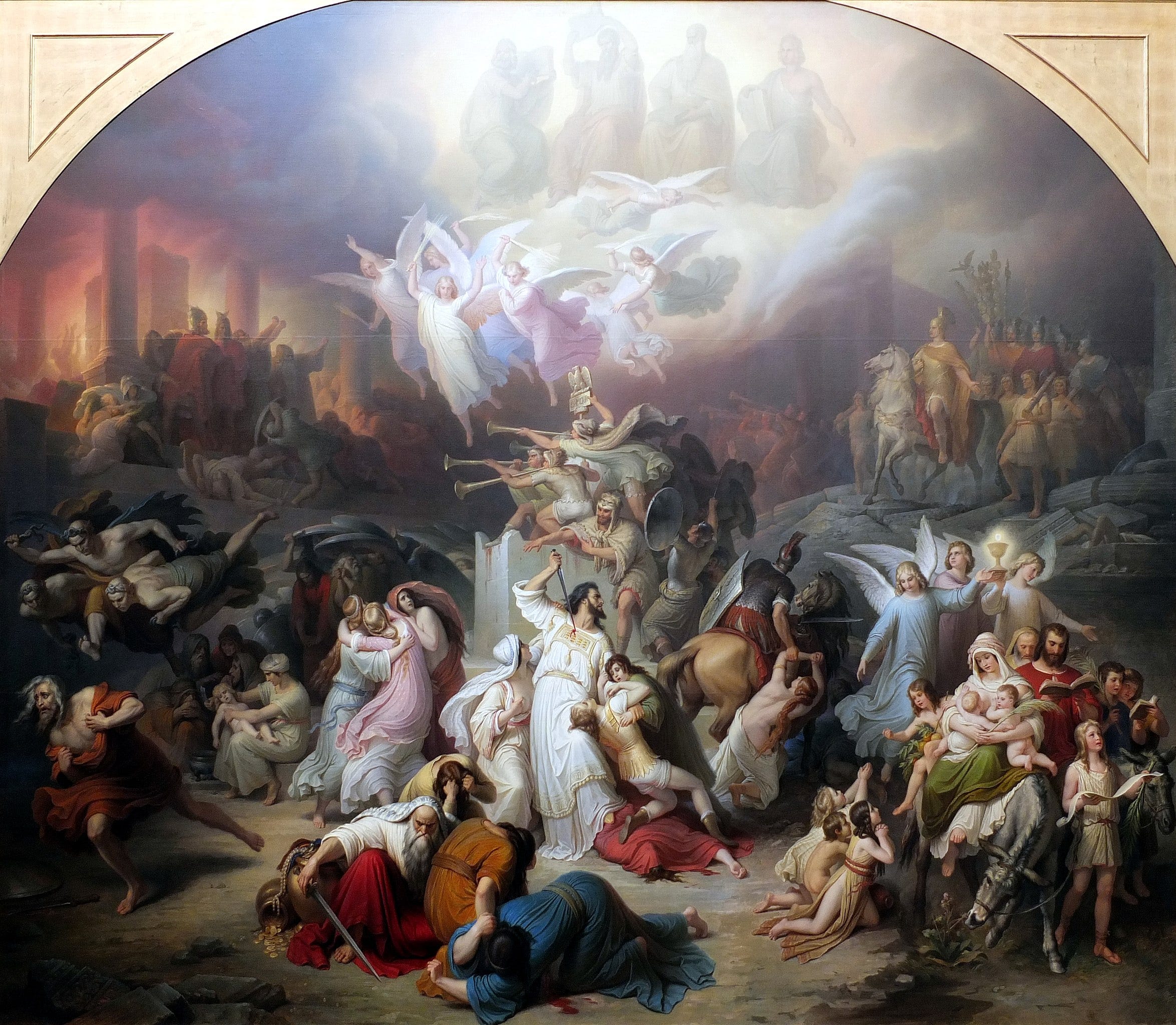
The Church escaped through providential timing, while divine justice fell upon Jerusalem for rejecting Christ. And yet, God preserved a remnant of the Jews for their future conversion.
Editor’s Notes
Jerusalem’s Doom—Part VIII
At the Mass of the final Sunday of Pentecost – the “24th Sunday” after Pentecost – the Church reads Christ’s prophecy of the destruction of Jerusalem.
Our Lord presents this chastisement of Jerusalem and the Jews as a foreshadowing and a warning of what is to come for the whole world at the end of time.
In this chapter, Fr Coleridge tells us…
How the Roman standards fulfilled Daniel’s prophecy and gave Christians their moment to flee.
That God’s wrath fell upon the Jews for rejecting Christ, yet his mercy preserved a remnant.
Why the brief window between Cestius’ retreat and Titus’ siege saved the Church entirely.
He shows us that Christ’s prophecy guided the faithful through the very hour of chastisement.
The Doom of Jerusalem
Passiontide—Part I
Chapter XIII
St. Matt. xxiv. 1-28; St. Mark xiii. 1-23; St. Luke xxi. 5-24;
Story of the Gospels, § 144.
(Read on the 24th and Last Sunday after Pentecost)
How close are we to Judgement Day? Here’s what Christ’s signs tell us
Why does the world instinctively hate the Church and her faithful children?
Why no Christians perished in the destruction of Jerusalem in AD 70
Escape of the Christians
It is certainly very natural to look upon the presence of the Roman standards in sight of the city, and even in the precincts of the Temple itself, or its neighbourhood, as a fulfilment of that sign which our Lord had given them, taking it from the well-known prophecy of Daniel.
The destruction of the army of Cestius was followed by a long pause, for the year after this occurrence was spent by Vespasian in the reduction of Galilee, and it was not till the opening of the following year (A.D. 68) that he undertook the siege of Jerusalem, from which, however, at the last moment, he was called away by the news of the revolt in Gaul, and the death of Nero.
It is clear that there could have been no chance of escape either when Vespasian approached the city, or when the siege was afterwards undertaken by Titus. Our Lord tells the disciples that when they see the sign which He gives them in this prophecy, they are to know that the desolation is at hand.
Again, as has been said, the state of things in the city after the retreat of Cestius up to the time of the siege by Titus would have been full of danger to the Christians. As has been said, they retired then, and none of them, it is said, perished.
Terrible fate of the Jews
The description given in the verses which have last been quoted is terrible indeed, but it does not seem too terrible when compared even with the accounts that have come down to us, which must be supposed to be silent as to many details of a chastisement without parallel in the history of the world.
It must be remembered that the Jews were now made the victims of the just severity of God, avenging on them all their national crimes, and especially our Lord’s Death. They had been brought into the Holy Land as the executors of the judgment, which had been accumulating for centuries, against the nations whom they were commissioned to exterminate for the abominable and unnatural crimes of which they had been guilty.
We are told that it was a complaint on the part of God against the Jews that they had not done their work of extermination so completely as it was required by His justice, and yet we know how fearful are the accounts which are given of the slaughter of whole nations in the early historical books of the Old Testament. Now the Jews were, not the executioners, but the victims, and, as St. Paul says of them before this time, ‘The wrath of God was come upon them to the uttermost.’
It would have been according to the justice of God that the whole nation should have perished for the Blood of our Lord, as Caiphas had said when he uttered his unconscious prophecy at the moment when he proposed the death of one man instead of the nation. But St. Paul tells the Romans, when speaking of the rejection of the Jews:
‘As concerning the Gospel, indeed, they are enemies for your sake, but as touching the election, they are most dear for the sake of the fathers, for the gifts and the calling of God are without repentance.’1
‘The elect’
And so our Lord here says:
‘In those days there shall be great tribulations, such as were not from the beginning of the creation which God created until now, neither shall be, and unless the Lord had shortened the days, no flesh shall be saved, but for the sake of the elect whom He hath chosen, He hath shortened the days.’
This may be understood in two ways, ‘The elect whom He hath chosen,’ may be the Christian Jews, and it is certain that a provision was made, as we have seen, by which they were enabled to escape.
But it may perhaps appear that this was an exemption from the chastisement, rather a sparing of some of those on whom it actually fell.
And it may be understood that but for the ‘shortening of the days,’ the whole Jewish nation throughout the world would have been exterminated, as they had exterminated the inhabitants of the land before them.
But God, Whose gifts and calling are ‘without repentance,’ had it in His designs once more in the end of time to gather back that guilty nation to Himself, and so He in His judgment remembered His mercy, and left some, in order that the nation might live on, and, when the time of the Gentiles had passed away, be in its turn converted to the Church.
And this seems to be contained in the words which St. Luke has recorded. ‘They shall fall by the edge of the sword, and shall be led away captive into all nations, and Jerusalem shall be trodden down by the Gentiles, until the times of the nations be fulfilled.’
Slaughter of the Jews by the Romans
The destruction of life in the Jewish war, and the disturbances which preceded it, is reckoned by some calculators at between two and three millions. This, however, was but a portion of the loss of life, for there were massacres of the Jews in various parts of the Empire, and an immense number besides were sold as slaves.
It must also be remembered that the miserable Jews who remained were often breaking out into rebellion and outrages, which provoked most bloody retaliation on the part of their oppressors. In the reign of Trajan they are said to have massacred or caused the death of as many as four hundred and fifty thousand persons in Libya, the neighbourhood of Cyrene, and Egypt, and also in Mesopotamia, and in the suppression which followed we are told that they were nearly exterminated in Egypt, Africa, and Mesopotamia.
Revolt under Barchocab
They rose again in fierce rebellion under Hadrian, under Barchochab. The war which ensued was almost as important as the war of Vespasian and Titus, and lasted as long as nine years.
There was a great siege of Bethar, like that of Jerusalem. Five hundred thousand persons perished by the sword alone, and an unknown number besides by pestilence and fire.
The Rabbis relate that twice the number of persons that came out of Egypt at the Exodus perished in that war, that is, twelve hundred thousand grown persons. The Jews then had a false Christ in whom they believed—their leader Barchochab. It was after the suppression of this great rebellion that the parts of Jerusalem which had been left standing by Titus were levelled with the ground.
The Temple was ploughed up by Annius Rufus, and was so in the time of Eusebius.2 A Roman colony was planted on the spot by Hadrian, but the Jews were forbidden to settle in Judæa, or come within sight of Jerusalem on pain of death.
We need not pursue the history further.
The Doom of Jerusalem
How close are we to Judgement Day? Here’s what Christ’s signs tell us
Why does the world instinctively hate the Church and her faithful children?
Why no Christians perished in the destruction of Jerusalem in AD 70
Here’s why you should subscribe to The Father Coleridge Reader and share with others:
Fr Coleridge provides solid explanations of the entirety of the Gospel
His work is full of doctrine and piety, and is highly credible
He gives a clear trajectory of the life of Christ, its drama and all its stages—increasing our appreciation and admiration for the God-Man.
If more Catholics knew about works like Coleridge’s, then other works based on sentimentality and dubious private revelations would be much less attractive.
But sourcing and curating the texts, cleaning up scans, and editing them for online reading is a labour of love, and takes a lot of time.
Will you lend us a hand and hit subscribe?
Follow our projects on Twitter, YouTube and Telegram:
Twitter (The WM Review)
Romans xi. 28, 29.
Demonstratio Evangelica, v. 13, 273.
Blessings and appreciation from Sydney Australia.