

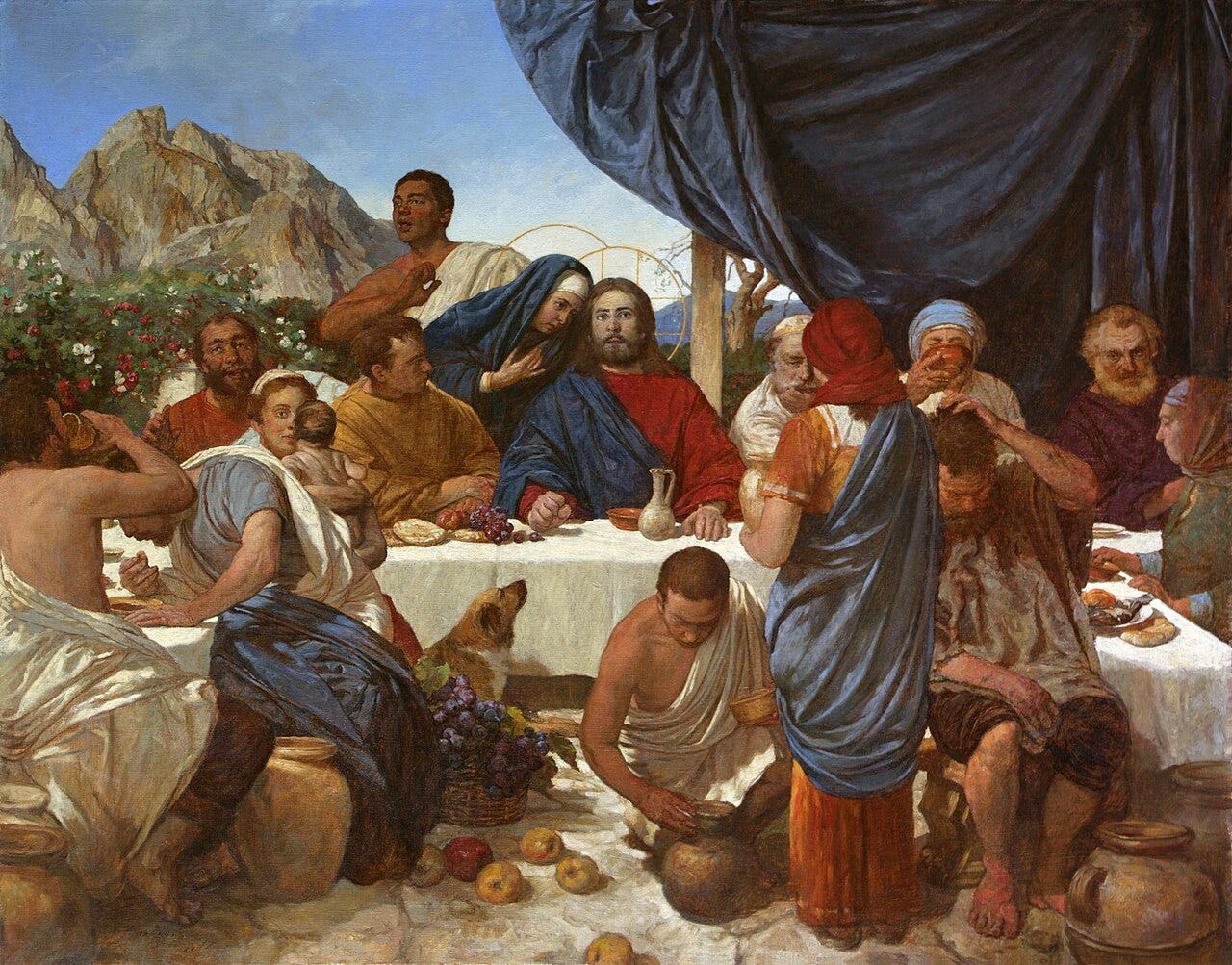
The miracle at Cana reveals God’s generous way of giving, transforming what is ordinary into a sign of lasting spiritual joy.
Editor’s Notes
In this piece, Father Coleridge tells us:
How the miracle at Cana shows God’s generosity in giving more than is asked or expected.
That Our Lord uses what is ordinary to bring about what is extraordinary
Why the best gift is kept for the end, as a sign of spiritual growth.
He shows us that faithful obedience leads the soul from hardship into lasting joy.
For more context, see Part I.

Water made Wine
From
The Ministry of St. John the Baptist
Fr Henry James Coleridge SJ
1886, Ch. XII
St. John ii. 1–11
Story of the Gospels, § 22
Second Sunday after Epiphany
See also:
Lessons from our Lord’s miracle—largeness and perfection of the gift
When it is remembered that our Lord, according to the constant teaching of the Fathers and the uniform belief of devout Christians, teaches us by His acts as well as by His words, and that every circumstance of His actions is full of significance, it cannot seem wonderful that the various parts of this great action of His which we are now contemplating should have been considered by Christian contemplatives as having each their own moral or spiritual meaning.
For instance, the circumstance of which notice has already been taken, the largeness and munificence of the gift now bestowed upon the entertainers of our Lord, His Mother, and His Apostles, has been dwelt upon as showing how abundantly God repays any who give Him something or do something for Him.
Again, it is characteristic of the gifts of God that they should be most choice and perfect in their kind, and that they should be bestowed in overflowing copiousness, as in the oil multiplied for the widow at the prayer of Eliseus, or again, as when the five loaves and the fishes were multiplied by our Lord for the people in the wilderness, and there remained basketsful of fragments of what had been bestowed in this miraculous manner.
There has been the same characteristic to be noted whenever the saints of God, in fulfilment of our Lord’s promise, have had the gift of imitating Him in His miracles of this kind, as well as that of following Him in His virtues. God loves a cheerful, large-handed giver, and He is Himself the model and pattern of magnificence in giving.
He loves those who are not content with good works or services to Him which are just such as to pass muster and attain the end at which they are aimed, but who strive, by purity of intention and exactness and perseverance to the very end, to make what they do for Him and offer to Him as perfectly beautiful and precious as by the help of His grace they may.
And so, when He goes out of His ordinary manner in dealing with His children, showering upon them preternatural gifts and favours, everything that comes from Him at such times has a celestial perfection, a completeness, and a priceless excellence.
Use of something common
It is also noted that now, as on other occasions in the course of His Life, our Blessed Lord took something common and ready to His hand to bring out of it the great wonder which He intended to perform.
He might have created the wine in the vessels instead of using water. He might have called bread in abundance into being when He fed the multitudes in the wilderness; but He did not do so.
Some holy writers think that in this He paid a kind of reverence and homage to the creative power of His Father—not taking it into His own hands, though His power is the same with that of His Father, leaving it to Him to be the Creator of all as He is the First Person in that Ever-Blessed Godhead, the source and origin of all being.
Or, we may add, our Lord chose in this also to be dependent upon His Father, taking the creatures which He had made and making them, as it were, the seeds and germs out of which He wrought what He desired. There may also have been other reasons.
Indeed, great as would have been the miracle if, in the cases of which we are speaking, He had created what He had need of out of nothing, it might still have seemed more like a magical illusion than it could when the water which the servants knew that they had drawn from the well or fountain was turned into wine, or when the five loaves and two fishes of the lad were taken from his basket and multiplied so as to feed the crowds.
Change of substance
Another circumstance, which is certainly unusual in our Lord’s miracles, and therefore may be thought all the more significant, is the change of one substance into another, and this so perfectly that the ruler of the feast and others like him could bear witness to the excellence of the wine which had before been water.
Holy writers see in this the symbolical character of the miracle, inasmuch as our Lord came not to destroy but to fulfil—to take up what had already been taught, revealed, and practised, and transform it into something more noble and more worthy of Himself.
This He did with the Law, changing it into the Gospel, with the whole of the Old Testament institutions, making all things new and more sublime, full of grace and overflowing with spiritual riches. Instead of circumcision, He was to give baptism, instead of external purification, interior cleansing, instead of temporal rewards, an eternal kingdom, instead of carnal sacrifices, the pure oblation of the Immaculate Lamb, instead of legal rites, Christian sacraments.
Use of the element of water
Some authors also dwell on the manifold use made of the element of water in the Old Testament for the wonderful works of God, as in Egypt, the Red Sea, and the Jordan, and suppose that it was now chosen to be the subject of a still higher miracle because our Lord had just sanctified it by His own touch in His Baptism.
Others see in it an image of the weakness and instability of our human nature, which is to be transformed by grace into something noble and divine through His Incarnation.
And, inasmuch as our Lord’s miracles looked both forwards and backwards—preparations and foreshadowings of His great permanent wonders in the Christian sacraments—we can hardly help seeing in this change of water into wine an anticipation of the great wonder of the change of bread and wine into the Precious Body and Blood of our Lord in the Blessed Sacrament, just as the later miracle of the feeding of the five thousand foreshadowed other features of the same sublime mystery.
Spiritual meaning of the words of the ruler of the feast
The words of the ruler of the feast to the bridegroom were probably uttered in all simplicity, and may have been recorded by St. John to attest the completeness of the miracle.
Still, they sound to us as if they had a parabolic meaning, as if the speaker unconsciously prophesied of the characteristic feature of our Lord’s dealing with us as the Spouse and Master of our souls.
It is the distinguishing mark of earthly joys and goods that they are soon exhausted: the first taste of them is the sweetest, and they pall upon the appetite, however highly valued they may be at first, they soon become insipid by use, and at last, if forced beyond satiety, they become disgusting. The world begins well and ends badly, nothing that lacks the transforming touch of divine grace can truly please or hold the soul. On the other hand, God begins with what seems hard and stern—commandments, rules, limitations on our liberty, and restraints upon our nature.
‘The fear of the Lord is the beginning of wisdom,’ and He first trains us in holy discipline. But He raises us higher and higher; He gives us new tastes and perceptions, and when we come to enjoy spiritual delights, they are like the good wine which was kept to the last.
At first, the Cross is hard to bear, humility is difficult, and it is painful to conquer and subdue ourselves; but once the soul finds the sweetness of these things, no other sweetness can compare.
And if this is so in this life—if the yoke and burthen of our Lord are even now easy and light to those who take them up courageously—how much more is it true in the next world, the last and greatest gift our merciful God has in store for us, the last and the best.
Water Made Wine
See also:
From Fr Henry James Coleridge, The Ministry of St. John the Baptist
Here’s why you should subscribe to The Father Coleridge Reader and share with others:
Fr Coleridge provides solid explanations of the entirety of the Gospel
His work is full of doctrine and piety, and is highly credible
He gives a clear trajectory of the life of Christ, its drama and all its stages—increasing our appreciation and admiration for the God-Man.
If more Catholics knew about works like Coleridge’s, then other works based on sentimentality and dubious private revelations would be much less attractive.
But sourcing and curating the texts, cleaning up scans, and editing them for online reading is a labour of love, and takes a lot of time.
Will you lend us a hand and hit subscribe?
Read next:

Follow our projects on Twitter, YouTube and Telegram:
Twitter (The WM Review)
Dear Brothers is Christ.
May this reply find us all ever closer to God, and His overflowing Mercy.
'Best wine kept for last'? The Happy Fault and His Mercy is overflowing.
(and more!)
".. Meditations on Wedding at Cana, Sacrament of Reconciliation" https://stevenwork.substack.com/p/multiverse-journal-index-number-2224
https://archive.is/IM5T0
Here is the YouTube mirror of the generated audio overview of this Apologetic you never seen before. https://www.youtube.com/watch?v=gANhluLGsJg
--
But, maybe we need an Abrahamic World-Wide Justice System .. and a Pope-King-Man (of course!) to Judge this version.
https://www.youtube.com/watch?v=4NkpLdRpzrQ
"Multiverse Journal - Index Number 2228:, 8th October 2025, By the Will of God, Our First possible 'Treatise Concerning ..' From Offices of Papal-King" https://stevenwork.substack.com/p/multiverse-journal-index-number-2228
https://archive.is/aEcrq
---
Feedback welcome.
God Bless., Steve
The church only gives wafers since lockdown