

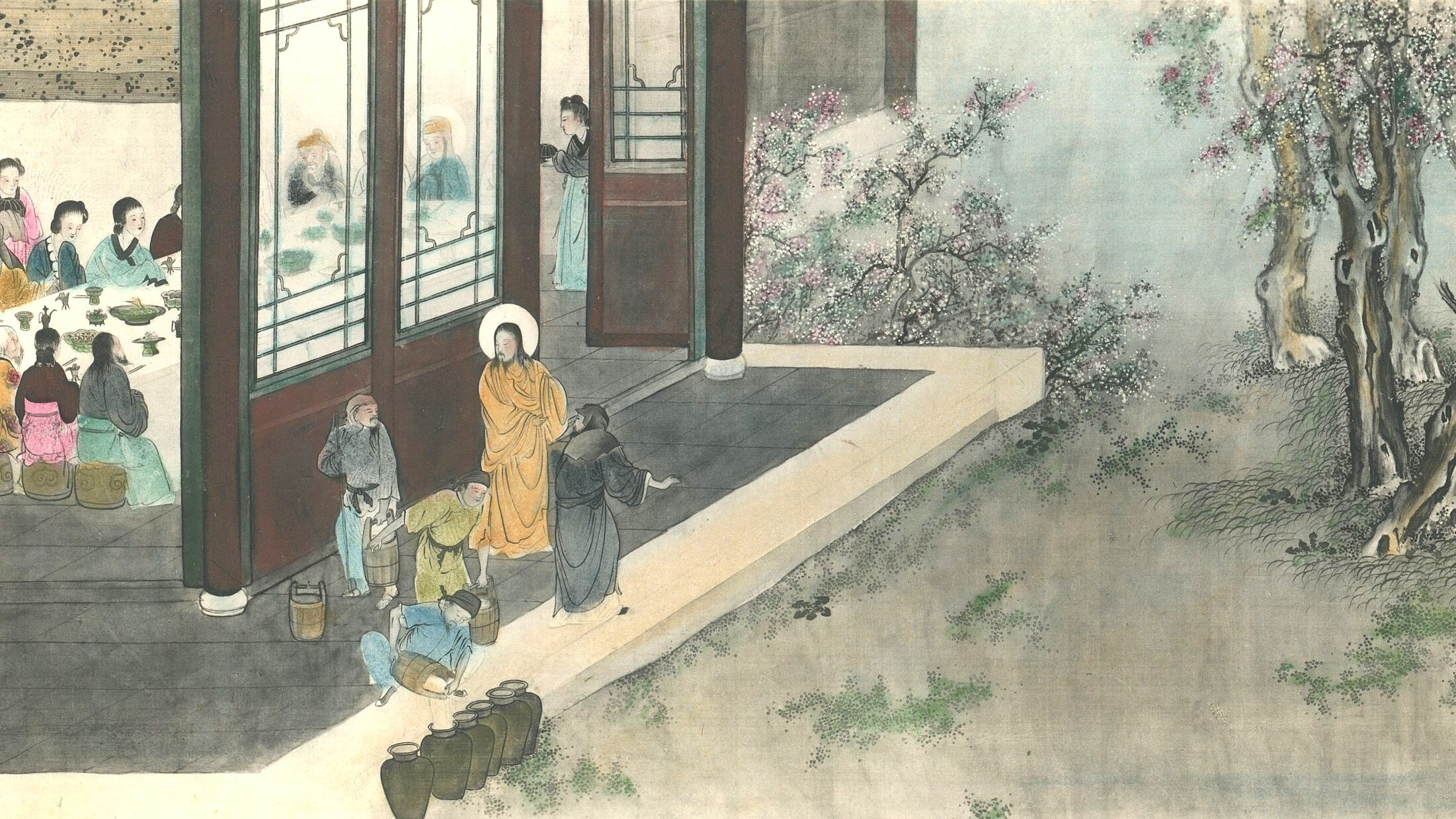
Christ worked this 'first of signs' at this wedding to teach us a vital lesson about the Christian life.
Editor’s Notes
The account of Our Lord’s changing of water into wine at the wedding at Cana is read every year on the Second Sunday after Epiphany – the first “green Sunday” of the year, given the placing of the Feast of the Holy Family.
The episode takes place at the very beginning of Our Lord’s public ministry, following his baptism, and temptation in the desert. The Gospels convey that he has already gathered a certain number of disciples around him – but that this is the first miracle he works to confirm his divine power.
This miracle also shows the important role of Our Lady’s intercession in the divine order of the New Testament – as Fr Coleridge discusses.
In this piece, Father Coleridge tells us:
How the miracle at Cana reveals Christ’s responsiveness to prayer and the power of His Blessed Mother’s intercession.
Why its splendour shows God’s generosity and invites us to approach Him with faith.
What spiritual truths it teaches, including the transformation of nature by grace and a foreshadowing of the sacraments.
He shows us that Cana highlights the power of prayer, the richness of God’s gifts, and the lasting joy of His grace.

Water made Wine
From
The Ministry of St. John the Baptist
Fr Henry James Coleridge SJ
1886, Ch. XII
St. John ii. 1–11
Story of the Gospels, § 22
Second Sunday after Epiphany
See also:
Natural interpretation of our Lord's action
If our Lord had been an ordinary person, who had been asked by His mother or by a friend to grant an alms to the poor, or to do some other act of kindness or mercy, and who had answered the request in some such words as, ‘Leave it to Me, you need not urge Me, but it is not yet time,’ and then had immediately proceeded to do what He had been asked to do, it would hardly have been thought that there could have been reasonable ground for doubt that the petition made to Him had so far influenced Him as to lead Him to perform that work of mercy sooner than might otherwise have been the case.
It is only because our Blessed Lady is the petitioner in the case of the miracle at Cana, because our Lord is the Person Who performs the merciful work, and because that merciful work is so great a miracle and the beginning of His miracles in the office of the Christ, that certain people feel so much reluctance to admit the plain and natural meaning of the words of our Lord and of His Evangelist.
If, indeed, our Blessed Lady’s action in the matter was the action of authority, if she is supposed to have commanded her Son, as His Mother, to perform a work which belonged to Him in His character of the Messias, it would then be natural to see in the words of His answer to her something like reprehension, or warning, or, at the least, an explanation that there were certain spheres in which it was not her place to use any such authority.
But even this would not alter the subsequent circumstances of the history, as they are related by St. John, though it would make it less easily intelligible why, after having been forced to speak in a tone almost of rebuke, our Lord had gone on to do exactly what He was requested to do, or rather—insofar as our Lady’s request contained nothing at all as to the manner in which the want of wine was to be supplied—to do what He was requested to do in the most wonderful and supernatural manner possible.
Consolation as to prayer
We have seen, however, that there is nothing at all in our Blessed Lady’s request to her Divine Son which goes beyond the range of prayer—prayer which might conceivably have been made to Him by anyone present, if such a person had had as lively a faith in His power and as perfect a reliance on His mercifulness and considerateness as she had.
This being the case, what might otherwise be a difficulty becomes a source of wonderful and most consoling instruction. For, in some way and in some degree, though we are not distinctly told how far, our Blessed Lord did certainly hasten on the time of this great manifestation at the prayer of His Mother.
And in this He only acted as God has always acted from the first, as He Himself acted all through the time of His Public Life, and as He has acted continually in the history of the Church from that time to this.
That is, certain things have been done and granted by God in His providence and by our Blessed Lord in His Life and in His Kingdom, which would not have been done but for prayer, or they have been done sooner or in a more magnificent way than would otherwise have been the case, on account of prayer.
Prayer a recognised power in His kingdom
Prayer, intercession, the merits and pleadings and sufferings of the saints on earth, and the petitions of the saints in heaven, are a recognised force and power in the ordering of the history of the world and of each particular soul, though they are a force and a power the exercise and influence of which depend upon the will of man.
And thus there is a strict and natural fitness in the circumstances of this miracle at Cana, which, being the first of our Lord’s great manifestations of this kind, may well be considered as a typical instance in which all the influences which ordinarily guide the results in such cases must have their lawful place.
We are thus pointedly and plainly told that prayer has the power of modifying, influencing, hastening on to their execution, the decrees of God in relation to human affairs, and that, in particular, with regard to the whole system of miracles and preternatural graces which was now about to be inaugurated, prayer, if it is not always to be the moving power, is at least in ordinary cases to be the required condition as well as the occasion of the great bounties of God.
Apparent rebuffs to prayer
Thus, the lesson which we learn from this incident in the miracle before us is the same as that which is taught us by the case of the Syrophoenician woman who pleaded so urgently and with so much ultimate success for her daughter.1
Hers was a case beyond the range of the direct mission of our Blessed Lord, and yet His mercifulness went beyond the bounds which were set to it in order to obey, as we may say, her faith and her prayer. In this case, it is the time that is anticipated; in hers, it is the limit that is enlarged.
And in each case, we have the same encouragement and the same beautiful lesson about what seem to be unfavourable answers that we receive when we pray, namely, that they are in truth invitations from God to pray more earnestly and more faithfully, to act as our Blessed Lady acted, as if we had received a promise that what we ask should be granted, in the same spirit as David of old, the man after God’s own Heart in this and other respects, who, though he had been told from God that the child of his sin was to die, nevertheless fasted and prayed as long as the child’s life lasted, saying, ‘Who knoweth whether the Lord may not give him to me, and the child may live?’2
The stone jars
The details of the miracle now performed have already been quoted from St. John. The servants received their instructions from our Blessed Lady to obey our Lord in everything; and then He turned to the largest vessels that could have been within reach, as if to make the miracle more splendid by the abundance with which the deficiency of wine was to be supplied.
There were six large stone jars or vessels, placed probably near the entrance of the house to furnish that plentiful store of water which was needed for the daily life of the Jews.
The measure which St. John gives of the contents of each would, at the lowest computation, amount to from ten to fifteen of our gallons. They were empty,3 and our Lord bade the servants set them up and fill them with water.
The ruler of the feast
When this was done, He bade them draw from them and take the liquor to the ruler of the feast, probably a friend who had the charge of the arrangements and who presided at the banquet. He tasted it, and it was wine of the choicest flavour, so that in his delight he sent for the bridegroom and complimented him upon its quality.
He had done a strange thing, he told him. It was usual to give good wine first, and then inferior; but he had done just the reverse, he had kept the good wine for the last. At the time at which he spoke, he was ignorant of what had passed, our Lord, as it seems, being at another part of the table; perhaps, as Ludolph suggests, He had practised on this occasion what He afterwards recommended to others, to go and sit in the lowest place, or perhaps He was quietly conversing or teaching apart from the chief body of the guests.
Water Made Wine
See also:
From Fr Henry James Coleridge, The Ministry of St. John the Baptist
Here’s why you should subscribe to The Father Coleridge Reader and share with others:
Fr Coleridge provides solid explanations of the entirety of the Gospel
His work is full of doctrine and piety, and is highly credible
He gives a clear trajectory of the life of Christ, its drama and all its stages—increasing our appreciation and admiration for the God-Man.
If more Catholics knew about works like Coleridge’s, then other works based on sentimentality and dubious private revelations would be much less attractive.
But sourcing and curating the texts, cleaning up scans, and editing them for online reading is a labour of love, and takes a lot of time.
Will you lend us a hand and hit subscribe?
Read next:


Follow our projects on Twitter, YouTube and Telegram:
Twitter (The WM Review)
St. Matt. xv. 21-28
2 Kings xii. 22.
κέιμεναι