

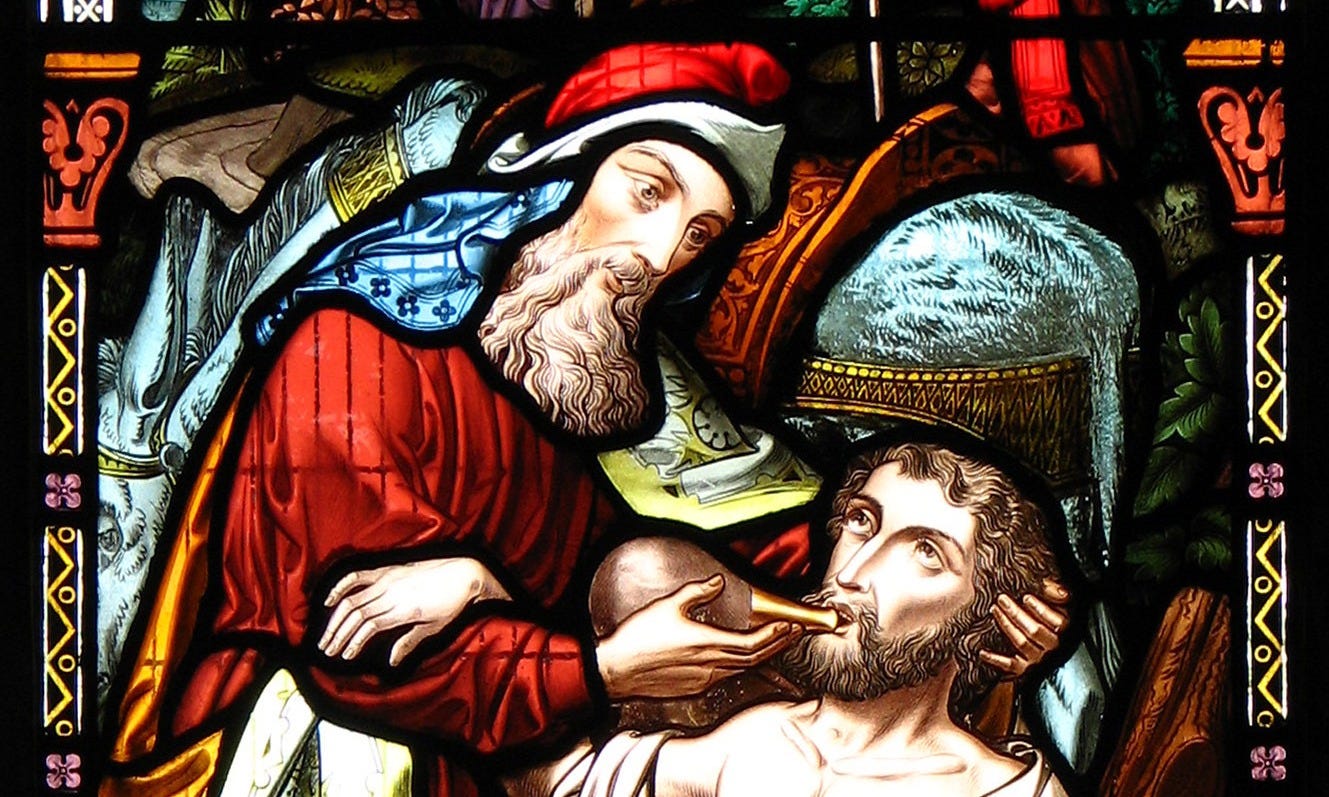
Fr Henry James Coleridge reveals that certain presuppositions that colour our understanding of the Good Samaritan parable, and warns us not to let our religion become wholly external.
Editor’s Notes
On the Twelfth Sunday after Pentecost, the Church reads Our Lord’s parable of the Good Samaritan:
“At that time, Jesus said to His disciples: Blessed are the eyes that see what you see! For I say to you, many prophets and kings have desired to see what you see, and they have not seen it; and to hear what you hear, and they have not heard it.
“And behold, a certain lawyer got up to test Him, saying, Master, what must I do to gain eternal life? But He said to him, What is written in the Law? How do you read? He answered and said, You shall love the Lord your God with your whole heart, and with your whole soul, and with your whole strength, and with your whole mind; and your neighbor as yourself. And He said to him, You have answered rightly; do this and you shall live. But he, wishing to justify himself, said to Jesus, And who is my neighbor?
“Jesus answered and said, A certain man was going down from Jerusalem to Jericho, and he fell in with robbers, who after both stripping him and beating him went their way, leaving him half-dead. But, as it happened, a certain priest was going down the same way; and when he saw him, he passed by. And likewise a Levite also, when he was near the place and saw him, passed by. But a certain Samaritan as he journeyed came upon him, and seeing him, was moved with compassion. And he went up to him and bound up his wounds, pouring on oil and wine. And setting him on his own beast, he brought him to an inn and took care of him. And the next day he took out two denarii and gave them to the innkeeper and said, ‘Take care of him; and whatever more you spend, I, on my way back, will repay you.’
“Which of these three, in your opinion, proved himself neighbor to him who fell among the robbers? And he said, He who took pity on him. And Jesus said to him, Go and do also in like manner.”
Our Lord recounts this parable towards the start of what Fr Coleridge calls “the preaching of the Cross” – during the later Judaean ministry, after the mission of the Seventy, and before Our Lord’s visit to Martha and Mary.
The occasion of the parable was a question from a “lawyer.” The “lawyers” are normally associated with the factions of the Pharisees and Scribes, and are awarded with two “Woes” from Christ in the chapter following this Parable:
Woe to you lawyers also, because you load men with burdens which they cannot bear and you yourselves touch not the packs with one of your fingers. […]
Woe to you lawyers, for you have taken away the key of knowledge. You yourselves have not entered in: and those that were entering in, you have hindered.
St Luke also tells us, in the following chapter, that:
As he was saying these things, the Pharisees and the lawyers began violently to urge him and to oppress his mouth about many things, lying in wait for him and seeking to catch something from his mouth, that they might accuse him.
Because of this, it is understandable that many explanations of this parable present the “lawyer” as trying to catch Our Lord out, and to present himself in the best light – based on the Gospels saying that he sought to “test” or “tempt” Our Lord, and to “justify” himself.
However, the question that prompted this parable came before this, and before the “Woes” already mentioned.
And in fact, Fr Coleridge shows that this more negative interpretation of the lawyer is based on several assumptions which are far from certain – and which may change our understanding of this whole incident.
In addition to exploring this issue, Fr Coleridge’s reflections provide much of value to modern day traditionalists and conservatives. The many liberals that profess heresy in the name of the Catholic religion (and thus whose charity is at best naturalistic, if not insincere) cannot blind us to the reality that faith is the foundation of the Christian life, and not its end – and that the liturgy and external traditions are means to help us achieve that end.
And that end is is love of God and of our neighbour.
The Good Samaritan
The Training of the Apostles, Vol. IV, Chap. XV
St. Luke x. 25-37
Story of the Gospels, § 100
Burns and Oates, London, 1886
Read on the Twelfth Sunday after Pentecost.
Part I: Have we made the wrong assumptions about the Good Samaritan parable and its context?

Was the lawyer who prompted the parable trying to trick Our Lord, and make himself look good – or something else?
Part II: External rituals and theological debates are nothing without love
The parable of the Good Samaritan reveals both practical and theological truth – and shows that without love, religion can deteriorate into emptiness.
Part III: The Good Samaritan and using religion as an excuse for neglect

Our Lord shatters narrow debates by showing that love of neighbour is proved only in action: the Samaritan saw a brother where others saw a burden.
Part IV: Why Jesus is the Good Samaritan of the parable

Why does Christ call Himself a Samaritan, accepting a name of reproach – and how does the parable match up to the Incarnation and Redemption?
Here’s why you should subscribe to The Father Coleridge Reader and share with others:
Fr Coleridge provides solid explanations of the entirety of the Gospel
His work is full of doctrine and piety, and is highly credible
He gives a clear trajectory of the life of Christ, its drama and all its stages—increasing our appreciation and admiration for the God-Man.
If more Catholics knew about works like Coleridge’s, then other works based on sentimentality and dubious private revelations would be much less attractive.
But sourcing and curating the texts, cleaning up scans, and editing them for online reading is a labour of love, and takes a lot of time.
Will you lend us a hand and hit subscribe?
Follow our projects on Twitter, YouTube and Telegram:
Twitter (The WM Review)