

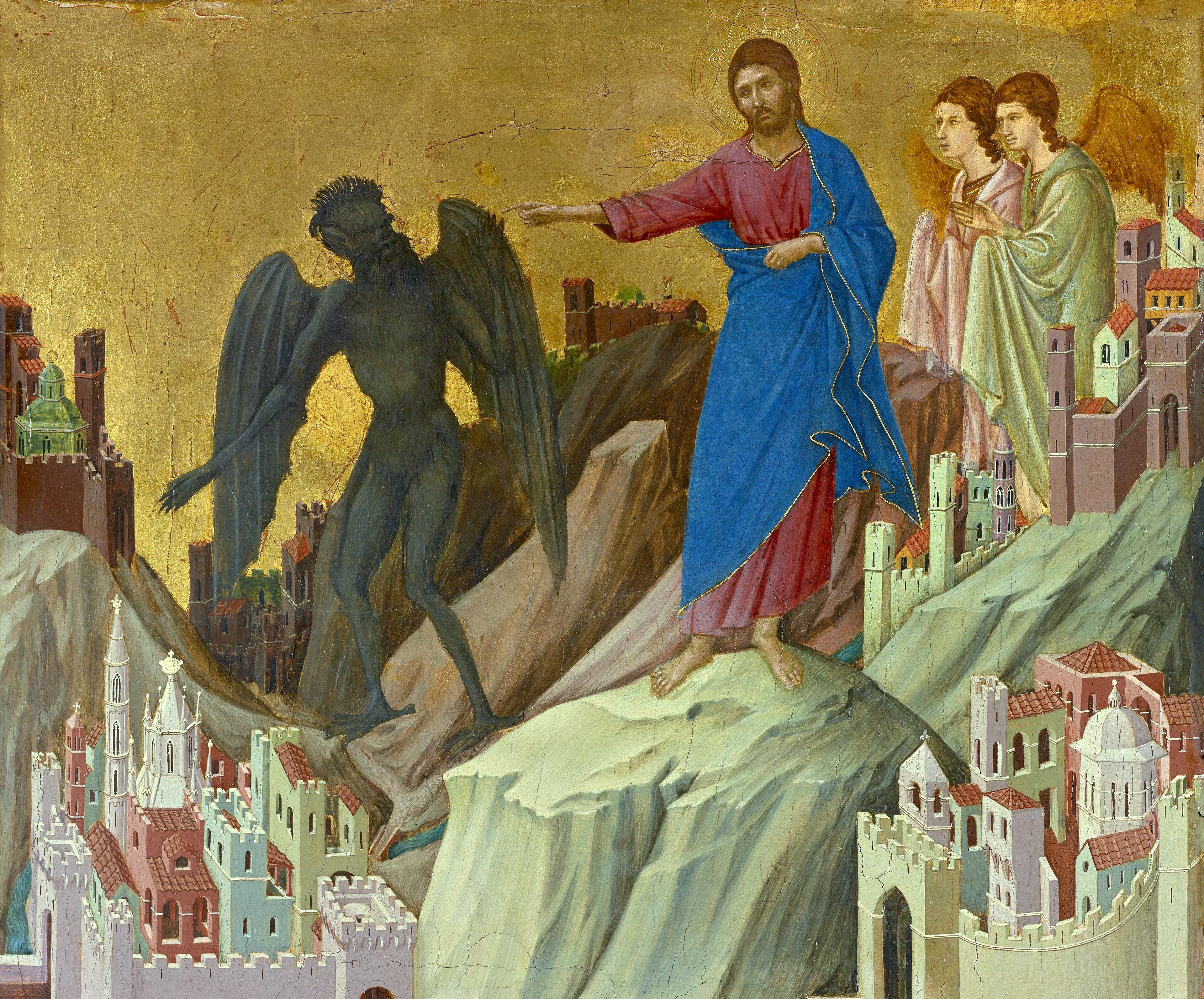
Behind each temptation, Satan has multiple ulterior motives – so that a temptation to one sin may really be designed to have us fall into another.
Editor’s Notes
In this part, Fr Coleridge tells us…
How each temptation hides deeper snares
That ambition and love of power can often overthrow even disciplined and spiritual men.
Why worship belongs to God alone, and worldly glory easily breeds forgetfulness and ingratitude.
He shows us that pure intention and humble faith alone defeat the devil and keep the soul faithful to God.
For more context on this episode, see Part I.
Temptations of our Lord
The Ministry of St. John the Baptist
Chapter V
St. Matt. iv. 2–10; St. Mark i. 13; St. Luke iv. 2–12.
Story of the Gospels, § 18
Burns and Oates, London, 1888
Headings and some line breaks added.
Sung on First Sunday of Lent
Grossness of the second temptation
The temptation which, if we follow the order of the more historical of the two Evangelists on whom we are dependent as to this mystery, he next assailed our Lord, seems at first sight to have so gross, palpable, and outrageous a character of wickedness about it, as to make it almost a matter of wonder that even Satan should have the insolence to propose it to one whom he must at least have known to be a very holy man, or the folly to suppose that it could be proposed with success.
‘And the devil led Him unto a very high mountain, and showed Him all the kingdoms of the earth in a moment of time, and he said to Him, To Thee will I give all this power, and the glory of them, for to me they are delivered, and to whom I will I give them. If Thou, therefore, wilt adore before me, all shall be Thine.’
It is also to be noted that in this temptation he no longer uses the form, ‘If Thou art the Son of God.’
Gross indeed and outrageous was such a temptation as addressed to our Blessed Lord; but it must be again remembered that Satan is eaten up with the most intense pride, skilful and subtle as he is.
Power of the temptation by ambition
And we often see in those who are his greatest instruments among men a sort of infatuation, arising from pride, the folly and impolicy of which men of the most ordinary prudence would avoid. There is, therefore, nothing very surprising in the transparent vanity, mendacity, and foolishness of the pretensions which Satan here advances, and of the proposal which he makes.
Nevertheless, in dealing with mankind he may often find that such temptations, which appeal to ambition, the love of power and influence, a nobler concupiscence than that of the gratification of the senses on which the first temptation was grounded, may be far more successful than the others.
For even spiritual men, men who have conquered the lower passions, and can live above nature in fasting and mortification, are liable to fall before the allurements of ambition, and we see this constantly before our eyes in the history of the Church, some of the most unhappy pages of which are those which record the love of power and the consequent jealousies and rivalries which have ruined lofty souls, and hindered, more almost than anything else, the greater glory of God.
Satan could not understand the perfect humility and dependence upon God which breathed in our Lord’s first answer, but he knew well enough from experience that when a man has tamed his sensual appetites he has often a yet harder conquest to achieve in subduing his ambition.
Satan again tries to discover our Lord
Again, many holy writers remark, as to this second temptation, that it does not at all exclude that second purpose which Satan is thought to have conceived in his approaches to our Lord, that is, the purpose of discovering who He was, as well as the purpose of inducing Him to sin.
There is, indeed, no open mention of the Son of God, no overt challenge to our Lord to prove His Sonship by this or by that, as in the other temptations, and yet it may well be supposed that Satan hoped in this temptation also to lead our Lord to reveal Himself. He may have imagined, from our Lord’s first answer, that He was on His guard, and desirous not to betray Himself, and thus he may have shaped his second attack with the object of forcing Him to declare who He was, if He were really the Son of God, by claiming as his own the kingdoms of the world, which, in truth, did not belong to him, and by asking Him to pay him that adoration which was rather due from the creature to the Creator than from the Creator to the creature.
Certainly if Satan had been challenged himself by some claim or offer which implied his own inferiority, nothing more would have been required to make him boil over with indignation and turn upon his tempter with words of outraged pride. And so, perhaps, he thought that the Incarnate Son of God, if He were there before him, would have disclosed His majesty in answer to so insulting a proposal, rebuking him for his false claim, and asserting His own right to the kingdoms which were offered to Him on so degrading a condition.
Manner of the temptation
The manner in which this temptation was presented to our Lord is not explained in the narrative of the Evangelists.
Both in this and in the following temptation Satan is permitted to go beyond mere suggestions, as he has a certain power allowed him of leading our Lord where he wills, and, indeed, in the other temptation, of transporting Him preternaturally through the air. No mountain, of course, could be found from which any human eye could take in all the kingdoms of the earth and their glory, and yet it would appear that the mountain spoken of here is not as visionary as the representation of ‘all the kingdoms’ must have been.
Little, indeed, must the sight, however dressed out and magnified by the preternatural power of illusion which Satan was allowed to exercise, of all the glories of the earth, and all the pomp and splendour of Imperial Rome, of Alexandria, Antioch, Ctesiphon, or whatever other capitals may have been pictured in this vision, with their subject provinces, have seemed to the eye of Him Whose human Soul from the first dawn of its being had been familiar with the blessed sight of God and the glories of His heavenly kingdom, especially when He knew, as none other knows, in the perfection of the gifts of the Holy Ghost, ‘what was in man,’ and what all this outward show was worth.
‘Avaunt Satan’
And strange indeed must it have sounded in our Lord’s ears, that the possession of goods so perishable and so unable to satisfy the soul, could be a motive for committing so enormous a sin as that of giving to a creature and to the enemy of God the worship due to Him alone. But our Lord condescended to bear even this insult calmly and meekly, for our sakes, rebuking the tempter, indeed, as was necessary for the honour of God, ‘Avaunt, Satan!’ but at the same time answering him with a few words of Sacred Scripture, which may serve as a light and a defence to all His children who might be tempted after Him in a like manner.
The answer of our Lord makes no direct mention of the offer which had been made to Him, any more than of the falsehood of Satan’s claim to be the master of the world and to have the disposal of its kingdoms and their glory.
But though there is no direct mention of the desire of earthly power, wealth, and magnificence, and so no reason given for refusing to gratify it, as was the case in the former temptation, yet our Lord, after restoring the honour of His Father, which had been insulted by the proposal of the tempter, quotes a passage of Scripture which seems not only to give the direct prohibition against the adoration of any one but God, but also, when the context is examined, to point to the danger which worldly possessions and prosperity bring with them of making us forget God, and so in time coming to worship something else, whether it be what is formally called an idol or not. For Moses, in the passage quoted by our Lord, earnestly warns the people against such forgetfulness and the ingratitude which follows upon it.
‘And when the Lord thy God shall have brought thee into the land for which He swore to thy fathers, Abraham, Isaac, and Jacob, and shall have given thee great and goodly cities which thou didst not build, houses full of riches, which thou didst not set up, cisterns which thou didst not dig, vineyards and oliveyards which thou didst not plant, and thou shalt have eaten and be full, take heed diligently lest thou forget the Lord, Who brought thee out of the land of Egypt and of the house of bondage—thou shalt fear the Lord thy God, and serve Him only, and shalt swear by His name.’1
Dangers of ingratitude
Wealth and power have this inevitable danger as their shadow, of forgetfulness of God and ingratitude, and when men are once sunk in ingratitude to God, as we know from St. Paul’s account of heathendom in the Epistle to the Romans, they may soon find their way even to the abominations of idolatry, actual as well as moral.
And if we take our Lord’s words as furnishing us with instruction against every kind of worldliness, love of power, ambition, and the virtual worship of the devil, who is so often spoken of in Scripture as the god of this world, the lesson comes to this, that we are to have a pure intention to seek God’s glory in all things, to make His service the end of our being and of all our actions, and then even the possession of wealth, material or intellectual, of rank, high estate, influence and power, will be no hindrance to us, but rather the means of fulfilling the end for which we are made, and of glorifying God in the place and time in which He has fixed our lot.
Temptations of Our Lord
Read Next:

Here’s why you should subscribe to The Father Coleridge Reader and share with others:
Fr Coleridge provides solid explanations of the entirety of the Gospel
His work is full of doctrine and piety, and is highly credible
He gives a clear trajectory of the life of Christ, its drama and all its stages—increasing our appreciation and admiration for the God-Man.
If more Catholics knew about works like Coleridge’s, then other works based on sentimentality and dubious private revelations would be much less attractive.
But sourcing and curating the texts, cleaning up scans, and editing them for online reading is a labour of love, and takes a lot of time.
Will you lend us a hand and hit subscribe?
Follow our projects on Twitter, YouTube and Telegram:
Twitter (The WM Review)
Deut. vi. 10–13.