

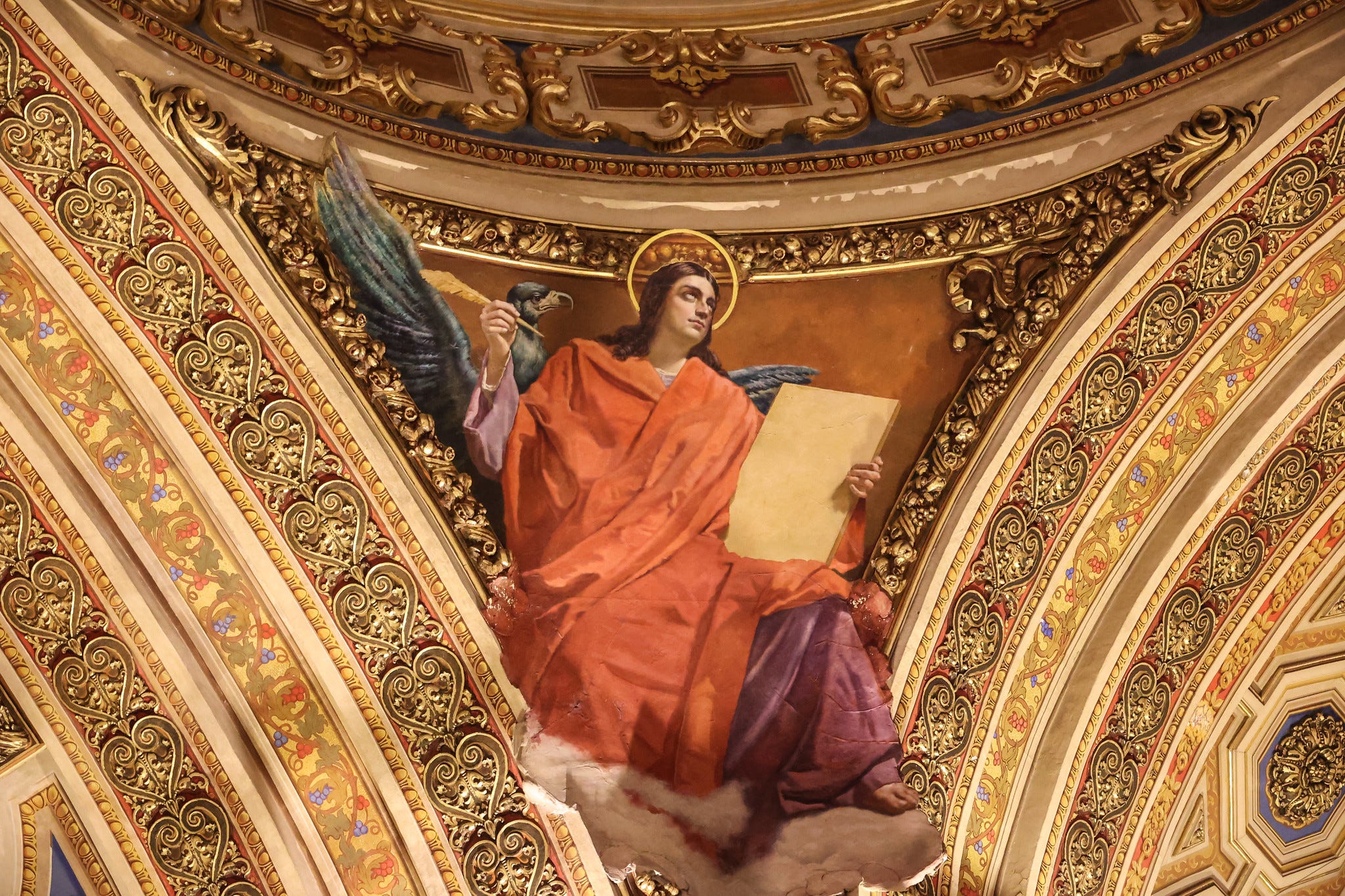
Here’s how St John’s crowns the Gospel narratives, and the charge of bearing witness to Christ passes to the Church.
Editor’s Notes
In the this part, we present Fr Coleridge’s account of St John’s Gospel on the Resurrection. We have previously published Fr Coleridge’s harmonisation of the Gospels’ account of the Resurrection narratives:
The WM Review also published a synthesis of these accounts, based on Fr Coleridge’s work, in one continuous text:
In this mini-series, Fr Coleridge provides further explanation of why each Gospel treats of these matters in their particular ways – and the role of these accounts in the life of the Church.
The Resurrection and Ascension of our Lord in the Four Gospels
The Life of our Life, Vol. II
Chapter XI
St. Matt. xxvii. 35–44; St. Mark xv. 24–32; St. Luke xxiii. 34–43; St. John xix. 13–27; Story of the Gospels, § 170.
Burns and Oates, London, 1876
St John’s additions
In the last place we turn to St. John, and we find the same main divisions of the short story, which is all that belongs to the sphere of the Gospel records as to the Resurrection and the forty days.
The single figure among the women who are commissioned to break the great tidings to the Apostles is, in this Gospel, Mary Magdalene. Whether her first visit to the sepulchre, ‘while it was yet dark,’ was in company with the other women who are mentioned by St. Luke or not, she alone is named by St. John. On seeing the stone taken away from the door, she runs at once and tells Peter and John: ‘They have taken away our Lord from the monument, and we know not where they have laid Him!’
Then Peter and John run to the sepulchre, the latter reaching it, the former entering it, first. St. John ‘believes,’ and with St. Peter retires again. Mary remains outside weeping, and our Lord appears to her, as has been related above. He bids her go and tell His brethren of His Ascension—the next great mystery to be accomplished in the unfolding of the counsels of God.
St. John then passes to the second head of the history. He relates the same appearance to the ten Apostles which St. Luke has spoken of, but he passes quickly over that part of the scene which St. Luke has described so particularly, and goes on to what we may consider as belonging to the third head, that is, the charges or instructions or commissions given to the Apostles. He mentions that our Lord breathed on them, and gave them the Holy Ghost and the power to forgive sins.
Thus St. Matthew has mentioned the charge to teach and baptize, giving the form of the sacrament in our Lord’s own words, and he has added the promise made at the same time of our Lord’s perpetual presence with the Church. St. Mark has mentioned the promise of the signs which are to authenticate their mission. St. Luke speaks of their commission as witnesses, of their preaching, and of the fulfilment of the Scriptures, and St. John has added the gift of the Holy Ghost, the solemn mission, ‘as My Father hath sent Me, even so send I you,’ and the power of absolution.
St. John mentions in the next place the absence of Thomas, his incredulity, and our Lord’s condescension in convincing him. The other great manifestation which he has inserted belongs to both the latter heads of the history. For he not only gives the account of the manifestation which took place on the shore of the sea of Tiberias, but he has connected with this the great mystery of the appointment of St. Peter to the office of Shepherd over the flock of Christ.
This last scene is a sort of supplement to his Gospel, which seems to terminate after the other manifestation first spoken of, with the declaration that our Lord did many other signs in the sight of His disciples, and that these are written in order that Christians may believe that He is the Christ. Then, as it seems, the other section is added, containing, as has been said, the commission given to St. Peter, as well as what our Lord said about the ‘death by which he should glorify God,’ and also as to St. John himself, in answer to the question put to Him by St. Peter.
And the last words of His which St. John records are the injunction to the Chief of the Apostles, ‘Follow thou Me!’
The Ascension
The only Evangelists who mention the Ascension of our Lord are St. Mark and St. Luke, the first without describing it, and the other in a very few words. But St. Luke has filled in the picture of the Ascension by the details which he has added at the beginning of the Acts, where he also directly connects the two works together in the introductive words addressed to Theophilus. There is therefore no need to continue our comparison of the various accounts which we possess as to the subject-matter of this book further than the Ascension.
As to this, St. Mark’s few words are characteristic, for he mentions our Lord sitting at the right hand of God, while St. Luke, on the other hand, mentions in his Gospel how our Lord parted from His beloved flock in the act of blessing them. These two sentences express very beautifully the dominant tones in the two several Gospels of St. Mark and St. Luke, and the same may be said of the concluding words in the other two Gospels.
The brevity and apparent want of connection which characterize the accounts of the Resurrection and of the period after it are not therefore to be set down to any want of care or consideration on the part of the holy writers. They have given so little in writing, because after the Resurrection the Life of our Lord in the Flesh passes, as it were, into His Life in the Church.
With her, as St. Matthew states, He remains all days, even unto the consummation of the world,—her, as St. Mark tells us, He ever assists with the power of One sitting at the right hand of the Majesty on high,—she, as St. Luke informs us, is clothed with power by the mission of the Holy Ghost,—and, according to the words of St. John, has been placed by our Lord Himself under the pastoral care of St. Peter and his successors.
The Resurrection and Ascension of our Lord in the Four Gospels
Here’s why you should subscribe to The Father Coleridge Reader and share with others:
Fr Coleridge provides solid explanations of the entirety of the Gospel
His work is full of doctrine and piety, and is highly credible
He gives a clear trajectory of the life of Christ, its drama and all its stages—increasing our appreciation and admiration for the God-Man.
If more Catholics knew about works like Coleridge’s, then other works based on sentimentality and dubious private revelations would be much less attractive.
But sourcing and curating the texts, cleaning up scans, and editing them for online reading is a labour of love, and takes a lot of time.
Will you lend us a hand and hit subscribe?
Follow our projects on Twitter, YouTube and Telegram:
Twitter (The WM Review)