

After the visits to the Sepulchre, Our Lord appeared to his Apostles in several different ways. What were the reasons for this?
Editor’s Notes
Easter Week is over, but Eastertide continues. The liturgical readings on the Sundays of Easter move on from the Resurrection, and soon become focused on the Ascension – but we are going to continue considering Fr Coleridge’s account of the Resurrection narratives.
As noted in another article, Fr Coleridge’s work did not just include commentary on the Gospels, but also their harmonisation.
In his two-volume work The Life of our Life – the same title as that which is given to his much longer series of the life of Our Lord – he deals with the harmonistic questions with great clarity, and sometimes even ingenuity.
The Resurrection is one area in which such ingenuity is needed. In this mini-series, we will present Chapters X and XI of Volume II, along with our own ordering of his harmony.
In this part, he begins setting the Resurrection appearances in order – and draws out some important points that some might find surprising.
Over at The WM Review, we published a synthesis of all four narratives based on Fr Coleridge’s harmony:

The Resurrection and Ascension of our Lord
The Life of our Life, Vol. II
Chapter X
Burns and Oates, London, 1876
The travellers to Emmaus
The little band of the disciples, outside the Apostles, was as full of doubt and hesitation as the Apostles themselves. As yet, only the holy women professed to have seen our Lord. He left the report to work its way and prepare heart after heart for the astounding and most marvellous truth.
Two of the party, one of whom was Cleophas, set out in the course of the day for Emmaus, a village at a considerable distance.1 He joined them, in appearance as a stranger, entered into conversation with them, and asked the cause of their sorrow. They told Him of the death of their Master, of the women, Joanna’s party, who had visited the sepulchre and seen the Angels, who declared Him to be alive, and of the inspection of the tomb made by Peter and John. More they had not heard.
Our Lord reproached them for their dulness in believing what had been so plainly foretold in Scripture, and expounded to them passage after passage that related to His own Person. When they arrived in the afternoon at Emmaus, they urged Him to come and lodge with them, as it was towards evening, and then, when they sat down to their meal, He took bread, and blessed it, and gave it to them, and by this familiar action the knew their Master and Lord. He was gone at once, and they too returned in all haste to Jerusalem, to tell what they had seen to the rest.
Their tale was not believed, but when they went to the eleven Apostles it was confirmed. In the course of the day our Lord had appeared to Peter himself, and there was no more doubt. ‘The Lord is risen indeed, and hath appeared unto Simon.’ This is the manifestation of which St. Paul speaks in the first place, because it was the first manifestation made to one of the appointed witnesses who were to testify to the world.
It mattered very little whether the tale told by the two travellers was credited or not, and it is not wonderful that we should be told that they were disbelieved by some, as St. Mark tells us—all the more as their story implied a further revelation of the new conditions of the Risen Life of our Lord, Who, if He was not in more places than one, at least passed from one place to another with a celerity and freedom which in itself must have seemed miraculous.
Gradual revelations
Thus at the close of the first Easter Day the hearts of the disciples of various classes in Jerusalem had been prepared for the full certainty of faith as to our Lord’s Resurrection.
If it seems to us that the revelation was unduly delayed, or broken to them with a gradual care which appears unintelligible, it is because we do not understand either the extremity of consternation and distress into which the sudden catastrophe of the Passion had thrown them, or the immense importance attached by our Lord to the merit of faith.
He had it in His power to bring home the truth with the utmost certainty of conviction, by the evidence of the senses, to all the inhabitants of Jerusalem at once, from Pilate or Caiaphas or Herod downwards. The way which He choose was the way which we know was the best, because He chose it, and it was the most consonant to the whole character of God’s Providence in regard of the new Kingdom. The law of that Providence made the acceptance of the truth depend on the will, in the sense in which we say that faith in general depends on the will, and therefore the Apostles and others had to be dealt with in the gentlest way.
If all had been able to believe in the truth of the Resurrection at the simple word of the women, or like St. John, at the sight of the empty sepulchre, we cannot doubt that it would have been better. Our Lord would then have been able to commence at once the instruction of His Apostles in the things concerning the kingdom of God, which were to be the main topics of His conversation with them during the few weeks which were to pass before His Ascension.
The Ten Apostles
The disciples who had returned from Emmaus were still speaking of what they had seen, and hearing what had passed in Jerusalem during their absence, when our Lord Himself suddenly stood in the midst of the holy company.2
The doors were fast shut, ‘for fear of the Jews,’ and He entered without opening them or giving any sign of His approach. He addressed them for the first time with the salutation which expresses so well the peculiar and characteristic grace which He had won for heaven and earth, men and angels, by His triumph over sin and death, ‘Peace be with you!’ ‘It is I, fear not,’ He added, and when they shrank back in fright and trouble, He bade them see His hands and feet, in which He still preserved the marks of His glorious Wounds, and bade them feel Him, that He was not a spirit.
Even then their joy was so great, as in a way of its own to hinder their belief, and then He asked them for something that He might eat, and they gave Him part of a broiled fish and a honeycomb. He ate some of this, and then gave the rest to them. It was then that He solemnly commissioned the Apostles, sending them, as His Father had sent Him, breathed on them, saying, ‘Receive the Holy Ghost,’ and gave them the power to forgive and retain sins.
St Thomas
We have one more appearance of our Lord to the Apostles chronicled for us, before that departure into Galilee which had been spoken of by Himself before His Passion, and also by the angels and by Himself to the holy women after the Resurrection.
This was just a week after the appearance of which we have been now speaking. Thomas had not been with the rest when our Lord visited them, and when he was told of what had passed he declared that he would believe nothing but his own senses. He must see the marks of the nails and feel them for himself, and put his hand into the wound of our Lord’s side.
Our Lord then appeared this second time to all the Apostles, Thomas being now with them, and gave him the test on which he had insisted. Thomas confessed his faith, calling Him ‘My Lord and my God.’ Then our Lord summed up, as it were, the whole of these successive manifestations of Himself in Jerusalem, saying, ‘Because thou hast seen, Thomas, thou hast believed. Blessed are they who have not seen, and yet have believed.’
By the Lake of Tiberias
A week out of the forty days had now passed, the feast was over, and the multitudes of strangers from distant lands, as well as from Galilee and Peræa, were hastening to their homes. Galilee had been fixed by our Lord as the scene of the manifestations of Himself which He had promised to make to them after the Resurrection, and there some weeks were now spent by the Apostles and the other disciples.
We are not told of any other manifestations in Jerusalem before the journey of the company of disciples to Galilee, and we must suppose that faith in the Resurrection spread gradually among the mass of the disciples as distinguished from the Apostles. But a veil hangs over by far the greater part of this blessed time, nor are we told of the particulars of any teaching of our Lord except in the few prominent instances which yet remain to be mentioned.
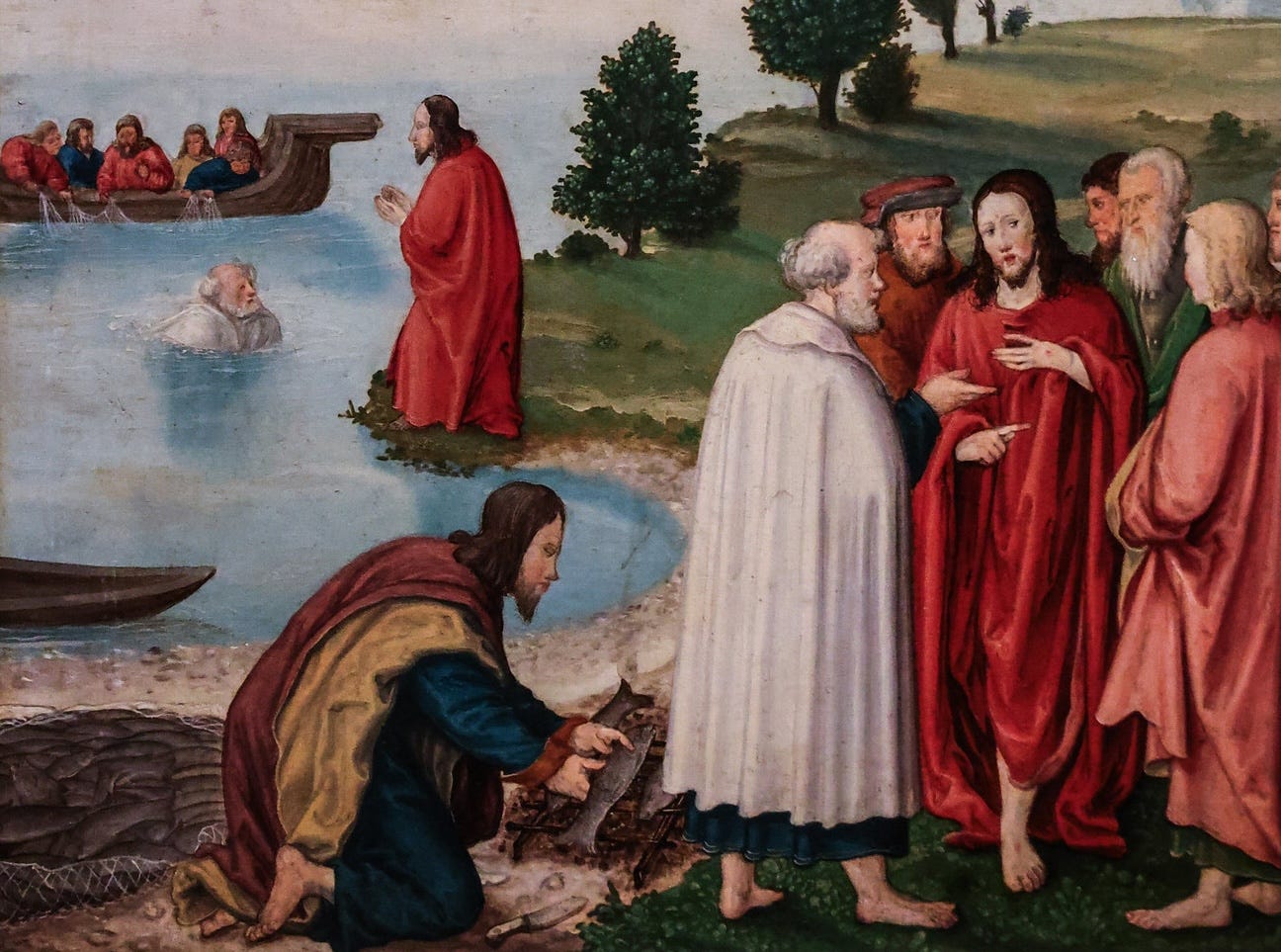
The most detailed account of any appearance of our Lord is that which is given by St. John as the third manifestation which was made to the Apostles.3 This was the occasion when seven of them were together fishing, St. Peter, St. Thomas, St. James, St. John, St. Bartholomew or Nathanael, and two others. They fished all night, as once before, in the early days of our Lord’s Public Ministry, and caught nothing.
In the dawn of the morning our Lord was on the shore near them, but they did not know Him. He asked them if they had any food, and when they answered No, He bade them cast their net on the right side of the boat. The net was filled with fishes. St. John had already discerned our Lord, and told St. Peter Who it was. St. Peter leapt into the sea in his short tunic, and made for the land. The others followed in the boat, dragging the net. They found our Lord, with a fire of coals burning, a fish upon it, and some bread.
Then our Lord told them to bring some of the fish which they had caught, and Peter dragged the net to land, with a hundred and fifty-three large fishes in it. The net was unbroken. Our Lord bade them come and take their food, no one asking Him Who He was, ‘knowing that it was the Lord.’ Then it was that our Lord asked St. Peter three times whether he loved Him more than the others. Each time St. Peter answered in almost the same words, and received the charge to feed the sheep and the lambs.4 The last time St. Peter was pained at the question, and told our Lord that He knew all things, He knew that he loved Him.
Then our Lord prophesied to him of his martyrdom:
‘Amen, amen, I say to thee, when thou wast young thou didst gird thyself, and didst walk where thou wouldst. But when thou shalt be old, thou shalt stretch forth thy hands, and another shall gird thee and lead thee whither thou wouldst not.’ Now, too, St. Peter asked our Lord what was to be the lot of St. John, and received the mysterious answer, ‘So I will have him to remain till I come. What is it to thee? Follow thou Me.’
The Resurrection and Ascension of our Lord
Here’s why you should subscribe to The Father Coleridge Reader and share with others:
Fr Coleridge provides solid explanations of the entirety of the Gospel
His work is full of doctrine and piety, and is highly credible
He gives a clear trajectory of the life of Christ, its drama and all its stages—increasing our appreciation and admiration for the God-Man.
If more Catholics knew about works like Coleridge’s, then other works based on sentimentality and dubious private revelations would be much less attractive.
But sourcing and curating the texts, cleaning up scans, and editing them for online reading is a labour of love, and takes a lot of time.
Will you lend us a hand and hit subscribe?
Follow our projects on Twitter, YouTube and Telegram:
Twitter (The WM Review)
§ 176. St. Mark xvi. 12, 13; St. Luke xxiv. 13–35.
§ 177. St. Luke xxiv. 36—43; St. John xx. 19—29.
§ 178. St. John xxi. 1–14.
§ 179. St. John xxi. 15–24.