

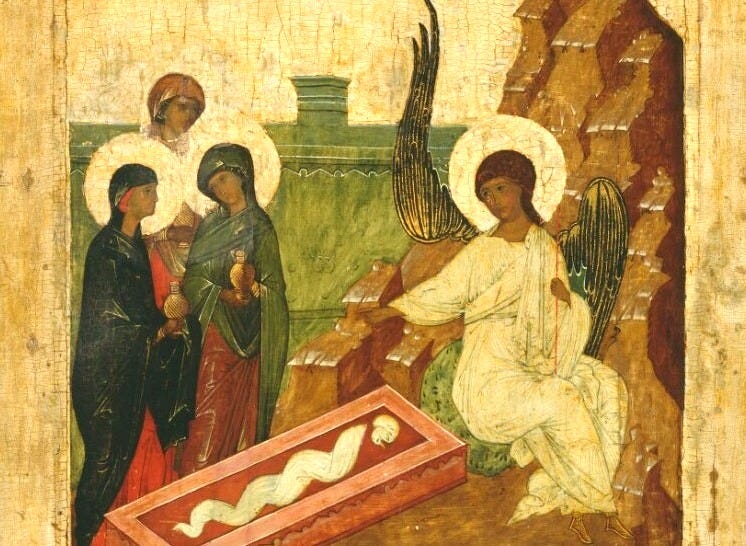
The whole narrative falls into place when we notice that the Gospels present us with multiple visits to the Sepulchre.
Editor’s Notes
As noted in another article, Fr Coleridge’s work did not just include commentary on the Gospels, but also their harmonisation.
In his two-volume work The Life of our Life – the same title as that which is given to his much longer series of the life of Our Lord – he deals with the harmonistic questions with great clarity, and sometimes even ingenuity.
The Resurrection is one area in which such ingenuity is needed. In this mini-series, we will present Chapters X and XI of Volume II, along with our own ordering of his harmony.
In this part, he begins setting the Resurrection appearances in order – and draws out some important points that some might find surprising.
One of the chief difficulties arises from assuming that the Gospels were all talking about a single group of women visiting the tomb. This assumption is not necessitated by the texts at all. Fr Coleridge presents the arguments for several parties of women, and several visits to the Sepulchre – one of which was even on Saturday evening (the beginning of Sunday, by the reckoning of the Jews). Once we consider this possibility, which is amply supported by the Gospels themselves, and only contradicted by our own gratuitous assumptions, everything falls into place.
The Resurrection and Ascension of our Lord
The Life of our Life, Vol. II
Chapter X
Burns and Oates, London, 1876
The Resurrection unseen
We may now proceed to put in order, as far as is possible, the several accounts which remain to us in the Gospels of the incidents of the great day of the Resurrection.
The Resurrection itself was unwitnessed, as far as we know, by mortal eye. When our Lord’s Soul once more entered into the Sacred Body which was lying in the sepulchre, it needed no power but its own to pierce the stone and issue forth at will. The Roman guards were the only persons present, and we are nowhere told that their eyes were enlightened so as to discern the heavenly majesty of the Risen Body of our Lord.
Early tradition has pointed out the spot on Calvary, very near indeed to the sepulchre, where our Blessed Lady was when our Lord manifested Himself to her; and we need not attempt to trace His footsteps any further until He must have left her to console that other Mary, who had stood by her at the foot of the Cross. Soon after His Resurrection, but we are not told at what interval, occurred the first incident of which the Gospels give any account.1
‘Behold, there was a great earthquake; for an angel of the Lord descended from heaven, and coming, rolled back the stone, and sat upon it. And for fear of him the guards were struck with terror, and became as dead men.’
Thus was the sepulchre opened to the visits of our Lord’s friends, and the soldiers, who might have hindered their free approach, filled with consternation, and even, as it appears, put to flight. It was as yet not dawn, some time before sunrise.
Several parties of women
We now return to the holy women from Galilee, whom we have found the Evangelists mentioning in their accounts of the crucifixion and sepulture of our Lord. Three of these are mentioned by name by St. Matthew and St. Mark, Mary Magdalene, Mary the mother of James and Joses, and Salome. The first two of these had watched the burial on Friday evening—sitting over against the sepulchre, and seeing where He was laid.
On Saturday the same two came to visit the sepulchre, just as the evening fell.2 After sunset, they purchased aromatic ointments and spices, in order that as soon as morning dawned they might come and perform for our Lord’s sacred Body the rites which had been omitted on Friday on account of the pressure of time.
But our Lord had many such devoted friends at that time in Jerusalem or in its neighbourhood—for some of them may have had to come as far as from Bethany.
Father Coleridge Reader is a labour of love. But curating, cleaning up and publishing these texts takes real work.
To keep this project going, and to make more of this treasury available, we rely on reader support. Some posts are reserved for members to sustain this mission.
We’re trying to keep something precious alive.
If you’ve benefited, consider joining us as a subscriber. It makes a real difference.