

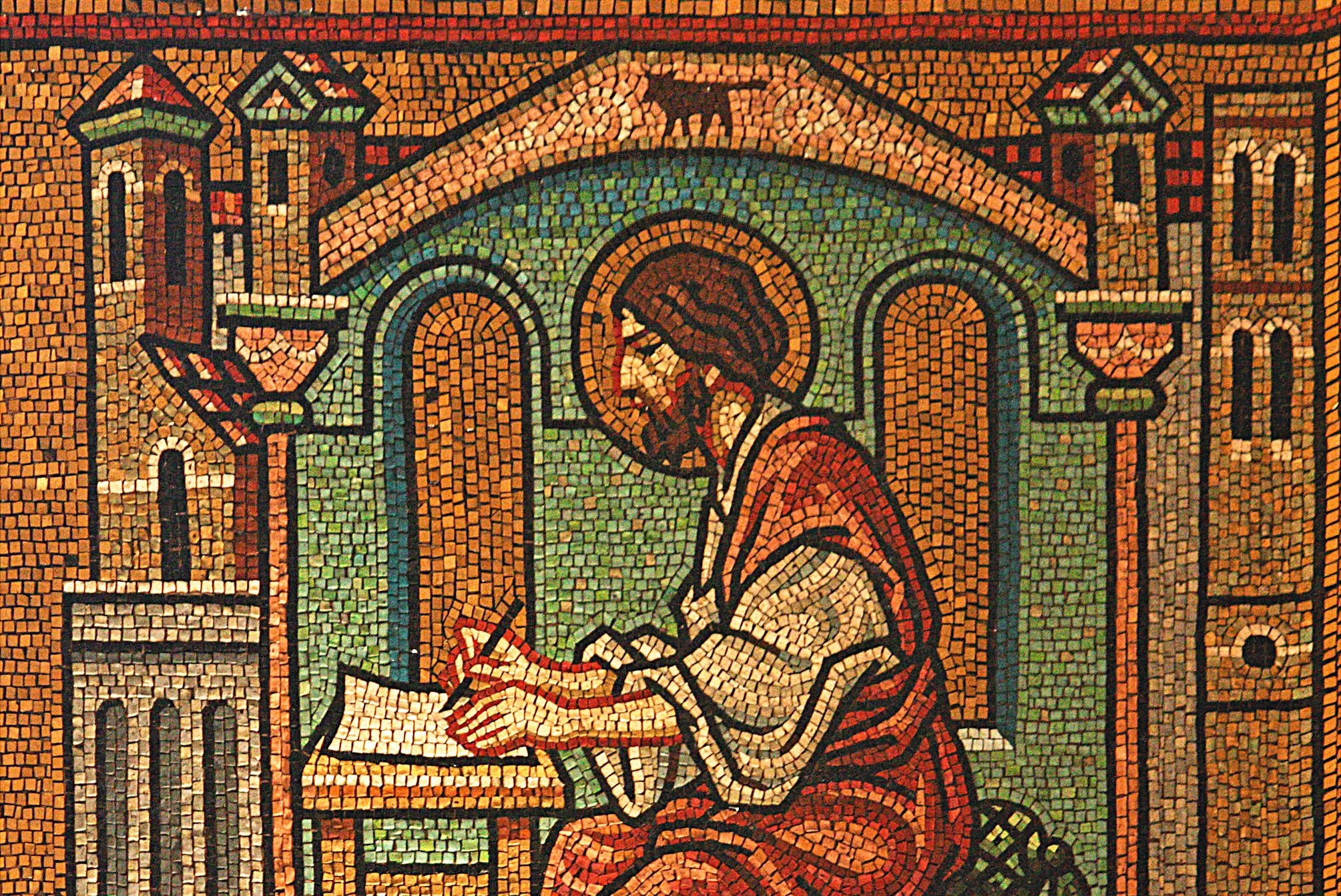
Close attention to St Luke resolves the difficulties that are sometimes raised.
Editor’s Notes
In the this part, we present Fr Coleridge’s account of St Luke’s Gospel on the Resurrection. The fact that some of these points have been overlooked has led to confusion over how the four Gospels can be reconciled – but this confusion is totally dispelled by Fr Coleridge.
We have previously published Fr Coleridge’s harmonisation of the Gospels’ account of the Resurrection narratives:
The WM Review also published a synthesis of these accounts, based on Fr Coleridge’s work, in one continuous text:
In this mini-series, Fr Coleridge provides further explanation of why each Gospel treats of these matters in their particular ways – and the role of these accounts in the life of the Church.
The Resurrection and Ascension of our Lord in the Four Gospels
The Life of our Life, Vol. II
Chapter XI
St. Matt. xxvii. 35–44; St. Mark xv. 24–32; St. Luke xxiii. 34–43; St. John xix. 13–27; Story of the Gospels, § 170.
Burns and Oates, London, 1876
St Luke supplementary
St. Luke, in the history of the Resurrection, plays the same part as in the rest of the Gospel narrative.
That is, his narrative is complete in itself, he as far as possible prefers to give new incidents which resemble those which have been already given by the Evangelists who have preceded him, rather than to relate exactly what the others have related, he supplements what requires supplement, and while he writes throughout as an historian he gives a colour and character of his own to the whole story which make it as individual as the tone of a voice or the expression of a countenance.
His parallelism rather than identity with St. Matthew and St. Mark begins from the last touches which he gives to his account of the entombment of our Lord. For he mentions the women who had followed our Lord from Galilee as watching the burial, and their going home that evening, and before the Sabbath had begun, preparing their spices and unguents. This is enough to tell us, in St. Luke’s modest way, that he is speaking of a party of women different from that which had been mentioned by St. Matthew and St. Mark.
Then he carries on the history of these same women. They came to the sepulchre deep in the twilight—evidently therefore before the others, who, as St. Mark tells us, did not arrive until the sun had risen. Here again we have one of St. Luke’s notes of difference. They find the stone rolled away, go in, and the Body is not there. Two angels, instead of one, appear to them, and ask them why they seek the living among the dead, and remind them of the words of our Lord as to His Passion and Resurrection, while He was in Galilee.
No charge is given to them to tell the Apostles, but they go and tell these things to the eleven and the other disciples. Their words appear to them as idle wanderings, and are not believed. This is St. Luke’s contribution to the first part, as we have called it, of the three into which the Gospel narrative of the Resurrection may be divided. He sums up by naming the women who ‘told these things to the Apostles,’ but this catalogue is not to be considered as including those only who belonged to the party of which St. Luke has himself spoken.
It is an enumeration of all the women who at different times brought messages to the Apostles—Mary Magdalene, the first, Joanna and her companions, the second, and Mary mother of James and the others with her, the third. As the Apostles were the witnesses to the world, so these women were to the Apostles, the witnesses whose word they ought to have believed at once.
The latter parts of the history in his Gospel
St. Luke’s further account hangs together without any break. He mentions first, in a few words, the visit of Peter to the tomb. Then he gives at full length the story of the travellers to Emmaus, and how our Lord made Himself known to them in the ‘breaking of bread.’
The account which Cleophas and his companion gave our Lord of the state of their knowledge as to the incidents of the day before they left Jerusalem exactly coincides with that which one would give who had heard the account of the women whom St. Luke has already mentioned, for he speaks of their having been to the sepulchre before light, of the vision of angels, that is, more than one, and he makes no mention of an order to go to Galilee. The message to go into Galilee was not sent by them.
The other fact he mentions is the visit of ‘some of ours,’ that is, Peter and John, to the tomb. We cannot doubt that the visit thus paid by St. Peter prepared his mind, at all events, for the fulness of faith which was afterwards rewarded by our Lord’s appearance to him, of which the travellers are informed when they return to Jerusalem.
St. Luke then proceeds to what we have called the second element in the history. He says nothing of those appearances of our Lord to His Apostles of which St. Matthew and St. Mark have spoken, but he adds the entirely new incident of His appearance to them on the very evening of Easter Day, when He entered while the doors were shut, showed them His hands and feet, bade them feel Him, and even ate something with them.
Then St. Luke passes at once, without any mention again of Galilee, to the charge or instruction which our Lord gave to the Apostles—as it seems, at a time subsequent to that of the first apparition to them on Easter Day, at which our Lord conferred on them the Holy Ghost and the power of absolution, of which this Evangelist makes no mention. St. Luke’s instruction relates to the fulfilment of the Scriptures, to the gift of intelligence given to them at this time, to their duty as witnesses, and the command to remain in Jerusalem until the coming of the Holy Ghost.
He then, as has been said, briefly mentions the Ascension, and the time they spent in retirement, ‘being always in the Temple praising and blessing God.’
The Resurrection and Ascension of our Lord in the Four Gospels
Here’s why you should subscribe to The Father Coleridge Reader and share with others:
Fr Coleridge provides solid explanations of the entirety of the Gospel
His work is full of doctrine and piety, and is highly credible
He gives a clear trajectory of the life of Christ, its drama and all its stages—increasing our appreciation and admiration for the God-Man.
If more Catholics knew about works like Coleridge’s, then other works based on sentimentality and dubious private revelations would be much less attractive.
But sourcing and curating the texts, cleaning up scans, and editing them for online reading is a labour of love, and takes a lot of time.
Will you lend us a hand and hit subscribe?
Follow our projects on Twitter, YouTube and Telegram:
Twitter (The WM Review)