
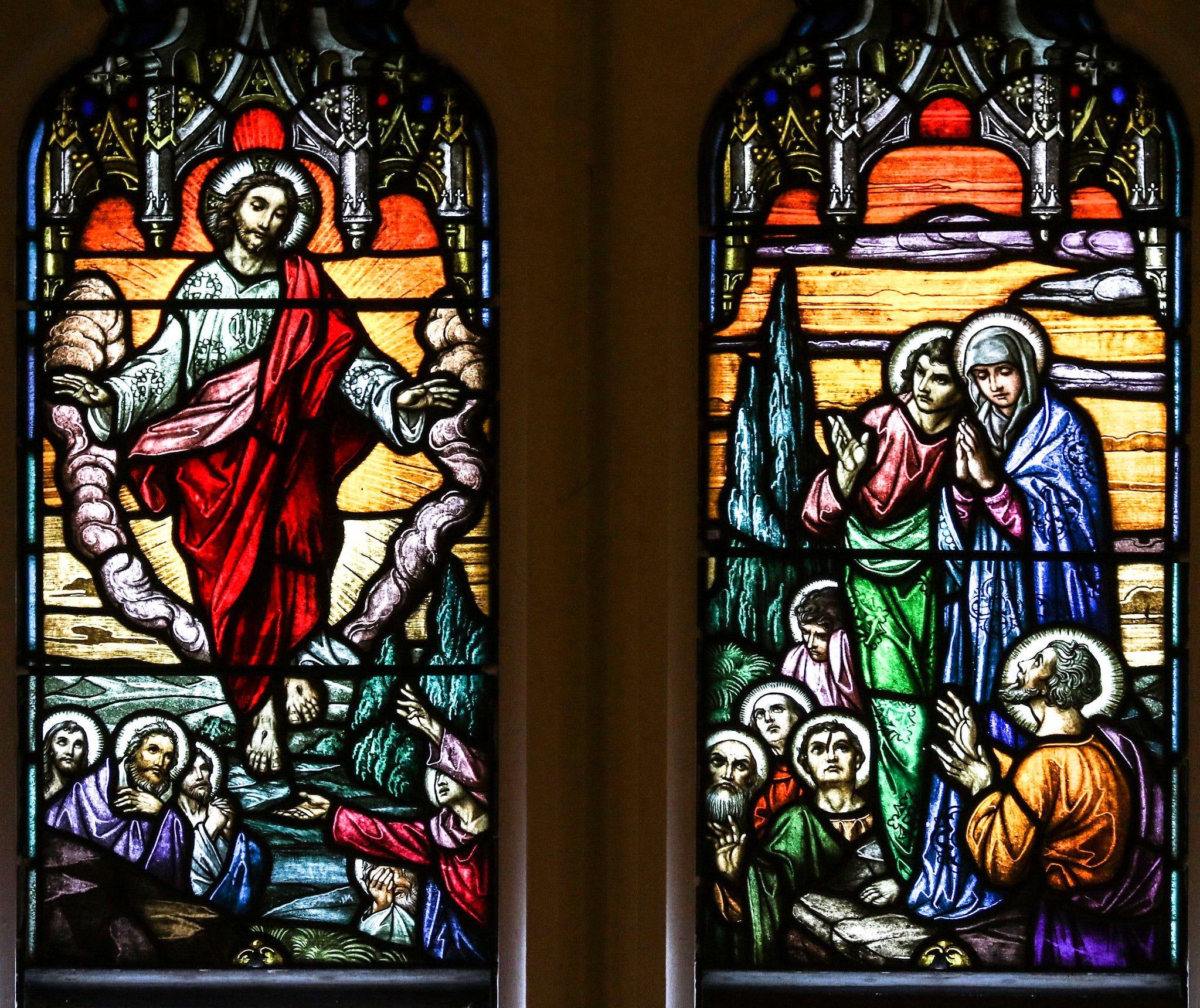
After the visits to the Sepulchre, Our Lord appeared to his Apostles in several different ways. What were the reasons for this?
Editor’s Notes
The liturgical readings on the Sundays of Easter rapidly move on from the Resurrection, and soon become focused on the Ascension. Those readings are primarily drawn from the discourses at the Last Supper, but the Gospels themselves indicate that there were a number of appearances of Our Lord in the lead up to the Ascension itself.
In this part, Fr Coleridge explains those appearances.
Over at The WM Review, we published a synthesis of all four narratives based on Fr Coleridge’s harmony:

The Resurrection and Ascension of our Lord
The Life of our Life, Vol. II
Chapter X
Burns and Oates, London, 1876
On the mountain
The other chief manifestation of this time in Galilee is that of which St. Paul speaks in the passage to which reference has already been made, when our Lord was seen, as he says, by more than five hundred brethren at once. It is clear that a manifestation of this kind could hardly have taken place near Jerusalem, without attracting great notice.
Although it was perfectly easy for our Lord to quell by an exertion of power any attempts that might have been made to hinder such an assembly, or to prevent any measures that might otherwise have been taken in consequence, it was not in accordance with the Divine order of Providence that any display of power of that kind should be made.
On the contrary, one of the reasons which may fairly be assigned for the retirement into Galilee at this time, is the security which would be afforded thereby for the meetings of the disciples and for the quiet communings with the Apostles with which our Lord was now chiefly occupied. Galilee would be all the more secure, inasmuch as a considerable space of time had now passed since our Lord had been seen in that province in the exercise of His ordinary Ministry.
It must always be uncertain whether we are to consider the juxtaposition of certain incidents in St. Matthew, and indeed, in this part of the history, in the other Evangelists also, as a sure sign that the incidents thus placed side by side were actually connected in time and scene. But there seems no reason for doubting that St. Matthew intends us to consider that at this great meeting, which he speaks of as a meeting of the eleven Apostles on a mountain which our Lord had appointed,1 the great charge was conferred upon them with which the narrative of the first Gospel is closed.
Thus this manifestation would in a manner correspond to and be the complement of the manifestation on the shore of the sea of Tiberias, of which we have last spoken. On that occasion our Lord conferred on St. Peter the supreme care and government of His Church, in the presence of other Apostles. At this on the mountain our Lord conferred on the whole Apostolic body, as it seems, in the presence of a large body of believers, the commission to be the teachers of the whole world.
‘All power is given to Me in heaven and on earth. Go ye therefore and teach all nations, baptizing them in the name of the Father, and of the Son, and of the Holy Ghost, teaching them to keep all things whatsoever I have commanded you, and lo, I am with you all days, even unto the consummation of the world.’
Last scene in St. Mark
We have spoken of the final manifestations which are given by St. Matthew and St. John: it remains to say a few words as to those which end this part of the history in St. Mark and St. Luke. Each Evangelist ends his work with a characteristic passage, in harmony with the general tone which has pervaded his Gospel. St. Mark mentions the message to the Apostles to go into Galilee,2 but he gives us no account of anything that passed there. The scene of his last passage is evidently Jerusalem.
He tells us that our Lord, ‘at a later time,’ appeared to the eleven as they were at meat, and that He upbraided them with their incredulity and hardness of heart in not believing those who had seen that He was risen. This incident seems to belong very naturally indeed to the first Easter Day, and may perhaps seem out of place at a later point of time, especially after the return of the Apostles to Jerusalem which must have taken place before the Ascension.
It must remain quite uncertain, as has been said, whether this manifestation of Himself took place at the earlier date or at the later, but as it seems in St. Mark to be connected with the last words of our Lord which he records, there can be no reason against placing it there. When we remember the importance and the prerogatives of faith in the new kingdom, it need not surprise us to find our Lord at the very last so earnestly rebuking the founders of that kingdom for their own defects in this regard. St. Mark brings out especially the power of miracles as conferred on the Apostles and on believers generally in order to authenticate their mission.
‘He said to them, Go into the whole world, and preach the Gospel to the whole creation.3 He that shall believe and be baptized shall be saved, and he that shall not believe shall be condemned. But these signs shall follow those who believe: in My Name they shall cast out devils, they shall speak with new tongues, they shall take up serpents, and if they drink anything deadly, it shall not hurt them, they shall lay their hands on the sick, and they shall recover.’
And the Evangelist adds, that our Lord was afterwards taken up into heaven, and sitteth at the right hand of God.
‘But they went forth, and preached everywhere, the Lord working with them, and confirming the word by the signs which followed.’
Last scene in St. Luke
St. Luke’s last manifestation is one in which our Lord speaks to the Apostles of the fulfilment which had been necessary of all that had been written concerning Him in the Law of Moses, in the Prophets, and in the Psalms.4 He then opened their intelligences that they might understand the Scriptures.
‘So it is written, and so it did behove Christ to suffer, and to rise again from the dead the third day, and that penitence and remission of sins should be preached in His Name unto all nations, beginning from Jerusalem.’
‘And you,’ He said, ‘are the witnesses of these things. And I send the promise of My Father upon you; but do you abide in the city, until you be clothed with power from on high.’
St. Luke concludes his Gospel with a short mention of the Ascension of our Lord, in the act of blessing them. ‘And they adoring Him returned unto Jerusalem with great joy, and they were always in the Temple, praising and glorifying God.’
The Ascension
A few passages from St. Luke’s other work, the Acts of the Apostles, which is in truth a continuation of the Gospels, relating the Life of our Lord in His Church, must suffice to end this history.5
The Acts open with a more detailed account of what took place just before the Ascension than has been given in the Gospel. Our Lord, he says, appeared to His chosen Apostles for forty days, speaking of the kingdom of God. He bade them remain in Jerusalem, to await there the promise of His Father, which they had heard from Himself, ‘for John indeed baptized with water, but you shall be baptized with the Holy Ghost after these few days.’
They asked Him whether He was now about to restore the kingdom of Israel. He told them that it was not for them to know the times and the seasons which the Father has kept in His own power. Their work was to receive the power of the Holy Ghost which should come upon them, and to be witnesses to Him in Jerusalem, in all Judæa, in Samaria, and to the very end of the earth. While He was speaking He was raised up, and a cloud received Him out of their sight. They remained gazing up into heaven, when two angels stood by them and addressed them as Men of Galilee! why did they stand thus looking up into heaven?
‘This Jesus, Who is taken up from you into heaven, shall so come as you have seen Him go into heaven.’
Then they returned to Jerusalem to await the coming of the Holy Ghost. St. Luke goes on to relate the beautiful story of the beginnings of the Christian Church, the Apostles remaining in prayer with our Blessed Lady and the holy women, the election of St. Matthias in place of Judas at the bidding of Peter, the coming of the Comforter on the day of Pentecost, the miracle of the tongues, St. Peter’s address to the multitude, and the first admissions by baptism into the fold of our Lord.
Beginnings of the Church
The description which St. Luke gives of the fervour of that first Christian Church seems to gather into itself all the characteristic features which might be expected in a community which was the purest and freshest outburst of the seed sown in our Lord’s Human Life—unity in the Apostolic doctrine, in the reception of the Blessed Sacrament, and in prayer, the supernatural power of the Church manifesting itself in the holy fear which it produced by its display of miraculous power, and, still more wonderful and beautiful, the multitude of believers of one heart and soul, having even their earthly possessions in common, ever praying and praising God in the Temple, filled with a simple holy joy and peace, winning the love and favour of all around, and drawing by the charm of their lives and characters great numbers into the fold.
Other and darker lines were soon to be introduced into the picture, and the brightness of its heavenly beauty was soon to become dim, for the history of the Church was not to be in the main different in its incidents from the history of our Lord Himself.
But here, while the fair vision is as yet undarkened with gloom, before persecution comes from without, before national jealousies spring up within, before St. Peter has to use his magisterial power in punishment, before Stephen wins the first martyr’s crown and sets the example of efficacious prayer for the conversion of persecutors, before the first heresies and the first schisms, the first controversies and the first apostasies, even before the Church is thrown open to the Gentiles, and their great Apostle rises to take his place by the side of St. Peter, we may fitly pause and close the volume of the earthly history of the Life of our Life.
The Resurrection and Ascension of our Lord
Here’s why you should subscribe to The Father Coleridge Reader and share with others:
Fr Coleridge provides solid explanations of the entirety of the Gospel
His work is full of doctrine and piety, and is highly credible
He gives a clear trajectory of the life of Christ, its drama and all its stages—increasing our appreciation and admiration for the God-Man.
If more Catholics knew about works like Coleridge’s, then other works based on sentimentality and dubious private revelations would be much less attractive.
But sourcing and curating the texts, cleaning up scans, and editing them for online reading is a labour of love, and takes a lot of time.
Will you lend us a hand and hit subscribe?
Follow our projects on Twitter, YouTube and Telegram:
Twitter (The WM Review)
§ 180, 181. St. Matt. xxviii. 16–20.
§ 180. St. Mark xvi. 14–20.
πάσῃ τῇ κτίσει.
§§ 180, 181. St. Luke xxiv. 44–53.
§§ 182–185. Acts i. ii.