

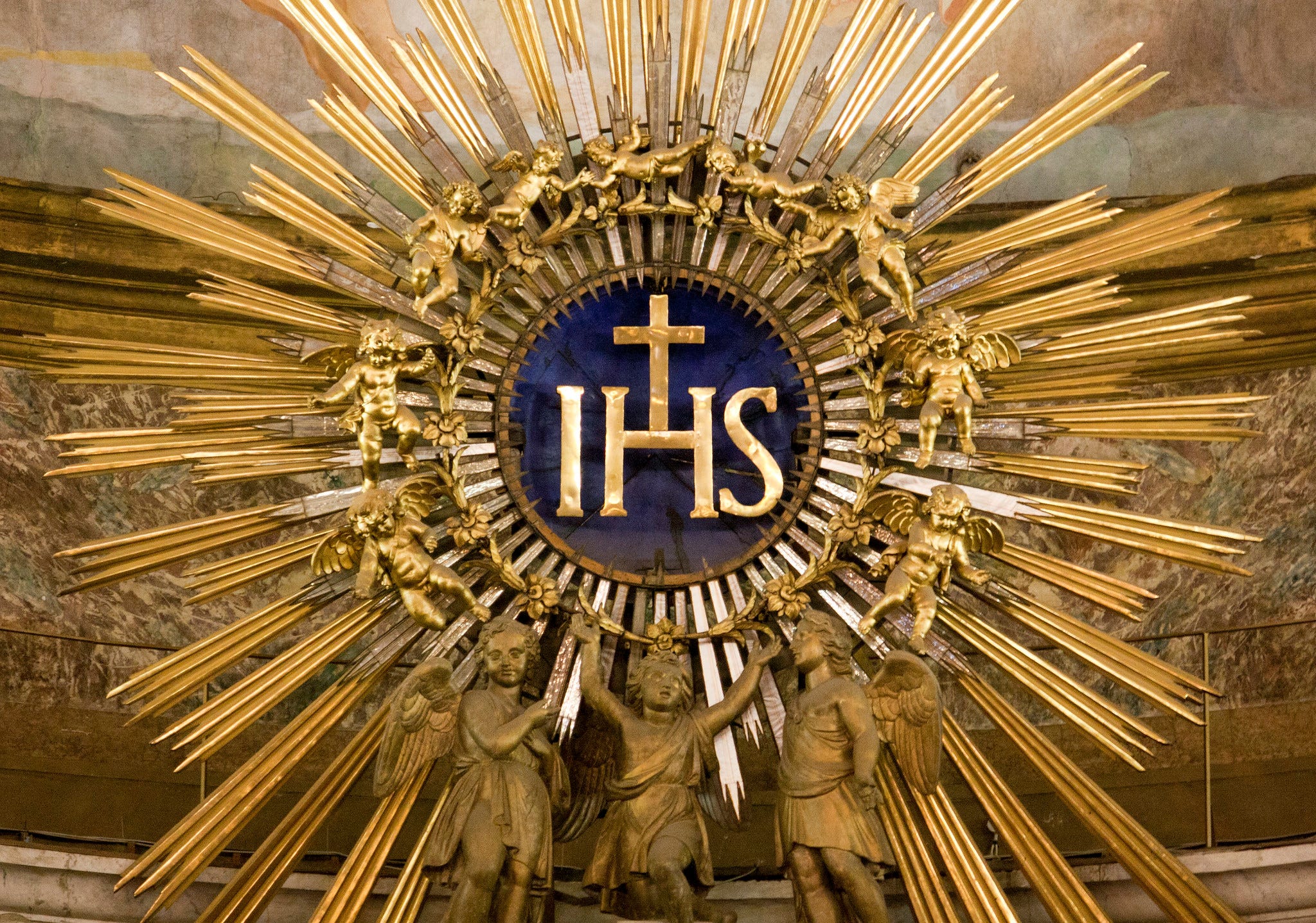
The Holy Name of Jesus conveys the victorious power by which grace is bestowed, prayer is heard, and the enemies of our salvation are put to flight.
Editor’s Notes
The Feast of the Most Holy Name of Jesus has been celebrated on different dates throughout history. In 1913, Pope St Pius X moved the feast to the Sunday between the Circumcision and the Epiphany.
For the Jews, the Circumcision was the moment in which the name was imposed upon a boy. Fr Coleridge addresses the devotion in the same chapter, and so we continue with his treatment.
In this passage, Fr. Coleridge tells us:
How the holy name gathers into one word all that Christ reveals of the Father.
That love of this name draws souls into deeper union, imitation, and confidence before God.
Why its invocation possesses real power against sin, fear, and the enemies of salvation.
He shows us that to name Jesus with faith is already to cling to him, and to be strengthened by his grace.
The Imposition of the Holy Name
The Thirty Years – Our Lord’s Infancy & Hidden Life
Chapter VII
St. Luke ii. 21; Vita Vite Nostræ, § 10.
Burns and Oates, London 1885 (1915 edition).
Headings and some line breaks added.
Our Lord revealing the Father
Our Lord came on earth in order to reveal His Father to us, and to win our hearts to our God. He was to do this especially by making Himself known, by the perfect beauty of His virtues, His sweetness and attractiveness and condescension, His humility and charity and meekness, and a thousand other charms in which the excellencies of His Sacred Heart unfolded themselves to our intelligence and made our affections captive.
This was the essence of His teaching, and as the accomplishment of our salvation required that we should learn to serve God by first loving Him, as well as by having our sins atoned for on the Cross, all this part of the work of our Lord is signified in the Holy Name. Thus it stands as a complete summary and description of our Lord’s character, as well as of His office, and it is under this aspect that it has been regarded by thousands of saints, whose hearts have melted at its mere sound, because it has recalled to them all that He has thus revealed to them of Himself, and intensified their love and the spiritual effects of His grace on their souls by that simple act of recollection.
It brings Him back to their minds and hearts as their God, their King, their Redeemer, their Mediator, their Saviour, their great Priest and Intercessor, the Captain under Whom they fight, the Leader Whom they follow, their Teacher, their Lawgiver, the Spouse and the Shepherd of their souls, their Light, their Life, the Judge before Whom they must stand, and their eternal Reward. But He is also to them the mirror of all the most glorious and winning virtues, Charity, Mercy, Kindness, Humility, Piety, Simplicity, Poverty, Chastity.
It is the prerogative of love to transform those who love into the likeness of him whom they love, and as the mere name of one who is loved cannot sound in the ears or be thought of in the mind without adding to the love which is already there, so the thought of the Holy Name and the mention of the Holy Name have a kind of sacramental power in the hearts of His saints. They seem to convey grace to think like Him, to act like Him, to sacrifice themselves to Him, to make Him known to others, and to win them also to love Him.
Power of the Holy Name
But the Holy Name is a name of power as well as of sweetness, as we are constantly reminded in the Sacred Scriptures themselves. His Church pleads it in all her prayers to God, as making her prayers His demands, and clothing their weakness in the might of His infinite satisfaction and resistless impetration.
The faithfulness of God, Who has given us our Lord, and commanded that His Name should sum up all that He is and all that He has done, is pledged to us that the invocation of that Name shall open the gates of mercy to our prayer. The name of Jesus unlocks all the treasures of the Divine Mercy, it stays the arm of His Justice, it turns His anger into pity, and makes His love for our Lord the measure of His compassion for us.
It represents on earth the Kingdom of the Incarnation, the authority and rule of Him to Whom all power is given in Heaven and on earth. The devils flee away at the name of Jesus. In the early days of the Church, and afterwards, amid simple populations lately converted to the faith, children could use it, as they could use the sign of the Cross, and the powers of Hell obeyed them.
The Holy Name has always been the great weapon for the working of miracles of every kind, for our Lord has promised not only that the Father will grant all that we ask in His Name, but also that in His Name those who believe in Him shall cast out devils, and perform all sorts of wonders.
By virtue of this Name thousands of spiritual graces also are constantly bestowed, and it has a singular efficacy in soothing trouble, chasing away fear and despondency, and filling the heart with light and joy and strength, as was the case with our Lord’s own bodily presence, as when He went up into the boat in which His disciples had been toiling against the winds and waves, and the sea fell, and the storm ceased, and they were at once at the shore.
Its invocation by the faithful
The truth that the invocation of this Name by the children of the Church has a legitimate power over the enemies of our salvation, is proved by the anecdote in the Acts, when it was used by those who had no right to use it, and the devil turned on them saying, “Jesus I know and Paul I know, but who are you?”1
This explains a great deal of the language of the Saints concerning the Holy Name. It is not only a Name of power and efficacy, pleading before God the infinite merits of Him Who bore it, and representing to the face of God and man Him Who has overcome Hell. It is also a token and seal of the union that makes those who believe in Him in His Church one with Him, members of His Body, of His Flesh and of His Bones, as St. Paul says. It is this union which gives to Christians a right to use it, as the children of a King have a right to use his name, and as his magistrates and officers and representatives clothe themselves by its use with his authority.
It is not a charm, as if it might be used for any purpose, by persons in any moral state, or of any form of belief. But when used with faith and devotion by who belong to our Lord, it may have any effect connected with the work of salvation which it signifies. This is what St. Peter says of it on the first occasion when it was used as a name of power, when he healed the lame man at the Beautiful Gate. “His Name, through faith in His Name, hath made this man strong whom you have seen and know.”2
The power is in the Name, when it is used in faith. There is no limit to the occasions when it may be used with efficacy, because our Lord, in His Human Life, has touched all the circumstances of our daily existence, He has lived like one of us, to make Himself our brother, and in consequence of this there is no part of our life in which we cannot unite ourselves with Him. Thus we may take, in this sense, literally what St. Paul says to the Colossians, “All whatsoever you do in word or work, do all in the Name of the Lord Jesus Christ.”3
For a devout and thoughtful interior act of union with Him in anything cannot be without its fruit in reviving all the grace which we have derived from Him, and thus the invocation of His Name at such a time has an efficacy, partly from our own devotion and faithfulness, but also from the Holy Name itself, in the sense in which St. Peter speaks. It is like the sign of the Cross, or the use of the Crucifix.
The Circumcision
Here’s why you should subscribe to The Father Coleridge Reader and share with others:
Fr Coleridge provides solid explanations of the entirety of the Gospel
His work is full of doctrine and piety, and is highly credible
He gives a clear trajectory of the life of Christ, its drama and all its stages—increasing our appreciation and admiration for the God-Man.
If more Catholics knew about works like Coleridge’s, then other works based on sentimentality and dubious private revelations would be much less attractive.
But sourcing and curating the texts, cleaning up scans, and editing them for online reading is a labour of love, and takes a lot of time.
Will you lend us a hand and hit subscribe?
Follow our projects on Twitter, YouTube and Telegram:
Twitter (The WM Review)
Acts xix. 15.
Acts iii. 16.
Coloss. iii. 17.