

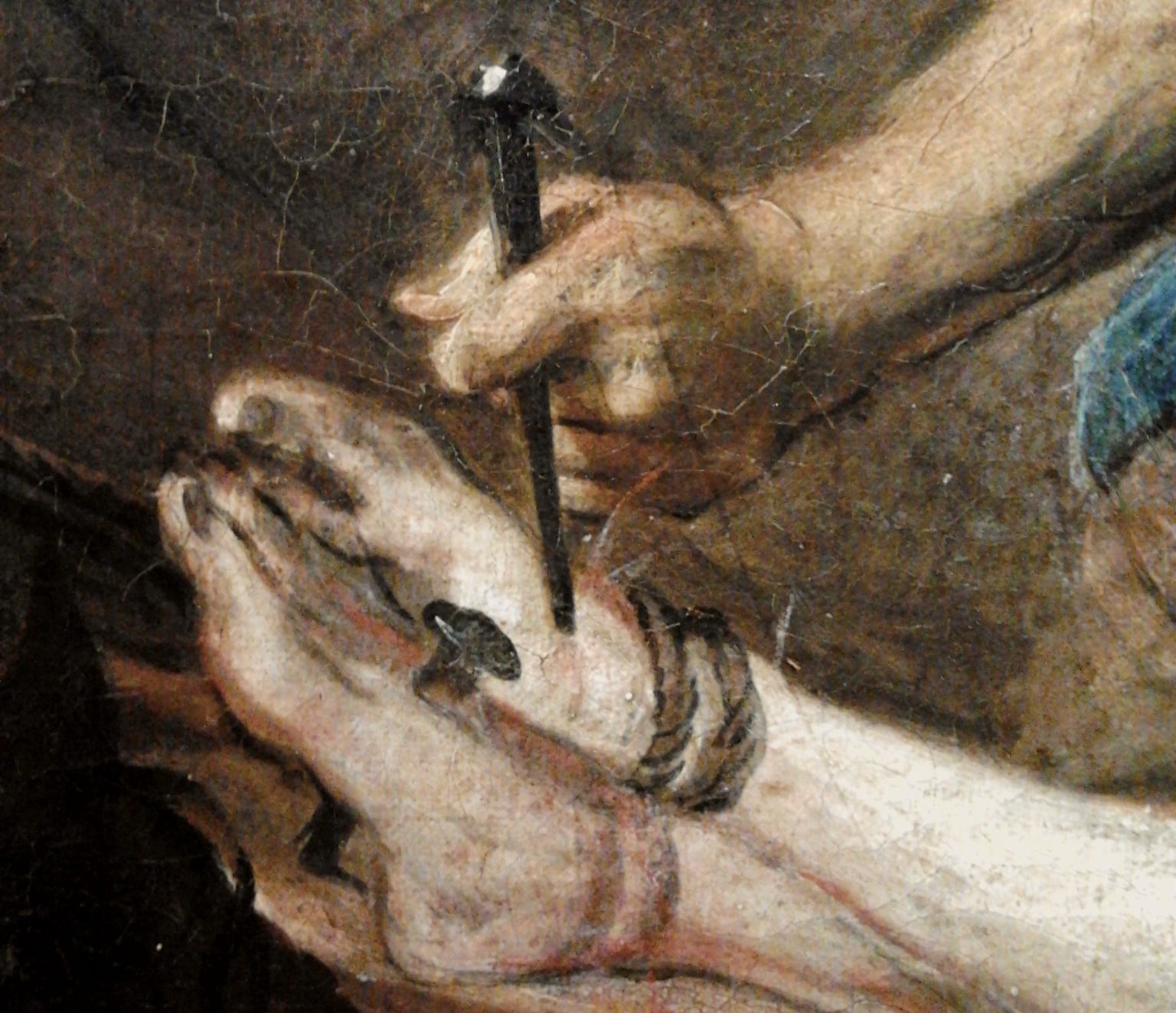
How did Jesus respond to the procedure for crucifying the condemned?
Editor’s Notes
Fr Coleridge’s account of the Cruxifixion covers two long chapters, and so it is necessary to start it before Good Friday, and to continue it after Easter Sunday.
In this part, he considers the way in which Christ was nailed to the Cross – along with the first of the “Seven Words from the Cross”, namely his prayer for the forgiveness of those who were acting out of ignorance.
For more context, see Part I. For more on Good Friday itself, see here:

As a further aid for meditation, The WM Review, Father Coleridge Reader and Catholic Hub last year produced a recording of Fr Coleridge’s harmonisation of the Passion narratives:
Calvary
The Passage of Our Lord to the Father
Chapter XII
St. Matt. xxvii. 35–44; St. Mark xv. 24–32; St. Luke xxiii. 34–43; St. John xix. 13–27; Story of the Gospels, § 170.
Burns and Oates, London, 1892
Manner of the Crucifixion
We may proceed now to the actual incidents of the Crucifixion.
The first thing that the executioners would do after the proffer of the cup of wine mingled with myrrh or gall, would be the stripping off of the garments of our Lord, which became their property, as the reward of the trouble which they had to take in the process of nailing Him naked to the Cross.
There may have been some countries in the Old World where—as in Japan in more recent times—the criminals were executed without being unclothed, but it does not seem to have been the Roman custom to spare them this humiliation of being previously stripped. It might seem a light thing in the eyes of common spectators, whether this ignominy were inflicted or not. But to our Lord, the most modest of men, the Prince of purity and decency, this fresh outrage must have been very sensible, and it must not be omitted in our reckoning of all that He suffered for us.
The numberless and most various sins against modesty for which He had to suffer for us, would doubtless present themselves to His Heart as He made this final sacrifice to the justice of His adorable Father, in the presence too of His Blessed Mother, who felt most poignantly all that it was costing Him. It is to be added also that there would be, besides the shame of the outrage on His modesty, a renewal of the pain of the many wounds with which His Body was now covered, to which His garments must in many places have become glued, so as to pain Him, as if the wounds had been torn open afresh.
It seems also that the crown of sharp thorns had not been taken off His Head at any stage of His sufferings. There must have been much fear of its now becoming entangled with the clothes as they were drawn over the Sacred Head. This would have led to fresh wounds from the thorns of which it was woven, and in many cases to the loss of fresh blood. Indeed we cannot give ourselves any full account of the sufferings now endured by our Saviour, though we can see that they must have been very great indeed.
Not described in the Gospels
But great as they may have been, there was much more and much worse still to come. The Evangelists do not tell us of the details of the actual Crucifixion, which may have been carried out in a variety of ways.
For our Lord may have been thrown on the ground with the Cross below His naked Body, and then fastened to it by the driving into the tenderest parts of His hands and feet of the large nails which were required in order to support its weight. In that case, the Cross must have been afterwards fixed in some cavity which had been made for it, and He must have had to suffer the pain which would have been caused by the jolting and jarring of the heavy wood as it was settled into its position, sometimes with a violent shock which would make itself felt through the whole of the Victim’s Body.
Another way in which the Crucifixion may have been performed would have been the fixing of the Cross in the ground at the outset, and the nailing of the hands and feet thereto, by the standing of our Lord close to it, being first mounted on a stool that raised Him a little above the ground, while the nails were driven in, the stool being removed when the hands and feet had been fixed in the places prepared for them. In this case, besides the pain caused by the driving in of the nails into the flesh, there would come a sudden shock when the weight of the Body of our Saviour was first left to bear entirely on the nails, from which it was to hang until life was extinct.
In whatever way we may suppose the execution of the sentence to have been carried out (and it would be contrary to our purpose to discuss the various opinions which are to be found in the authorities on the subject), it is clear that in any case the sufferings must have been intense and excessive. That is probably one reason why on this part of the Passion, as on the scourging also, the four Evangelists have been guided to be so brief and reticent—content to leave what they are relating to the silent feelings of those for whom they were writing.
The soldiers and their work
We have no reason for being sure that the Roman executioners in our Lord’s case were men more than usually cruel and brutal. They were probably accustomed to their task, and neither better nor worse than other men might have been.
There are some statements made about the scourgers, who are supposed to have been directed, either by Pilate or the priests, to do their work with unusual cruelty—the priests out of hatred to our Lord, the Governor because he wished Him to be made an object of great pity to the people. But there is little of the kind said about the soldiers who crucified Him. They may be supposed to have done what they had to do to our Lord, as to any other whom they had to treat in the same way.
But, on the other hand, we have no reason for supposing that they spared Him a single pang or torment from any special tenderness of heart, or because—at this stage at all events—they were much moved by what they witnessed of His adorable patience.
At the end of the three hours it may have been different. By that time a great change may have come over them—the silence, the darkness, the great prodigies, the prayers made by our Lord and the saints who stood at the foot of the Cross, and the example of His great patience, must have softened many hearts. And the only persons who have a hard word to say of Him are the priests, who in their inveterate malice, speaking in their last recorded words to Pilate, tell him how ‘that seducer’ had said that after three days He would rise again.
The first Word on the Cross – the excuse of ignorance
It does not seem inconsistent with the language of St. Luke, who is the only Evangelist who records the first Word spoken on the Cross by our Saviour, that He should have meant to imply that the Word was said at the very time that the executioners were engaged in the act of crucifixion.
For so the narrative runs—‘They crucified Him there and the robbers, one on the right hand and the other on the left. And Jesus said’—or He was saying, or kept saying—‘Father, forgive them, for they know not what they do.’
This, as has been said, is the first Word uttered by our Lord on the Cross, and it seems as if the very act of crucifixion, which was the beginning of the suffering which was intended to cause His death, brought to His Heart and lips this prayer, which He repeated more than once while the nails were being driven home.
Instead of any complaint, instead of any expression of pain, He thought of the poor soldiers who were the instruments of the wicked men who had brought about His condemnation, and by that injustice led to the abuse of the lawful power which God had entrusted to human society of applying the punishment of death, in certain cases, for the vindication of the law.
The executioners were first in the list of those for whom He prayed, for they were the most ignorant of all. But the prayer of our Lord included also the poor miserable judge who had acted, under a strong compulsion, against his own sense of right. It included the people misled by their natural guides and teachers, some even of the latter, who had taken an active part against our Lord in their blindness and timidity under the strong human considerations and influence brought to bear on them.
Only God can tell how many it did not include, for whom the excuse alleged by our Lord in this prayer could not be pleaded and allowed, in the infinite mercy of God. We find the compassionate mercifulness of our Lord soon making itself felt in the numbers of souls who were most deeply affected by the spectacle on Calvary, which made so many return from that holy mountain beating their breasts with sorrow, which wrought on the centurion and his soldiers, and which, after the Resurrection and the Day of Pentecost, increased the number of the faithful in a marvellous manner in so short a time.
This prayer of our Lord was the beginning of all the conversions, and His charity as embodied in it became ever afterwards the pattern for all who had to suffer death or persecution for the sake of His name, as we find it echoed in the last words of the first martyr, St. Stephen, and hundreds of others in all generations of the Church. Many great triumphs of grace won by prayer which is founded on this intercession of our Lord for His executioners are recorded in well-known histories, but how many have there been of which no record has come down to us, the charity embodied in the petition having been unknown to those who profited by it, and who will only know in the next world who have been their greatest benefactors in this!
Calvary
Read Next:
Here’s why you should subscribe to The Father Coleridge Reader and share with others:
Fr Coleridge provides solid explanations of the entirety of the Gospel
His work is full of doctrine and piety, and is highly credible
He gives a clear trajectory of the life of Christ, its drama and all its stages—increasing our appreciation and admiration for the God-Man.
If more Catholics knew about works like Coleridge’s, then other works based on sentimentality and dubious private revelations would be much less attractive.
But sourcing and curating the texts, cleaning up scans, and editing them for online reading is a labour of love, and takes a lot of time.
Will you lend us a hand and hit subscribe?
Follow our projects on Twitter, YouTube and Telegram:
Twitter (The WM Review)
I believe it's in Ven. Maria of Agreda's revelations & maybe one or more others too, that Our Lady prayed that Jesus wouldn't be totally naked & her prayer was answered.